
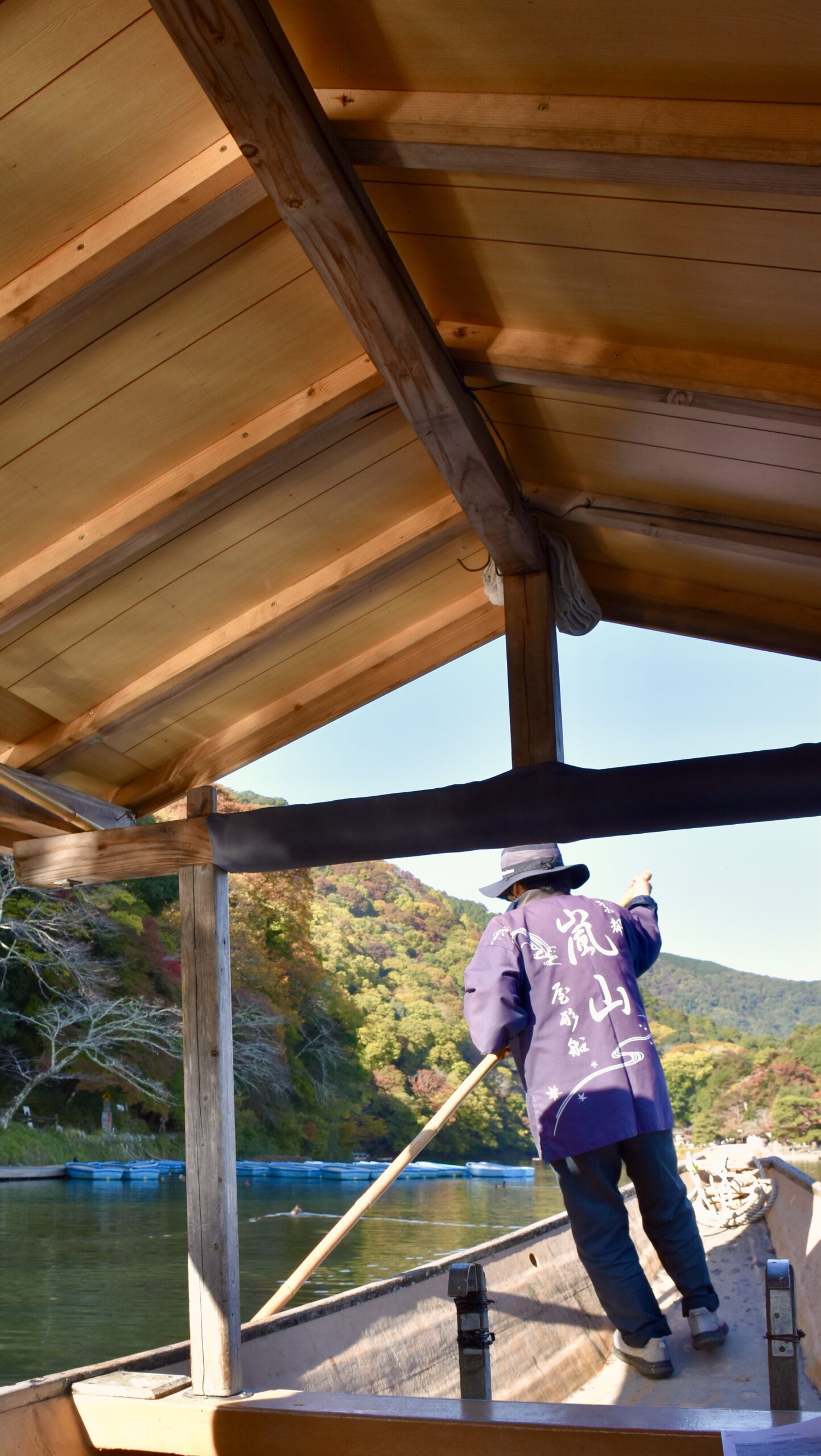
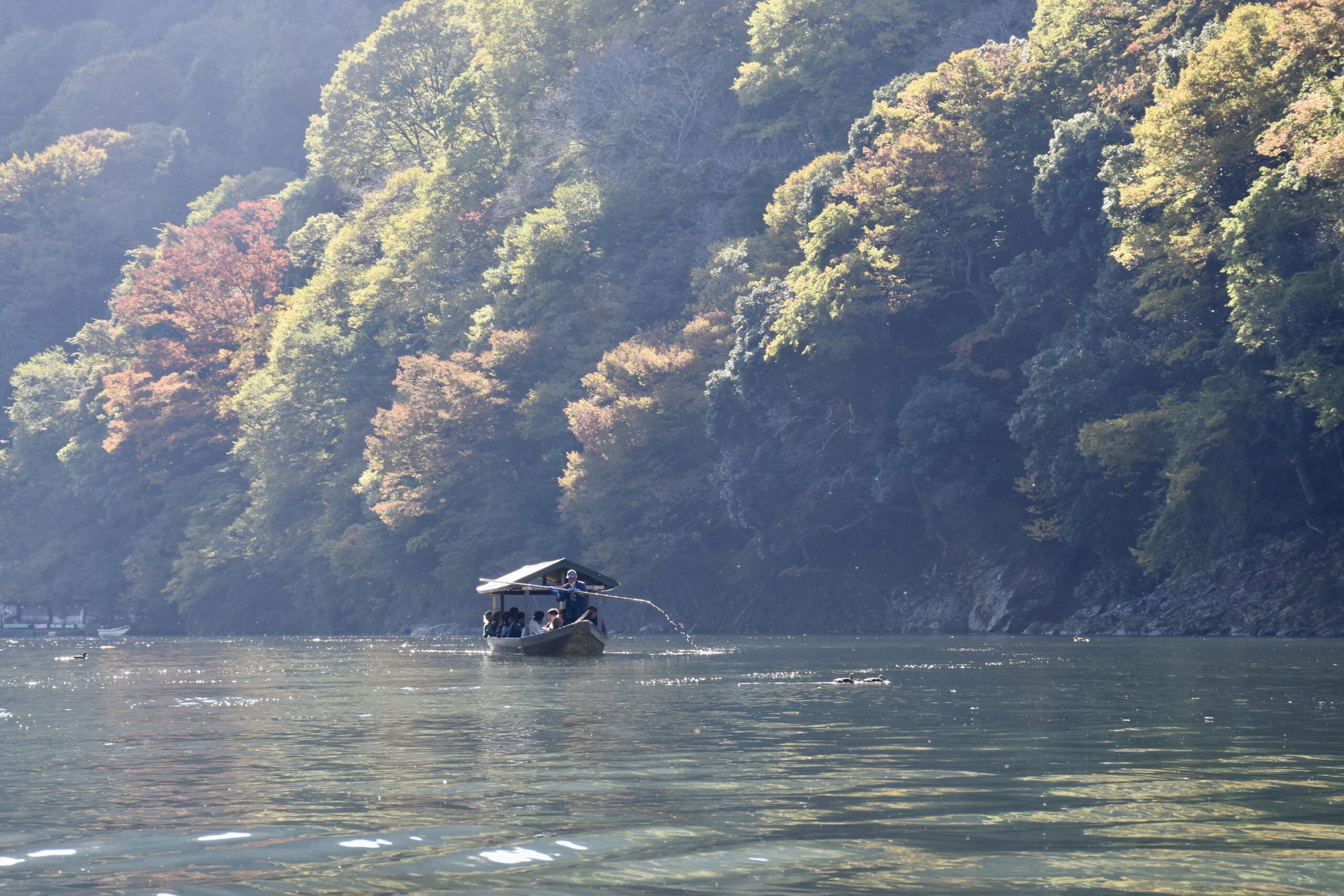
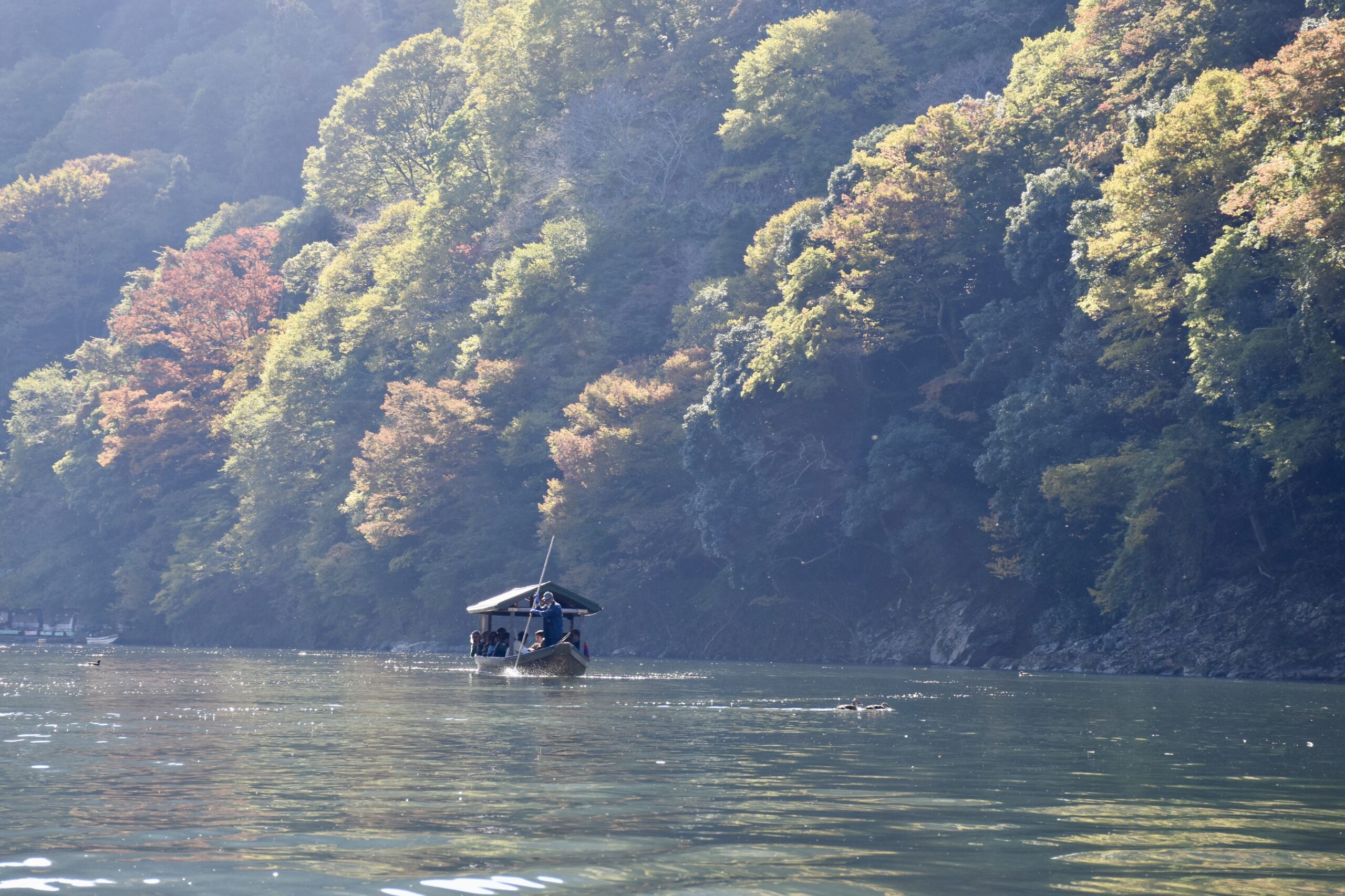
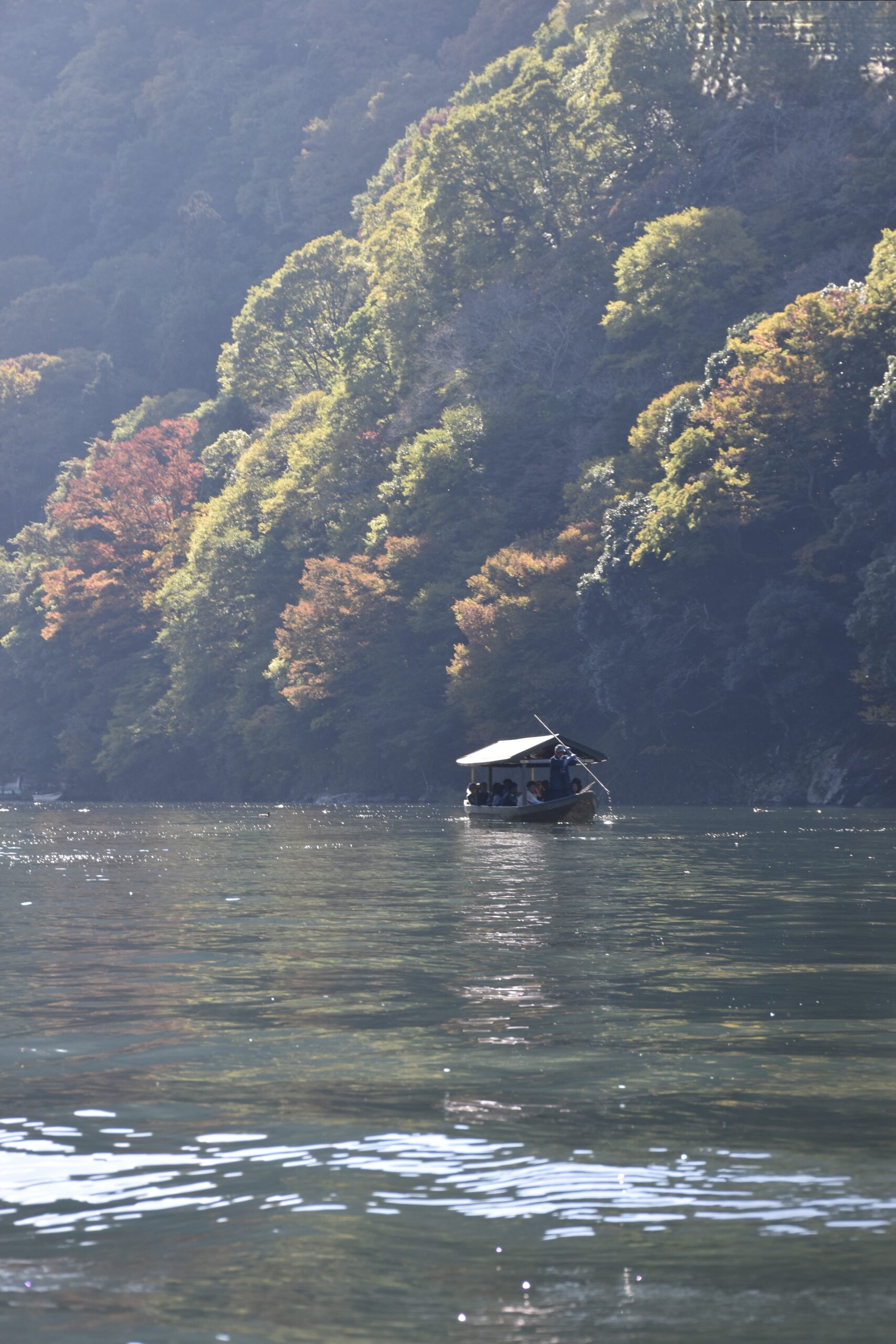
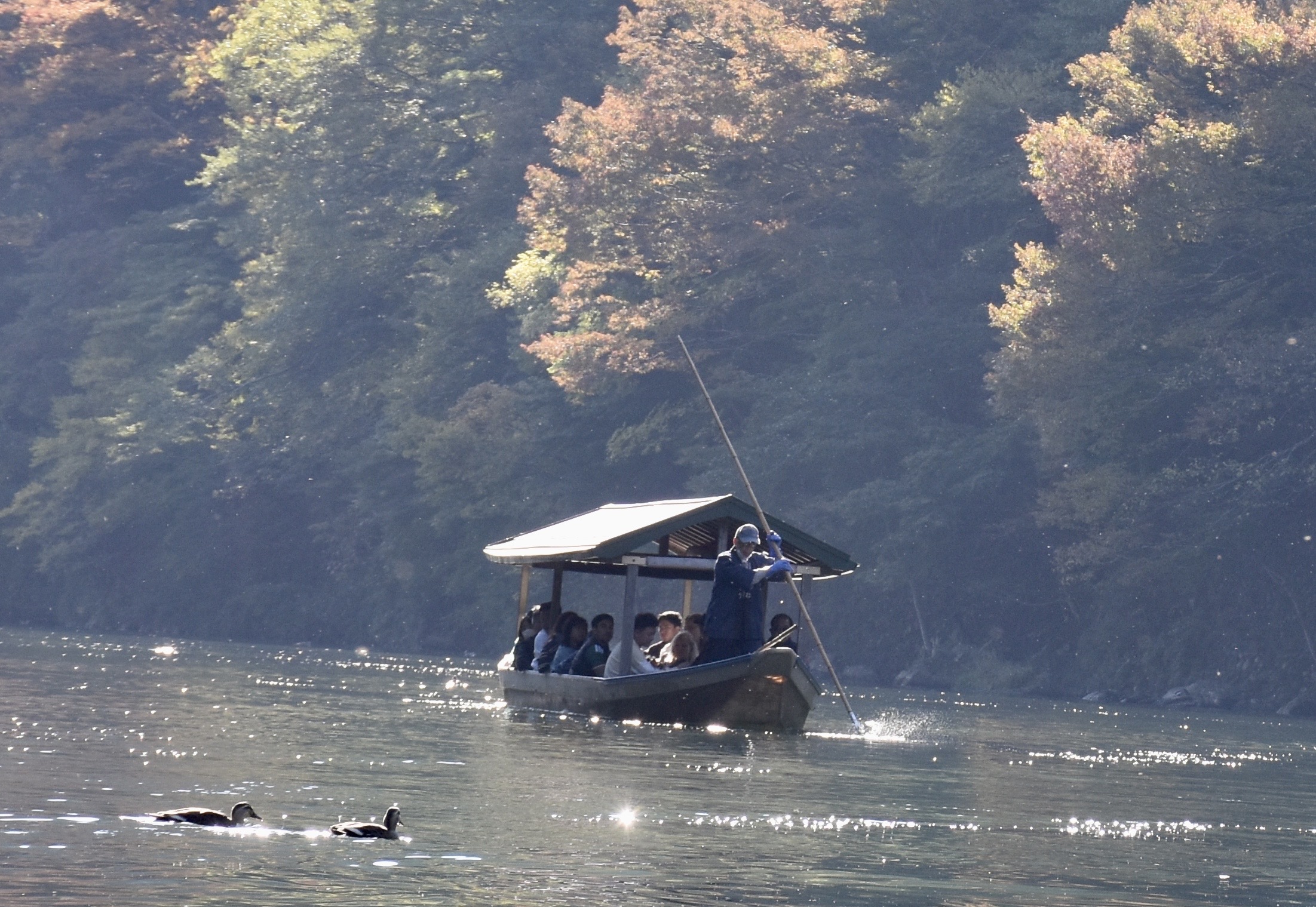
Our morning began with a boat ride on the Hozu River in Arashiyama, heading toward a small Buddhist temple perched on the hillside above the water. We had actually seen it from a distance a couple of days earlier, and now we were going to visit.
The boat was propelled by a man standing at the stern, using a long pole to push us along the river. It was a lovely, peaceful morning, and we had the river almost to ourselves. There was only one other boat in sight.
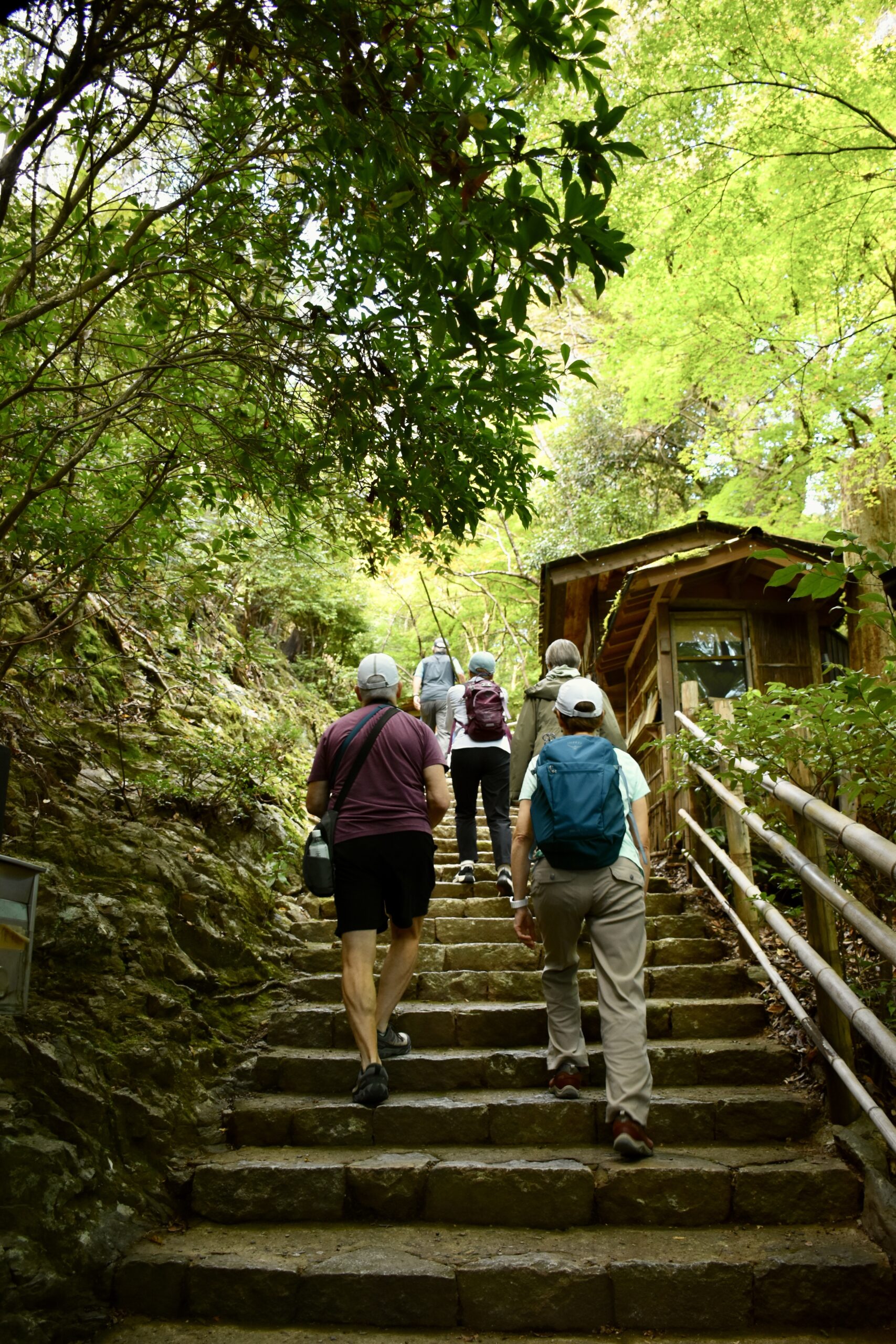
The temple was Daihikaku Senkō-ji, reached by climbing approximately 200 steps up the wooded hillside.
Four members of our group had decided that perhaps there was a better way to get there. They would ride up instead.
When we arrived, the monk came down with his dog to collect them. The dog looked remarkably like an oversized Shiba Inu: caramel-colored, fox-faced, with a curled tail, but substantially bigger than a Shiba and not quite Akita-sized.
The monk explained that this was the eighth generation of temple dog.
I was fascinated. Perhaps this is what Shiba Inus used to look like before somebody shrank them and left them with their Napoleonic complex.
The monk, the dog, and our four companions then drove up the hillside, while the rest of us started climbing.
And yes, he really did drive up those steps. The lower section had concrete filling the spaces beside the stairs, making the route just wide enough for his vehicle.
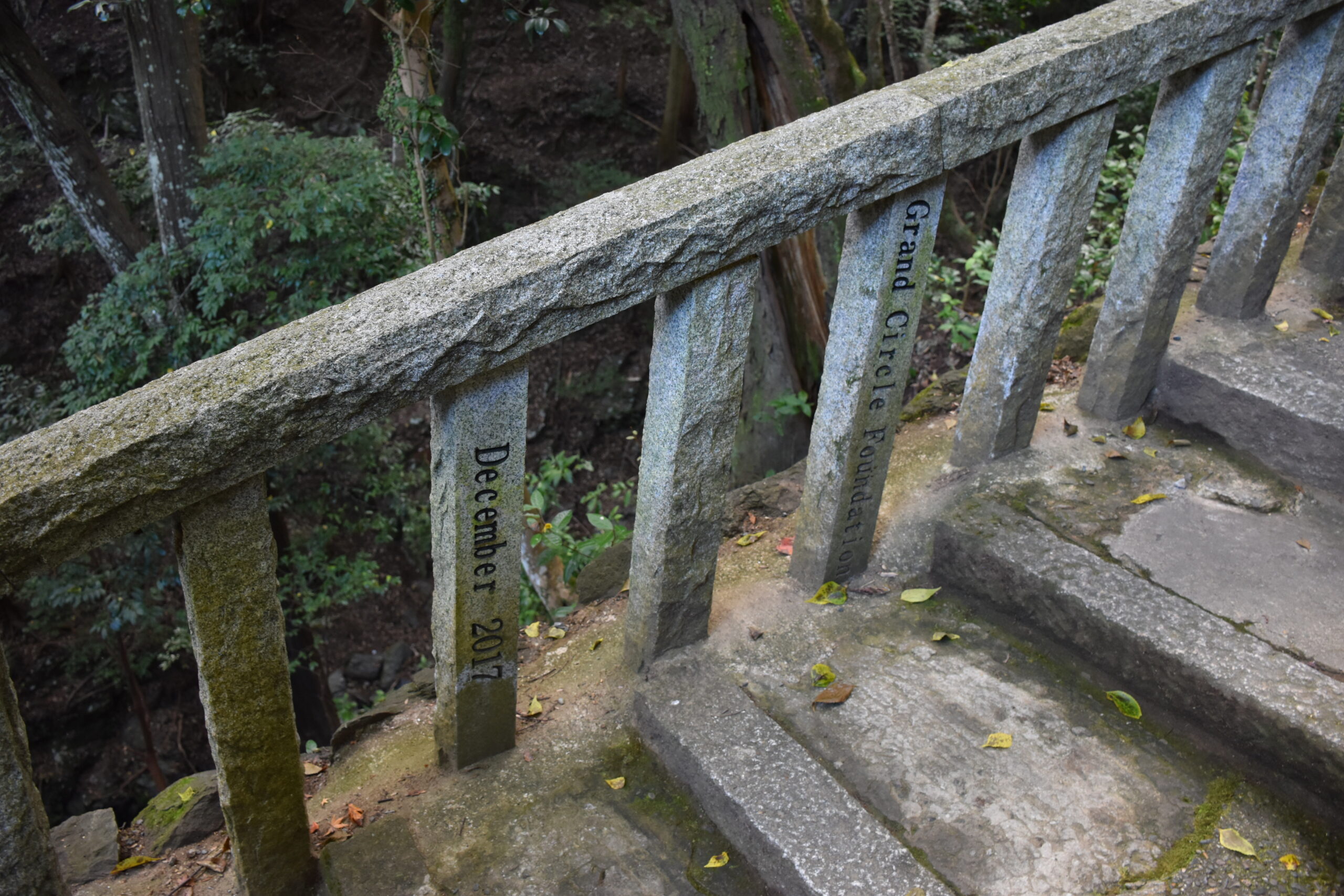
Along the way, I noticed some unusually sturdy railings inscribed with the name of the Grand Circle Foundation, the charitable foundation affiliated with Overseas Adventure Travel. The inscription was dated December 2017. I suspect the foundation helped pay for the railings, although I don’t know the details.
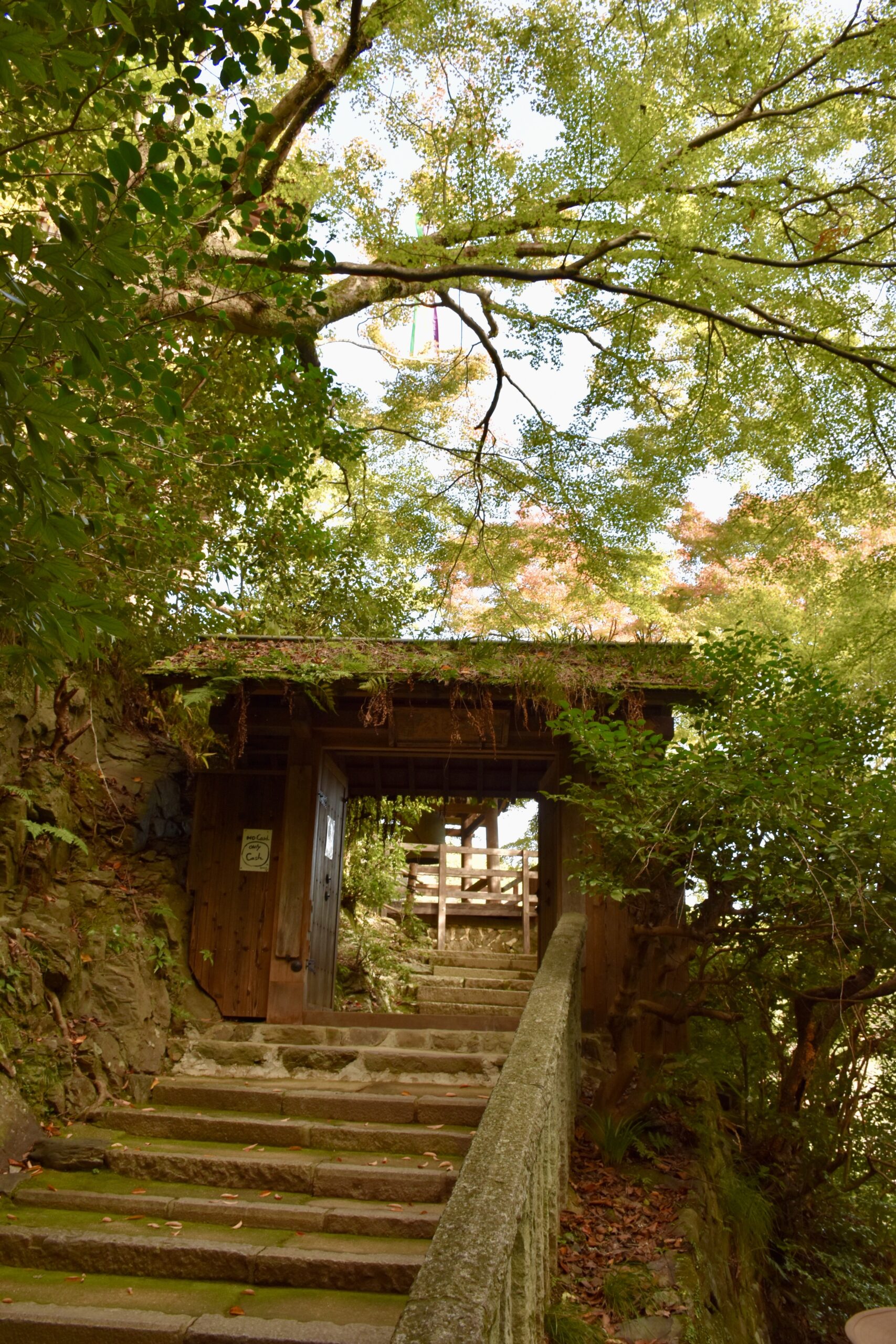
After our climb, we reached a little temple surrounded by trees, with a remarkable view across the river and surrounding hills.
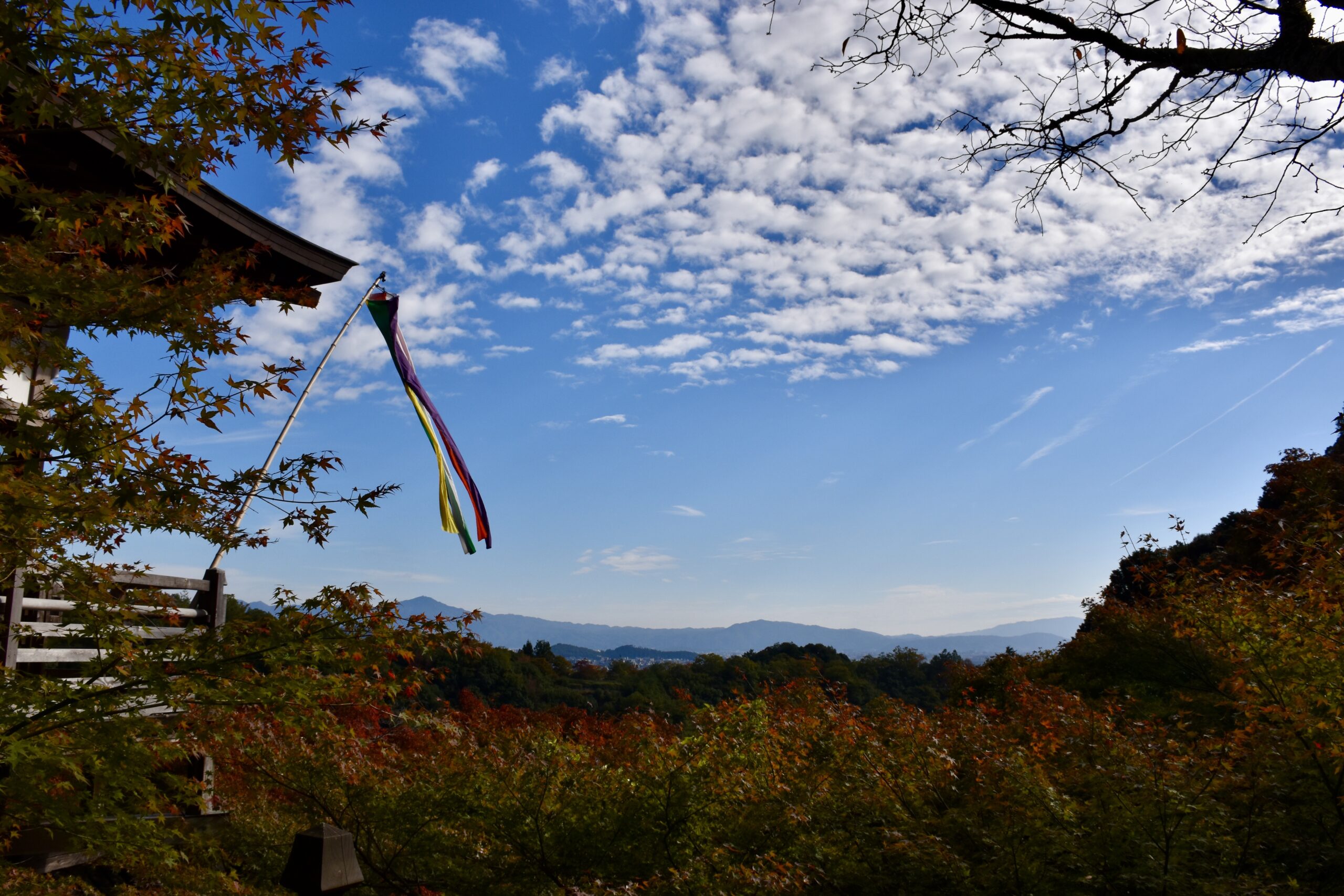
The Monk and His Temple
The monk was approximately 70 years old and had been living here for about 30 years.
He told us that he’d previously trained at Tenryū-ji, the much larger Buddhist temple we’d visited earlier in our Kyoto stay. At some point his master had asked for someone to take responsibility for Senkō-ji, which had fallen into serious disrepair.
As I understood the story, everyone else took a discreet step backward, leaving him rather unexpectedly volunteering.
But he said that the prospect of living surrounded by nature and history had appealed to him.
I’m not sure what his wife thought about that.
Thirty years later, he is still here. He has a wife, a son, a daughter, and, apparently, a continuing dynasty of temple dogs.
He also explained that dogs have been important to humans since their domestication from wolves. Among other things, dogs could keep watch at night, allowing their human companions to get some sleep.
Presumably the eighth-generation temple dog considers this part of his job description.
Senkō-ji’s history goes back considerably further than our monk’s arrival.
The temple was established on this hillside in the early seventeenth century through the efforts of Suminokura Ryōi, a wealthy Kyoto merchant who had made a fortune trading with Southeast Asia.
Ryōi subsequently invested heavily in improving Japan’s waterways, including the river below us. He dedicated the temple to the memory of people who had died during those projects.
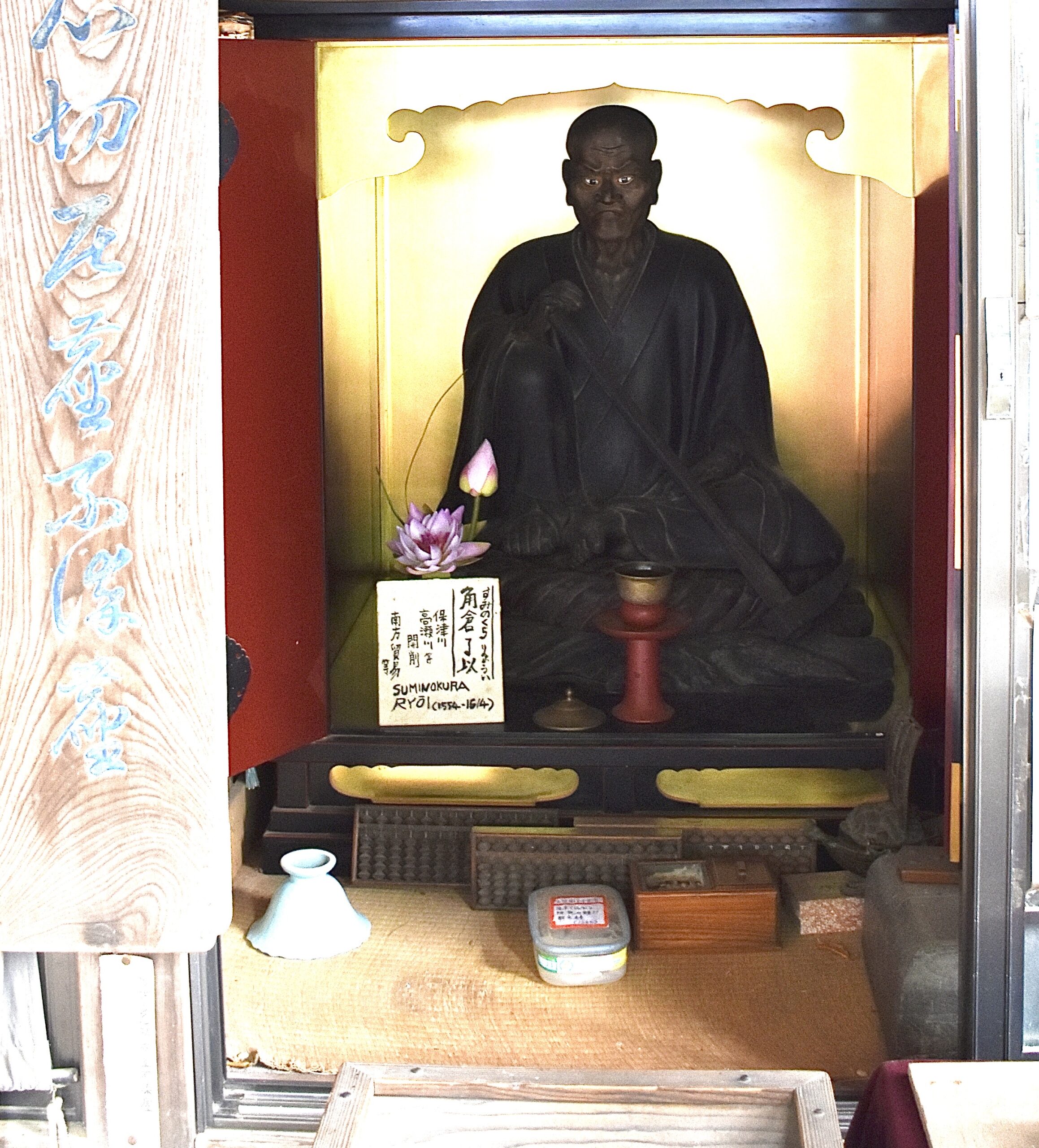
The monk told us that he thought Ryōi would be happy we’d come to visit.
The temple’s principal image is a Thousand-Armed Kannon, the Buddhist bodhisattva of compassion. The image had been associated with the temple long before our monk arrived and had been moved into a smaller building after the temple suffered serious storm damage.
He told us that the Kannon had even traveled to Dallas for a museum exhibition about twenty years ago, although he himself had never visited the United States. He had, however, met the Dalai Lama.
One question from our group concerned whether women could become Buddhist monks. Yes, he explained, although the path could be difficult.
There were many interesting things in the temple itself, including a little sign that particularly appealed to me:
“Teaism — Having a sip of Tea and Linger in the Beautiful Foolishness of things.”
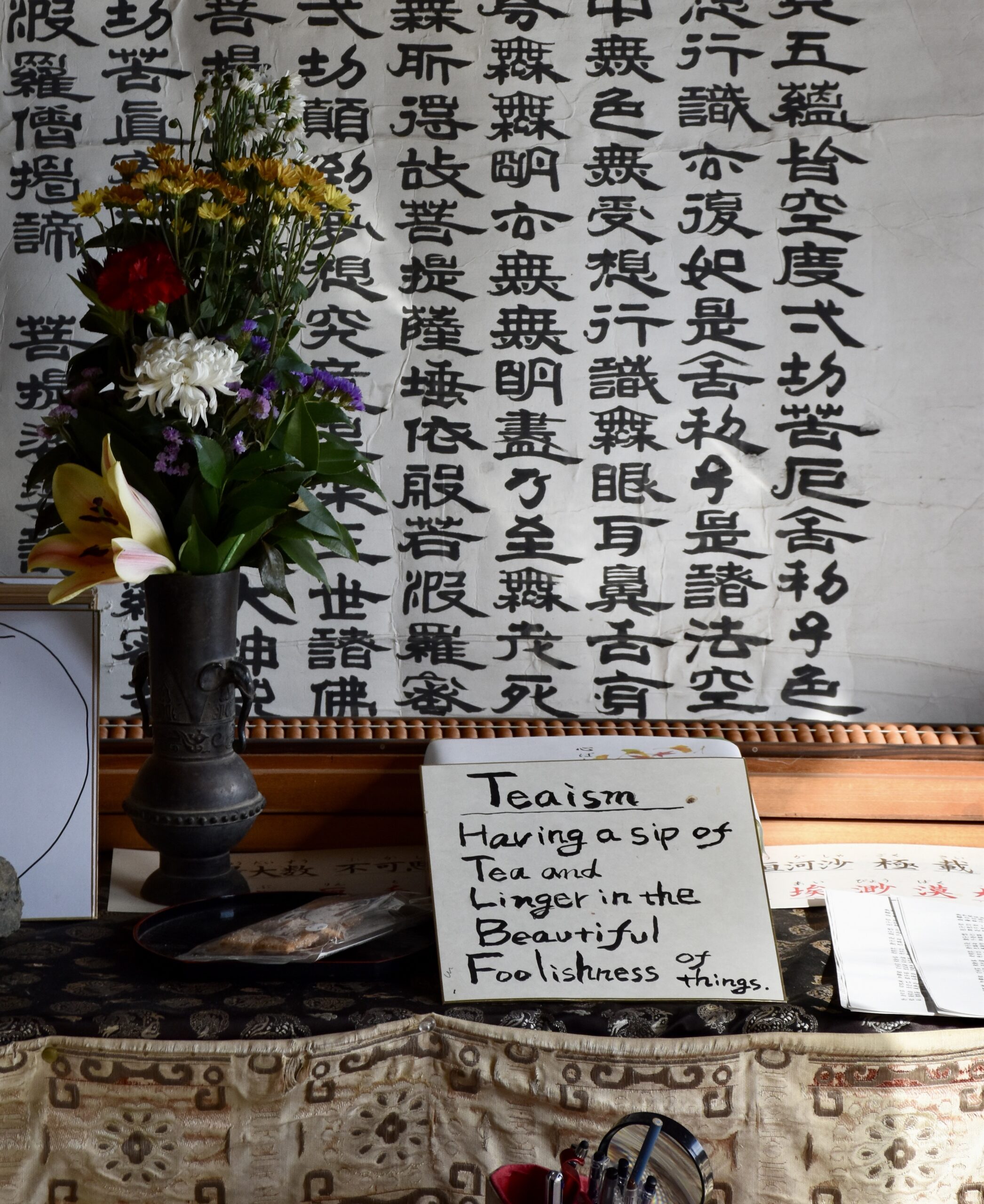
Behind it was a large piece of calligraphy containing the Heart Sutra, one of Buddhism’s best-known texts.
We were offered ocha, Japanese tea, and enjoyed the view from the open-sided room.
Enlightenment, Kannon, and a Lesson in Not Shushing People
Our monk gave us a short introduction to Buddhist philosophy before leading us through two meditation sessions.
One idea I particularly liked concerned enlightenment.
He explained that the light of enlightenment is not something you simply keep for yourself. As you progress, you first illuminate your own path, then help illuminate the paths of those around you. Eventually that light spreads farther outward.
He also talked about impermanence, selflessness, and nirvana.
Nirvana, he explained, involves extinguishing the inner fires of desire and attachment, allowing the mind to become peaceful and quiet.
But Buddhism is not simply about reaching that peaceful state and forgetting everyone else. Compassion matters, too.
Which brought us back to Kannon.
He explained that people often approach a problem from only one perspective. Kannon, as a figure of compassion and wisdom, can help us consider another way of seeing things.
He then told us something I had never known: the Canon camera company was originally named after Kannon. Its first camera prototype, developed in 1934, was called Kwanon, and its original emblem depicted the Thousand-Armed Kannon.
The association with photography and seeing things differently was rather apt.
Then came our meditation.
For the first session, we closed our eyes and were instructed to contemplate zero. Nothingness.
For the second, we kept our eyes open, gazing downward at approximately a 45-degree angle. We were given a koan involving Mount Fuji and a rope, and asked to consider how we might move the mountain.
I had moved from my chair onto the tatami mats by this point.
The monk also had a wooden paddle, which he occasionally used to give certain participants a sharp whack as an aid to concentration.
I did not get whacked.
However, I was presented with an entirely different challenge.
Three members of OUR OWN GROUP started talking during the meditation.
Now, remember, this was a private audience with a Buddhist monk, who had just spent considerable time explaining inner peace, selflessness, and enlightenment.
And there they were, chatting.
I was peeved.
I wanted to tell them to SHHHHHH. Or perhaps something a little less polite.
And then I started laughing to myself.
Well, there you go. There’s YOUR Zen lesson for today.
Do not tell them they’re jerks.
Do not say SHHHHH.
Just notice your irritation and deal with it.
Afterward I mentioned the experience to Amy and Michael, who burst out laughing. They had been thinking EXACTLY the same thing.
Apparently several of us had been working on the same koan, although it had nothing to do with moving Mount Fuji.
A Little Part of H
Throughout our meditation, I could hear the river below us and the calls of crows and ravens in the surrounding trees.
I kept thinking about H.
He was a Nichiren Buddhist, and I knew how much he would have loved this little temple, with its open views, quiet atmosphere, and birds calling from the hillside.
I found myself thinking, “H would be in heaven here.”
Also photography was his passion – though he was a Nikon, not a Cannon, guy. 🙂
After the session had ended, I asked Utako-san if she would stay with me for a moment to translate something for the monk.
I explained that H had been a Nichiren Buddhist and that he had died of COVID. I told him that I had some of H’s ashes made into small glass memorial marbles—cremarbles.
I had one with me.
I wanted to ask whether he would be willing to accept it and keep it at the temple.
I was very careful to explain that I understood completely if this would not be appropriate for his Buddhist tradition or for his temple. I didn’t want simply to leave something behind without permission.
The monk and Utako-san spoke together in Japanese for a while.
At first he pushed the marble back toward me. He indicated that it was too priceless to leave. I explained that I really did want him to have it, if he was willing.
Then he bowed deeply and extended both hands.
I held out both of mine and placed H’s marble into them.
He asked Utako-san to write H’s name in Japanese on a piece of paper.
Then he took the marble and placed it beneath the image of Kannon in the temple.
And he told me that he would talk to H every day.


I was very emotional.
I hadn’t planned any of this. I certainly hadn’t climbed those 200 steps expecting to leave a little part of H in a Buddhist temple above a Japanese river.
But the monk had received him with such kindness and respect.
There were two goshuin available at the temple, and I had intended to pay for both. The monk refused payment. He also gave me a special third one, which I understood to be connected to our conversation.
As I began walking back down, I encountered Amy and Michael, who were just leaving.
I told them what had happened.
They listened, and somehow telling them made me even more emotional. I was grateful to be able to share it with them, but afterward decided I didn’t want to keep talking about it.
I’d write about it instead.
So here we are.
There was one more temple ritual we took part in: the enormous bell, which visitors were instructed to ring no more than three times.
Naturally, I rang it three times.
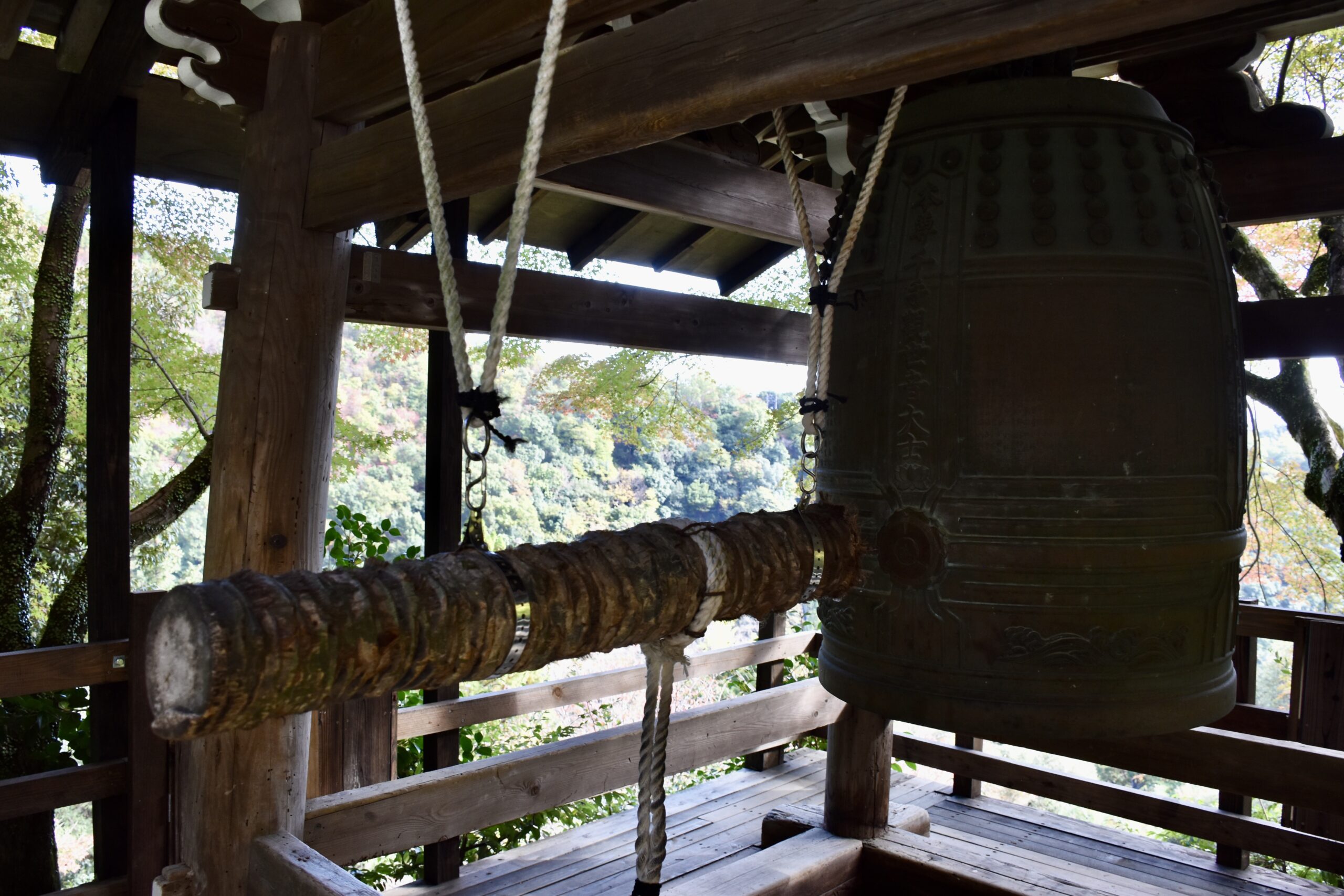

I’d also performed the traditional purification at the water basin: left hand, right hand, left hand to rinse the mouth, right hand again, and finally rinsing the handle of the ladle.

And then it was time to descend the hill and return to our boats.
The River Becomes a Traffic Jam
What a difference a few hours made.
The river that had been so quiet on our outward journey was now absolutely PACKED.
There were boats everywhere, including quite a few little rowboats with men rowing women around the river. We couldn’t quite figure out why there were so many, particularly on a Friday.


Twice, rowboats actually collided with the side of our boat.
Our boatman was NOT amused.
I wondered whether he might be personally responsible for any damage to his boat. I don’t know, but he certainly looked as though he’d rather not find out.
Fortunately, we made it back without further incident.
Sake Brewing—Almost
After lunch, we visited Sasaki Shuzō, a historic sake brewery in Kyoto.
I had rather high expectations for this visit.
I’d previously watched an excellent NHK program in which a Westerner living in Japan explored traditional crafts and occupations, including indigo dyeing, tea harvesting, roof-tile making, and sake brewing.
In the sake episode, there was a great deal of handling rice, working with koji, and stirring enormous fermentation vats.
I had been looking forward to seeing some of this firsthand.
Unfortunately, we were about a week too early.
Brewing season hadn’t started.
Whut-whaaaa.
Instead of watching the sake being made, we toured a collection of thoroughly motionless machinery.
Our guide explained that Sasaki is the last surviving sake brewery in Kyoto’s historic central district. There had once been many breweries in the city, but most either closed or moved to Fushimi, south of Kyoto.
One reason Kyoto was such a successful sake-making center was its water.
The local groundwater is exceptionally clean and relatively soft, with a mineral composition particularly suited to sake. Sasaki draws its brewing water from wells, and our guide emphasized how important the water is to the finished product.
We did see some of the equipment used in the process, including a large cloth sling containing steamed rice, which was lifted by a crane from the steamer and transferred to the next stage of production.


There were also enormous paddles used to stir the fermenting mixtures of rice, koji, yeast, and water.
Each paddle had a different color of tape on its handle. The colors identified the particular fermentation vats to which the paddles belonged, helping ensure that different yeast strains weren’t mixed.

Our guide explained the importance of rice polishing.
For premium sake, a substantial portion of each grain is polished away before brewing. A rice polishing ratio of 40%, for example, means that only 40% of the original grain remains.
The outer portions contain more proteins, fats, and other compounds that can contribute to richer, more savory flavors. More intensive polishing generally produces a more delicate, sometimes fruitier sake.
Of course, more polishing doesn’t automatically mean better sake.
But in the three we tasted, it certainly seemed to.
Our favorite was a Junmai Daiginjo with a 40% polishing ratio. The guide described it as the sort of sake you might save for an anniversary.
We also tasted examples polished to 50% and 60%, and I could definitely appreciate the differences.
The guide was quite emphatic that the premium 40% sake should NOT be heated, because warming it would diminish the delicate aromas.
We watched a woman applying labels by hand one label at a time, then tried our hand at it. No one is going to be asked to quit their day job. The sake in the bottles we labeled was less highly polished, and I thought it might actually benefit from a little warming.

I was also interested in the brewery’s use of different rice varieties and yeast strains. The tasting information identified both, illustrating how much variation can exist even among sakes made at the same brewery.

One particularly striking object was a huge piece of calligraphy hanging on the wall.
It read:
“Do not speak of other people’s shortcomings; do not boast of your own virtues.”
The words are attributed to the Buddhist monk Kūkai, and the brewery treats the saying as an important family principle.

And then there were the cats.
Sasaki has a tradition of brewery cats, originally useful for keeping rodents away from the enormous quantities of stored rice.
Cats appear on the brewery’s signs, bottles, and other decorations.


We didn’t actually see any cats.
I subsequently discovered that the brewery’s feline employees moved with the company president and have apparently embraced working from home.
Yes, really. Sasaki’s own website describes them as remote workers.
So we’d arrived a week before brewing began, toured idle machinery, and even the cats had already gone home.
HeatTech, Fluffies, and a Rather Unexpected Kimono Shop
After the brewery visit, Lynn and I headed off to Kyoto’s newly opened Uniqlo flagship store.
It was MOBBED.
Nevertheless, I managed to acquire three more HeatTech shirts and a pair of HeatTech leggings for my return to Japan this winter.
Mission accomplished.

Nearby, I spotted a silk-flower shop called Fluffy Wagon.
When I was a little girl, I called flowers “fluffies,” so obviously this was an establishment with impeccable naming instincts.
From there we walked back through Nishiki Market, which seemed to consist primarily of food, food, and MORE food.
I occasionally ducked into shops looking for particular things friends had asked me to find, but without success.
We also passed a seafood restaurant with the rather unexpected English name “SHALOM THE LORD.” We’d seen the same name in Tokyo, complete with a New York baseball cap displayed in the window. Both locations were closed when we passed them. Perhaps because it was Friday night?

Eventually we turned into the final alley leading toward our hotel.
And that’s when I spotted the back of a kimono shop.
The rear door was open, and I could see what appeared to be the storeroom.
I walked past it.
Then I stopped.
“Lynn, there’s something I really want to check out.”
And I walked in.
I definitely surprised the people working there.
Someone summoned a young woman who spoke English, and she led me down a hallway to the actual shop.
I explained that I was looking for kaku obi, the narrow, stiff sashes worn with men’s traditional clothing and also used in iaido.
She didn’t seem to understand what I wanted.
In fact, she kept pronouncing the first part of kaku obi differently, so I kept repeating “KAKU obi.”
Finally she summoned an older gentleman, Tanaka-san.
He was absolutely delightful, although he spoke virtually no English. And he appeared thoroughly perplexed as to why this tall Western woman was asking for kaku obi.
Eventually I pulled out photographs of myself practicing iaido and gestured toward my waist.
His eyes brightened. (They actually twinkled.)
AHA!
He pointed to a section of the wall where several familiar-looking obi were displayed.
There were a number of “standard” kaku obi with the white design on teal, grey, black, gold, just like you’d find at Tozando or e-Bogu, plus two black ones, a navy one, and a gold one.
I asked whether they were all the same length, and the young woman translated my question. Tanaka-san confirmed that they were.
There was also a sample obi lying rather messily on a shelf, so I tried it on.
Perfect. Same dimensions as the obi I use at home.
As we continued talking, I absentmindedly took the sample obi and folded it into the neat pentagon shape used for storing it.
The young woman stared.
“How did you DO that?”
I explained that I wore these regularly and knew how to fold them.
Tanaka-san looked at the folded obi and smiled.
And then things became interesting.
He indicated that we should follow him.
We squeezed into a tiny, decidedly elderly elevator and creaked up to the second floor.
There we emerged into a workroom where two older Japanese women were measuring lengths of kimono fabric.
They looked rather startled to see me.
After a rapid exchange of Japanese, my younger woman “translator” explained that they were calling me “Kill Bill” because, apparently, Tanaka-san had told them about my iaido photographs.
Well, if they want to compare me to Uma Thurman, who am I to argue?
The floor beyond the elevator was covered in tatami, so naturally I removed my shoes before stepping onto it.
Tanaka-san explained that this was their “antique room,” where they stored older pieces and fabrics. Somewhere among the shelves and pigeonholes, he thought there might be some additional kaku obi.
We would have to look.
And look we did.

There were two beautiful purple silk obi decorated with gold parasols, another with a stylized pattern that depicts arrow feathers or fletching (called yabane (矢羽根)), and one with an abstract design of a turtle’s back, indicating long life.
All were in excellent condition – never used.
While the second floor had been described as the ‘antique’ floor, perhaps these were past models that hadn’t sold. I didn’t care – I’d have them all.
Meanwhile, I still had the two black, one navy, and one gold obi from downstairs in my hands.
The young woman very helpfully gathered up the others.
Well, what was I supposed to do? Leave them there?
At that point I realized that I’d worn lace-up shoes and now had to get them back on.
Tanaka-san graciously pulled out his office chair so I could sit down.
Then he told the young woman (who told me) to offer me the obi from the “antique room” at a “family price.”
Awesome!
We returned downstairs in the ancient elevator, bowing goodbye to the women sorting kimono fabric.
The new obi were approximately $25 each—about half what comparable ones cost in the United States, and with a tighter, better-quality weave.
The older ones, while more, were considerably less expensive than I would have expected, thanks to Tanaka-san’s discount.
Of course, I immediately sent photographs to some of my iaido friends.
Dr. Scott Sensei had apparently been looking for a purple obi, and one of the purple silk pieces with gold parasols elicited a very enthusiastic “WOW!”
He has already claimed it, and may also want the arrow-patterned obi, particularly appropriate given that he practices kyūdō, Japanese archery.
Vlad has already bought the second black one.
So my accidental expedition into a kimono shop’s storeroom turned into a small international obi distribution operation.
All because I knew how to fold one.
And Finally…

After everything that had happened, I made one final discovery at a 7-Eleven.
A mandarin orange and whipped cream sandwich.
Because, really, who doesn’t go to a convenience store looking for one of those?
It had been quite a day.
We’d begun on a quiet river, climbed to a little Buddhist temple, learned something about enlightenment, and attempted to practice Zen meditation while resisting the urge to shush our fellow travelers.
I’d left a small part of H in the care of a kind monk who promised to speak with him every day.
Then we’d encountered a sake brewery not quite ready to brew, cats who worked remotely, a crowded Uniqlo, and an elderly kimono merchant who opened his “antique room” to a stranger because she knew how to fold an obi.
Japan continues to surprise me.
And I think H would have liked knowing where he ended up today.
I never get a percentage from any links I include – but! – if you are curious about Overseas Adventure Travel and want $100 off, call them at 1-800-955-1925 and request their amazing catalog, tell them you were referred by Sandy Shepard, customer number 3087257, and get $100 off your first trip! The catalog is what all good dreams are made of!