
Our last full day in Japan — Miyajima, November 17, 2026
There is something a little bittersweet about the last full day of a long trip. You’re still very much there, still looking around corners to see what might be waiting, but already conscious that tomorrow you’ll be packing up and heading home.
Fortunately, Japan wasn’t quite finished with me.
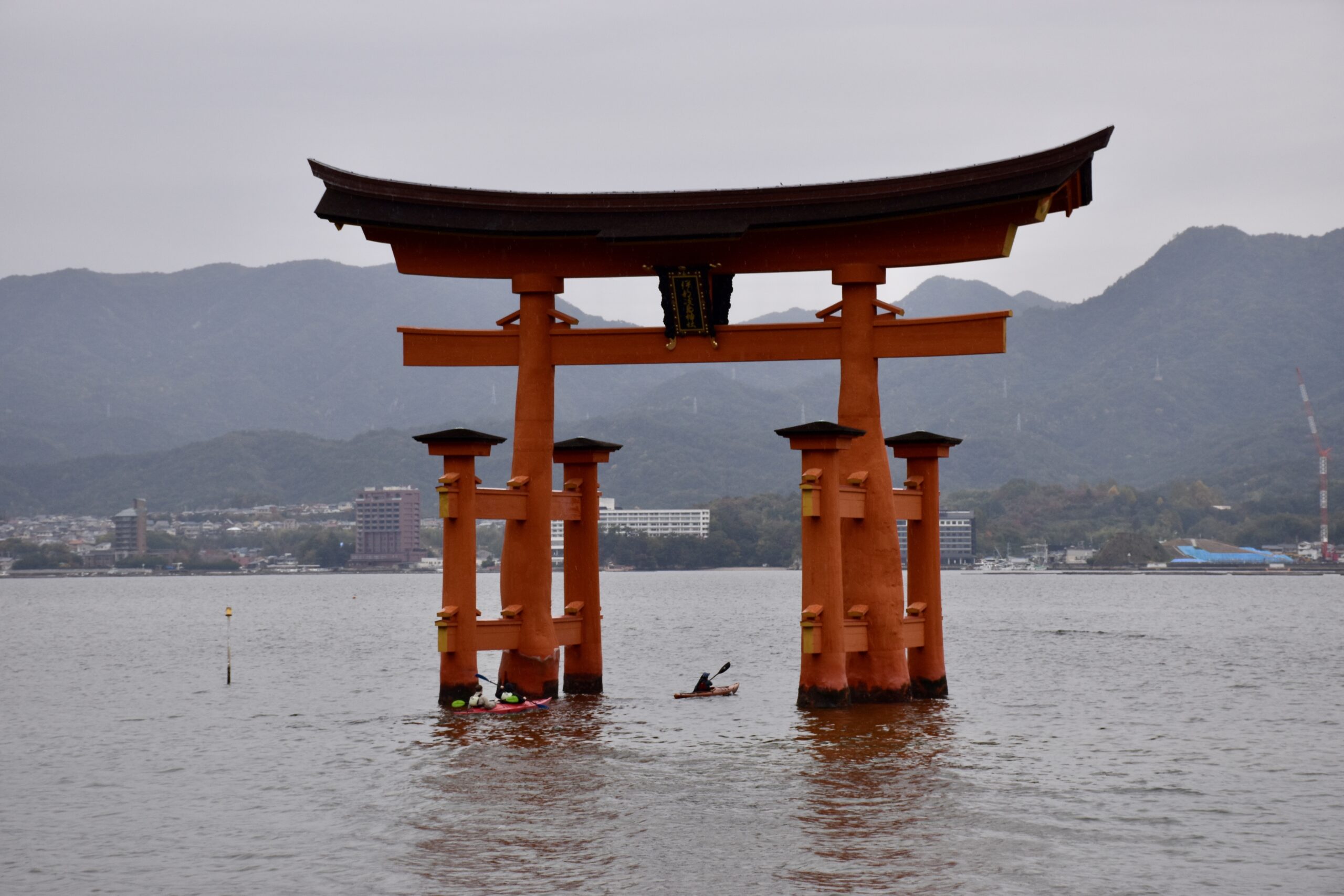
Today’s destination was Miyajima, the island famous for the great vermilion torii gate of Itsukushima Shrine, which appears to float on the water at high tide. I knew we would see the gate, visit the shrine, and have some time to explore.
What I hadn’t anticipated was that I would spend much of the day on an independent expedition involving three goshuin calligraphers, a very small Japanese lady, a handsome kendo practitioner, a deer, a rather questionable Google Maps route, and an increasingly serious rainstorm.
But I’m getting ahead of myself.
Approaching Miyajima
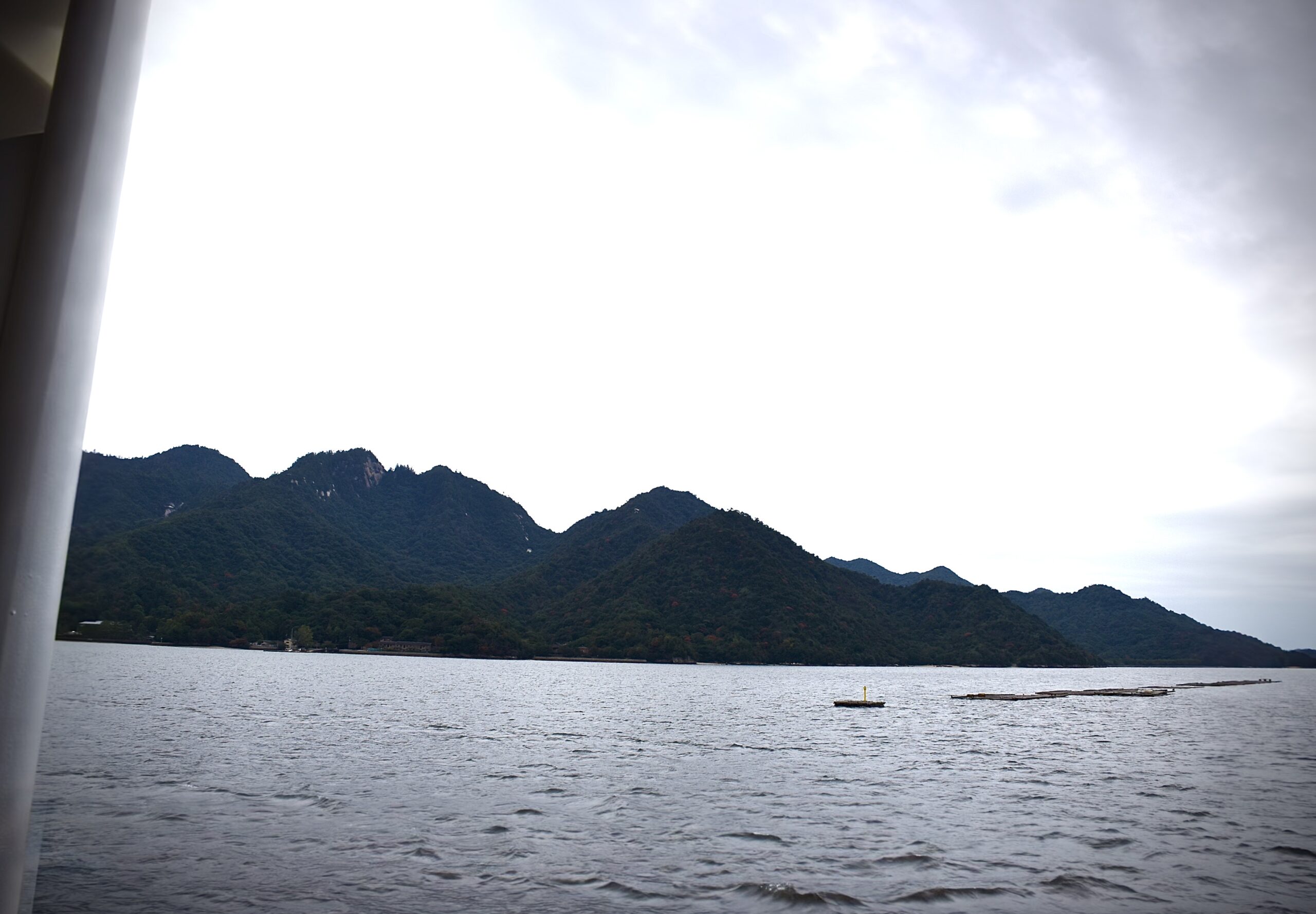
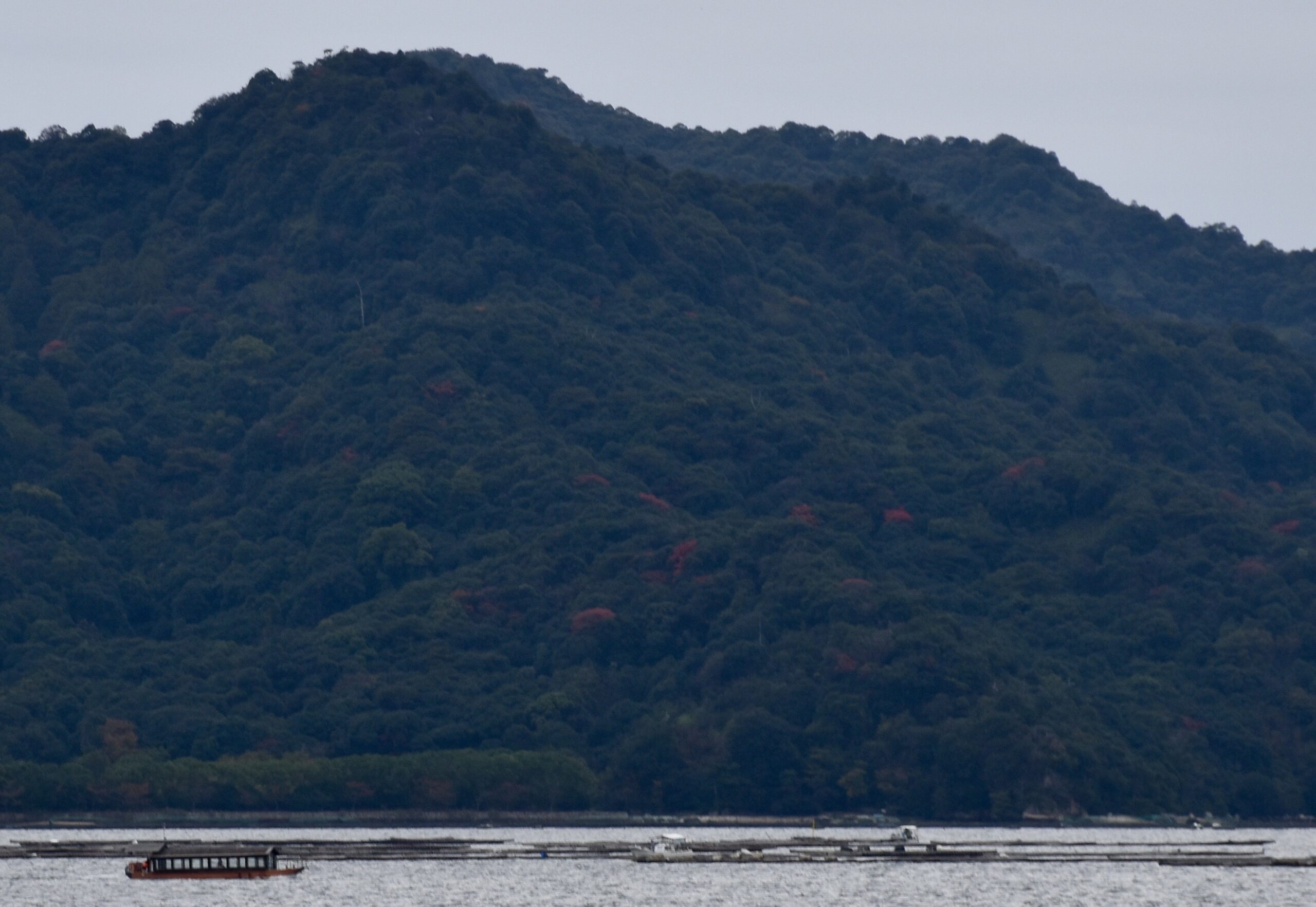
The first surprise was the landscape.
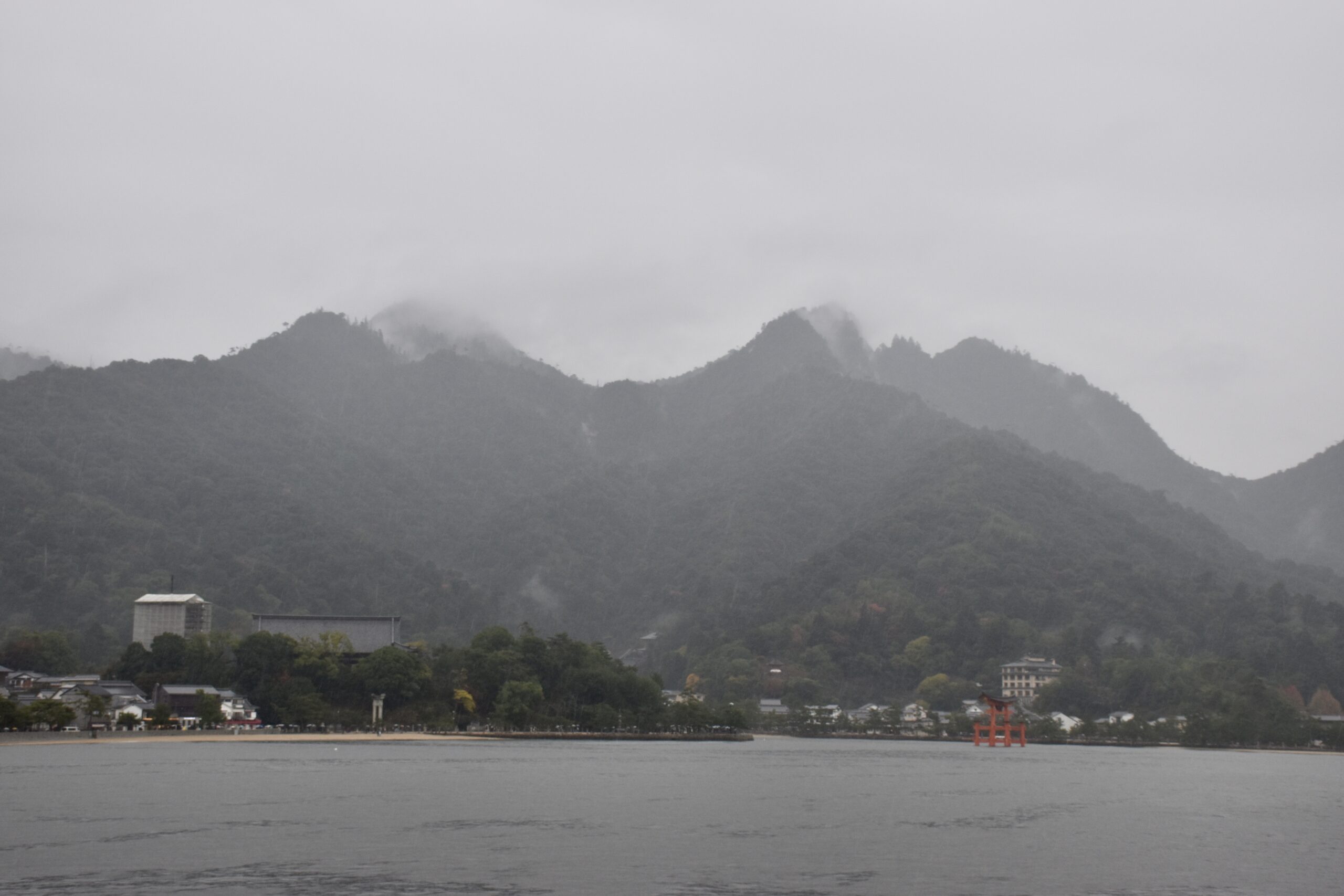
From the ferry, the islands rose out of the Inland Sea in extraordinarily sharp, rugged formations. The photographs don’t begin to do them justice. These weren’t simply pretty, wooded hills. The ridges were jagged and deeply folded, with abrupt rocky outcroppings that gave the mountains a wonderfully distinctive shape.
I kept trying to photograph them, knowing perfectly well that the camera wasn’t capturing what I was seeing.
And then, ahead of us, the great torii appeared.


One of the remarkable things about Itsukushima’s famous gate is that it isn’t actually fastened to the seabed. It stands by virtue of its enormous weight and carefully engineered construction. The present gate dates to 1875 and weighs roughly 60 tons.
Utako explained how this arrangement had helped it survive destructive weather that damaged other parts of the shrine. The idea of something so enormous simply standing there, amid tides and storms, is rather astonishing.
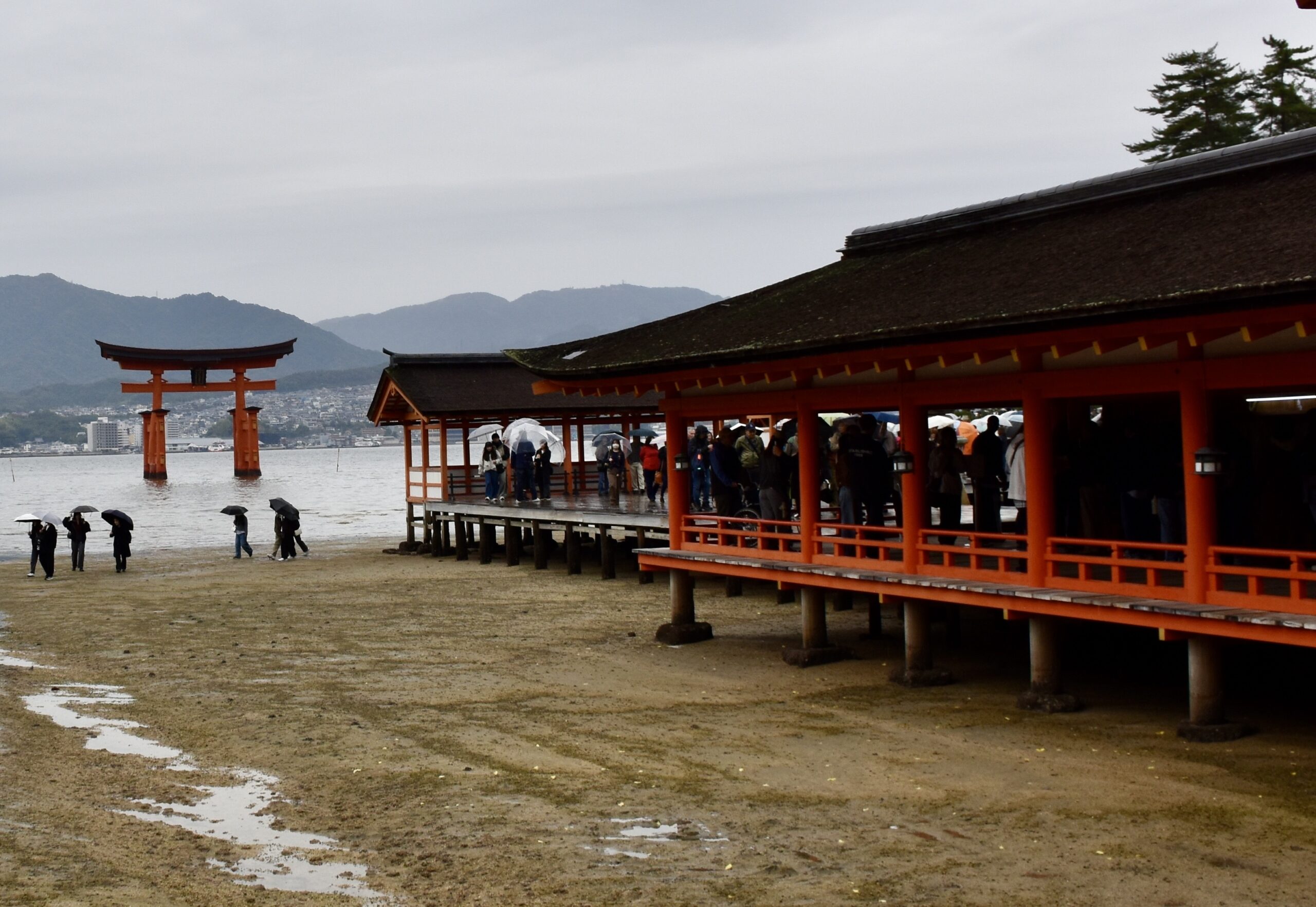
Behind the offshore gate, we could see the shrine’s long covered corridors, themselves built over the tidal flats. The shrine was designed to be approached from the sea, and arriving by boat gives you a sense of why.
The buildings seem almost to emerge from the water.
A Warrior Who Became a Monk
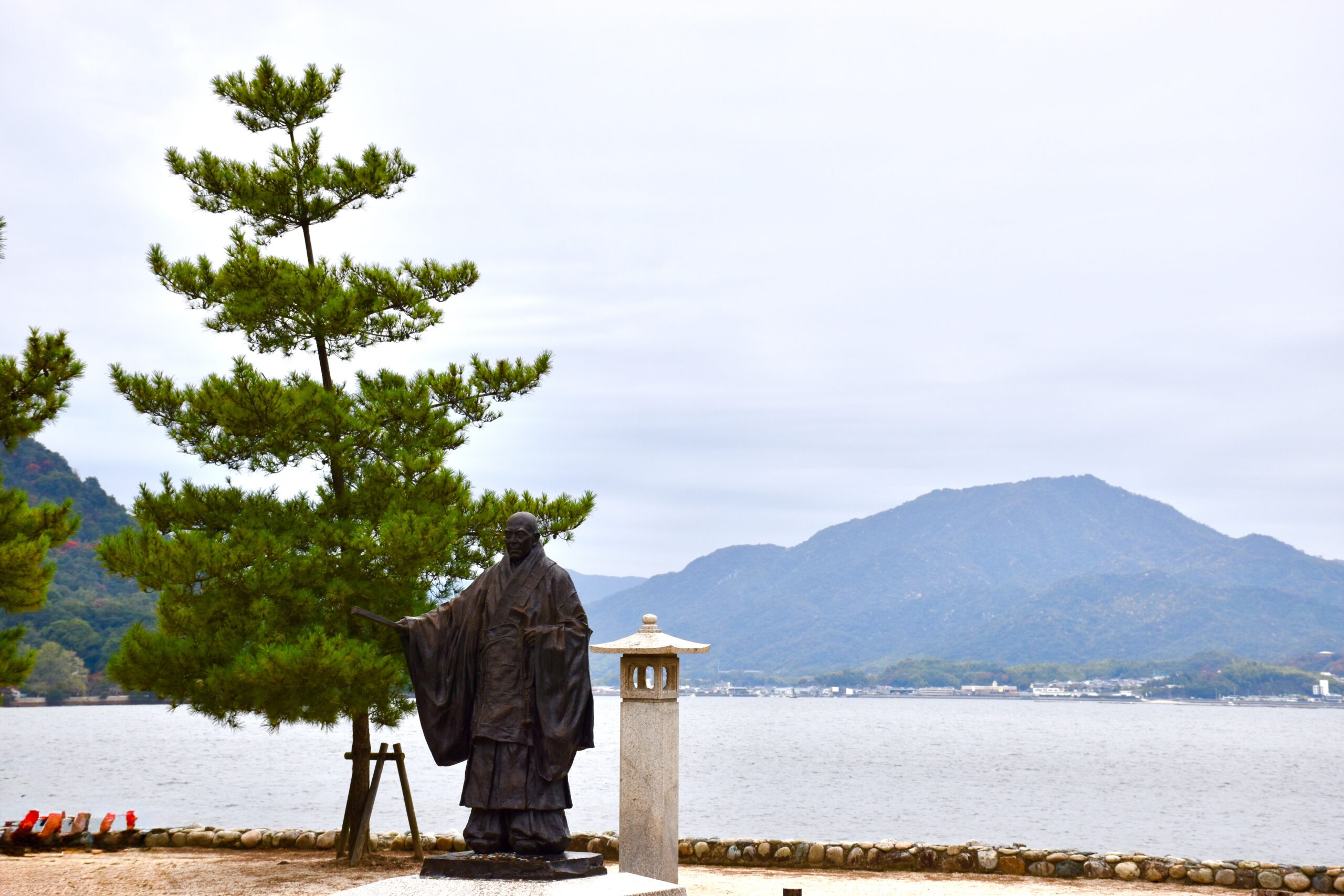
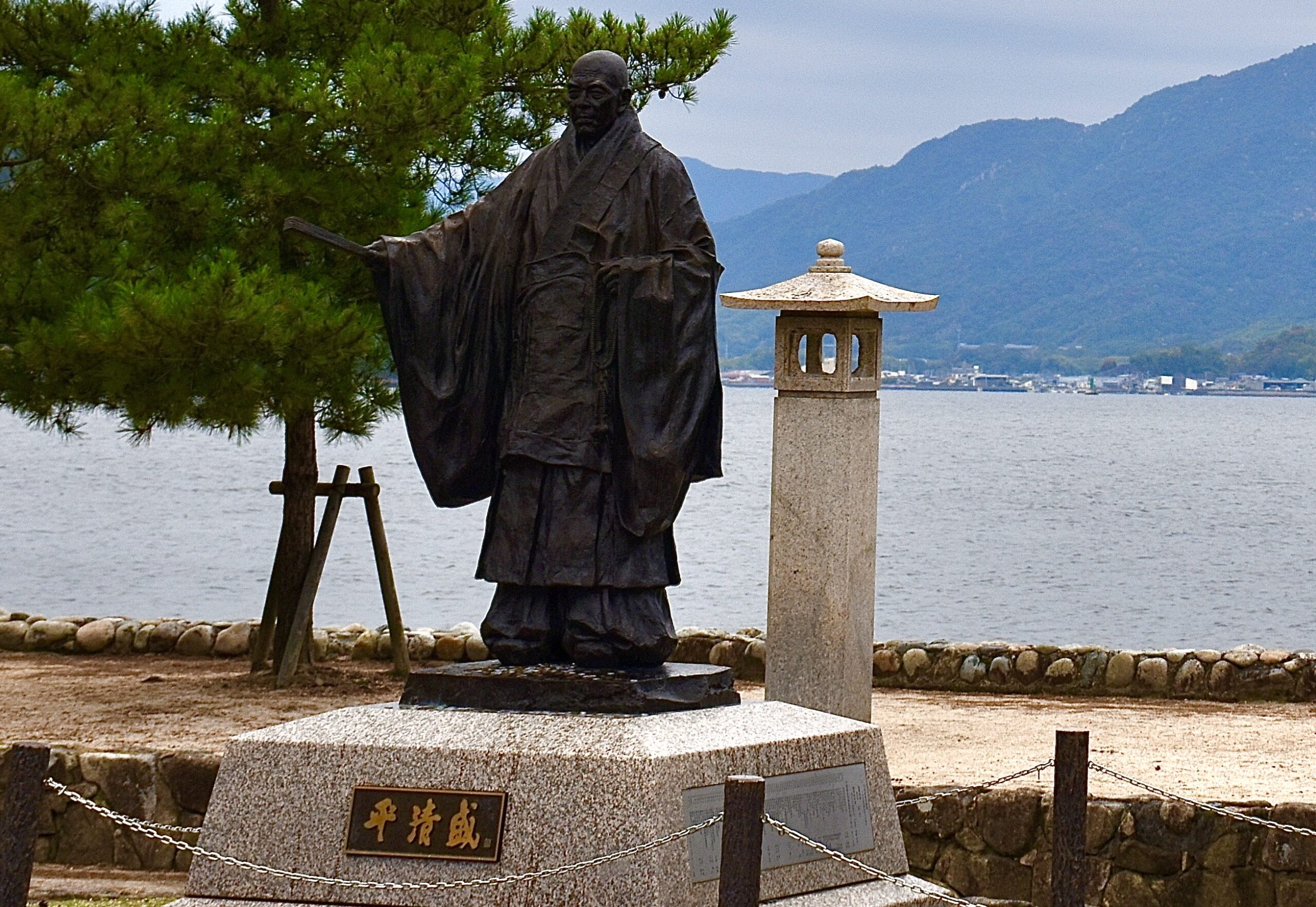
Near the waterfront stood a statue of Taira no Kiyomori, one of the most powerful men in twelfth-century Japan.
He looks rather like a monk, with his shaved head and robes, but Kiyomori was a warrior-statesman who rose to extraordinary political power. He later took Buddhist vows, which explains his appearance.
He was also the great patron of Itsukushima Shrine, sponsoring its development into the magnificent complex we see today.
I found this particularly interesting given my iaido studies. Here was a man who belonged to the world of Japan’s warrior aristocracy, standing watch over a shrine that he helped transform nearly 900 years ago.
And there we were, arriving by ferry in the twenty-first century.
Guardians, Deer, and a Very Wet Shrine


The island has a wonderful collection of entrances, gates, stone lanterns, and guardian figures.
At one of the landward torii gates stood a pair of komainu, the fierce-looking lion-dogs traditionally placed at sacred entrances to ward off evil. One often has its mouth open and the other closed, representing the beginning and ending of all things.
Nearby, an old pine tree had twisted itself into a remarkable shape, its trunk bending almost horizontally.
And then there were the deer.
Miyajima’s deer are quite accustomed to people, but they seemed rather less assertive than their counterparts in Nara. The Nara deer had practically turned bowing and demanding treats into a profession. These seemed content simply to wander about, occasionally inspecting the tourists.
Much more civilized.
I also spotted what appeared to be a crow or raven carved as part of a stone lantern. Naturally, I thought of H, for whom the raven had become such a personal symbol.
One of those little moments when a photograph becomes more than a photograph.


By now the weather was deteriorating.
One of my favorite photographs shows the great vermilion torii, a person with a white umbrella, and a little white egret wandering across the exposed tidal flats.
The egret seemed utterly indifferent to the enormous sacred structure behind it.
The people, on the other hand, were becoming increasingly preoccupied with their umbrellas.
It was pouring.
A Bridge, a Kimono, and Some Very Steep Stairs
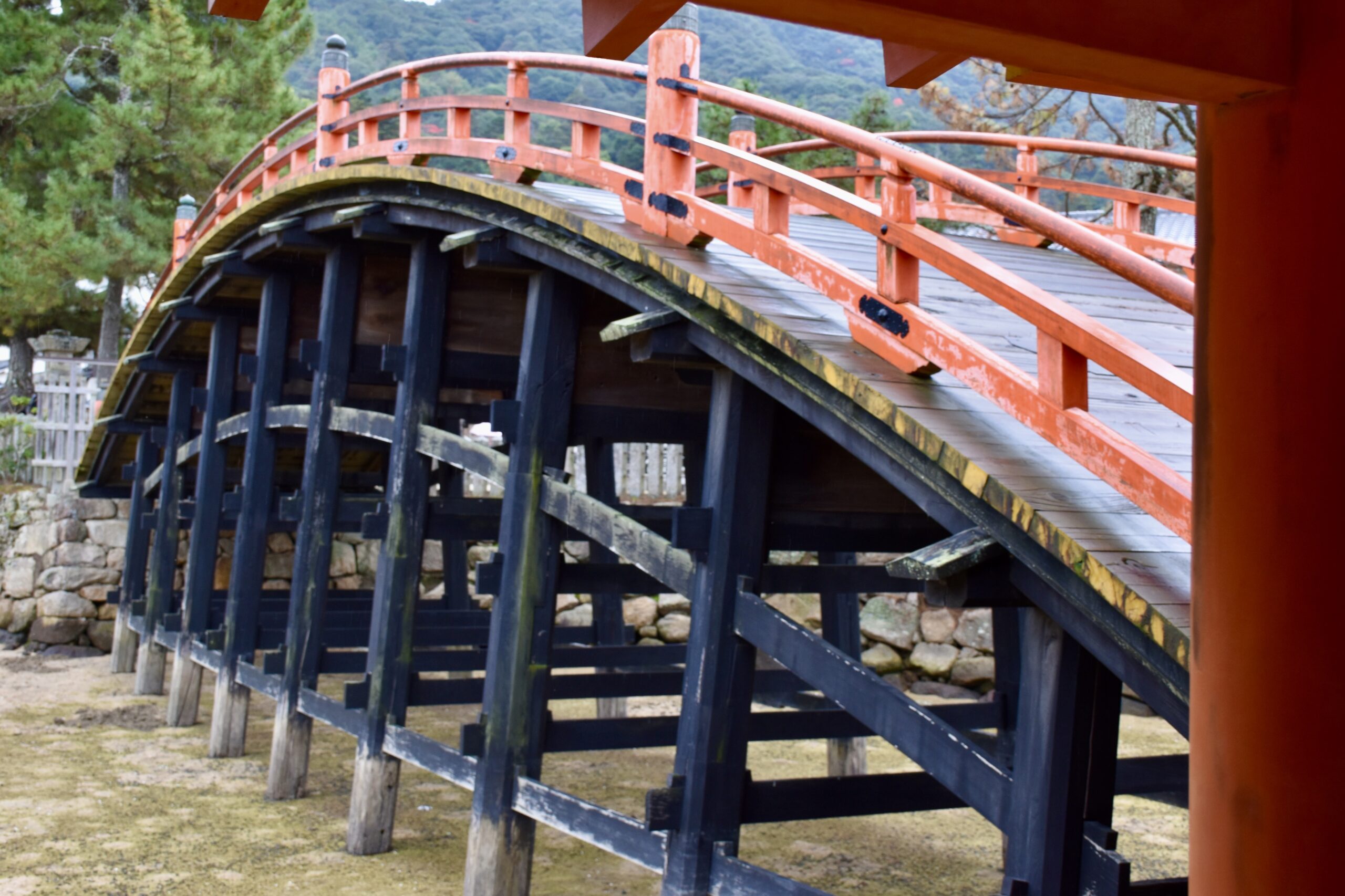
One of the shrine’s bridges prompted a wonderfully practical observation from Utako.
“Can you imagine going up and down that in a kimono?”
Looking at the steep arch, I really couldn’t.
And then there were the stairs. Japan seems to have a particular fondness for staircases that make you question the length of your legs, the condition of your knees, and the wisdom of your footwear.
As it happened, footwear was going to become a rather significant theme of my afternoon.
But first, there was a goshuin to collect.
The Goshuin Line — and Two New Friends
I had joined a line for goshuin calligraphy in one of the shrine’s covered corridors. I still had my “whisper” earpiece on, so although I was no longer walking with the group, I could hear Utako talking as everyone passed.
At one point I heard someone say something along the lines of, “Yes, there she is, in the line.”
Nothing like being nearly 6’2” to make oneself inconspicuous in Japan.
I had been standing there for perhaps ten or fifteen minutes when the group came through. They continued on, and I stayed put.
Ahead of me was the cutest older Japanese couple. The woman came up to approximately my belly button and looked rather like one of those delightful old-fashioned apple dolls, with a wonderfully expressive face.
Her husband had been amusing himself by testing the wooden planks of the corridor as we shuffled forward. A couple of them sagged quite noticeably under his weight.
When he stepped onto one particularly questionable plank, I made an involuntary “Oh!” noise.
He jumped off it, and we all laughed.
Eventually the woman tried to ask me something. I had absolutely no idea what she was saying, so she brought out her translation app.
The question appeared:
“185 cm?”
She was asking how tall I was!
I laughed, pointed upward, and indicated with my fingers “1-8-8.” In Japan, you indicate numbers higher than 5 by putting your fingers on the palm of your hand that is indicating 5, so it was 1 (1 finger) then 5 fingers pointing up, with 3 fingers from the other hand on that palm. A bit of a juggle given I was holding my goshuin and an umbrella.
She gave that wonderful Japanese gesture I’ve seen so often on this trip—both hands over her mouth in delighted surprise.
We began communicating back and forth through our translation apps.
As we finally approached the corner where the calligraphers were working, I decided to make a joke.
I typed:
“Now that we’re almost at the front, they’ll go to lunch.”
She read it and looked genuinely horrified.
Oh dear.
I immediately typed:
“Joke! Joke!”
And then we both dissolved into laughter.
At last we reached the front, where there were two separate windows. The goshuin cost ¥300, and I happened to have six ¥100 coins.
So I put three coins on their payment tray and three on mine.
My little friend looked astonished. She tried to give me a ¥500 coin.
“Ie,” I said. No.
And then I added the one Japanese word I hoped would convey what I meant.
“Tomodachi.” Friends.
She absolutely beamed.
I don’t think I’ll ever forget her face.
Kendo Meets Iaido
Meanwhile, another little encounter had been developing behind me.
There were three Japanese people in line, apparently a mother, father, and adult daughter. Every time I opened my phone to use the translation app, my lock-screen photograph appeared.
It’s a picture of me in my hakama, holding my iaito over my head, just about to slice down.
The gentleman noticed.
He spoke to the younger woman, who came over and pointed to my phone. Then she gestured toward him and said:
“Kendo.”
“Ah, sō desu ka?!” I replied.
Oh, really?
Then I pointed to myself.
“Iaido!”
And suddenly we were having an international martial-arts conversation in mime.
The gentleman, who was perhaps in his late fifties and quite handsome, began enthusiastically demonstrating the distinction to what I believe was his wife.
First came what I can only describe as a series of vigorous bashing motions—apparently kendo.
Then he assumed a samurai-like stance and made a beautifully theatrical slicing motion through the air.
Iaido!
He was grinning. I was laughing. His family was amused.
And there we were, standing in a line at a Japanese shrine, discussing sword arts. Through mime.
Who would have imagined?
I did notice, however, that he never once mentioned Kill Bill.
Apparently I’ve lost my Uma Thurman charm.
Another Goshuin — Without a Line!
By this time Utako had texted to ask whether I was still waiting.
Yes, I told her. And I probably had at least another ten minutes to go.
She replied that the group was heading toward Daishō-in Temple.
Once my first goshuin was completed, I followed the covered corridor, photographed the umbrellas and the egret, and emerged into the main shrine area.
And there, off to my right, I thought I saw a woman sitting at another goshuin station.
Surely not.
I’d just spent upwards of half an hour waiting for one.
But I walked over to investigate.
Yes. Another calligrapher.
And absolutely no line.
This woman spoke quite good English, and she completed another goshuin for me.
When there is more than one location for obtaining goshuin calligraphy, they are all different; you’re not getting the same one. The red stamps are different and the calligraphy is different. This happened to me a few times at larger temple complexes.
This calligrapher also showed me a special edition that they had at this “goshuin station” featuring Kannon in gold on red, which she described as a Fire Year design. Naturally, I purchased that as well, and she carefully added the date.
This was also where I reached the end of the ordinary pages in my original goshuinchō.
She explained that many people simply turned the book over and continued writing on the reverse side of the accordion pages.
But I had another idea.
I wanted to preserve the backs for penciled notes identifying each temple and date, and perhaps eventually stretch the entire book out and display it over a doorway.
It’s quite long!
So I thanked her and set off to find Daishō-in.
How difficult could that be?
Google Maps, a Deer, and a Rather Dubious Expedition


By this time it was raining quite hard.
I passed the aquarium, where there was an interesting sculpture outside, and encountered yet another shrine horse.
Japan has supplied me with a remarkable number of horses on this trip.
I had entered Daishō-in into Google Maps and was obediently following the blue line.
Up one street. Down another. Around a corner. Back up again.
Eventually it occurred to me that this seemed a rather strange way to reach a temple on foot.
And then I noticed the problem.
Google Maps was set to driving directions.
Oh.
Well, that explained a few things.


I switched it to walking directions and continued.
The route took me up a series of extraordinarily narrow stone steps and into a wooded hillside.
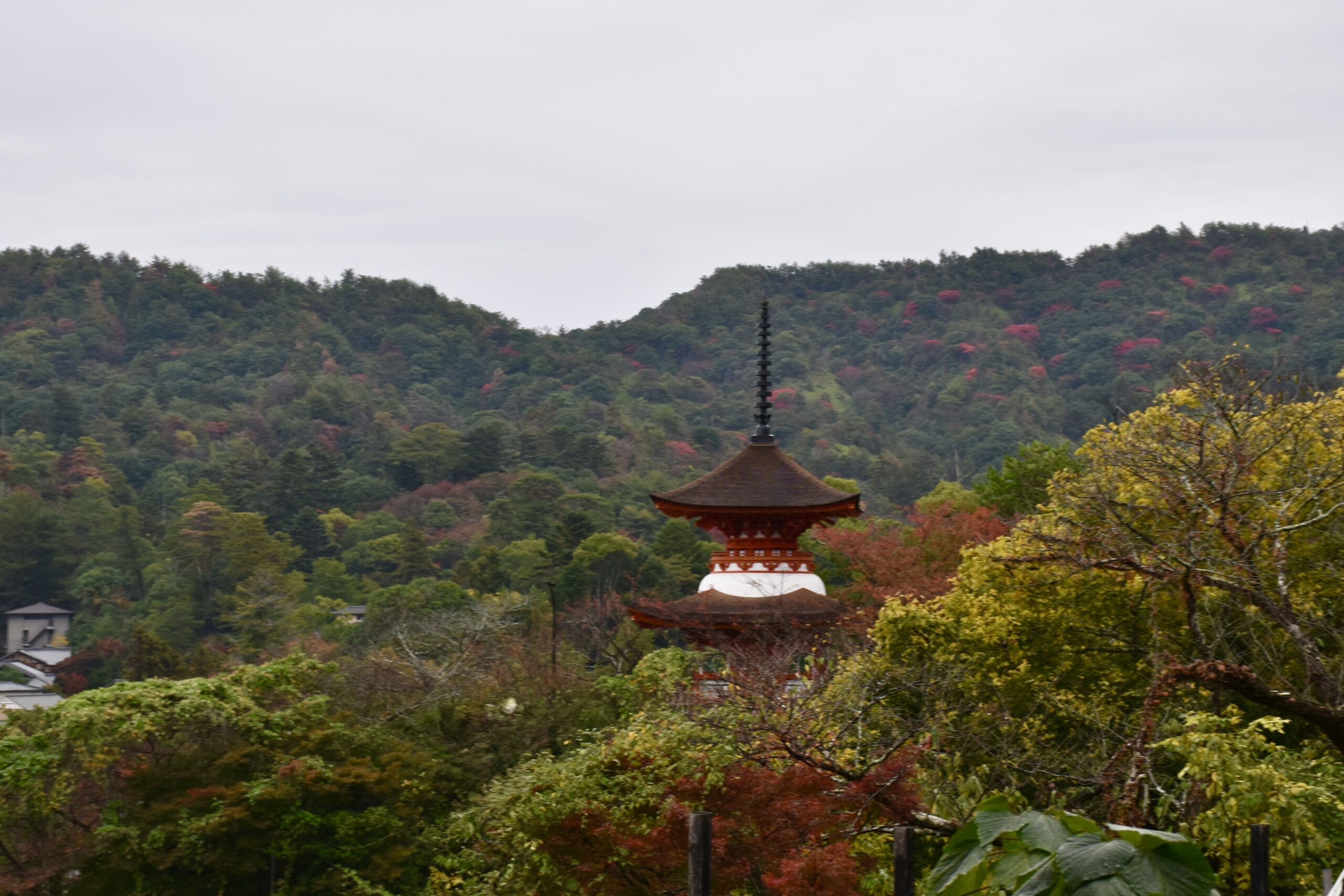
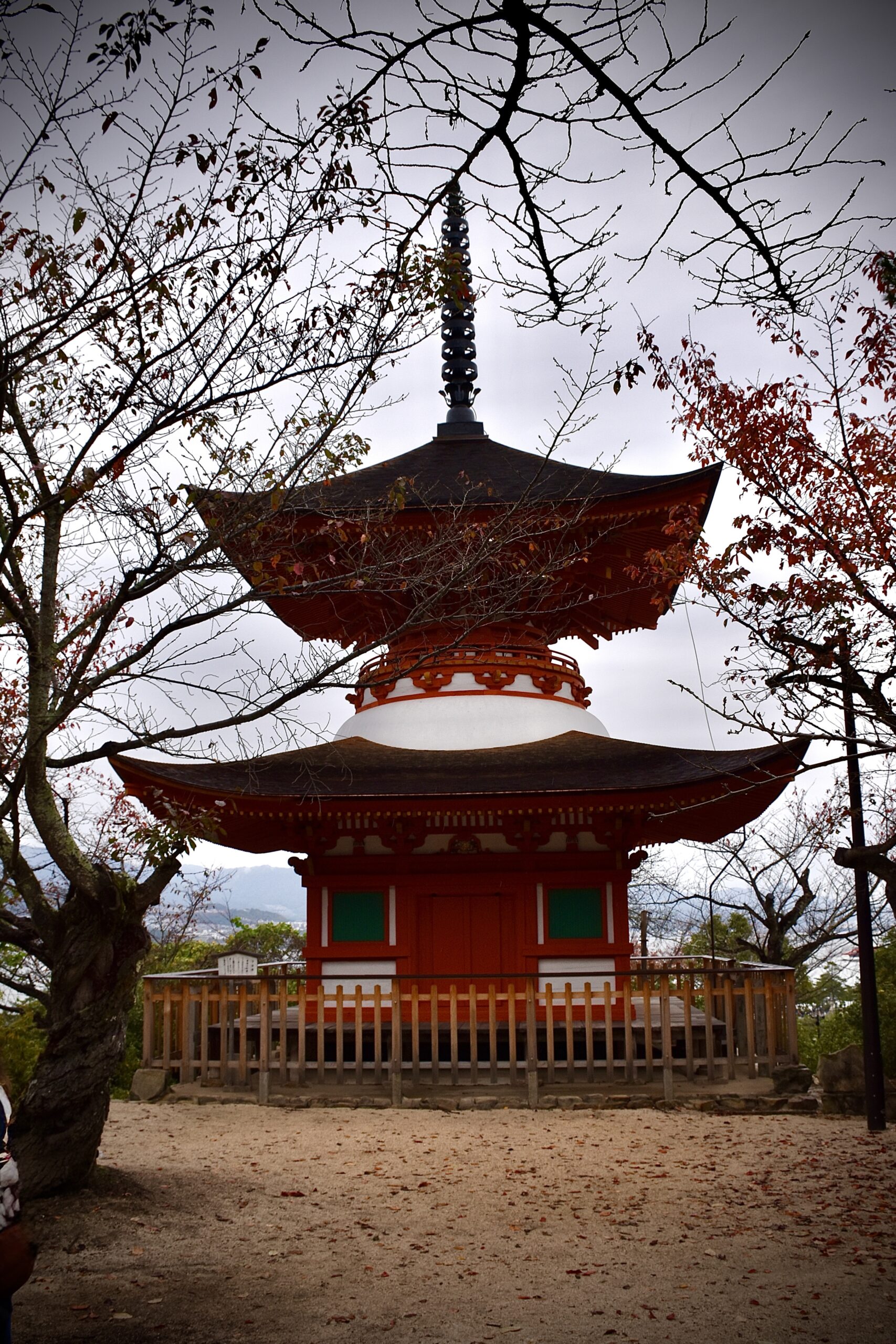
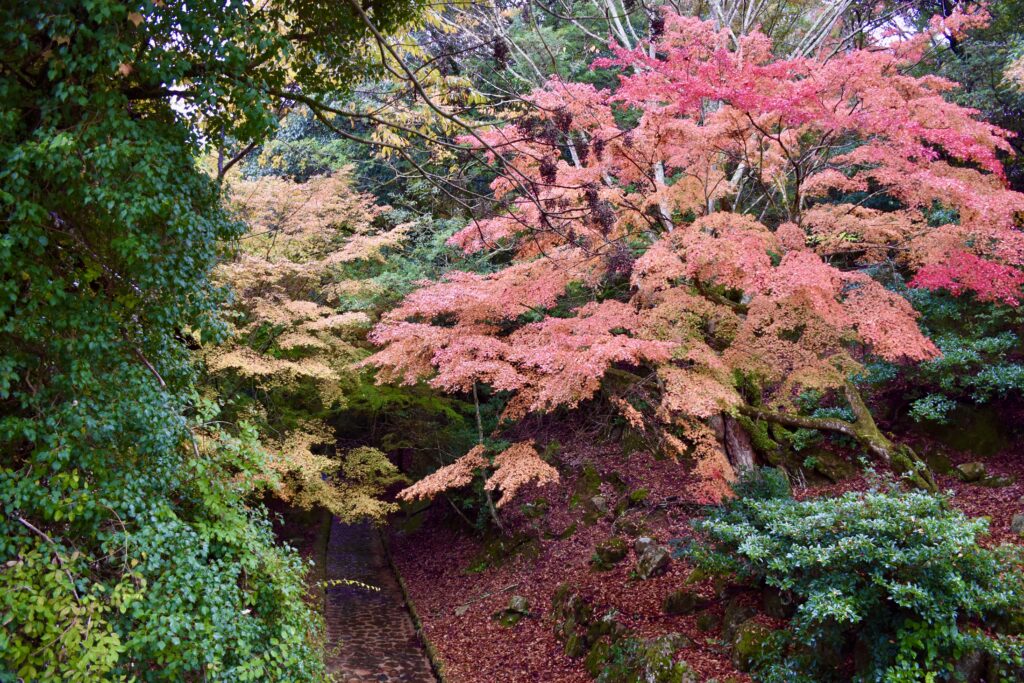
There were beautiful views back over the town, a pagoda rising among the trees, and autumn foliage glowing against the gray sky.
There were also remarkably few people.
In fact, for much of this little expedition, there was nobody else at all.
At one point I came face to face with a deer standing directly in the path.
We regarded one another.
I was apparently not interesting enough to warrant further investigation, and we eventually went our separate ways.
The whole experience reminded me a little of my solitary exploration at Fushimi Inari, where I’d wandered away from the crowds among the thousands of torii gates.
Except that this time it was pouring rain, my feet hurt, and I had a deadline.
There was another complication.
My yoga pants had become thoroughly soaked, and the fabric at the bottoms was stretching under the weight of the water. I had at least two inches of wet material hanging below my heels.
So there I was, navigating with Google Maps, taking photographs, trying not to slip on wet stone steps, and using one hand to hold up my trousers beneath my coat.
A bit of a circus act, really.
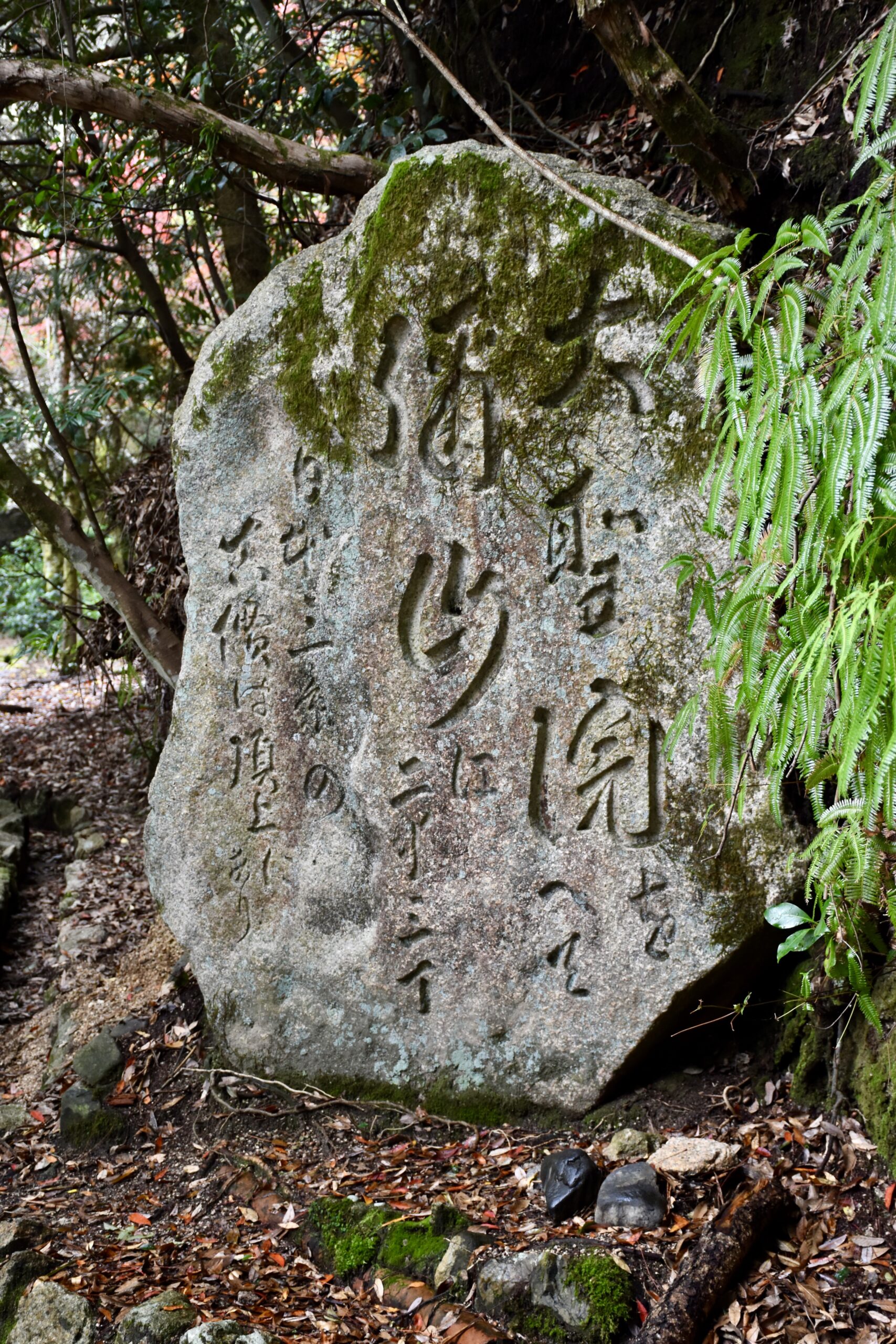
Somewhere along the way, in what felt like the middle of nowhere, I encountered a large inscribed stone.
I couldn’t read it, and at that point I was still hoping rather than knowing that my route would eventually lead to Daishō-in.
But I kept going.


And, to my considerable relief, it did.
Daishō-in and the Little Red Hats
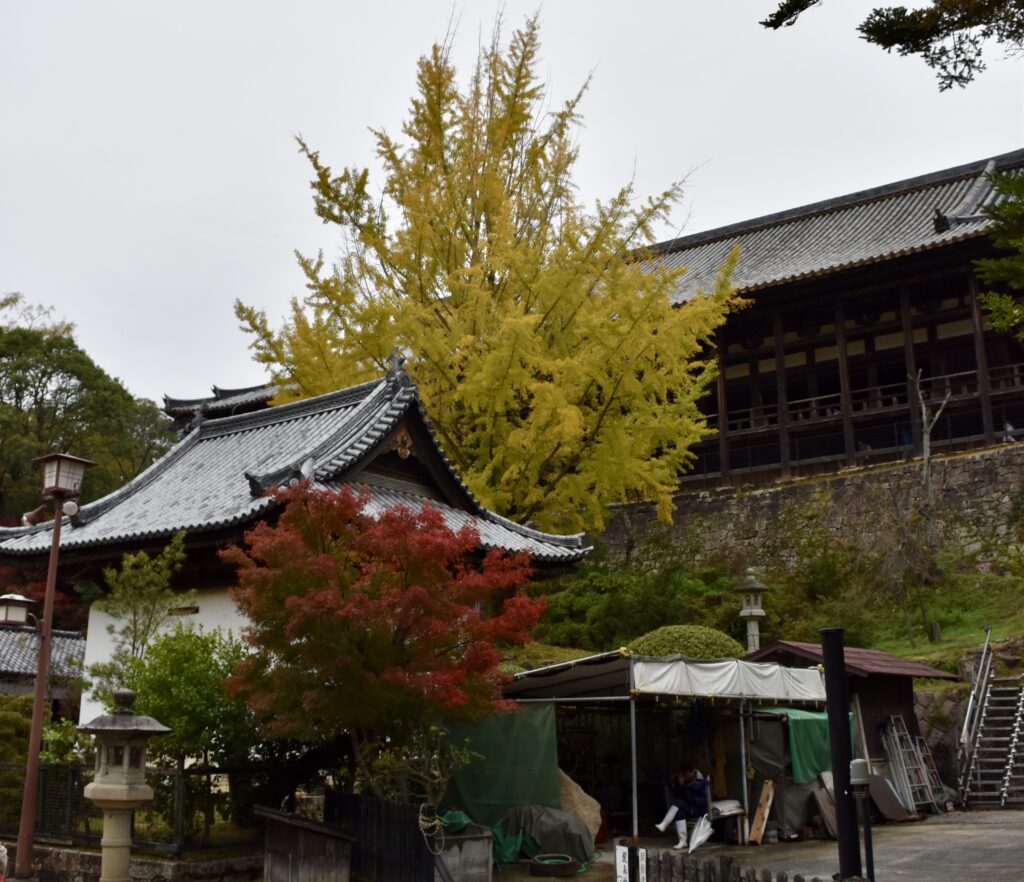
Daishō-in is one of Miyajima’s important Buddhist temples, set on the slopes of Mount Misen.
The grounds are full of religious buildings, stone figures, stairways, and small discoveries.
One of the most striking sights was a collection of little stone figures wearing bright red knitted caps and bibs.
Many are rakan, disciples of the Buddha, each with an individual face and expression. Elsewhere, red-capped Jizō figures evoke the Buddhist tradition of protecting children and travelers.
There was something both charming and moving about the sight of all those little figures, each carefully dressed against the weather.
And yes, there was another goshuin calligrapher.
This time I could see goshuinchō with numbered tickets, waiting to be collected. It reminded me of the system I’d encountered at Sensō-ji in Tokyo.
I left my book, received my number, and wandered around the temple grounds.
There were things I would have liked to explore more thoroughly, but I was increasingly conscious that I needed to get back to the group.
When my number was called, I collected my third handwritten goshuin of the day.
I also purchased an extraordinarily elaborate, two-page gold special edition, which was dated for me.
But there was one final complication.
My original goshuinchō was full.
Completely full.
There wasn’t even a proper page left.
I gestured toward the white inside surface of the back cover and tried to ask the calligrapher whether she could write there.
She nodded and smiled.
And so the final handwritten goshuin of my first book is not actually on a page at all.
It’s on the inside back cover.
I rather love that.
Twenty-Nine Goshuin — and Counting

By the time I began heading back down toward the town, I had acquired three handwritten goshuin and two special editions that day.
And I had filled my first goshuinchō to the very last available surface.
My goshuin are divided between two accordion books.
The first is a lovely book I purchased on Amazon before I knew much about goshuin collecting. The pages are a bit shorter than the second, but they’re perfectly suited to handwritten calligraphy, since the calligrapher simply adjusts the size of the inscription.
The second is my beautiful three-dimensional marquetry-covered goshuinchō, which I found in a woodworker’s shop earlier in the trip.
I can still hardly believe that Utako egged me on to buy it.
I’m so glad she did.
The larger format is especially useful for the elaborate preprinted goshuin, some of which are taller and span two pages. The smaller book accommodates many of the single-page designs beautifully, but the taller special editions need a little more room.
My marquetry book already has several of those special goshuin in it.
Which means it has quite a head start on my winter trip to Japan.
Amy and Michael have already suggested that I buy another goshuinchō if I see one I love, because they suspect I’ll fill this one as well.
Given that I’m returning in winter 2027 and again in spring 2028, I suspect they’re right.
And although I’m going home with quite a few presents for other people, I already know the one present I’ll be looking for for myself in two months, when I return.
Another beautiful goshuinchō.
The taller kind, of course.
Later, in answer to her question, I sent the total number of goshuin — 29 — to Utako through our group WhatsApp.
Her response was immediate:
“That’s a LOT!”
And Michael promptly chimed in:
“There’s still time…”
Ha!
Back to the Group — An Hour Early
Back to my soggy climb down Mt. Misen. I was determined not to be late.
Utako had sent a Google Maps pin for the meeting point, an information center outside the paid shrine entrance, about halfway back toward the ferry.
I made my way down from the hills, through the rain, and back into town.
Along the way I ran into Deborah and Doug, which reassured me that I couldn’t be terribly late.
I found the information center, where Lynn and the other Sandy had already located a place to sit.
I plunked down gratefully.
And discovered that I was an hour early.
An hour!
Lynn and Sandy suggested that I could go out, find something to eat, and explore a little more.
Under other circumstances, I probably would have.
But my feet were hurting, my clothes were wet, and my yoga pants were doing their best to drag themselves right off my body.
So I sat.
And was very happy to do so.
One Last Marble for the Water
On the ferry back toward the mainland, I suddenly remembered something I’d suggested to Lynn.
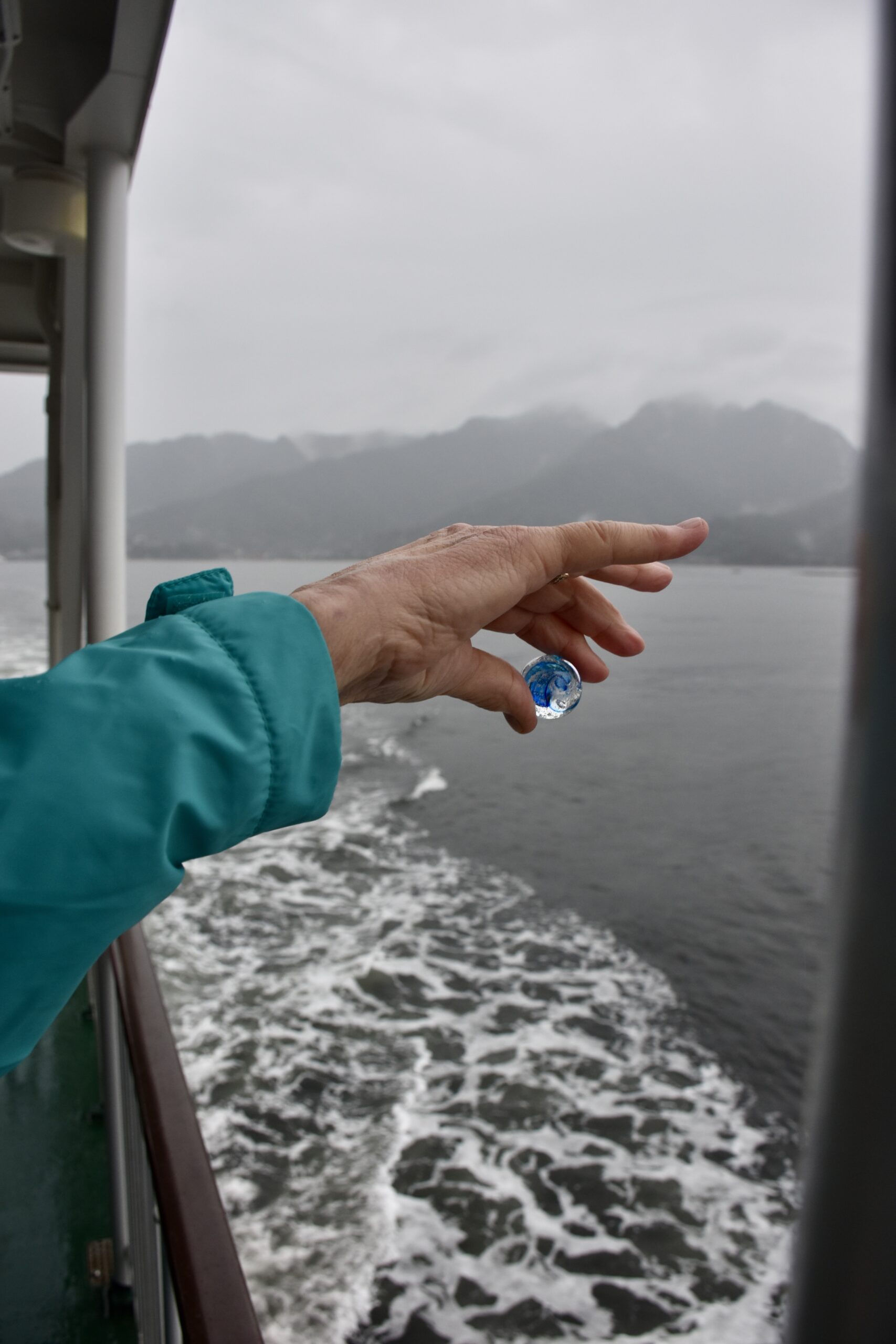
We had brought some of Jim’s cremarbles with us, with the idea that she could send one into the water near the great torii gate.
Lynn always called Jim a water baby.
H, on the other hand, was decidedly less enthusiastic about water.
But Jim belonged in it.
Unfortunately, by the time I remembered, we’d already traveled some distance from the shrine.
The torii was still visible, though very far away.
Lynn found one of the marbles, and I photographed her hand holding it with the distant gate behind her.
Then she sent it into the Seto Inland Sea.
It wasn’t quite the photograph we’d originally imagined.
But the important thing was that Jim had made it to Miyajima.
And into the water.
I think he would have liked that.

Ceramics, Trains, and a Farewell Dinner
Back on the mainland, we stopped at a lovely ceramics shop featuring pottery associated with the area.
There were beautiful pieces to admire, and the other Sandy emerged carrying a substantial shopping bag.
Then it was back onto the train, into taxis, and finally to the hotel.
I was more than ready to peel off my wet socks, trousers, and shoes.
I’d worn my Arcopedicos today partly to test whether they really were as uncomfortable as I remembered.
The answer, unfortunately, was yes.
Worse, in fact.
Amy and Michael have recommended a New Zealand hiking boot they love, with waterproof construction and a generous toe box. That sounds very promising, especially given my winter trip and the Kiso Road hike ahead.
But footwear research could wait.
Tonight was our farewell dinner.
And it was lovely.
After all these days together, the group had become a collection of familiar voices, running jokes, shared discoveries, and stories.
Amy and Michael would be leaving at an ungodly hour tomorrow morning for their flight. The rest of us would travel from Hiroshima to Haneda tomorrow afternoon, and then scatter in different directions.
Lynn and I had done a little packing, but since our flight wasn’t until the afternoon, there was time to finish after breakfast.
For now, there was dinner, conversation, and the realization that this extraordinary journey was almost over.
Collecting Encounters
I’ve been thinking about my goshuin collection.
Twenty-nine is a rather satisfying number, especially since I began the trip knowing almost nothing about the tradition.
But when I look at those books, I don’t think I’ll see only temples, dates, and beautiful calligraphy.
I’ll remember the little Japanese woman who asked how tall I was.
Her husband testing the wooden floorboards.
The moment she thought the calligraphers were about to go to lunch.
The gentleman demonstrating the difference between kendo and iaido through a vigorous series of imaginary blows and sword cuts.
The woman who patiently explained that I could continue writing on the reverse side of my book.
The calligrapher who agreed to use the inside back cover because I’d run out of pages.
And Utako, who encouraged me to buy a beautiful wooden goshuinchō that I might otherwise have left behind.
It reminds me a little of the Travel Angels stories I’ve collected over the years.
Sometimes the kindness is dramatic. Sometimes it’s a stranger helping when something has gone terribly wrong.
And sometimes it’s simply a shared laugh, an unexpected conversation, or a woman beaming when a foreign visitor says, “Tomodachi.”
I came to Japan hoping to see extraordinary places.
I certainly did.
But I also came home with something I hadn’t quite anticipated.
A collection of encounters.
And, as Michael reminded me, there’s still time.
After all, I’ll be back in January.
Postscript: Things I Meant to Tell You
As I was going through my notes from this trip, I discovered several little emails I’d sent to myself along the way, intending to include the observations in my blog.
And then, naturally, promptly forgot about them.
Some are historical, some are cultural, and some are simply too funny not to share. So before I close the book on this particular Japanese adventure, here are a few things I meant to tell you.
Kyoto: Where “Thank You” Sounds Different
In Kyoto, instead of the familiar arigatō for “thank you,” you may hear ōkini.
It’s a lovely regional expression, and one of those little linguistic differences that reminds you how much Japan’s cities have their own distinct personalities.
Kyoto’s personality, according to Utako-san, is particularly interesting.
People there can be considerably more circumspect than in Tokyo. Rather than tell you something directly, they may offer a compliment that actually means something quite different.
For example, a Kyoto resident might smile sweetly and say:
“You have a very nice watch.”
What they actually mean is:
It’s time for you to leave.
Or perhaps:
“Nice shoes!”
Translation:
Get off the grass!
And apparently the smile accompanying these remarks isn’t necessarily a sign of affection.
Sometimes it’s simply a particularly elegant way of being mean.
I rather admire the efficiency of it. One can deliver an insult, maintain perfect manners, and leave the recipient wondering whether they’ve just been complimented.
I suspect I would be hopeless at this.
Kyoto: Bread, Pickles, and Nintendo
Kyoto has a population of roughly 1.5 million people and an extraordinary concentration of visitors.
Tourism is a major part of its economy, alongside its traditional arts and crafts. And then there’s Nintendo, whose headquarters are in Kyoto.
I find that juxtaposition rather wonderful: centuries-old temples, exquisite traditional crafts, and Mario.
Utako also explained that Kyoto has a particularly strong bread culture, with people eating considerably more bread—and less rice—than one might expect.
I certainly noticed far more bakeries on the streets of Kyoto than I had in Tokyo.
And the bread packaging is ingenious.
Sliced loaves indicate not only the number of slices but, in some cases, the number of sandwiches they will make. So a loaf might be marked “4 and 2,” or “8 and 4.”
Four slices, two sandwiches.
Eight slices, four sandwiches.
Very practical!
Kyoto also has a remarkable pickling tradition. Its location in a basin, with hot summers and cold winters, helped encourage food-preservation practices, and the city is particularly famous for its tsukemono, or Japanese pickles.
Utako described how important preserved vegetables were in getting through the winter months.
And there was one more food distinction I found especially interesting: the different approaches to dashi, the stock that underlies so much Japanese cooking.
Utako explained that Kyoto cooking often favors a lighter, kelp-based dashi, while Tokyo cooking traditionally makes greater use of bonito.
For someone with my fish allergy, that is a distinction worth knowing—although I still need to check every dish carefully, because kelp-based dashi can also contain fish.
A New Vocabulary for Hot Food
Another small linguistic discovery came courtesy of Ken.
Whenever I remarked that something was “hot,” Robin would ask:
“Spicy, or warm?”
A perfectly reasonable question, because hot in English can mean either.
Ken suggested that I should use the word “thermal” when I meant temperature rather than spiciness.
I rather liked that.
Although, having encountered some spectacularly hot food during this trip, I think there’s a third category that deserves recognition.
Molten.
“Is it spicy?”
“No, it’s molten.”
A distinction I feel could prevent a considerable amount of suffering.
Poetry: Five, Seven, Five, Seven, Seven
We also encountered two examples of traditional Japanese poetry, one written by an emperor and the other by an empress.
I had initially thought of them as something like haiku, but learned that they were waka, specifically the form known as tanka.
Where a haiku follows a 5–7–5 pattern, these poems have five lines arranged:
5–7–5–7–7
That makes 31 sound units altogether, rather than 17. (I’d originally written 37 in my notes, but the arithmetic rather firmly insists on 31!)
Haiku traditionally include a seasonal reference and often a striking shift or juxtaposition. Tanka have more room to develop an emotion, image, or thought.
I love the idea of an emperor and empress expressing something personal within such a disciplined form.
Thirty-one little units of sound, and an entire thought or feeling contained within them.
Utako’s Memory of the 2011 Tsunami
One of the more sobering things Utako told us was that she had been in Fukushima during the devastating earthquake and tsunami of March 11, 2011.
She was on the twenty-second floor of a building, watching the water come in.
I can scarcely imagine what that must have been like.
We spent so much of this trip learning about Japan’s history—its wars, disasters, rebuilding, and remarkable resilience. But there is something entirely different about hearing a personal recollection from someone who was actually there.
Twenty-two floors above the ground, watching the tsunami arrive.
It’s an image that stays with you.
A Day in the Japanese Countryside
I also found a brief list of notes from our visit to the Ashigara countryside.
Green tea picking. Tempura. An old farmhouse. Origami. A private onsen. Light rain. A kaiseki dinner.
Just a few words, but they immediately brought the day back.
That was one of the pleasures of this trip: the chance to experience not only Japan’s great cities and famous monuments, but also a quieter rhythm of life.
The smell of the tea fields, the pleasure of making something with one’s hands, the warmth of the bath, and a beautifully prepared dinner.
I think I’ve already written about most of that day, but I’m glad those little reminders survived in my notes.
And One Last Thought
Reading these forgotten emails reminded me how much of travel consists of small observations that don’t necessarily fit neatly into an itinerary.
A regional word for thank you.
A compliment that isn’t really a compliment.
The number of slices in a loaf of bread.
A poem written centuries ago.
A conversation about whether dinner is hot, spicy, thermal, or molten.
And a guide sharing a memory that makes history suddenly, profoundly personal.
They’re not necessarily the things you set out to discover.
But they’re often the things you remember.
And now, fortunately, I won’t have to rely entirely on my memory.
I never get a percentage from any links I include – but! – if you are curious about Overseas Adventure Travel and want $100 off, call them at 1-800-955-1925 and request their amazing catalog, tell them you were referred by Sandy Shepard, customer number 3087257, and get $100 off your first trip! The catalog is what all good dreams are made of!