
Saturday, November 14, 2026
Our last full day in Kyoto began at Fushimi Inari Taisha, the Shinto shrine famous for its seemingly endless tunnels of vermilion torii gates. And by “endless,” I mean approximately 10,000. I believe I photographed a substantial percentage of them.
The shrine was founded in 711, long before Kyoto became Japan’s capital. It is dedicated to Inari, associated originally with rice cultivation and the harvest, and later with commerce, prosperity, and business success. Inari shrines can be found throughout Japan, but Fushimi Inari is the head shrine.
And it has a tie to Toyotomi Hideyoshi, who I’ve discussed many other times in this blog. His mother fell ill, and he prayed to Inari, promising a donation worth 10,000 koku of rice if she recovered. She did, and the shrine credits his donation with building the Rōmon, the big, two-story vermilion entrance gate, in 1589. (10,000 koku works out to about 3.3 million pounds of rice – the equivalent of a small daimyō’s domain’s entire annual output.
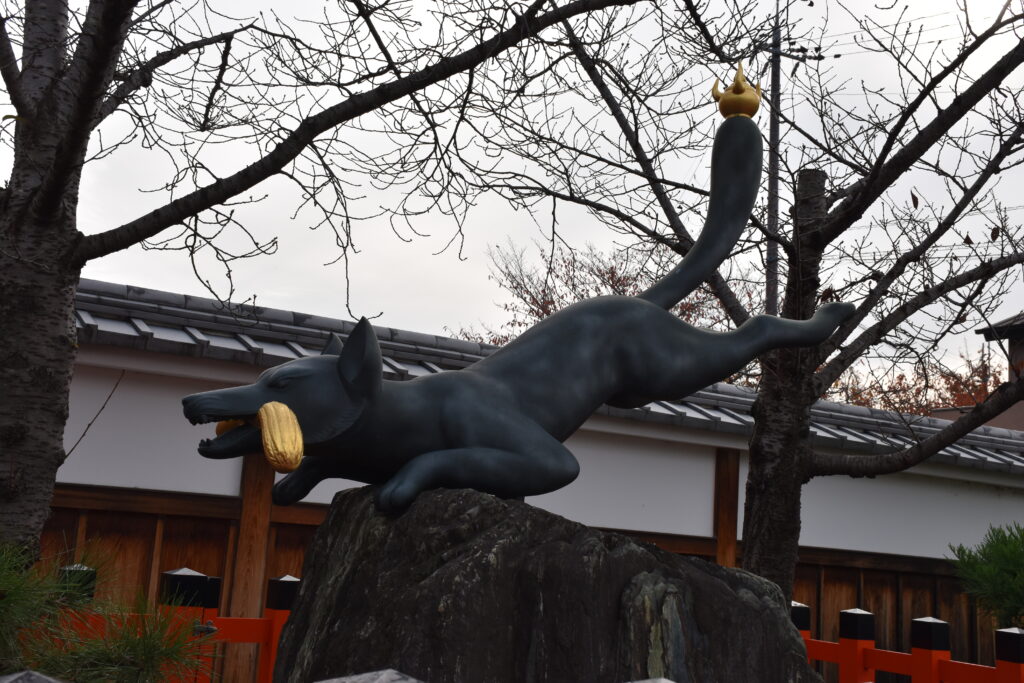
One of the first things we encountered was a collection of foxes. Not live ones, unfortunately, but rather wonderful statues. Foxes (kitsune) are considered messengers of Inari, and the things they carry have meanings. One fox had what looked to me like a corn cob in its mouth and a teapot attached to its tail
Apparently, the “corn cob” was actually an ear of rice. Fair enough. Another held a key, traditionally interpreted as the key to the rice storehouse—rice being wealth, after all. A third carried a ball, often associated with spiritual power or treasure.


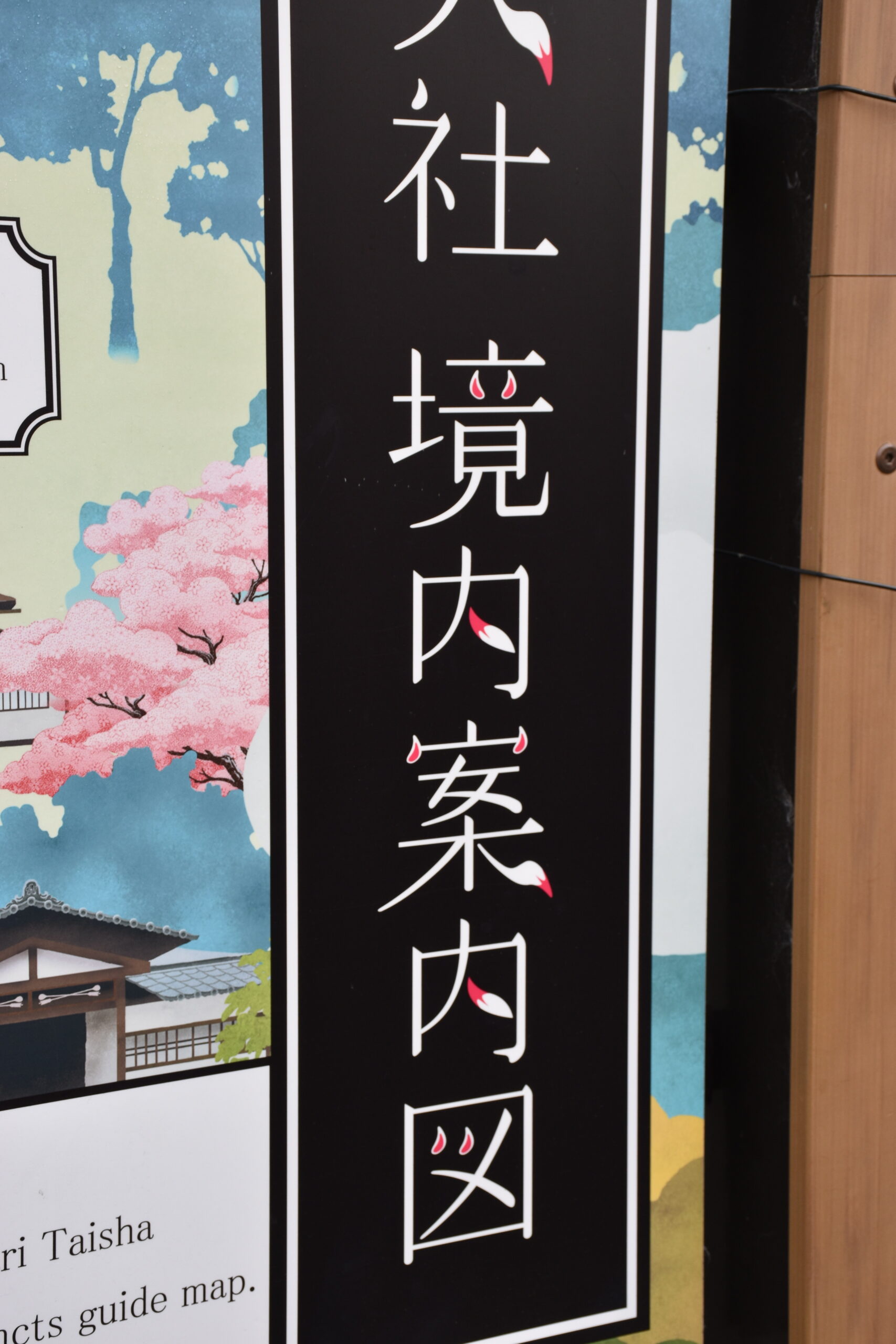
There was also a sign in which some of the Japanese characters had been given little fox ears and tails. Adorbs.
After the usual purification at the water basin, we entered the main shrine grounds.
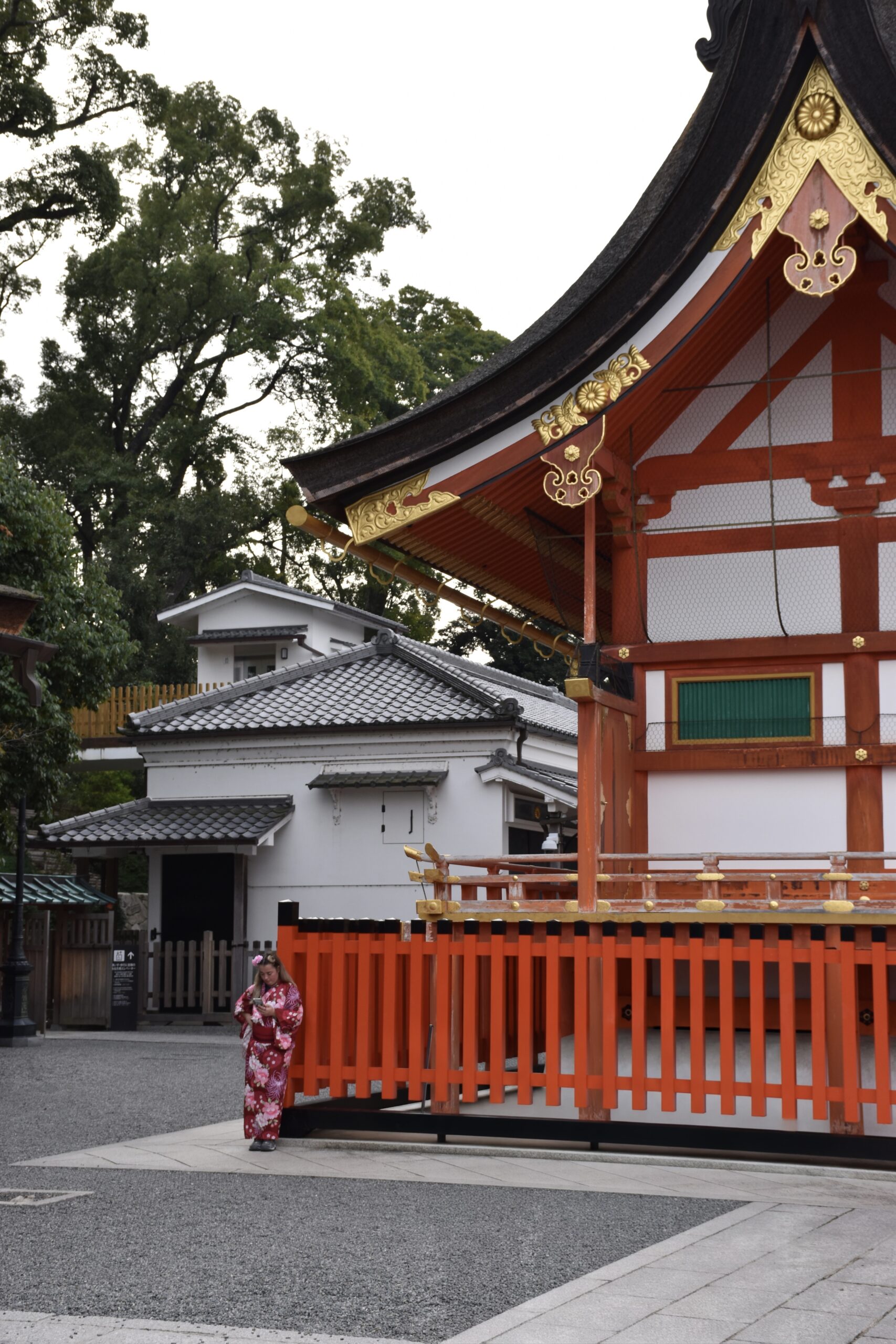
Beautiful buildings, elaborate rooflines, red-orange paint, gold ornamentation, and LOTS of people. At one point, I photographed a woman in a lovely traditional kimono standing beside one of the buildings, completely absorbed in her phone. Old Japan, meet modern Japan.
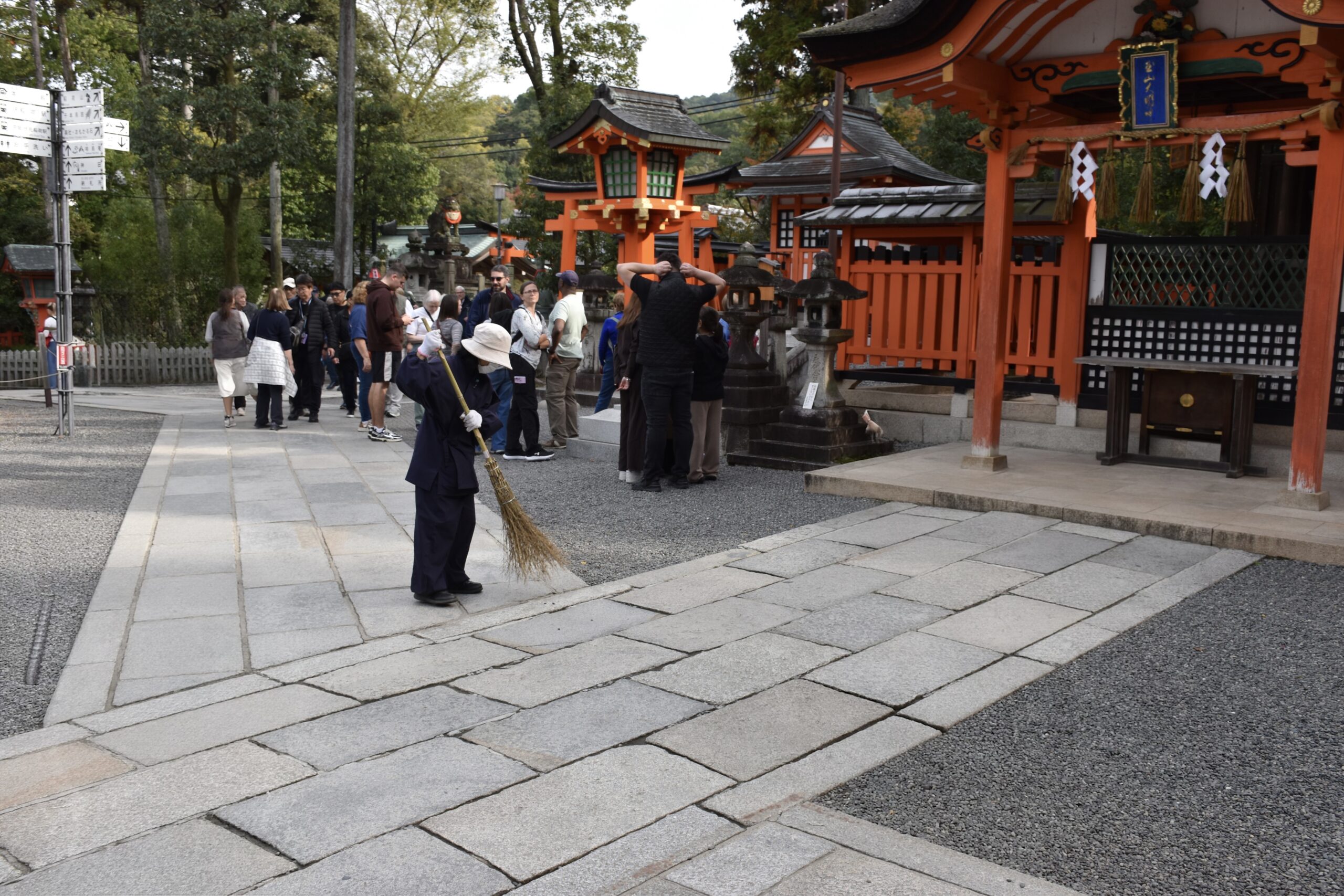
Nearby, a gardener was calmly sweeping the grounds while crowds flowed around her. An exercise in concentration, I thought.
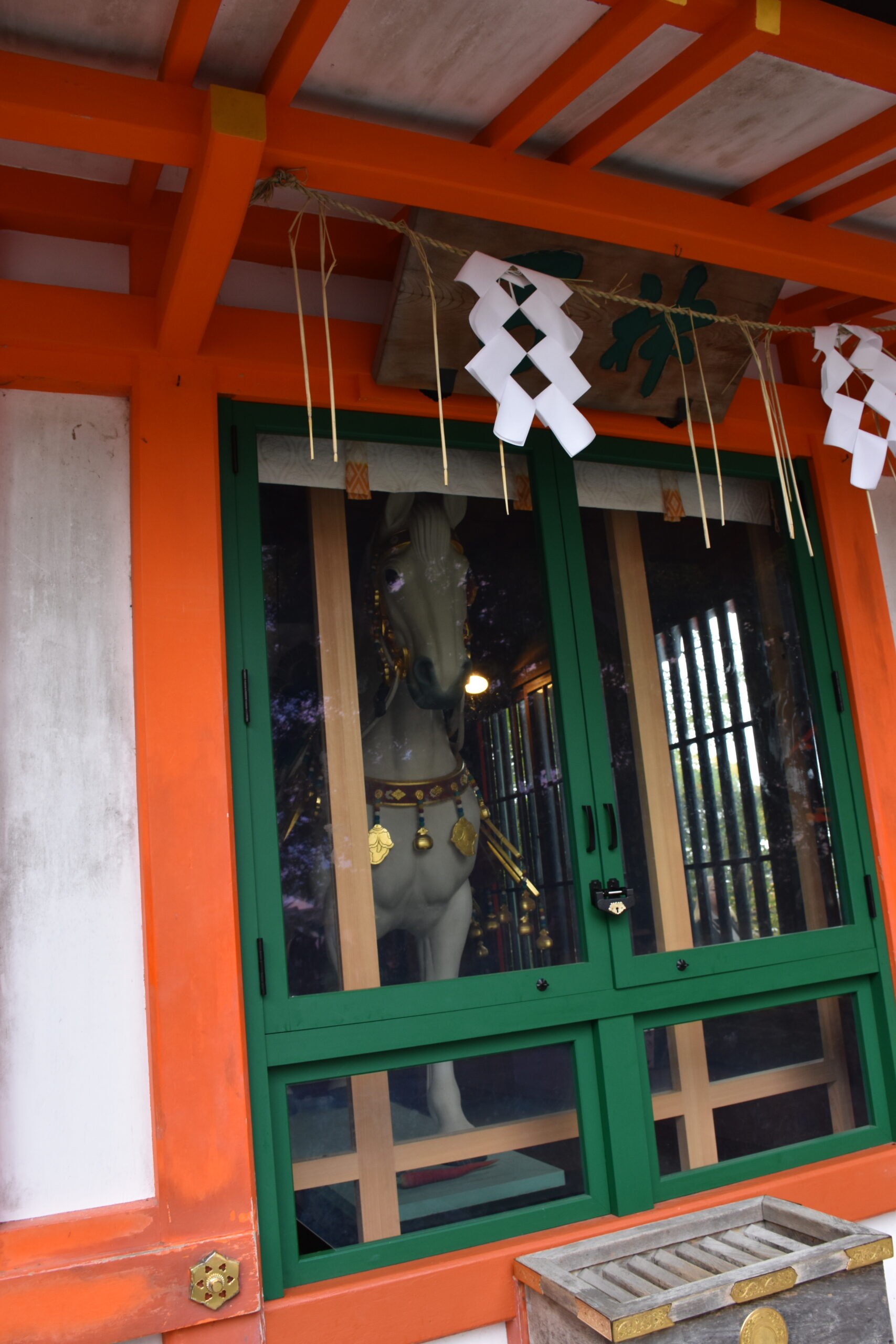
We also passed a small building containing a white horse. In Shinto tradition, horses were once offered to shrines as sacred messengers or mounts for the deities. Today, a symbolic horse often takes their place. I managed a quick photograph through the glass, although actually getting near the building was something of a challenge. Seemingly everyone needed a photograph of their significant other posing in front of the glass. And not just one photograph. Several. With adjustments.
I took what I could get and moved along.
Ten thousand gates. Give or take.
A torii marks the transition from the ordinary world into sacred space. At Fushimi Inari, thousands of them form long, densely packed tunnels winding up the wooded slopes of Mount Inari.
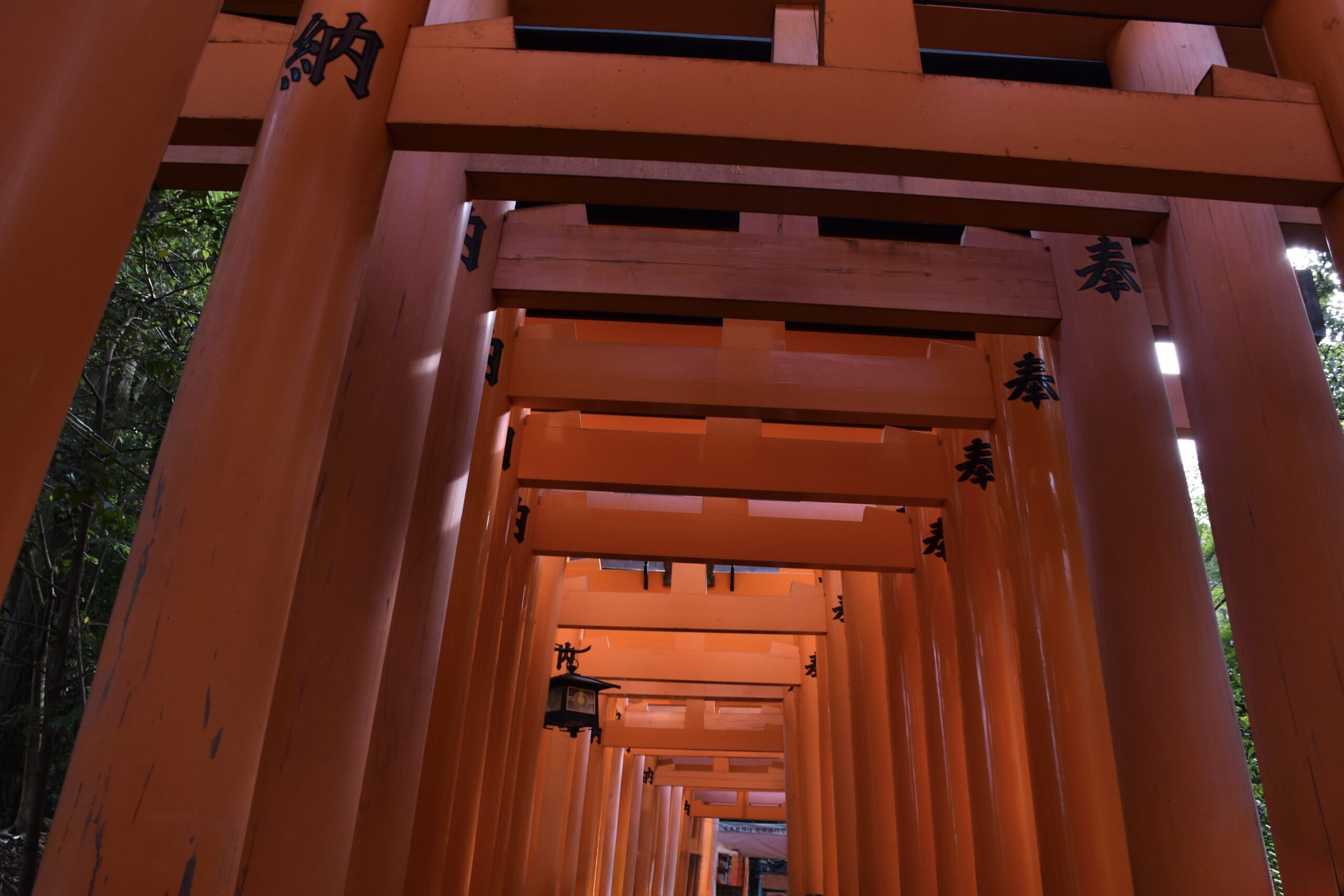
Most of the gates are donations, given by businesses and individuals either to request good fortune or to express gratitude for blessings received. The practice became particularly widespread during the Edo period.
What I found especially interesting was the writing. From the front, the gates are almost entirely orange; from the back, they are covered with the names of their donors and dates of dedication.
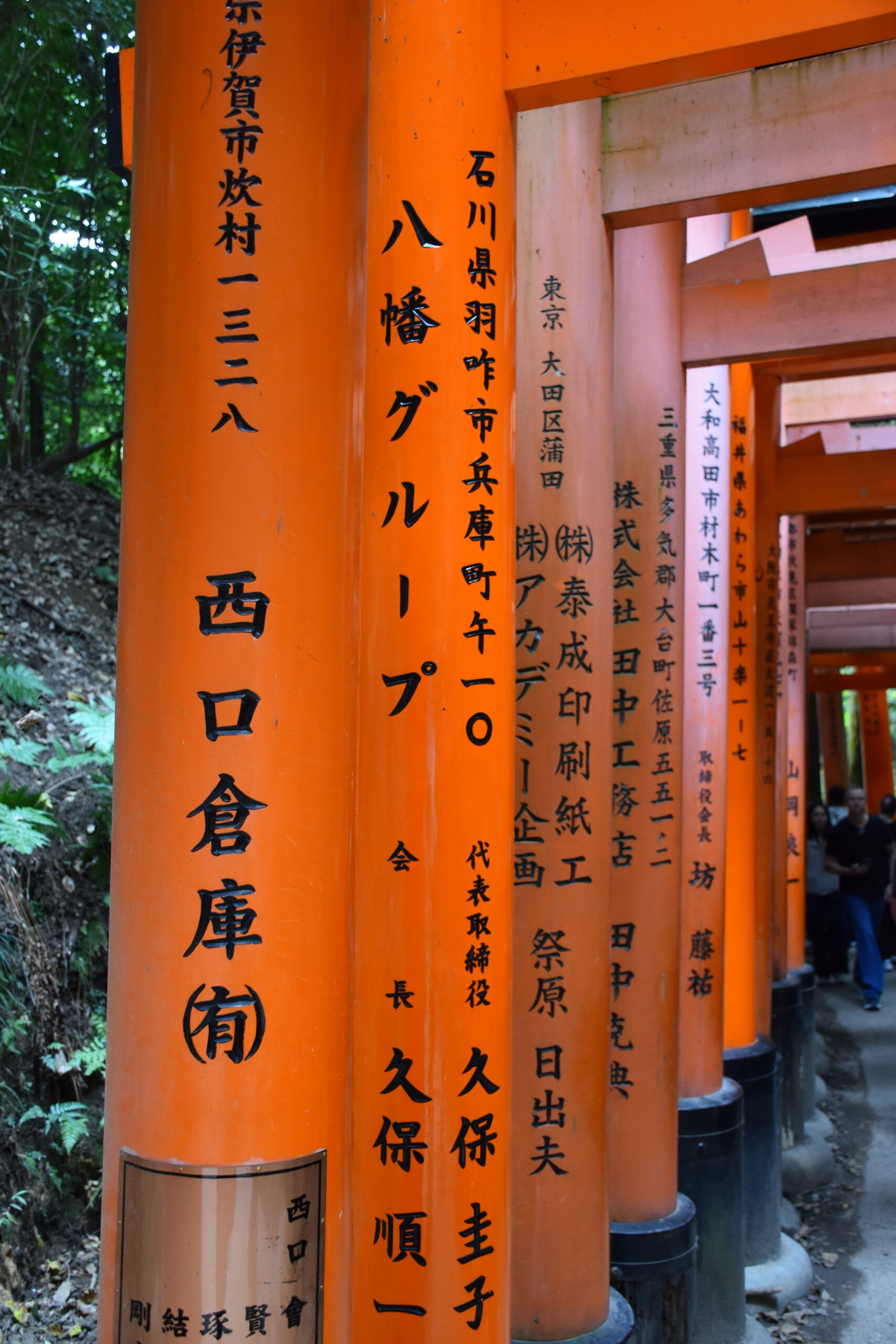
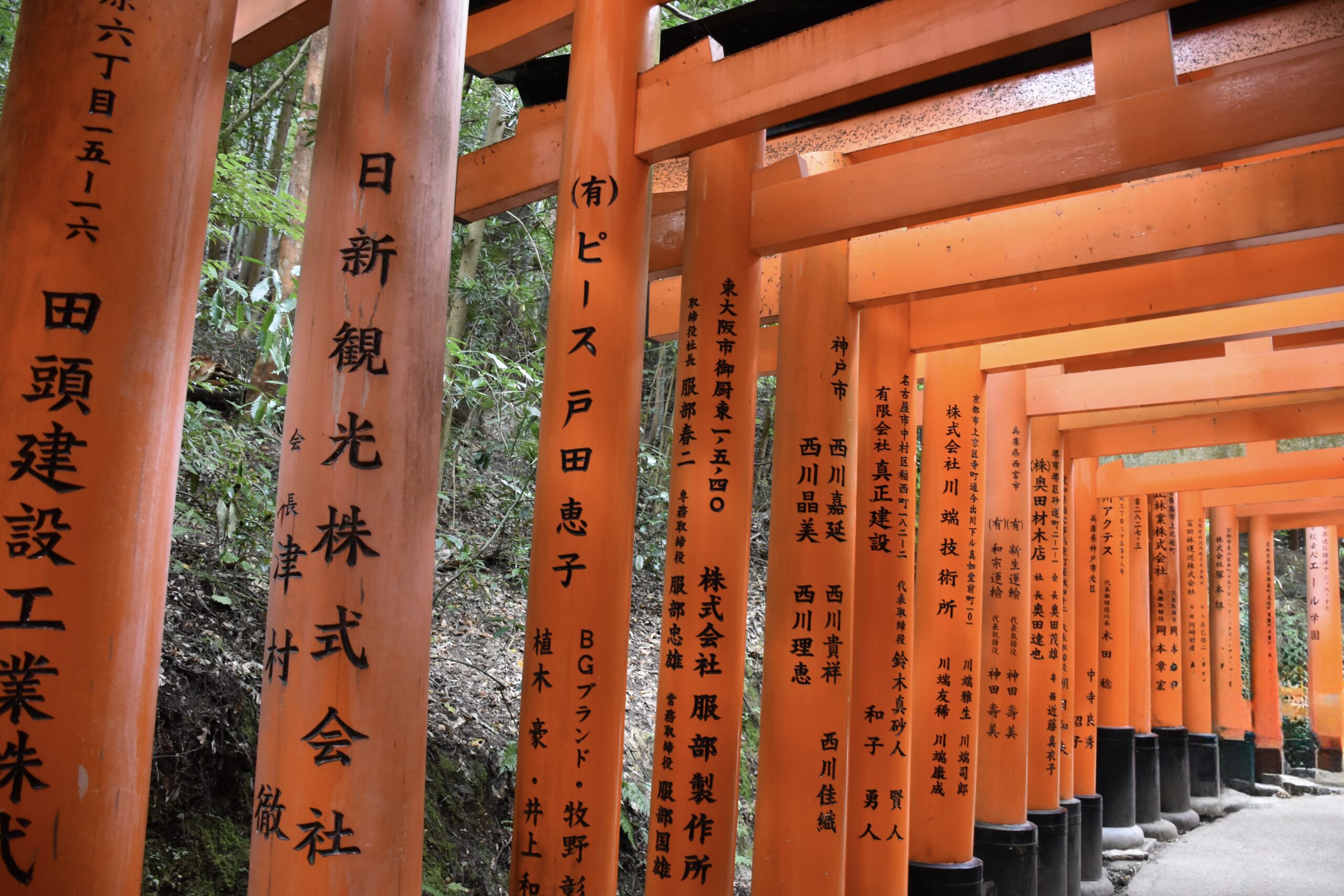
The shrine estimates that there are approximately 10,000 torii of various sizes along its mountain paths. The most famous section is called Senbon Torii — literally, a thousand torii — although that is the name of the passageway rather than a precise count.
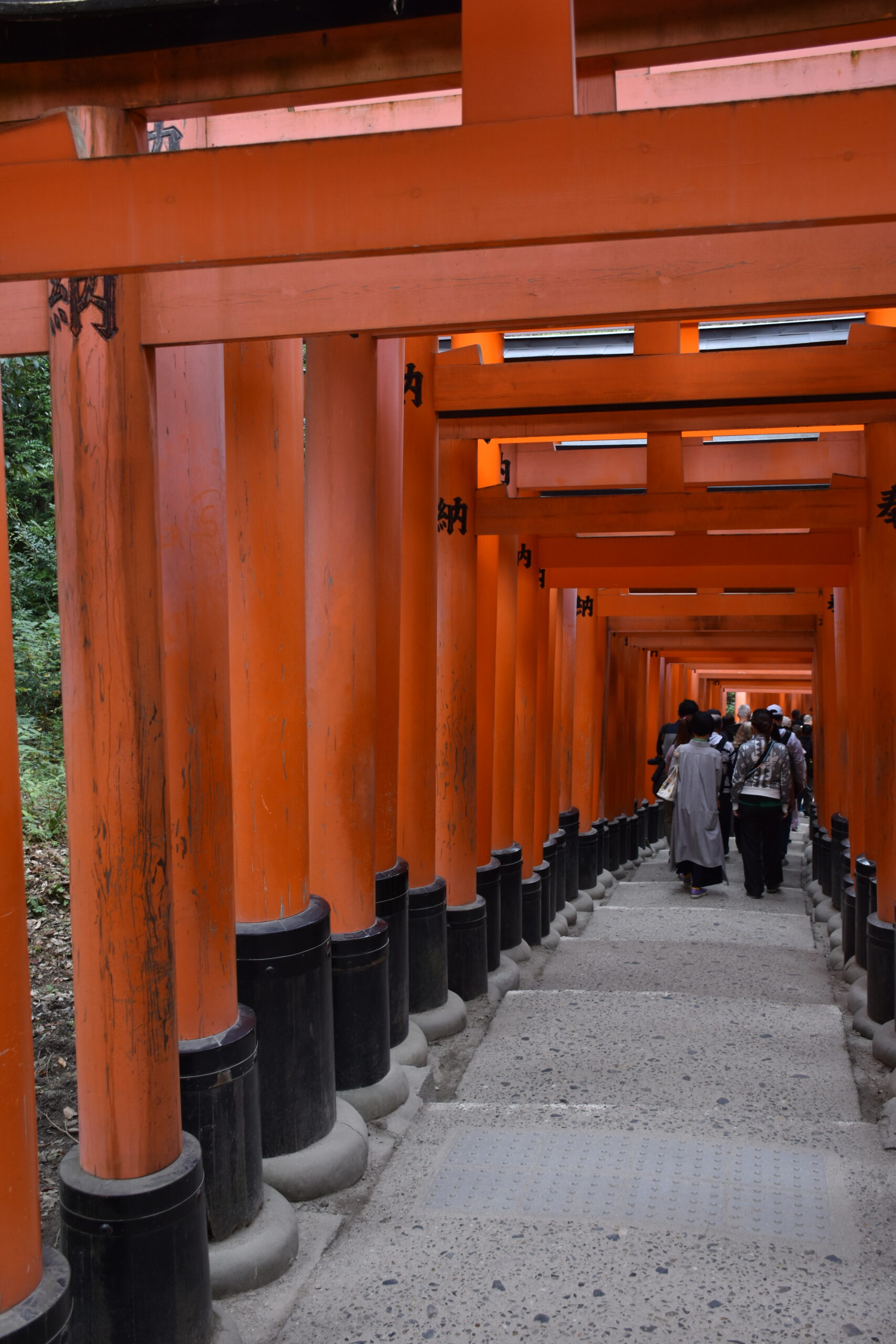
There were big gates, smaller gates, gates in pairs, gates disappearing around curves, and gates that seemed to be growing out of the forest itself. Eventually, there were also a remarkable number of people standing in the middle of the path looking at photographs they had just taken of gates.
But I am getting ahead of myself.
I had already fallen behind the group because I wanted to get goshuin, the beautiful calligraphic temple and shrine seals that I have been collecting throughout Japan. The line near the entrance was the longest yet, but I wanted one for Deborah and one for myself, and there I remained.
That meant I ended up exploring much of the mountain on my own. Which, as it happened, suited me rather well.


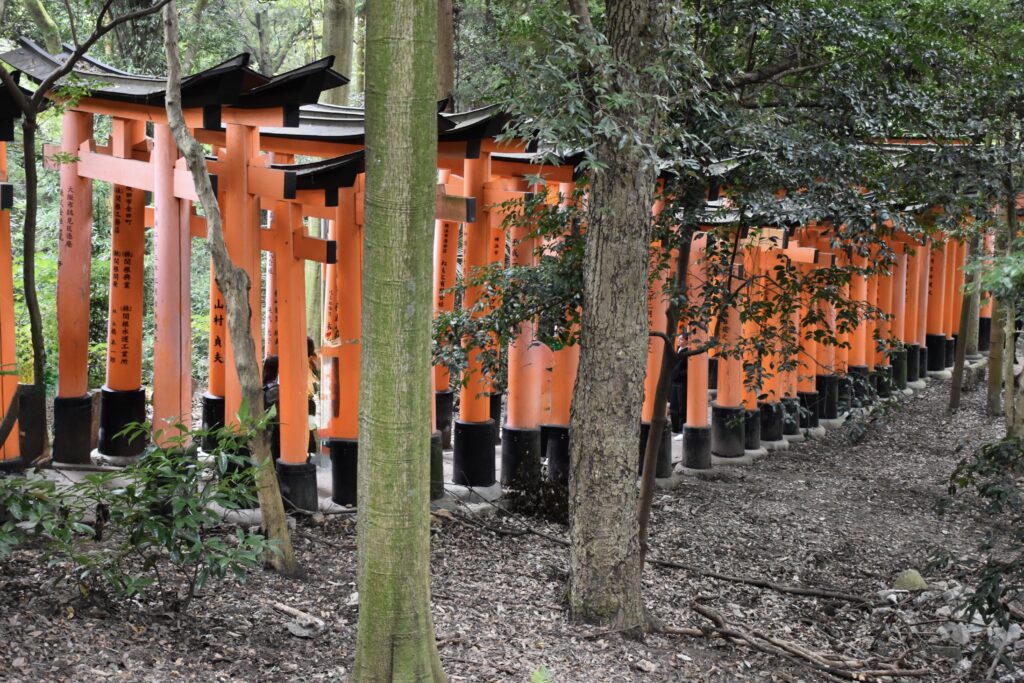

The little shrines off the beaten path
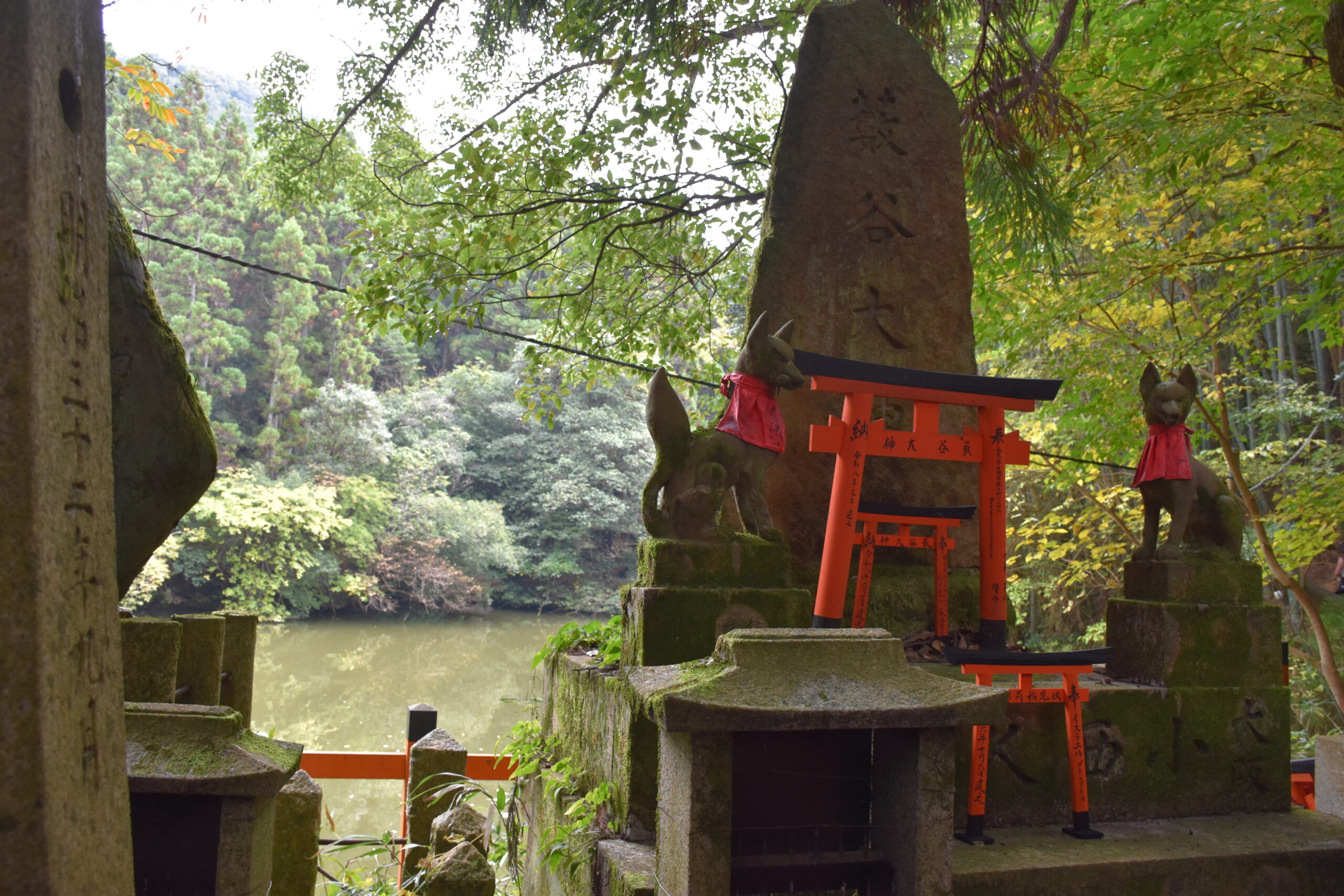
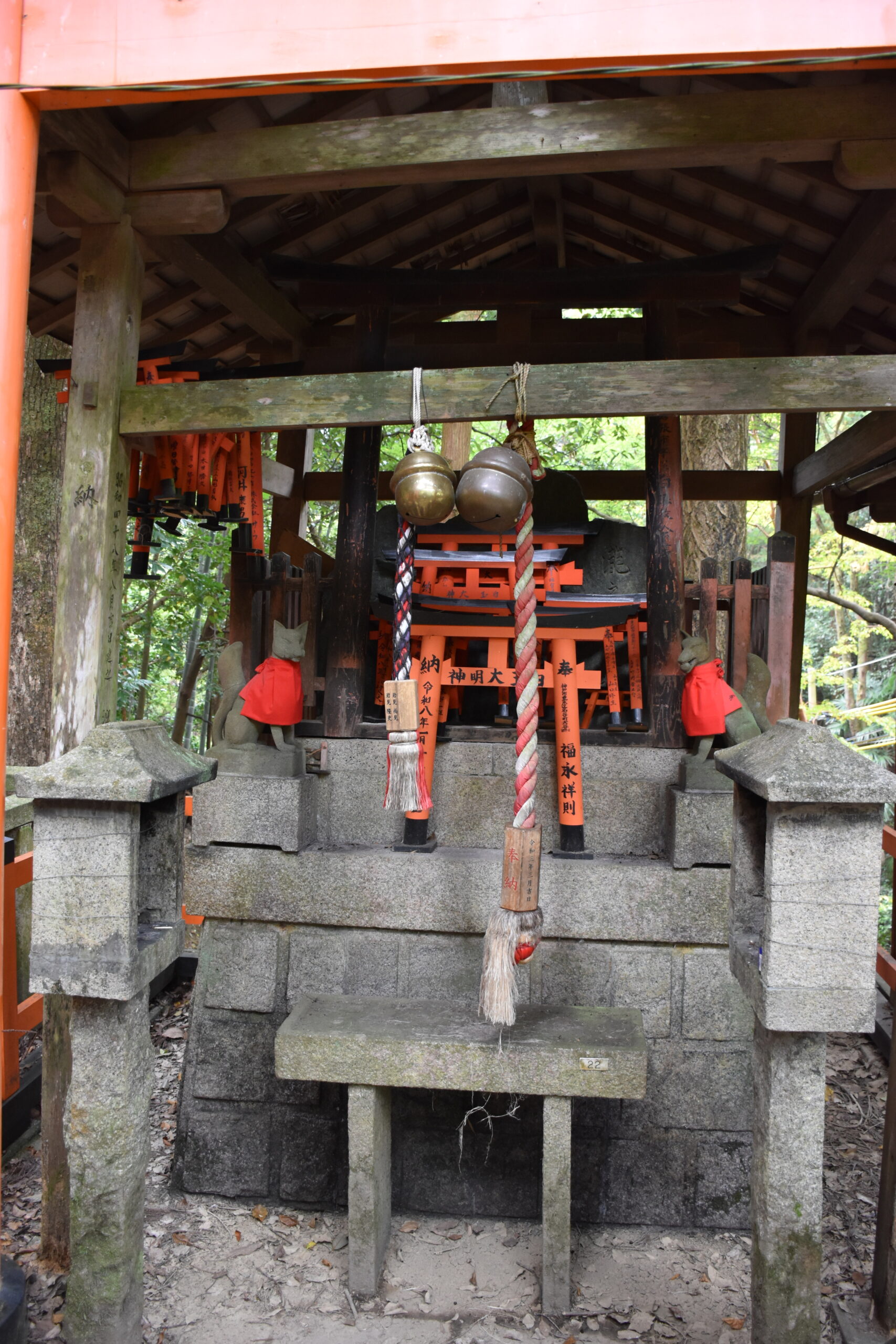
As I followed the torii tunnels upward, I kept noticing little paths leading away from the main route. Just a few steps off the busy walkway were clusters of much smaller shrines, miniature torii gates, moss-covered stone monuments, tiny fox guardians wearing red bibs, and bells hanging from ropes. Some were only a few inches high. These had been offered by worshippers as personal prayers or thanks. Utako-san had told the group that the small gates were included in the famous 10,000.
I loved these.
Some were tucked into the trees, others stood beside the water. They were close enough to the main route that I could still hear the passing crowds, yet hardly anyone seemed interested in stepping aside to look.


The smaller torii are also offered in devotion, though it is worth distinguishing these miniature offerings at individual shrines from the enormous gates forming the mountain pathways. Both belong to the larger tradition of giving thanks and making requests to Inari.
I was rather taken with these miniature worlds, especially where the shrines overlooked the water.
There was a particularly lovely little shrine beside a pond, with two foxes wearing red bibs and a miniature torii standing between them. I photographed it from several angles. In fact, I photographed quite a lot of these little shrines. Fortunately, I can put several into a gallery rather than making everyone scroll through every single one.
And yes, I rang some of the bells. They had ropes hanging down in front of the shrines, and I took that as a fairly strong indication that they were meant to be rung.
At one point I heard a very vocal black bird in the trees. As has happened so often during this trip, there was another crow or raven apparently keeping an eye on me.
Hello, Herbert.
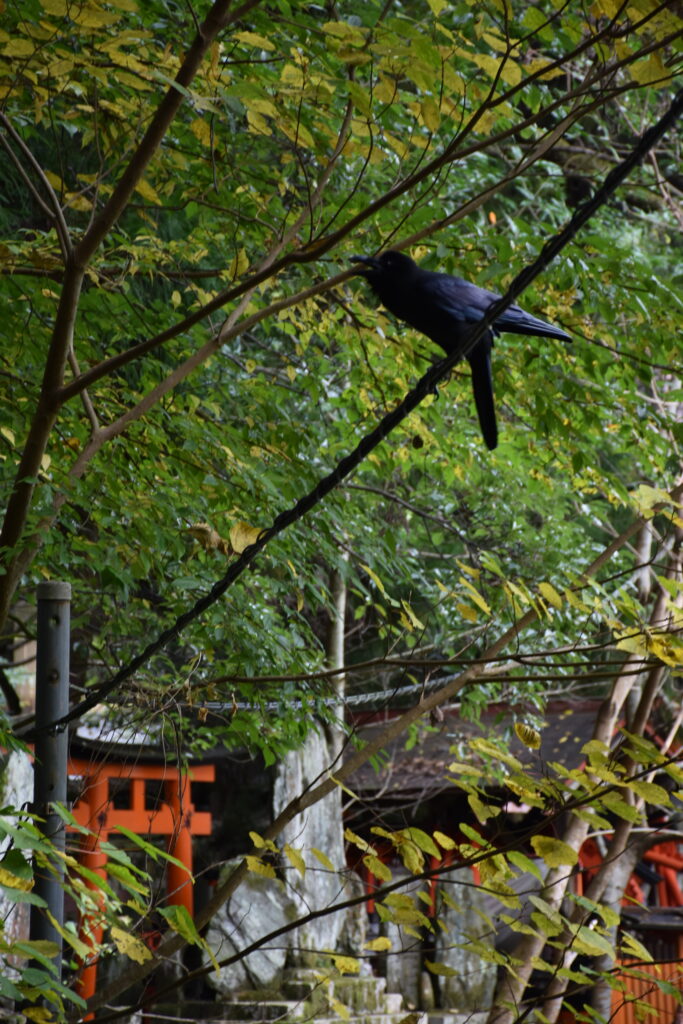
I’ve lost count of how many temples and shrines have had one of these birds nearby. Coincidence?
One of the most appealing things about wandering on my own was being able to stop and look at all these places. I could imagine how easy it would be to walk straight past them while concentrating on reaching the top of the mountain.
And I was doing a fair amount of concentrating on that myself, since I also had a deadline.
There were other little discoveries: an elaborate dragonfly ornament hanging from the eaves of a shrine featuring dragons, flowers that looked like the “spider orchids” I’ve always called them, and a dangling red-and-yellow flower that reminded me of a bleeding heart. A very large garden spider had thoughtfully built its web above the spider flowers, which seemed appropriate. I tried to photograph it, but by then I was doing rather more of a drive-by than a leisurely botanical survey.


And there were, of course, more torii gates.
The further I went, the more the path wound among trees and small shrines, with the orange gates appearing and disappearing through the greenery.
The mountain has other ideas
Eventually, I realized that if I wanted to reach the upper part of the route and get back in time to meet the others, I needed to keep moving. Unfortunately, a great many people had reached the opposite conclusion.
There were groups stopped in the middle of narrow paths, people studying photographs on their phones, and others apparently considering whether they might like to take yet another picture of the gate they had just passed through.
I am normally very patient about photography. I take enough pictures myself, after all. But standing in the middle of a narrow pathway to review them while everyone behind you comes to a complete halt? Really?
I did make it to the upper part of the route, stopping for another goshuin along the way. I had already obtained one halfway up, and each was being written directly into my book.
But the return journey turned into a monumental traffic jam. I texted Utako-san to warn her that I might be late.
Then I noticed a sign pointing toward the main shrine grounds. It was not the route everyone else was taking, but it certainly seemed worth investigating.
Off I went.
Pretty soon I found myself in what looked more like a residential neighborhood than a major tourist attraction. There were little buildings, quiet streets, and a rather striking fox sculpture apparently flying over a rooftop.
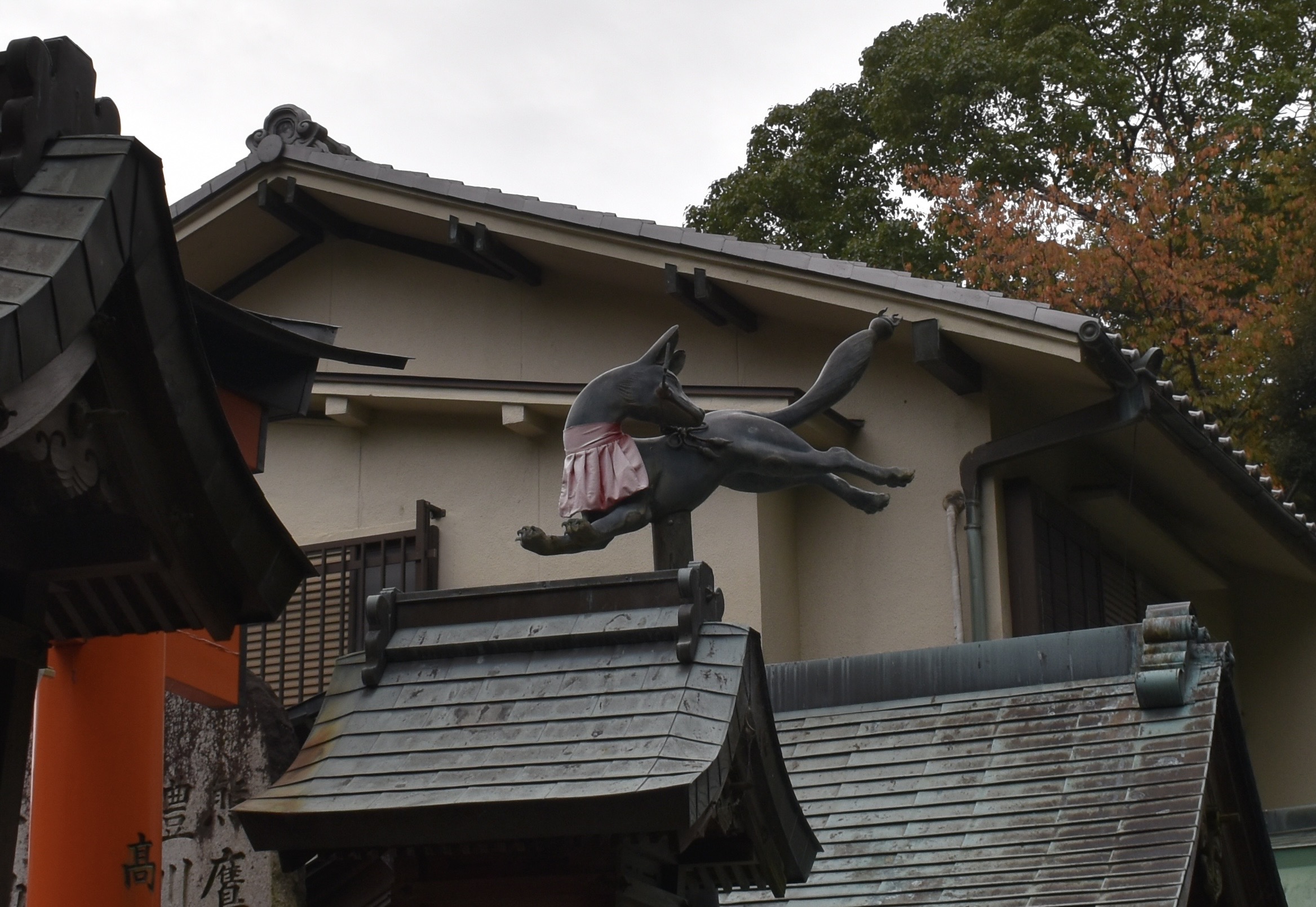
My accidental detour had one rather lovely reward: a golden statue of Kannon, the Buddhist bodhisattva of compassion, standing in a small neighborhood sanctuary. She held a child in one arm, with several smaller figures gathered around her feet. It was such an unexpected sight after all those Shinto shrines and torii gates. I had followed the signs hoping to find my way back to the main entrance, and instead found Kannon waiting quietly along the way. Not a bad wrong turn, as wrong turns go.
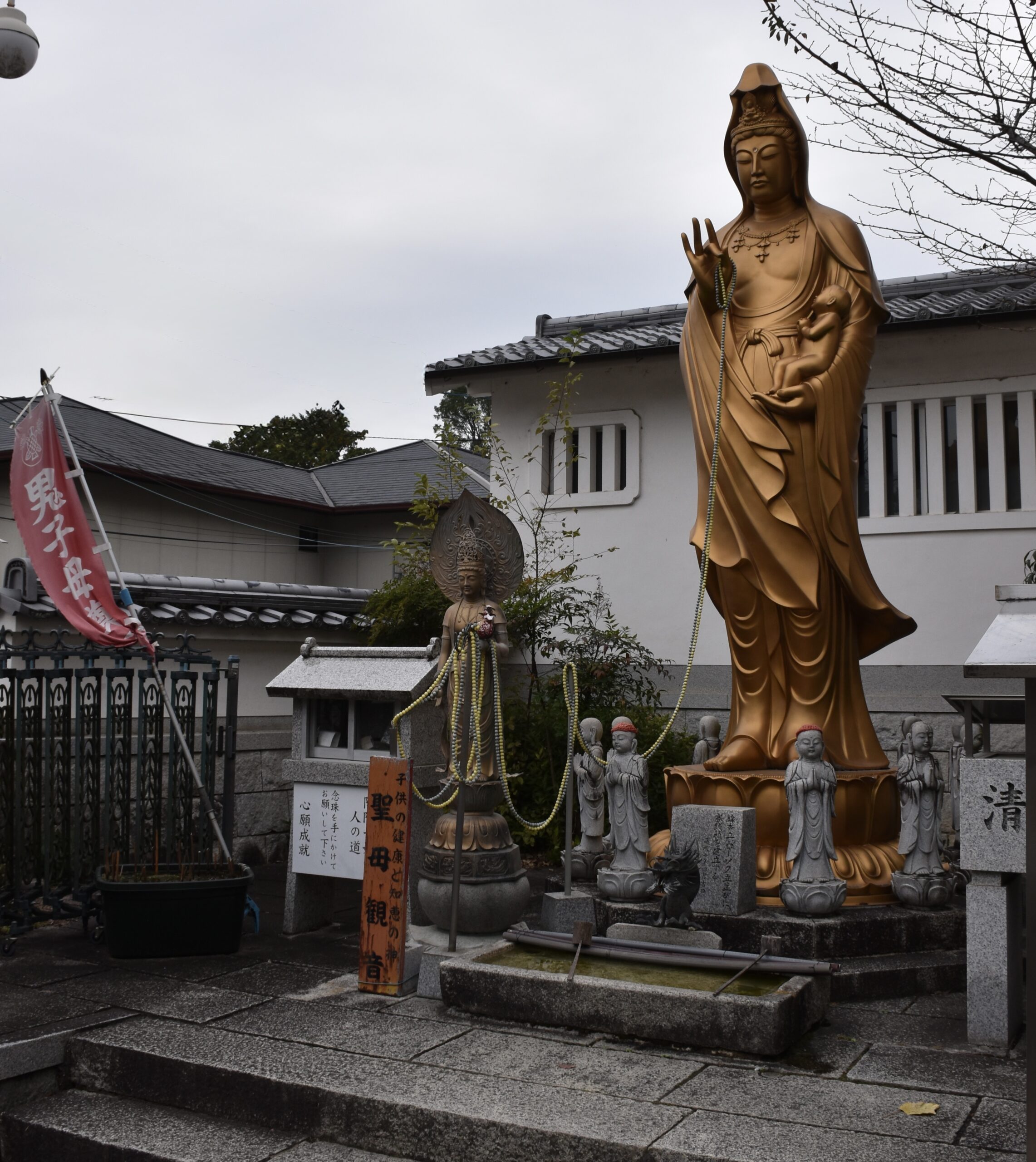
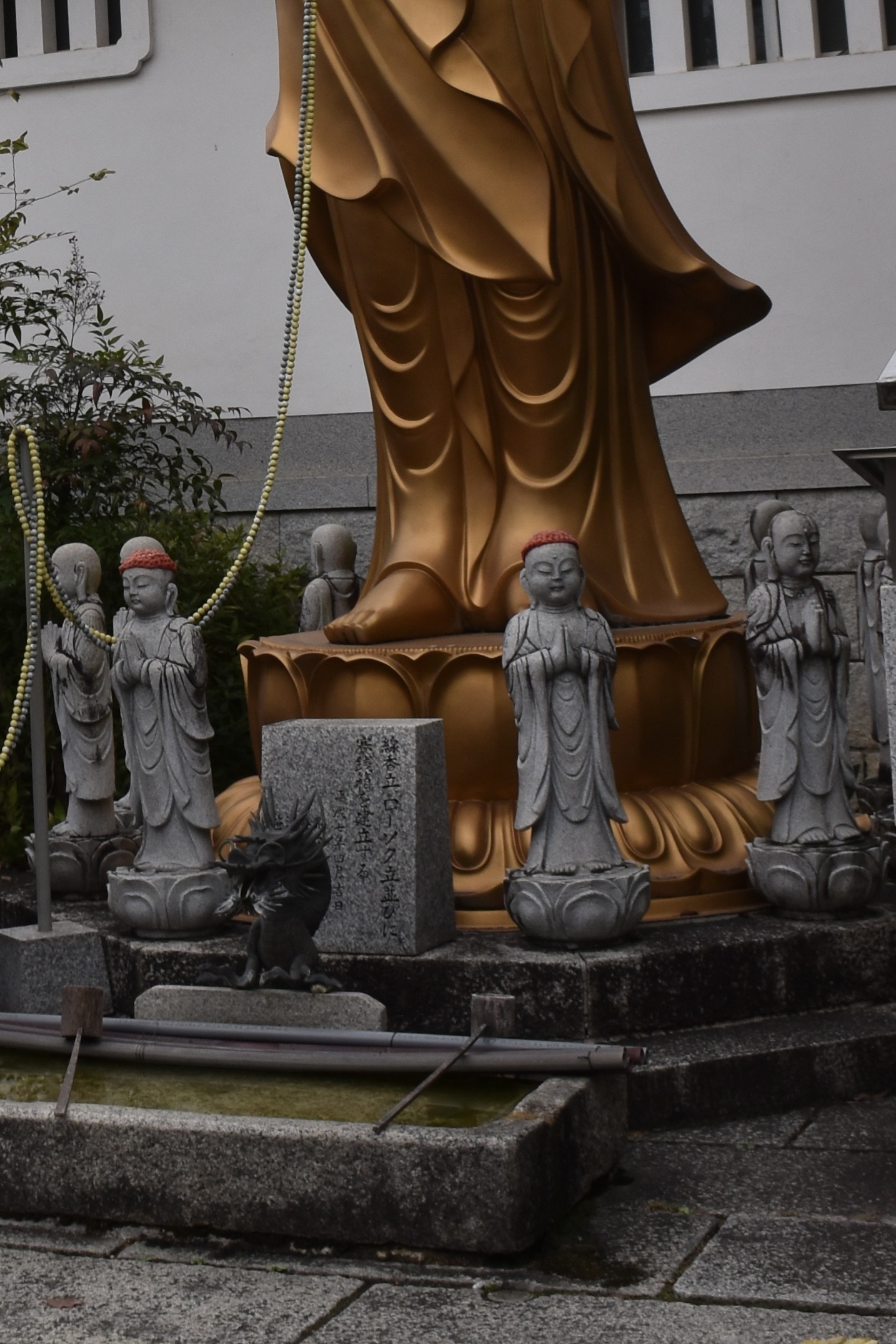
I had a few moments of wondering whether I had made a spectacular navigational error. (No torii gates in sight.) But I kept following the signs, and eventually emerged just outside the entrance to the shrine complex, remarkably close to where I needed to be.
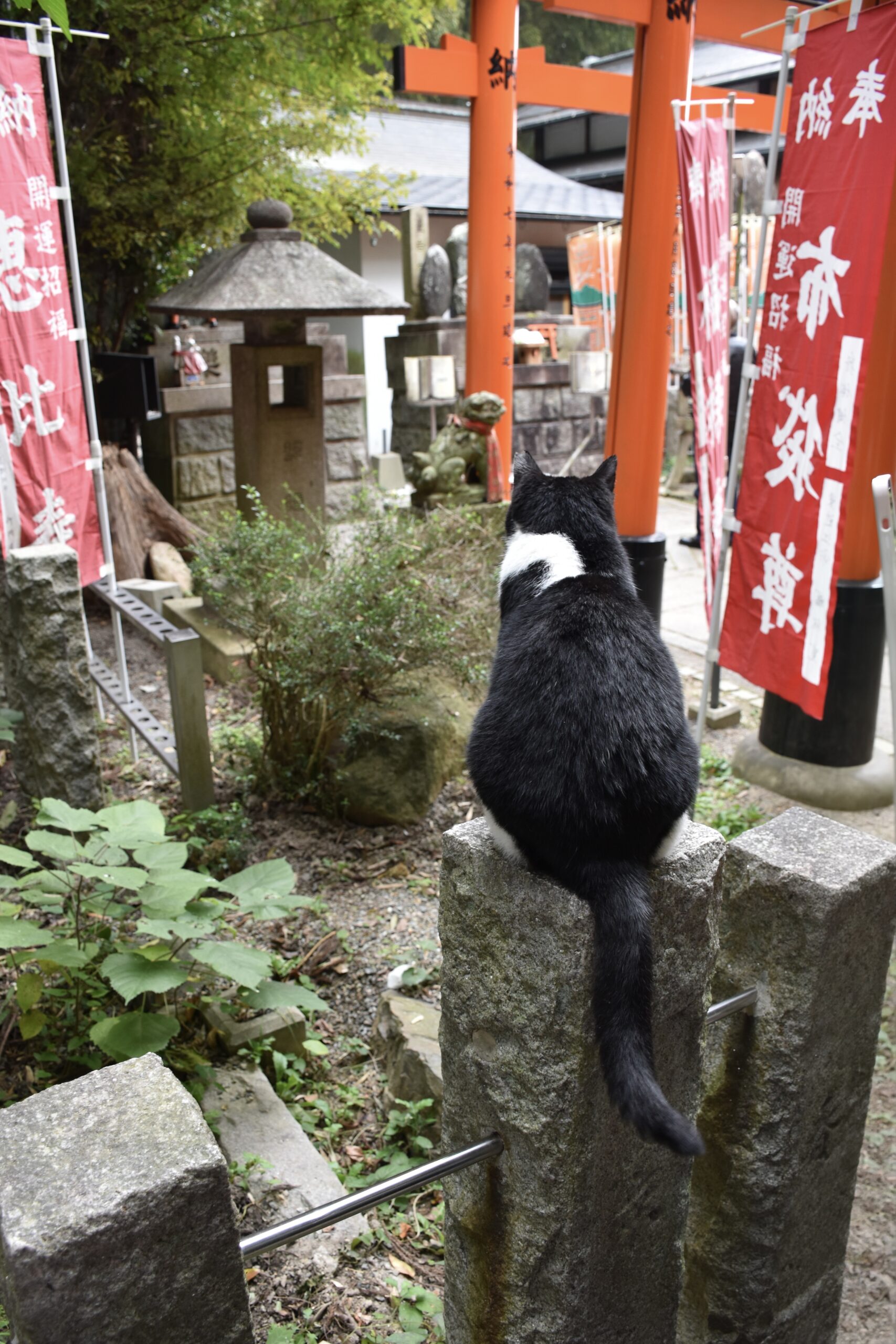
And there was a cat. A black-and-white shrine cat, sitting on a stone post and surveying the proceedings. He looked as though he owned the place.
A sacred offering
Once we were reunited, our group was given a special opportunity to observe a Shinto ritual offering, or kagura. We were seated on the stage, and the rules were explicit: no talking, no eating, no drinking, and absolutely no photographs. There were even stern guards standing in front of the stage (we were seated on the side of the stage), to make sure that last rule was obeyed.
Two women performed the ritual movements, first holding large evergreen branches, which they subsequently put down before picking up golden bells mounted on sticks. Accompanying them were a man playing a flute, a woman playing a koto, and another woman providing percussion and singing. The koto player sang as well.
The music, movement, and ritual objects were presented as an offering to the kami, the Shinto deities. There was something especially interesting about watching a ceremony performed for a spiritual purpose rather than simply as entertainment.
And in the middle . . . Sigh.
You may recall that during our Zen meditation yesterday, three people nearby had begun talking, and I had decided that the true lesson was for me to control my irritation rather than theirs.
Apparently, I had not fully mastered that lesson.
This time, despite the very clear instructions, there was conversation, and someone started to raise a phone to take a photograph. I found myself intervening, quietly but rather emphatically.
Several others noticed the distractions, too. I suspect they were having their own little Zen exercise in patience.
Perhaps I need another session with the monk.
There are no photographs to post of the ceremony, of course. Which is precisely as it should be.
A little left-handed luck.
I also had a small shopping mission: find a maneki-neko (the Japanese beckoning cat) to give my friend Marla. But not just ANY beckoning cat. It had to have its LEFT paw raised, which traditionally invites money and good financial fortune, while the right paw invites general good luck. All throughout the trip so far . . . Righties. As a left-hander, I am quite familiar with discrimination against the minority paw, but this was getting ridiculous. Fortunately, at a shop near the main gate, I found a little cat I really liked, complete with its own clear display box. And then, of the roughly 50 cats on offer, I found about five had their left paws raised. Huzzah! I grabbed one, along with a tiny fox talisman for myself to remember this portion of the trip. By then, I had spent every last yen, right down to the coins. A very successful day. (Now back to the ATM.)
A particularly successful goshuin expedition
By the time we left Fushimi Inari, I had collected several goshuin, including three written directly into my original book: one near the main entrance, one on the way up, and another on the way down.
There were also special paper designs featuring foxes, old photographs of the torii gates, and elaborate cutouts. The shrine staff calligraphied the date on these separately prepared sheets.
I nearly bought one of everything.
The limiting factor was not restraint. It was the supply of yen in my wallet.
There was one problem, though. Some of the special goshuin sheets were too large for my book. I was decidedly unhappy about the prospect of cutting them to fit.
More about that shortly.

Kyoto Station: a change of scenery
We took the train back to Kyoto, where the rest of the group was heading to a sushi-making class followed by a sushi lunch. Given my fish allergy, I decided that discretion was the better part of valor and went off to explore Kyoto Station instead.
And Kyoto Station is worth exploring.
Its enormous steel-and-glass interior is a fascinating piece of modern architecture, with escalators rising through multiple levels and a vast open space beneath the roof. I took four long escalators upward, pausing to photograph the structure as I climbed.


At the top, I discovered exactly what I was looking for: a colorful KYOTO sign, with Kyoto Tower rising in the background.
Unfortunately, several groups had also discovered it, and were attempting the familiar tourist maneuver of leaning backward as far as possible to squeeze both the sign and tower into a selfie.
I found an efficient solution. I offered to take their pictures.
Snap, snap, snap. Five or ten photographs for each group, and they were delighted.
More importantly, they moved.
After a few groups (including Japanese ones, where I kept having to smilingly mime to remove their face masks), I finally had the scene to myself and took the photograph I wanted.

Downstairs, there was a very lively craft beer gathering in progress. Booths from different breweries, people standing around with glasses of beer, and the sort of Saturday afternoon bustle that had replaced the shrine crowds with an altogether different sort of congregation.

For lunch, I chose the path of least resistance: Starbucks. A chicken wrap, a large iced decaf latte, and a New York cheesecake. Perfectly serviceable, particularly after the morning’s climbing and crowds.
But the ordering screen offered some intriguing alternatives.
Potato Soupuccino, anyone? Or perhaps a Joyful Medley Strawberry Creamy Tea Latte?


When my cheesecake arrived, someone had written “Good choice!” on the box.
Well, yes. I thought so, too.
The great suitcase redistribution
Bernard, Lynn, and I returned to the hotel together. Bernard needed to shed a jacket, Lynn had laundry to do, and I had a complicated luggage operation awaiting me.
Tomorrow we’re heading toward Hiroshima, and my large Delsey suitcase is going ahead without me.
That meant sorting out exactly what I would need for the next four days, including the flight home, and transferring those clothes and essentials into my smaller hard-sided Samsonite carry-on. Everything else—extra clothes, purchases, gifts, and assorted travel debris—went into the Delsey.
I even packed my black puffer tote inside it. Between the suitcase, the Samsonite, and the puffer bag, I was carrying rather more than I wanted to manage on a train.
There is going to be a serious reassessment of my luggage and clothing arrangements before my solo winter trip to Japan. But that is a project for another day.
And while sorting through everything, I made a most satisfying discovery.
Remember the beautiful marquetry goshuincho that Utako-san more or less insisted I buy in Hakone? Well, it turns out to be just slightly larger than the book I’ve been using.
Which means those oversized Fushimi Inari goshuin fit. Without cutting them.
Thank you, goshuin gods, for favoring me! 🙂
My original goshuincho now has exactly one blank page left. It has traveled from shrine to temple, acquiring beautiful calligraphy and stamps along the way, and has become a rather wonderful record of this trip.
The special paper goshuin from Fushimi Inari will go into the new marquetry book. I am not about to attack that lovely calligraphy with scissors.
I may bring both books to tonight’s final OAT talk or farewell dinner to show the others what I’ve been collecting. I suspect many of them have absolutely no idea what I’ve been doing every time I disappear into a long line at a temple or shrine.
We’re about to gather for our final OAT talk, followed by a farewell dinner. Four members of our group are leaving rather than continuing to Hiroshima, so tonight will mark a change in our traveling company.
Tomorrow, Hiroshima.
And after that, the optional tour I’ve looked forward to the most. Miyajima, with its famous torii gate standing in the water at high tide. I wonder how many goshuin I will encounter there. If there’s just one, it might make the perfect final entry in my original book.
If there are several, the new marquetry book is ready.
I never get a percentage from any links I include – but! – if you are curious about Overseas Adventure Travel and want $100 off, call them at 1-800-955-1925 and request their amazing catalog, tell them you were referred by Sandy Shepard, customer number 3087257, and get $100 off your first trip! The catalog is what all good dreams are made of!