
November 12th – Nara
Our destination today was Nara, about an hour and a half by bus from Kyoto. Nara was Japan’s first permanent capital, established in 710, and is home to some of the country’s most important Buddhist monuments. But before we got anywhere near the Buddha, we encountered the other great attraction of Nara: the deer.
They are EVERYWHERE.
Not just wandering around the park, either. They stroll along sidewalks, stand in front of shops, mingle with tourists, and occasionally require intervention from the local authorities to keep them out of traffic.
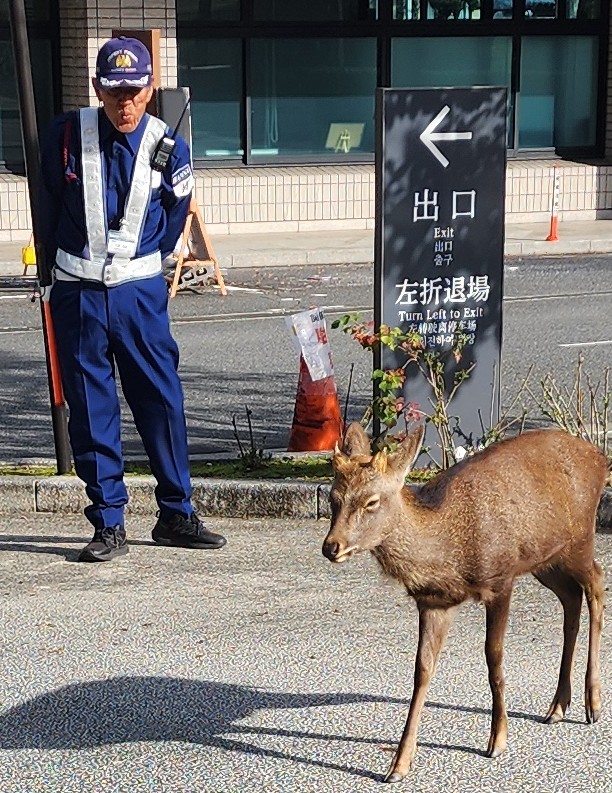
The deer have been considered sacred for centuries, traditionally associated with the Shinto deity Takemikazuchi, who, according to legend, arrived in Nara riding a white deer. They are now protected as natural monuments.
They are also extremely accustomed to humans.
We saw mothers nursing their young, deer investigating people’s pockets, and groups gathering around anyone who appeared even remotely likely to possess food.


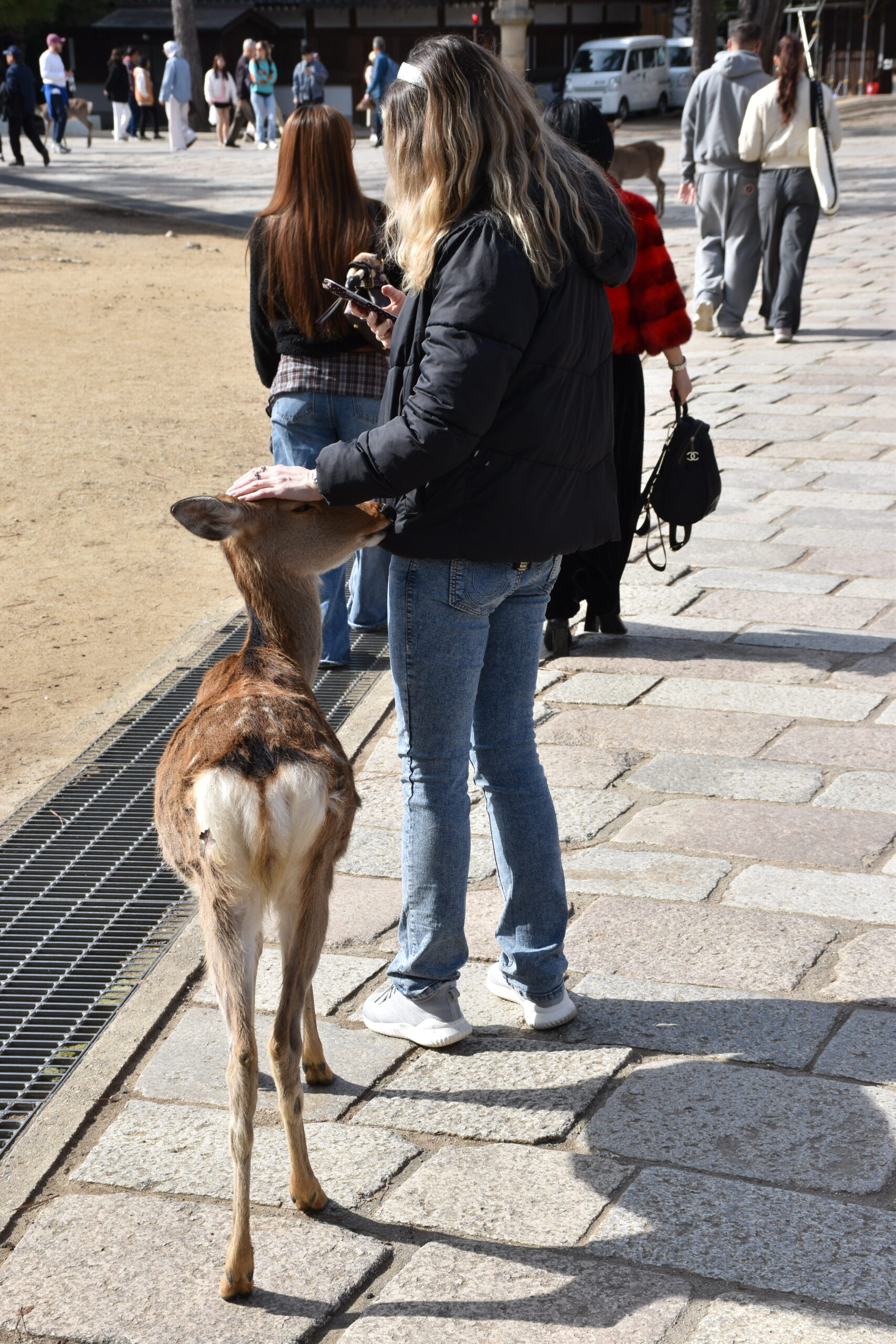
One deer simply came up to a young woman and walked along with her while she rested her hand on its forehead. Rather like a particularly accommodating Great Dane.
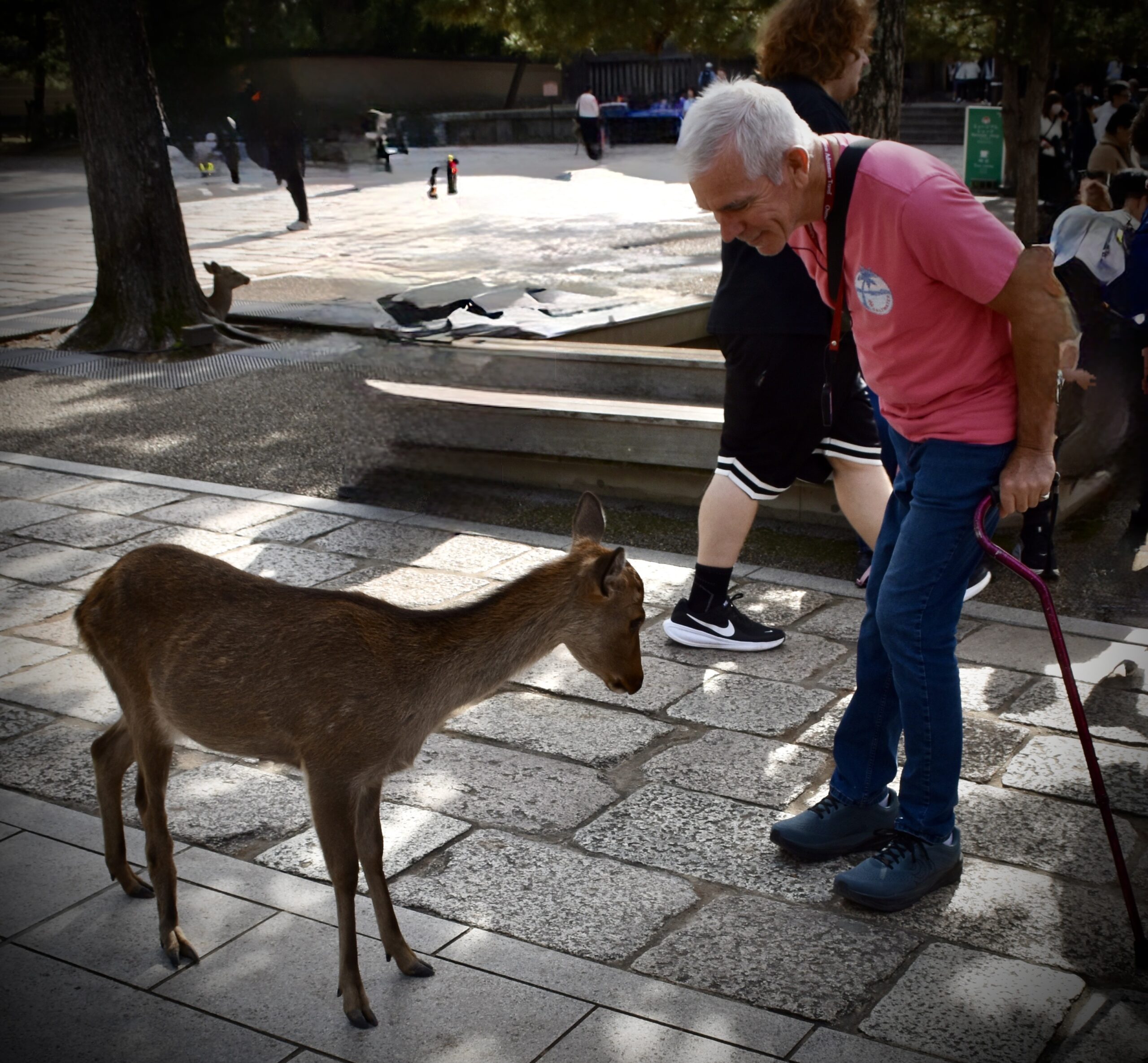
But the most entertaining thing about the Nara deer is that they BOW.
Yes, really.
Bow toward one, and quite often it will lower its head in return. This is a learned behavior, encouraged by generations of tourists offering special deer crackers as rewards. It may not be an expression of profound spiritual understanding, but it certainly looks like good manners.
Bernard decided to test the theory.
We then approached Tōdai-ji, one of Nara’s great Buddhist temples and the home of the enormous Great Buddha.
Before reaching the main hall, however, we passed through the Nandaimon, or Great South Gate.

The gate dates from the early thirteenth century, replacing an earlier structure destroyed by a storm. Its enormous wooden columns rise into an intricate system of beams and brackets that support the massive roof. The entire gate stands more than 25 meters high.

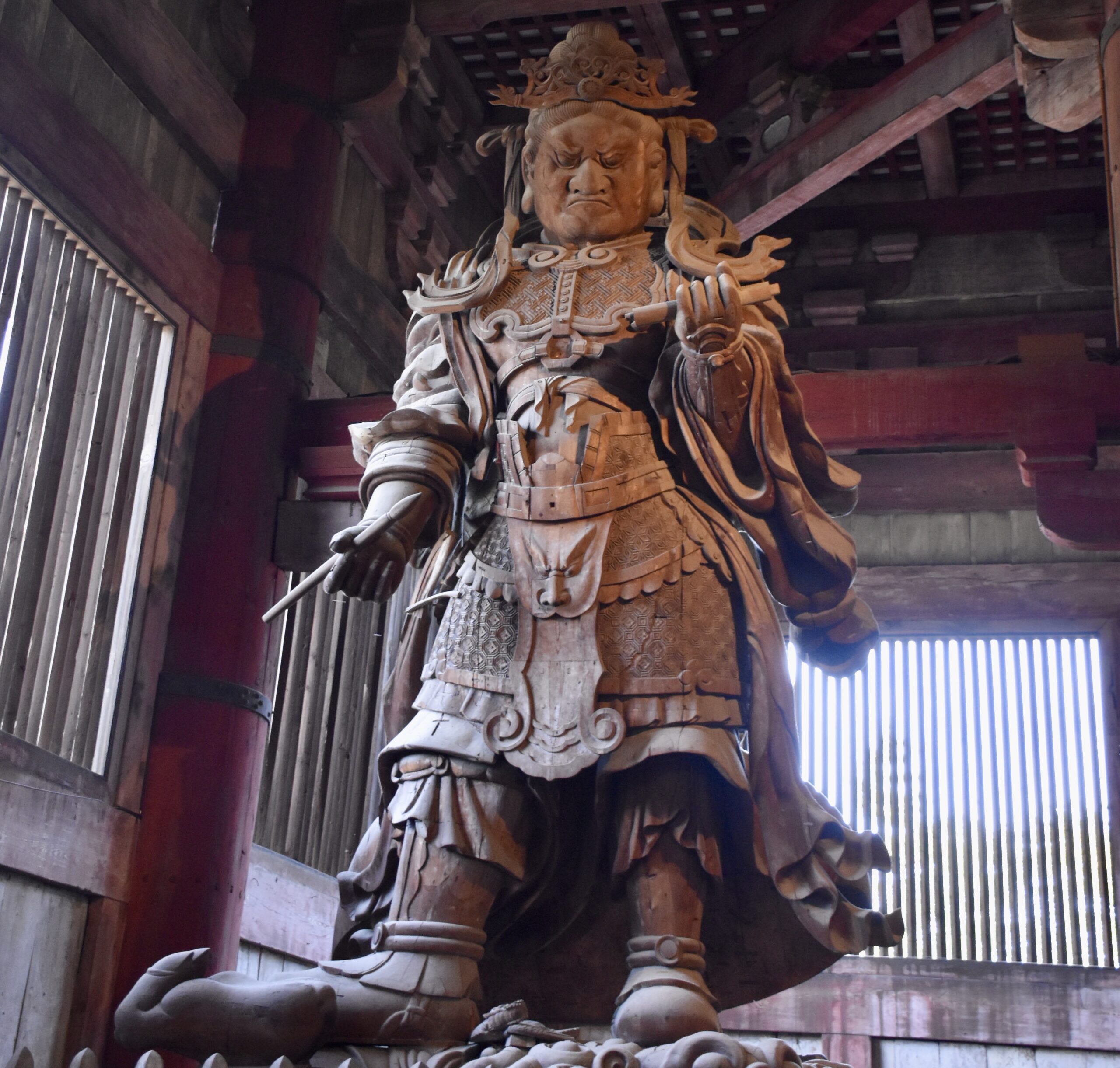
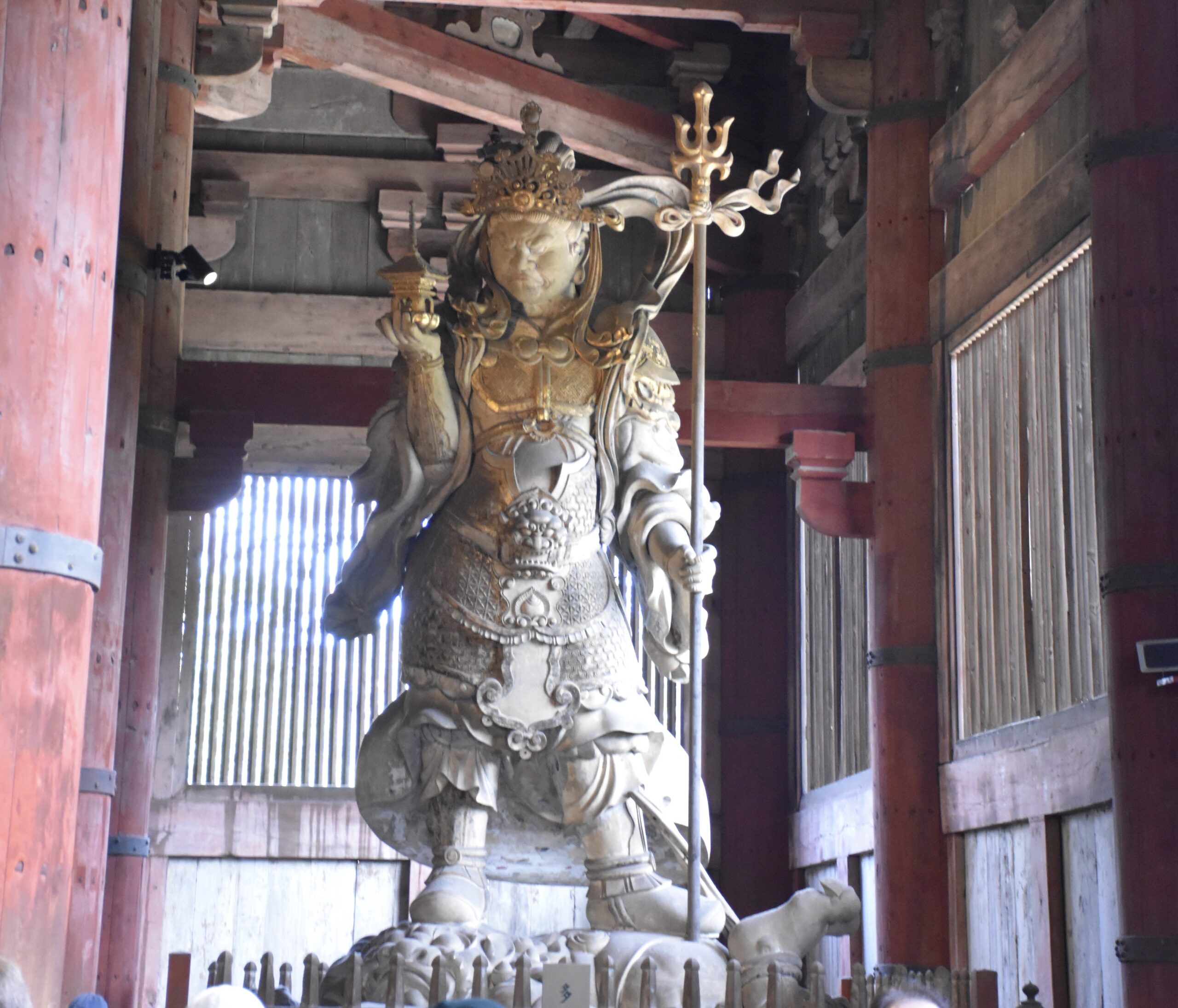
And on either side stand two extraordinary wooden guardians, the Kongō Rikishi, or Niō.
Each is approximately 8.4 meters tall, carved with bulging muscles, swirling garments, and expressions calculated to discourage anyone with questionable intentions from entering.


They were created in 1203 under the direction of the famous sculptors Unkei and Kaikei, reportedly in just 69 days. Considering their size and complexity, that seems almost impossible. The statues have survived more than eight centuries, although they have required conservation, and the protective wire screens make photography a challenge.
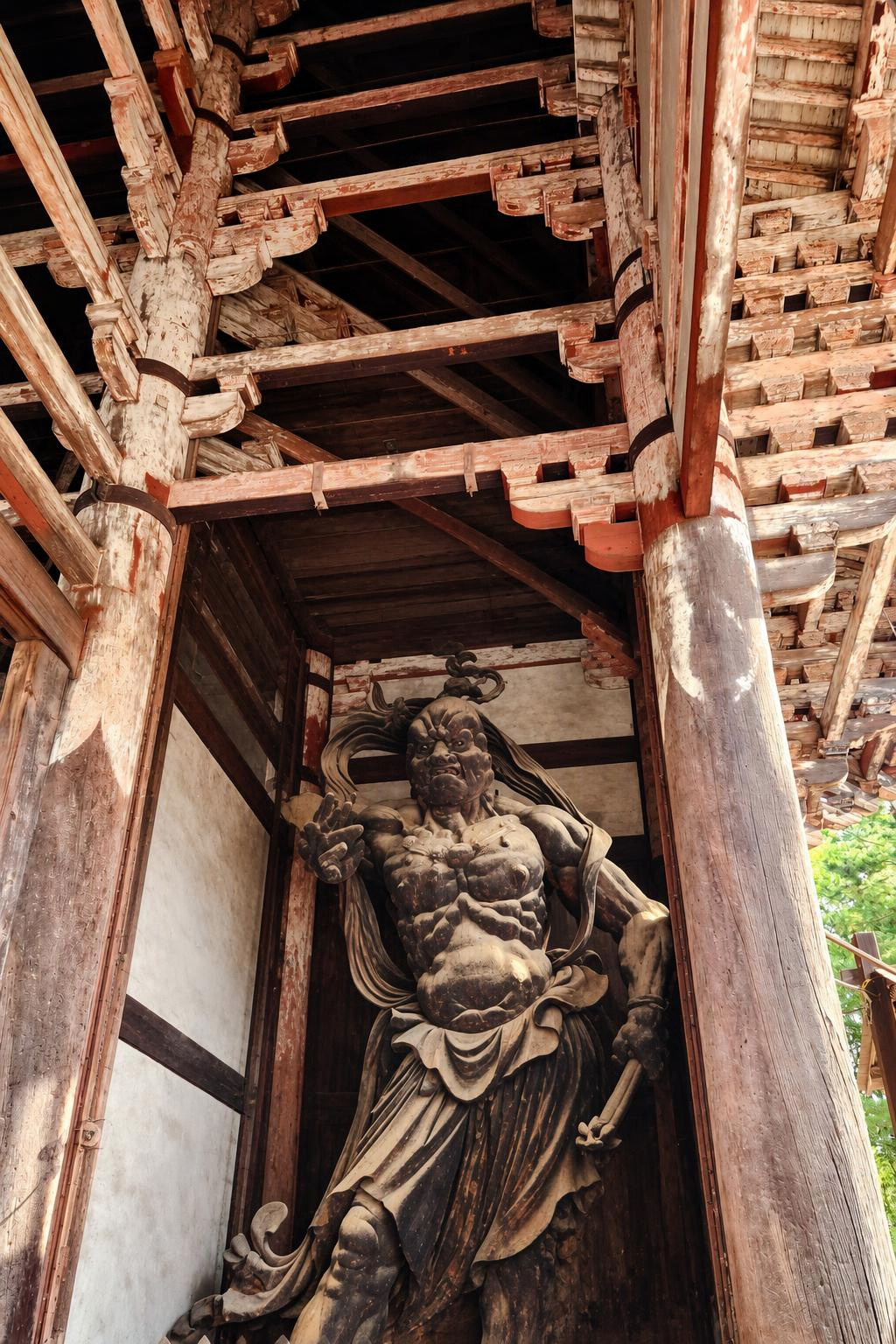
One guardian has his mouth open, representing the sound a (the first syllable in the Japanese syllabic alphabet); the other has his mouth closed, representing un (the last one). Together they symbolize the beginning and end of all things.
I managed to get AI to remove the protective wire from one photograph. For reasons known only to AI, it declined to do the same with the other, claiming something about not being permitted to alter a photograph involving children.
There were no children in the photograph.
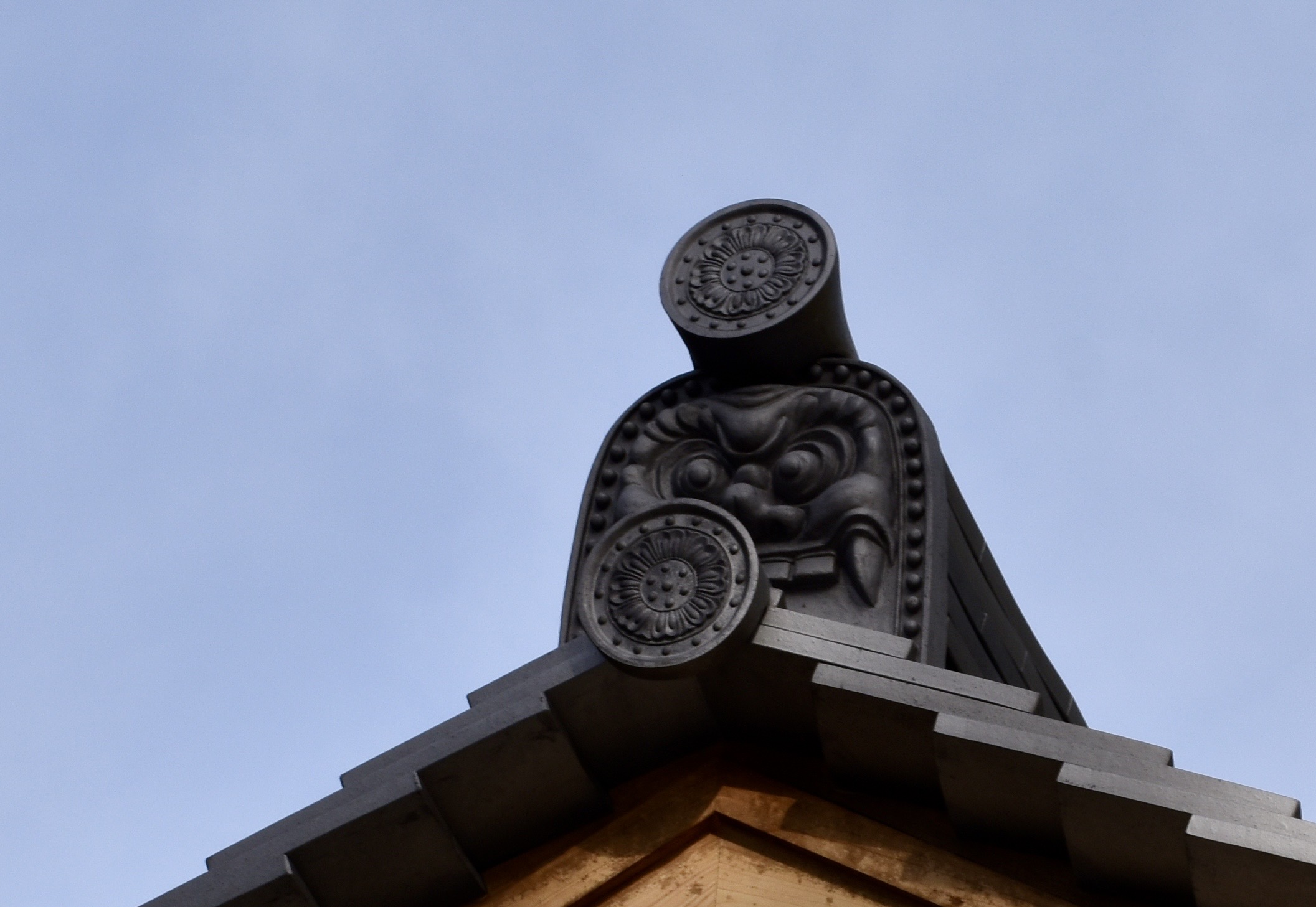
I also became interested in the architectural details, including a rather fierce-looking decorative roof tile called an onigawara, traditionally intended to ward off evil.
From there, after washing our hands (left, right, left/mouth, right, down the handle) we continued to the Daibutsuden, or Great Buddha Hall.
It is difficult to appreciate the scale of this building until you begin approaching it. The present hall dates from the early eighteenth century, following two earlier destructions by fire. And although the rebuilt structure is actually narrower than the original, it is still approximately 57 meters wide and nearly 49 meters high.
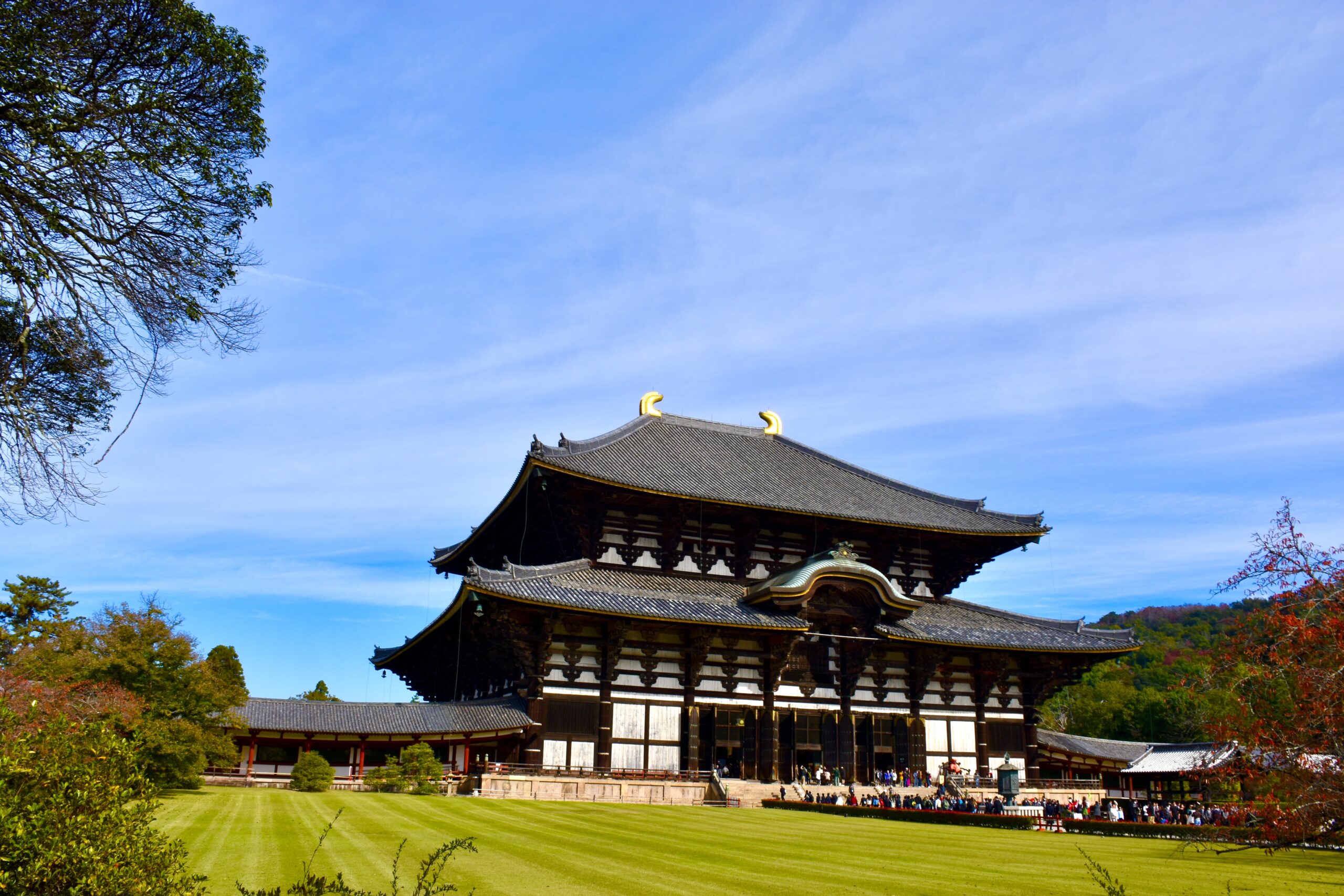
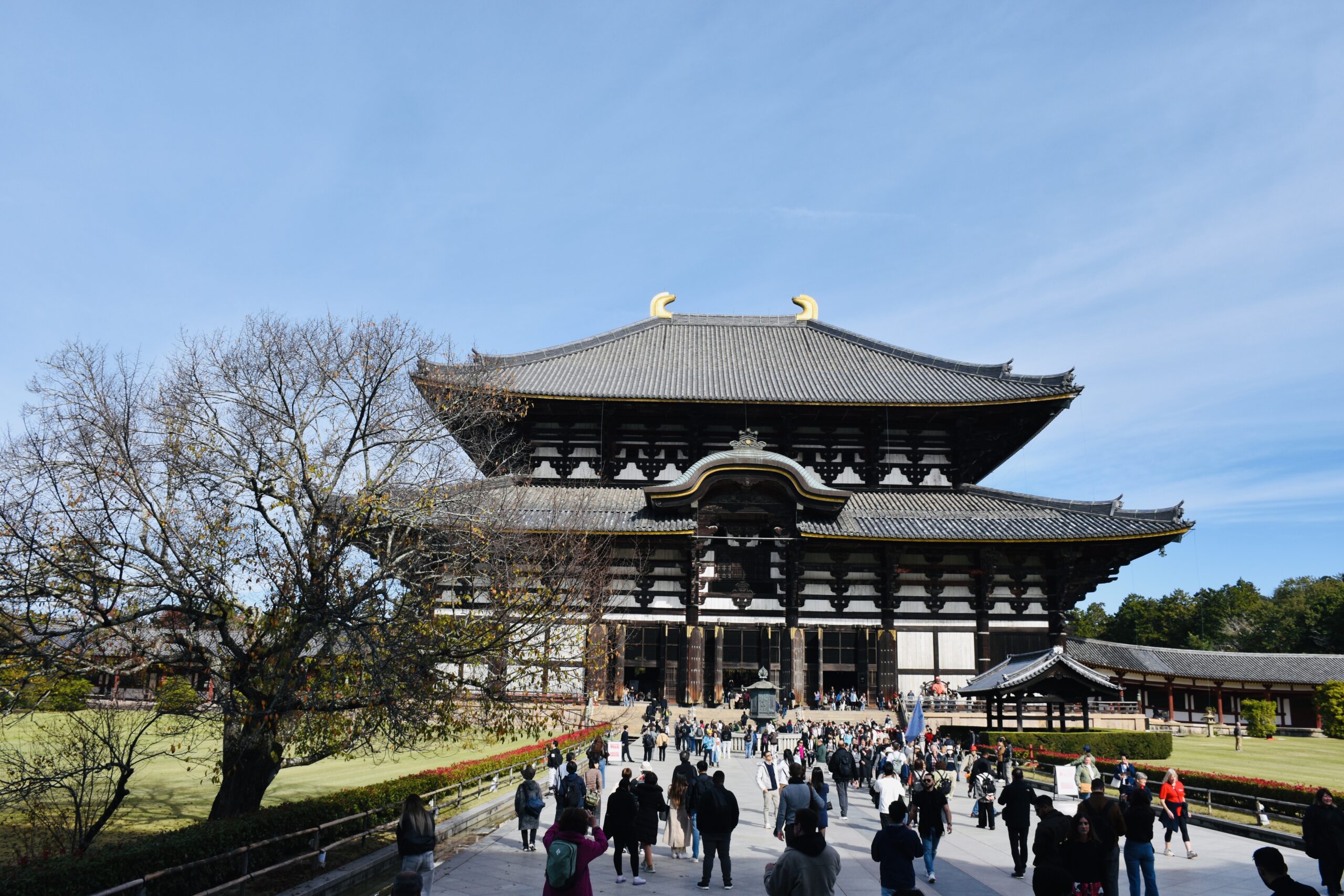
All that, to house one Buddha.
Inside sits the Daibutsu, a colossal bronze image of Vairocana Buddha. The original was dedicated in 752 under Emperor Shōmu, who hoped Buddhism would help protect and unify Japan. The statue has undergone substantial reconstruction over the centuries, but its presence is no less imposing.
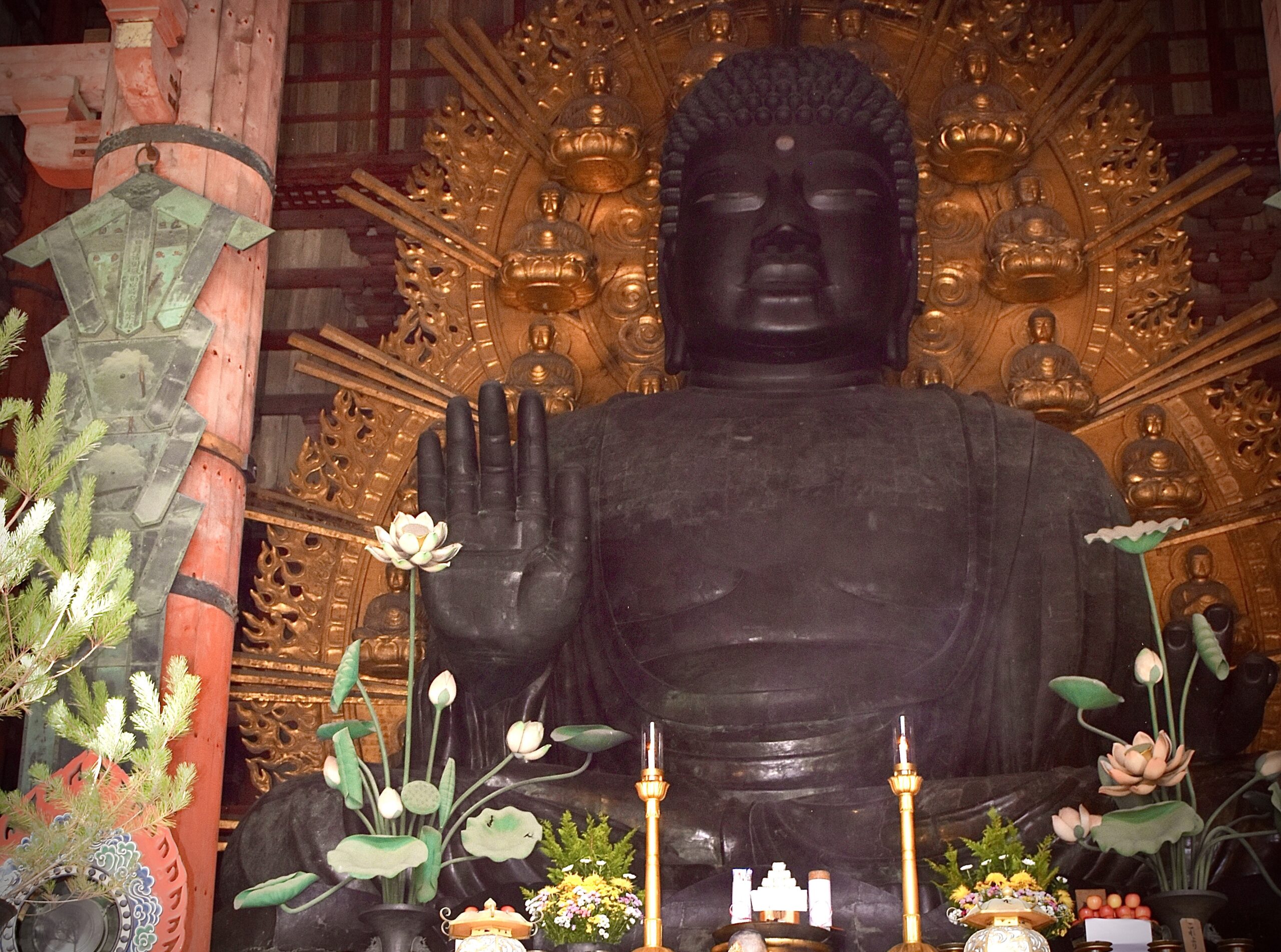
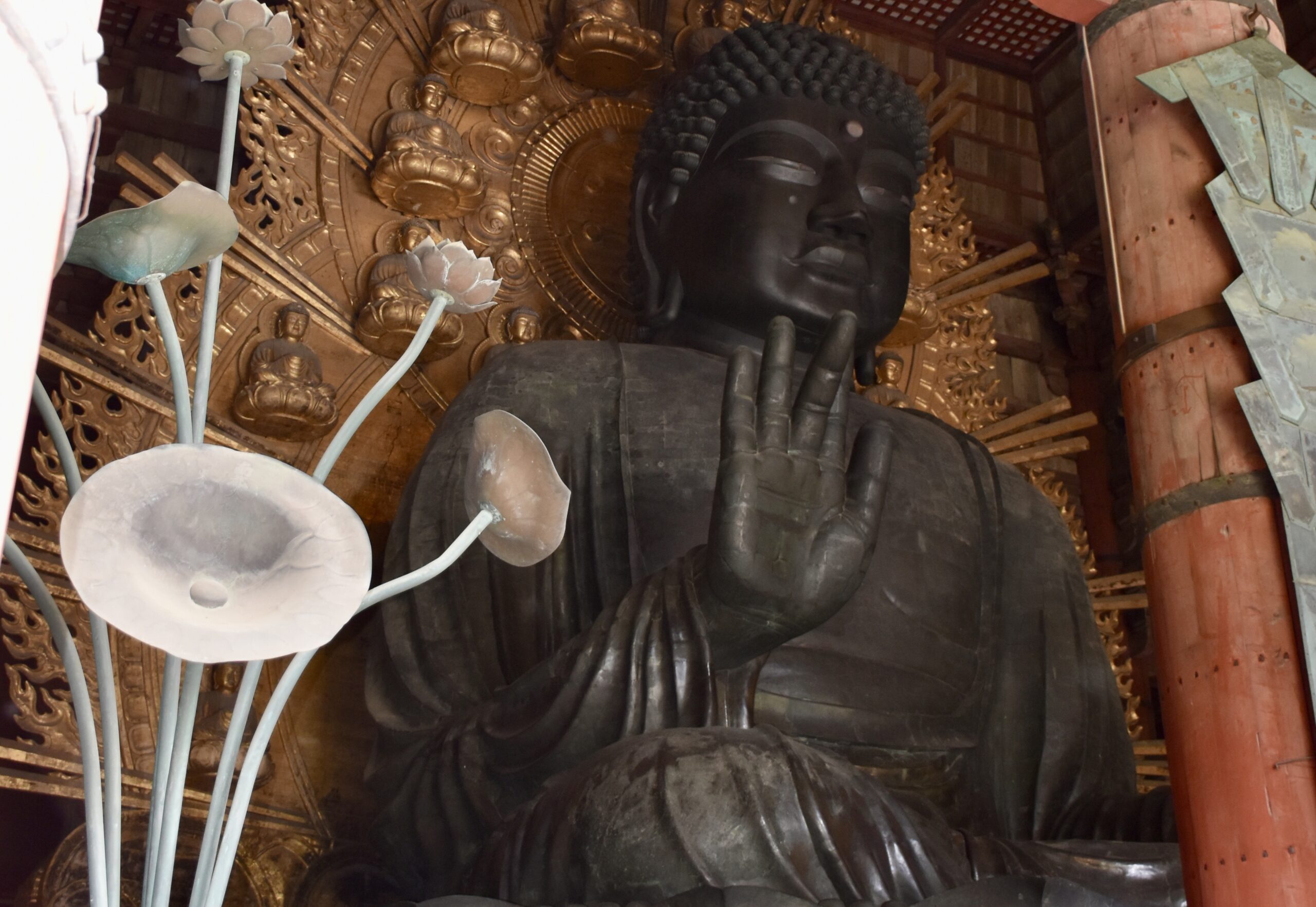
The Buddha sits with one hand raised, palm outward, in a gesture of reassurance and protection. The other rests open on his lap, expressing generosity and the granting of wishes or blessings.
His eyes are half closed. Utako-san explained this in a way I particularly liked: the Buddha is meditating, but he is also keeping an eye on us.
The tight little curls covering his head are called rahotsu, or snail-shell curls, a conventional feature of images depicting a fully enlightened Buddha.
Behind him is an elaborate golden halo filled with smaller seated Buddhas, while the enormous lotus pedestal and attendant figures add still more detail to the composition.
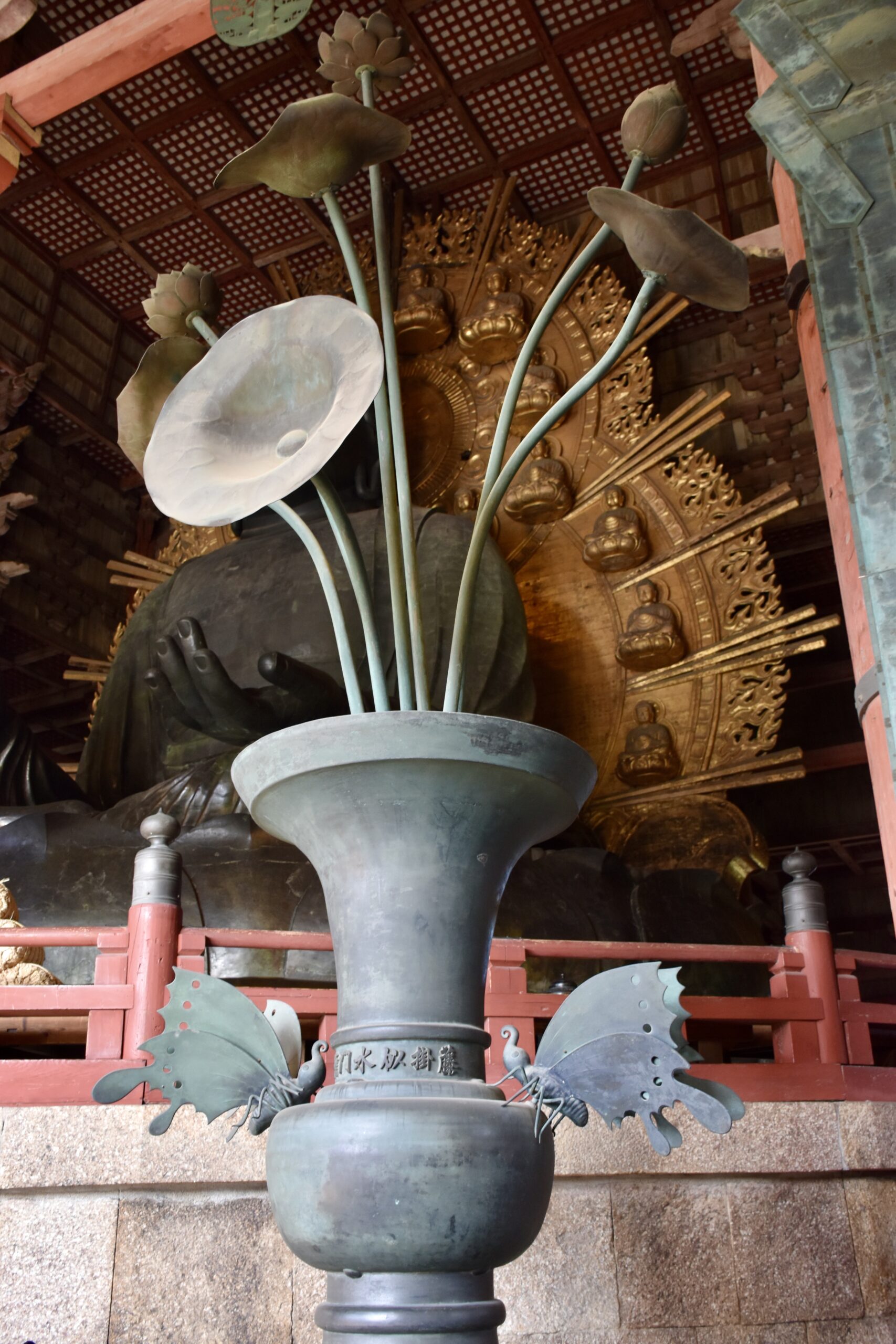
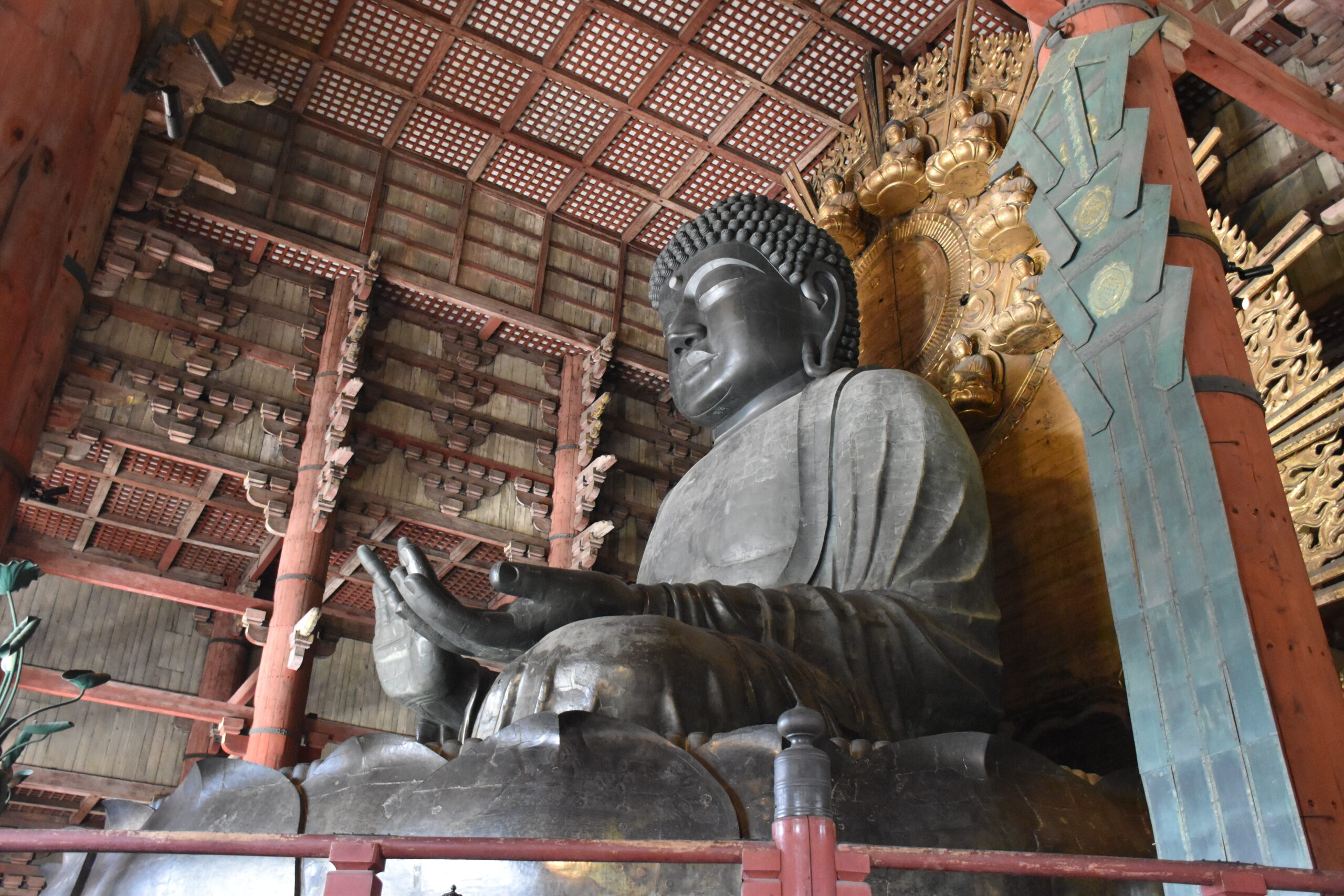
Seated beside the Great Buddha is an enormous gilded figure of Kokūzō Bosatsu, the Bodhisattva of Wisdom and Memory. A bodhisattva is an enlightened being who works toward helping others attain enlightenment, rather than simply entering nirvana alone. Kokūzō’s name means “Treasury of Boundless Space,” referring to wisdom and knowledge as limitless as the universe. The statue is about 23 feet tall, carved from wood and covered in gold, and dates from the eighteenth century. What struck me was the contrast: the Great Buddha, dark bronze and relatively unadorned, beside this elaborately crowned, golden figure with its radiating halo. And given my ongoing efforts (struggles) to remember Japanese terminology and sequences of movements, perhaps I should have spent a little more time paying my respects to the patron of memory!


We walked around the hall, where additional monumental Buddhist figures stand among the massive red columns and intricately joined timbers. The scale of everything makes you feel rather small.
And then we encountered something decidedly less solemn.
One of the great wooden pillars has a hole cut through its base. According to tradition, it is the same size as one of the Great Buddha’s nostrils.
If you can crawl through the hole, you are said to gain wisdom or enlightenment.
Naturally, there was a line.
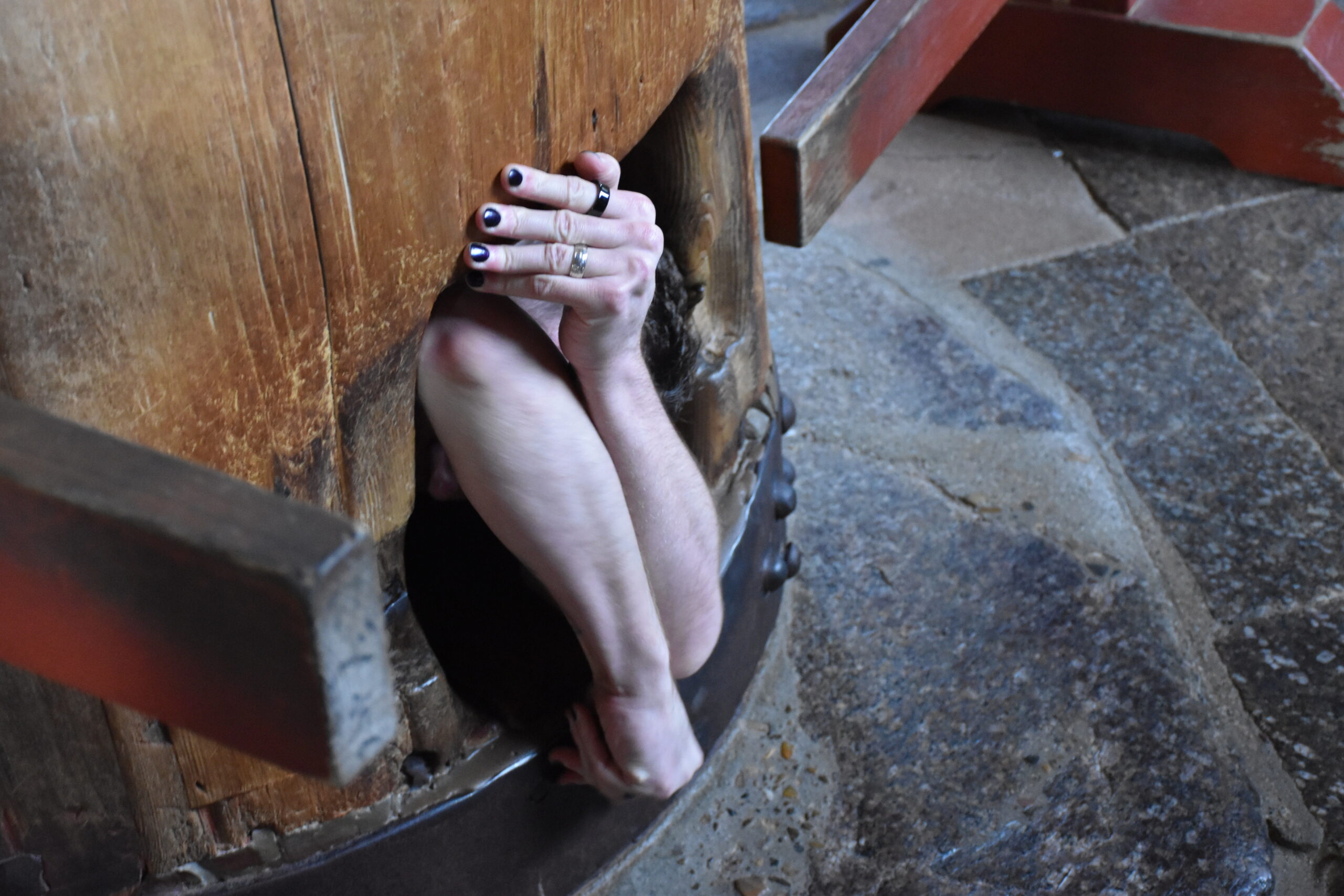
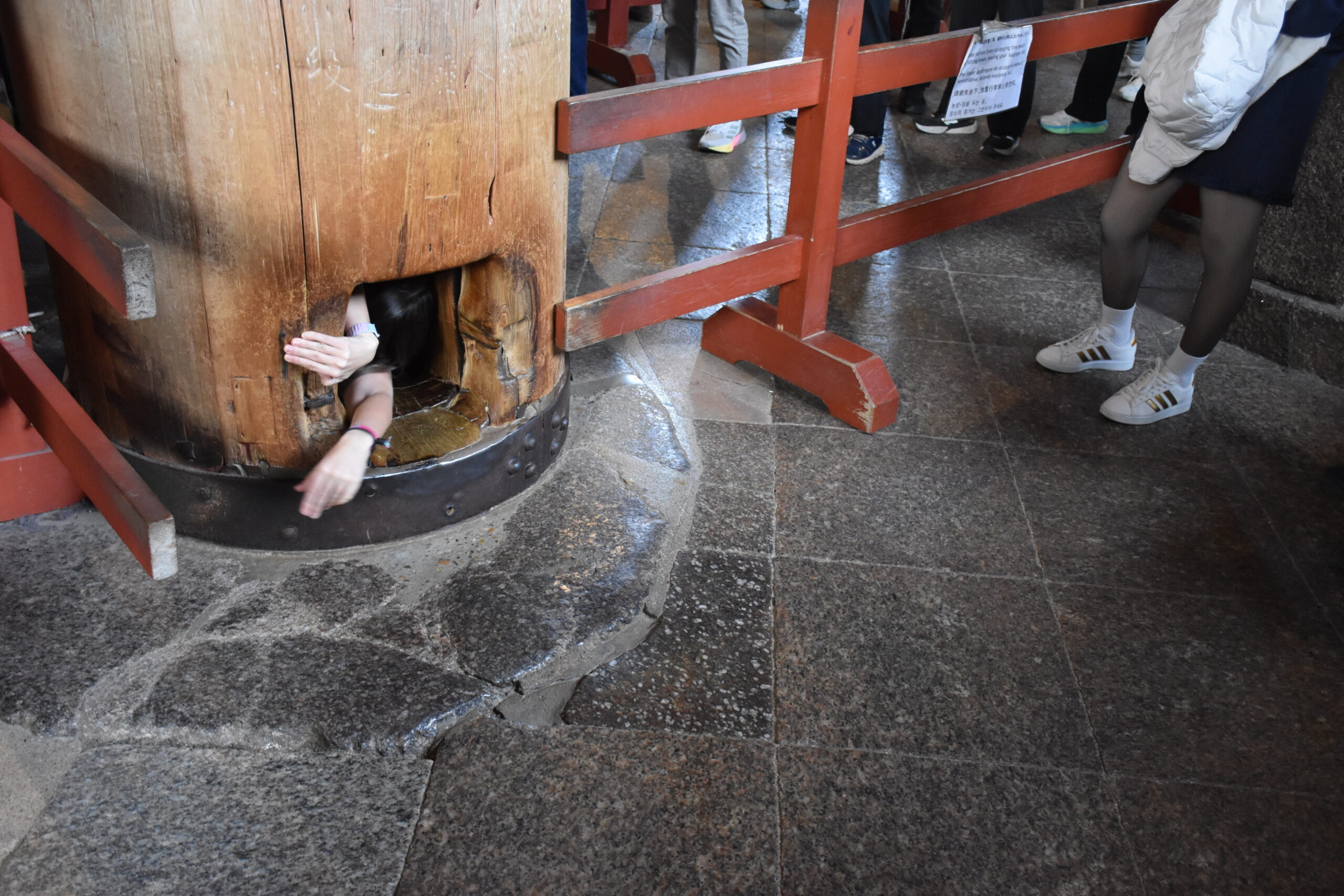
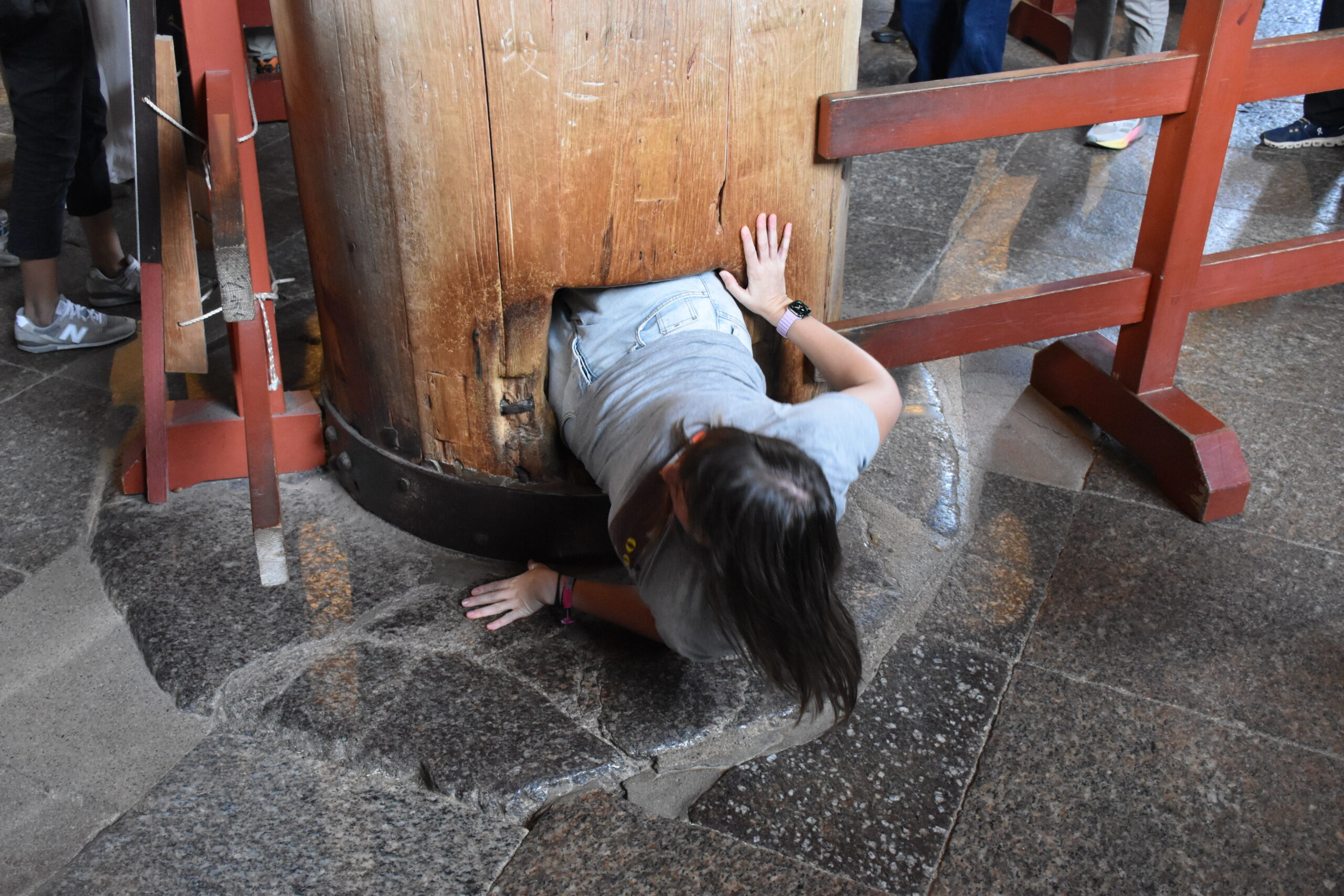
I watched one determined young woman maneuver herself through, eventually emerging after considerable rearrangement of limbs. Apparently one must be quite flexible to reach enlightenment.
Fortunately, nobody suggested I attempt it.
Elsewhere in the hall, I spotted two old roof tiles on display, both bearing names scratched into their surfaces. One was signed by someone from Oakland, California!
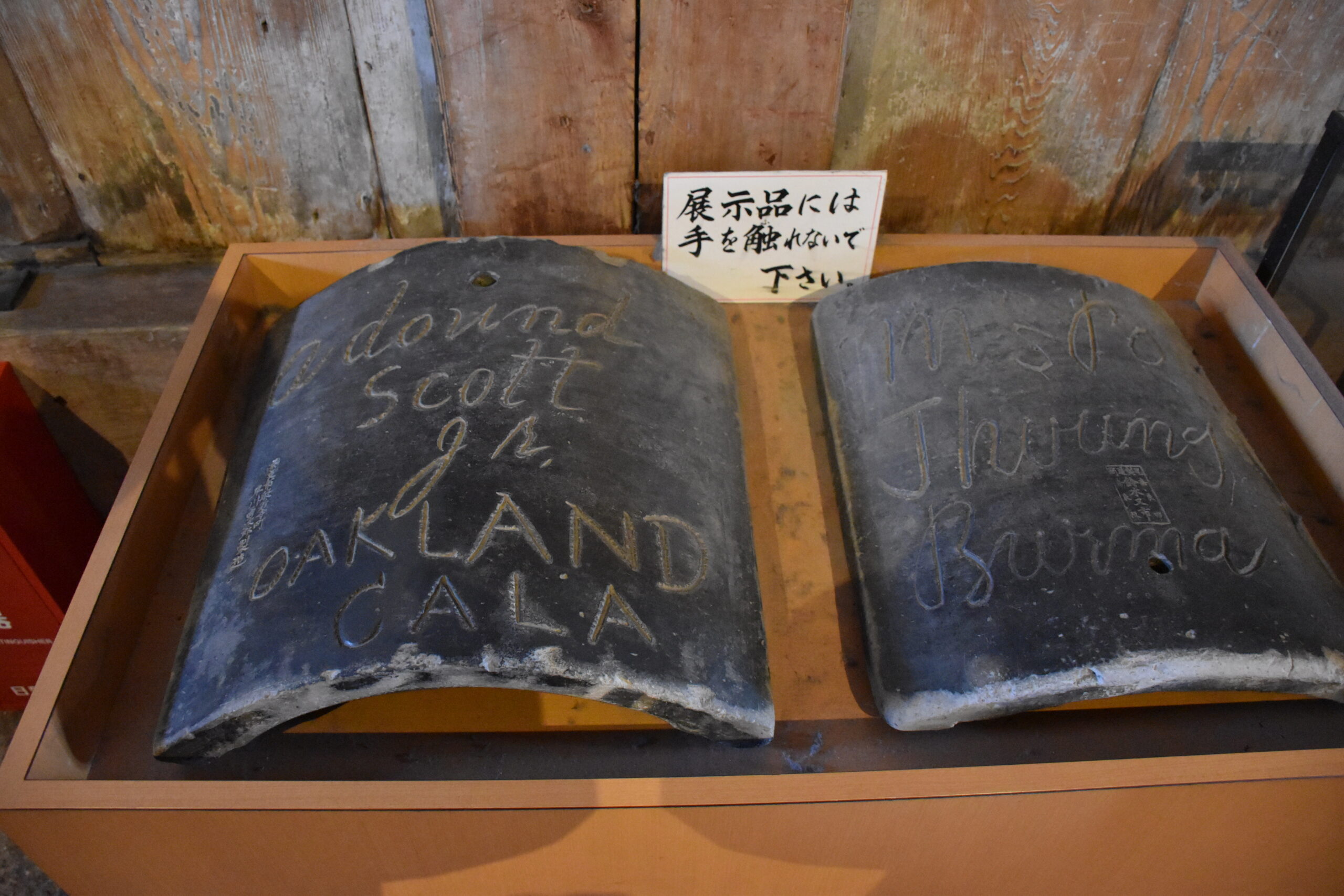
I still haven’t worked out their story. Were they connected to a restoration project? Donations? Some sort of international commemoration? The nearby Japanese sign merely warned visitors not to touch the exhibits.
So, a small mystery to take home.
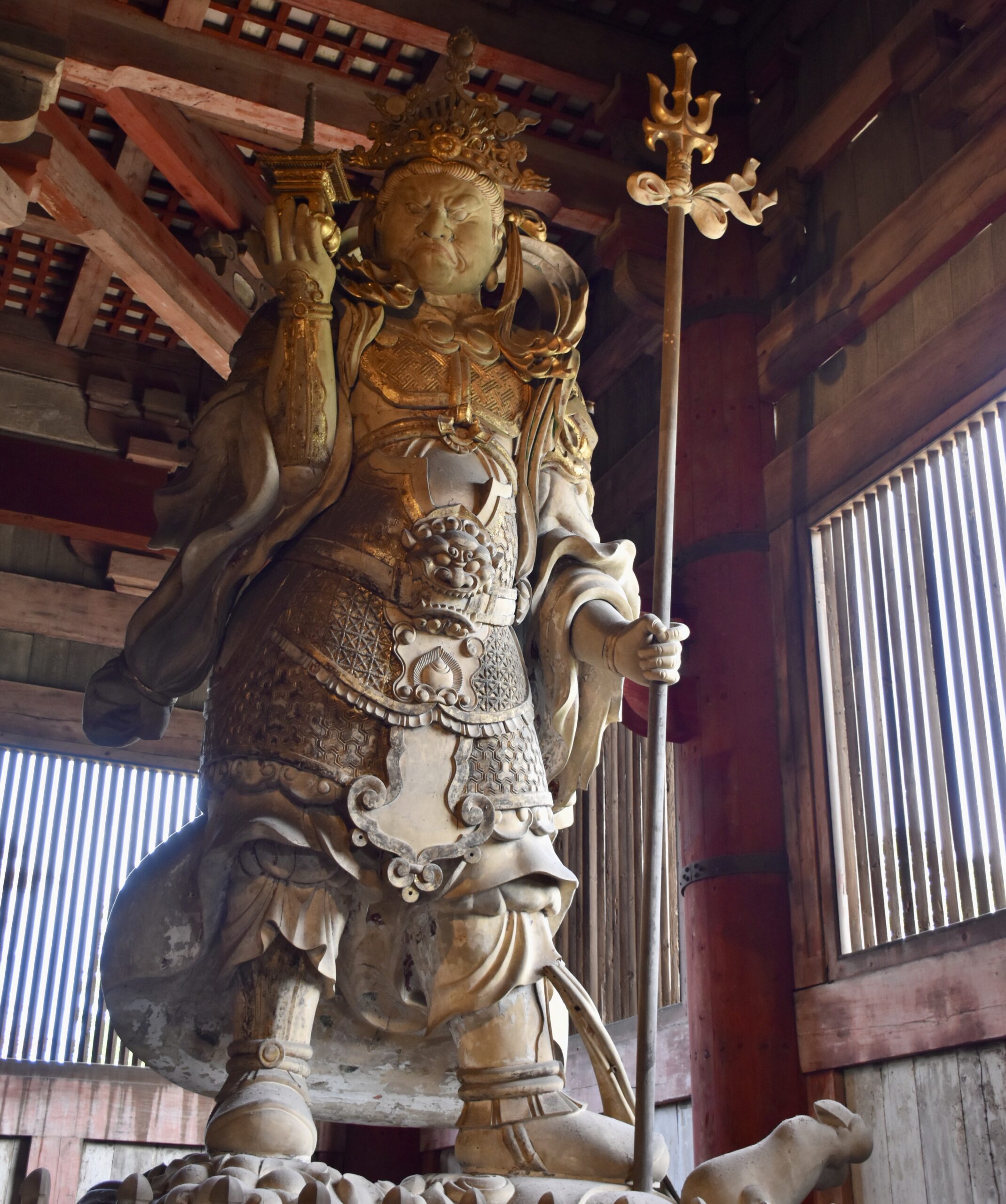
And – more fearsome guardians.
Another interesting figure sat outside the hall, wearing a bright red hood and cape. We promptly christened him Little Red Riding Hood Buddha.
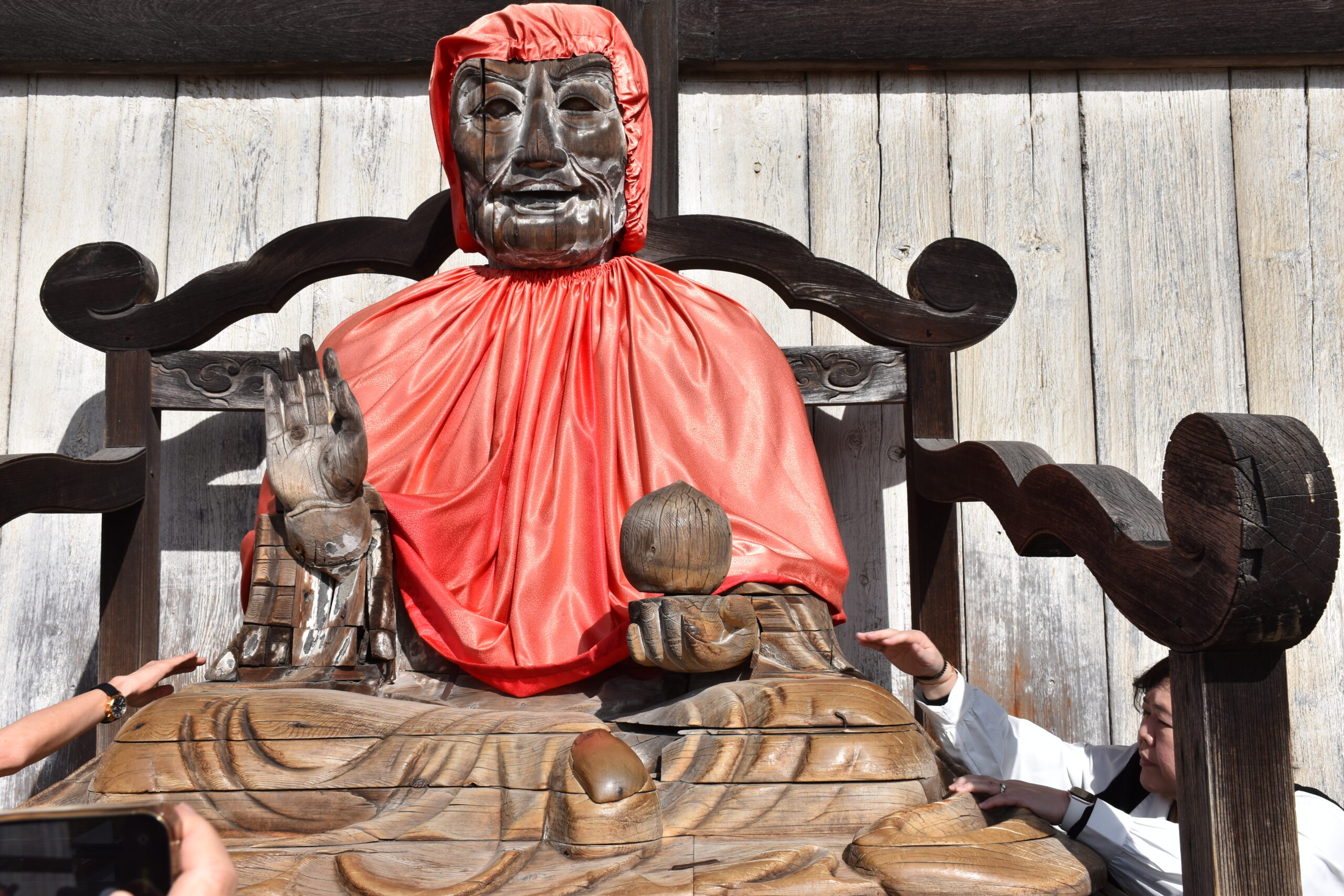
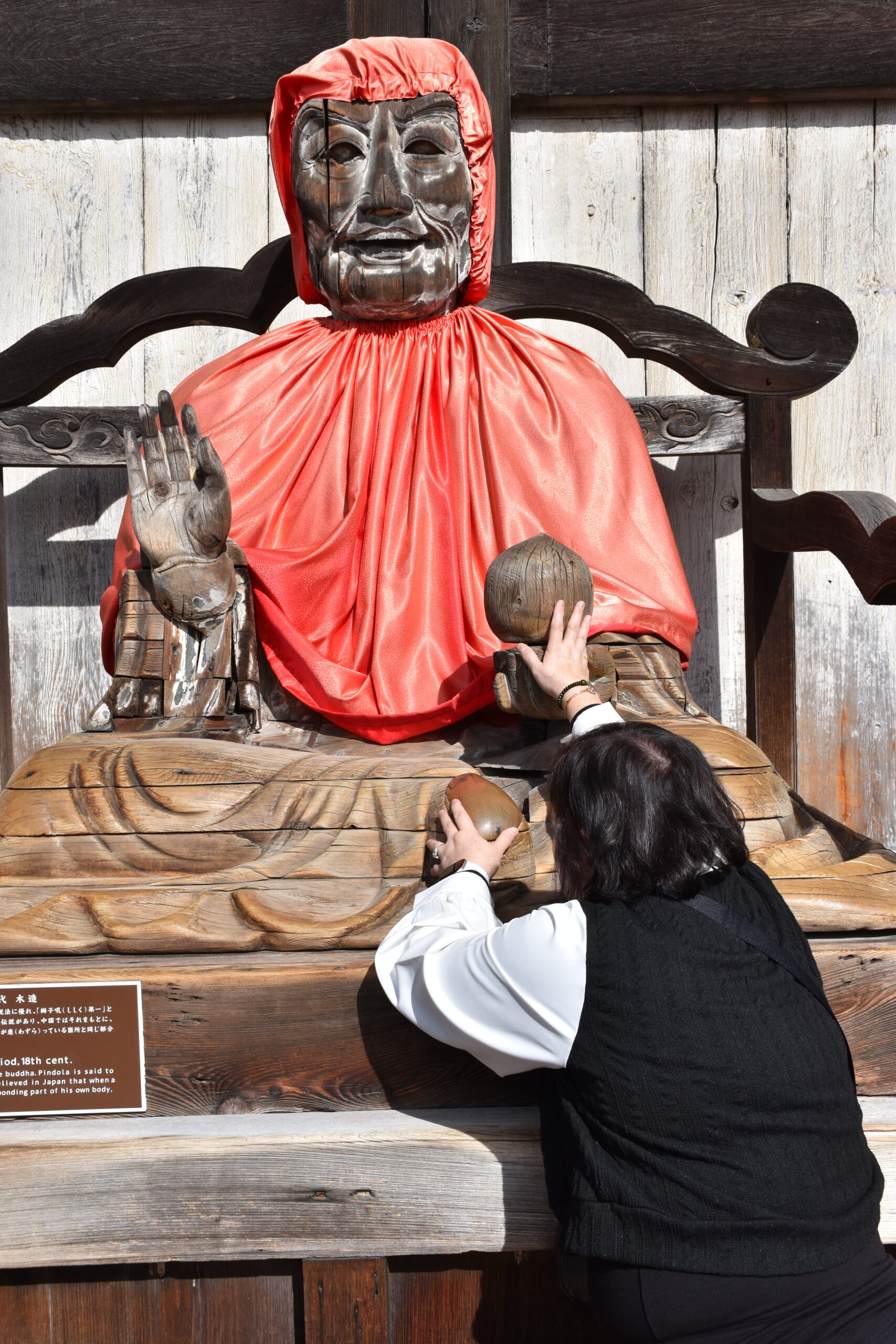
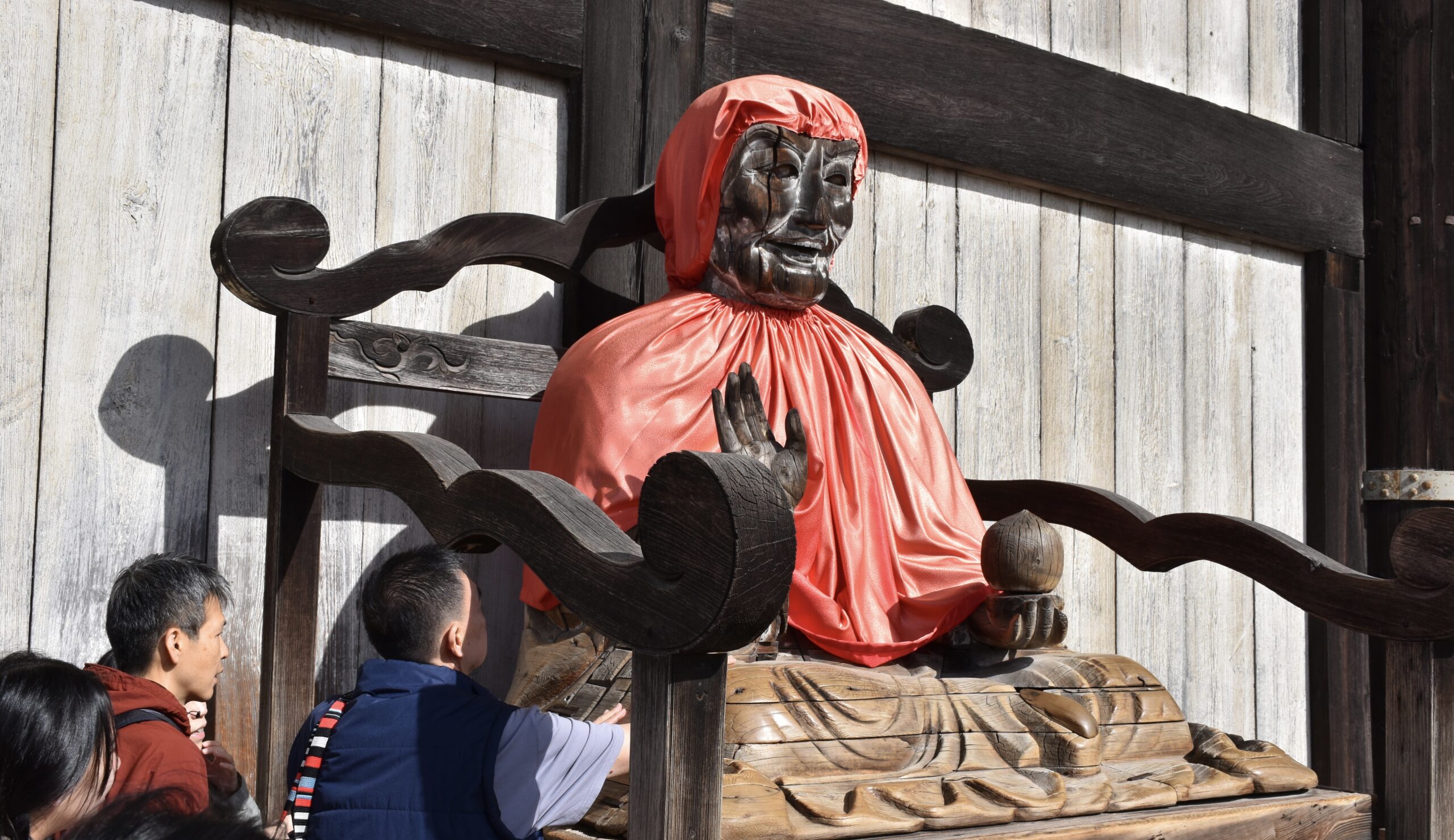
He is actually Binzuru, a disciple of the Buddha, traditionally associated with healing. Legend has it that he was excluded from the Buddha’s inner circle because of misconduct; to get back into the temple, he’d have to do good works. So, he helps people.
The custom is to rub the part of Binzuru’s body corresponding to your own ailment, then touch the same part of yourself, to have him help you with a cure.
Over centuries, the poor fellow has been rubbed quite extensively. His face and exposed wooden hands have a polished appearance from all that attention.
Before leaving, I added another goshuin to my growing collection. This one was only ¥300, rather than the ¥500 or more I had paid at several earlier temples. There were six calligraphers working at separate windows. Clearly Tōdai-ji knows how to manage a substantial volume of temple visitors.
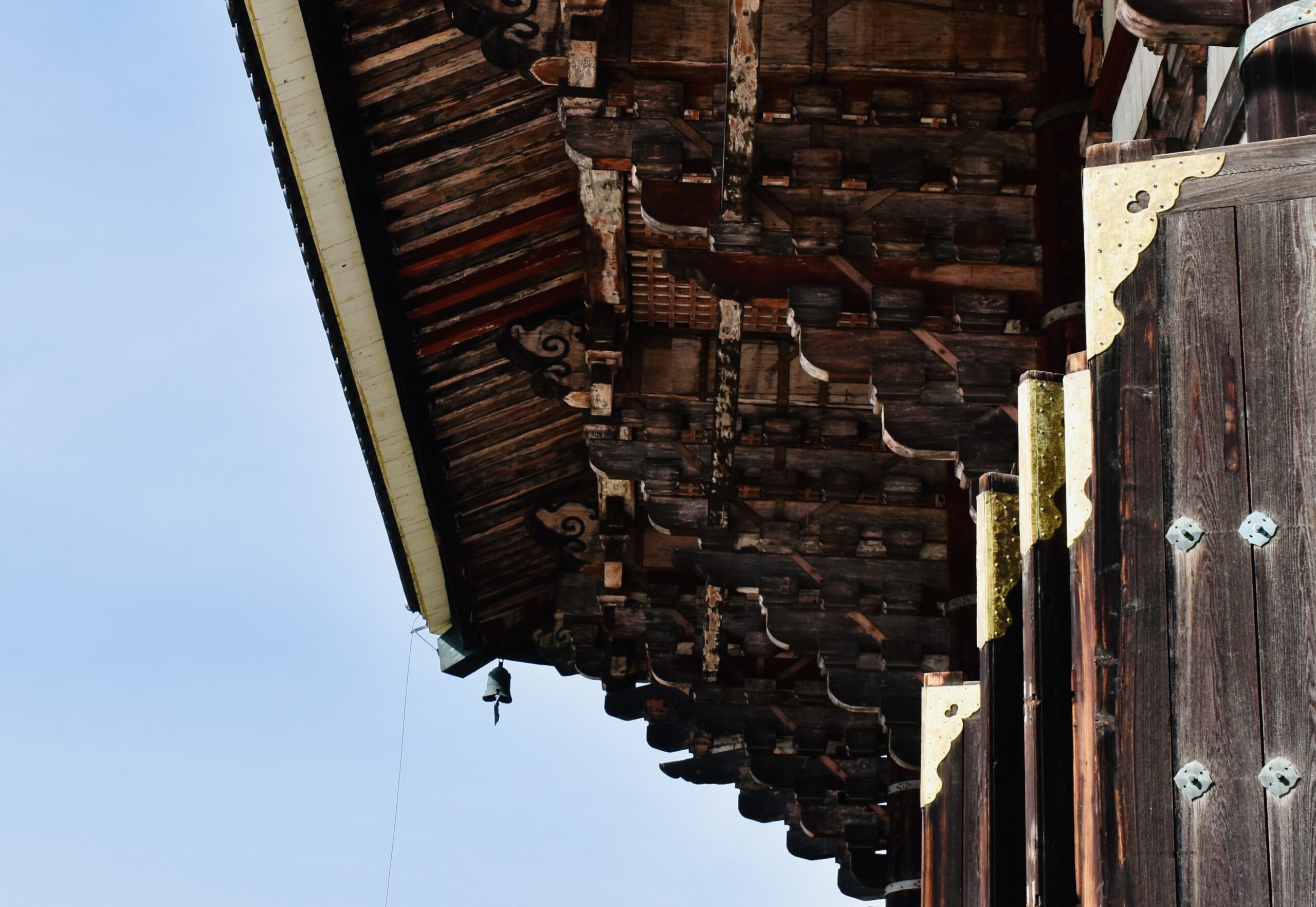
Goshuin safely collected, I stepped outside and took one last photograph looking up into the enormous wooden eaves. Hanging from one corner was a small bronze bell, apparently a fūtaku, an ancient form of wind chime used on Buddhist temples. These bells sound when the wind moves an internal clapper, and traditionally were believed to help ward off evil or misfortune. A rather modest little guardian for such an enormous building.
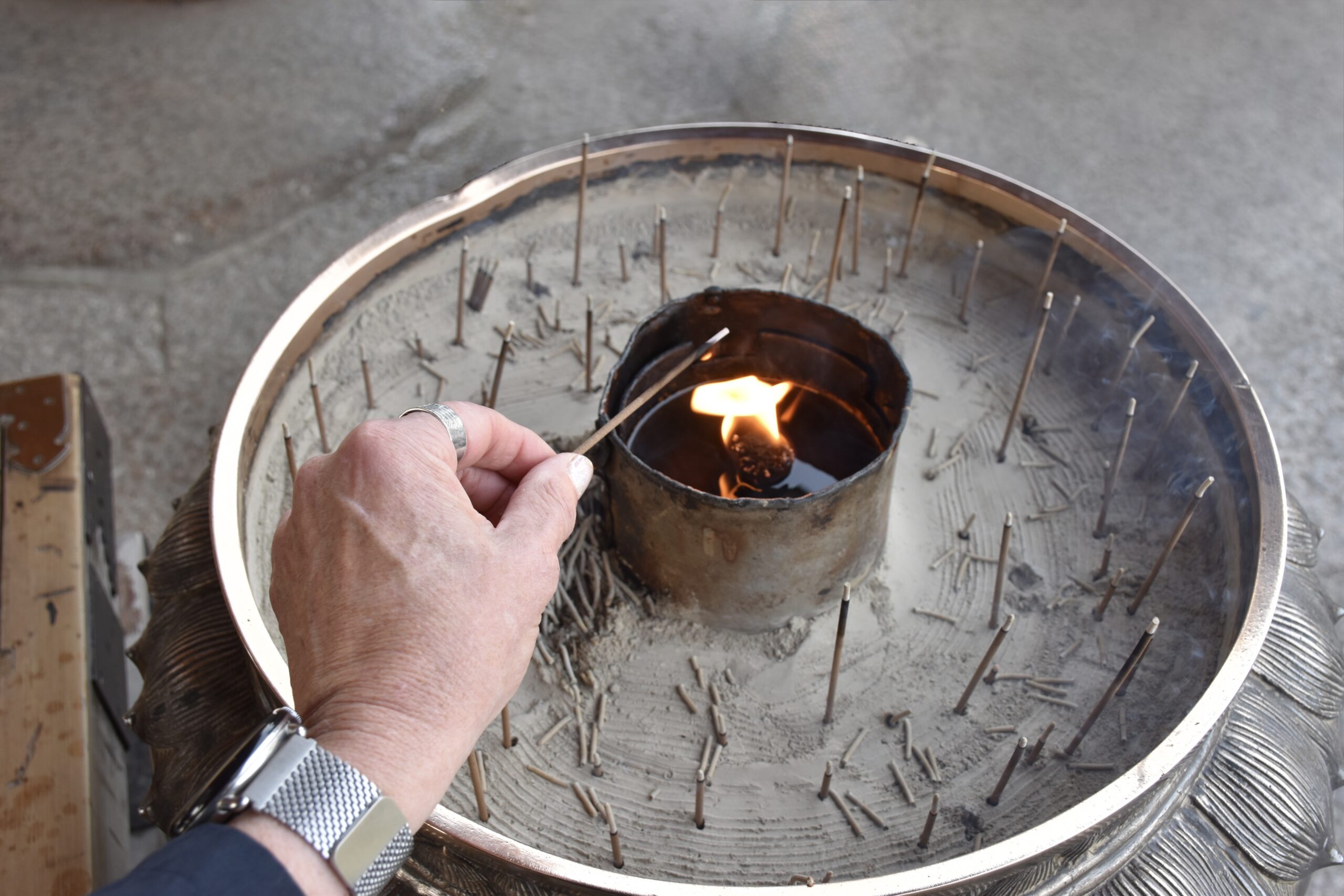
I also lit incense before departing.
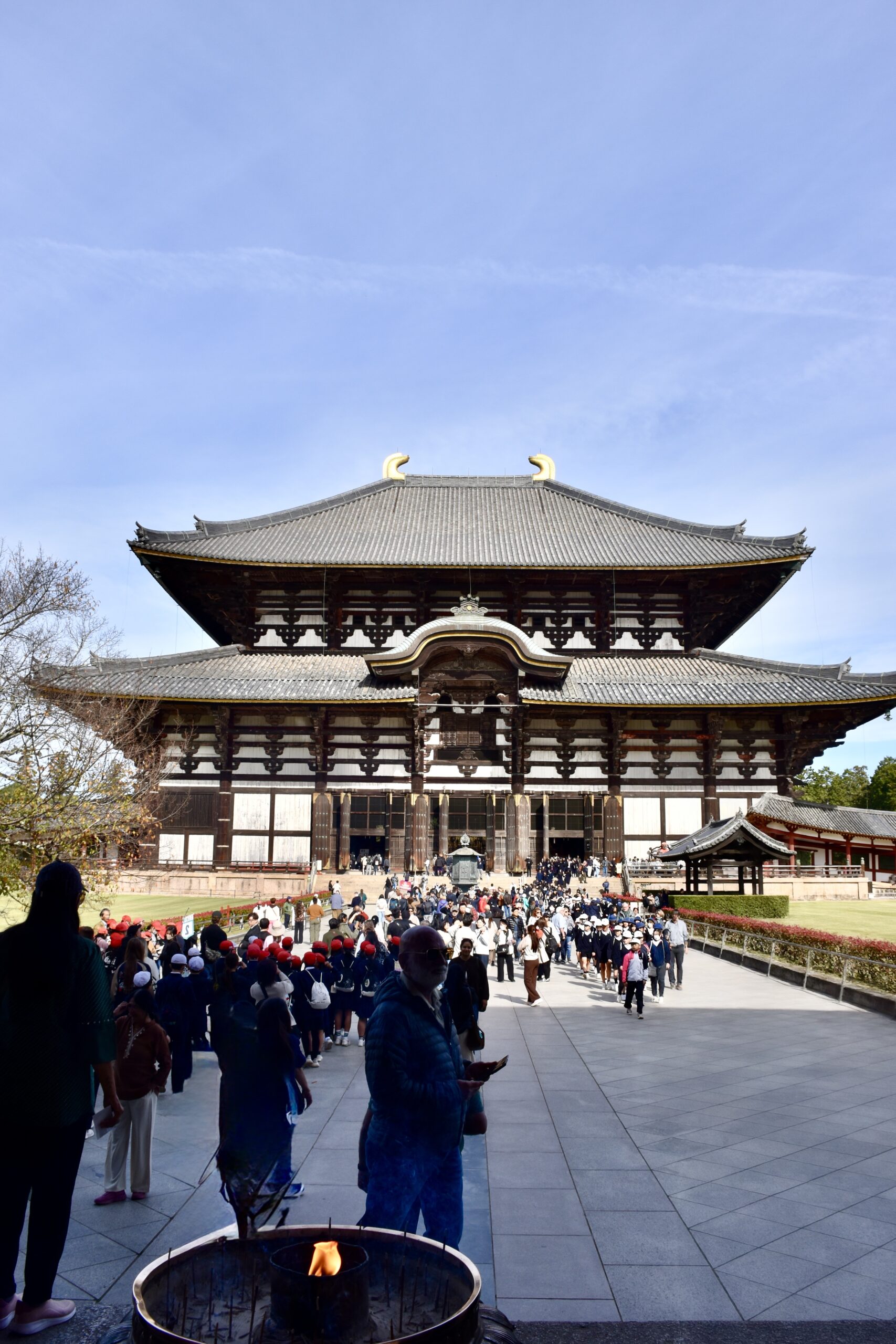
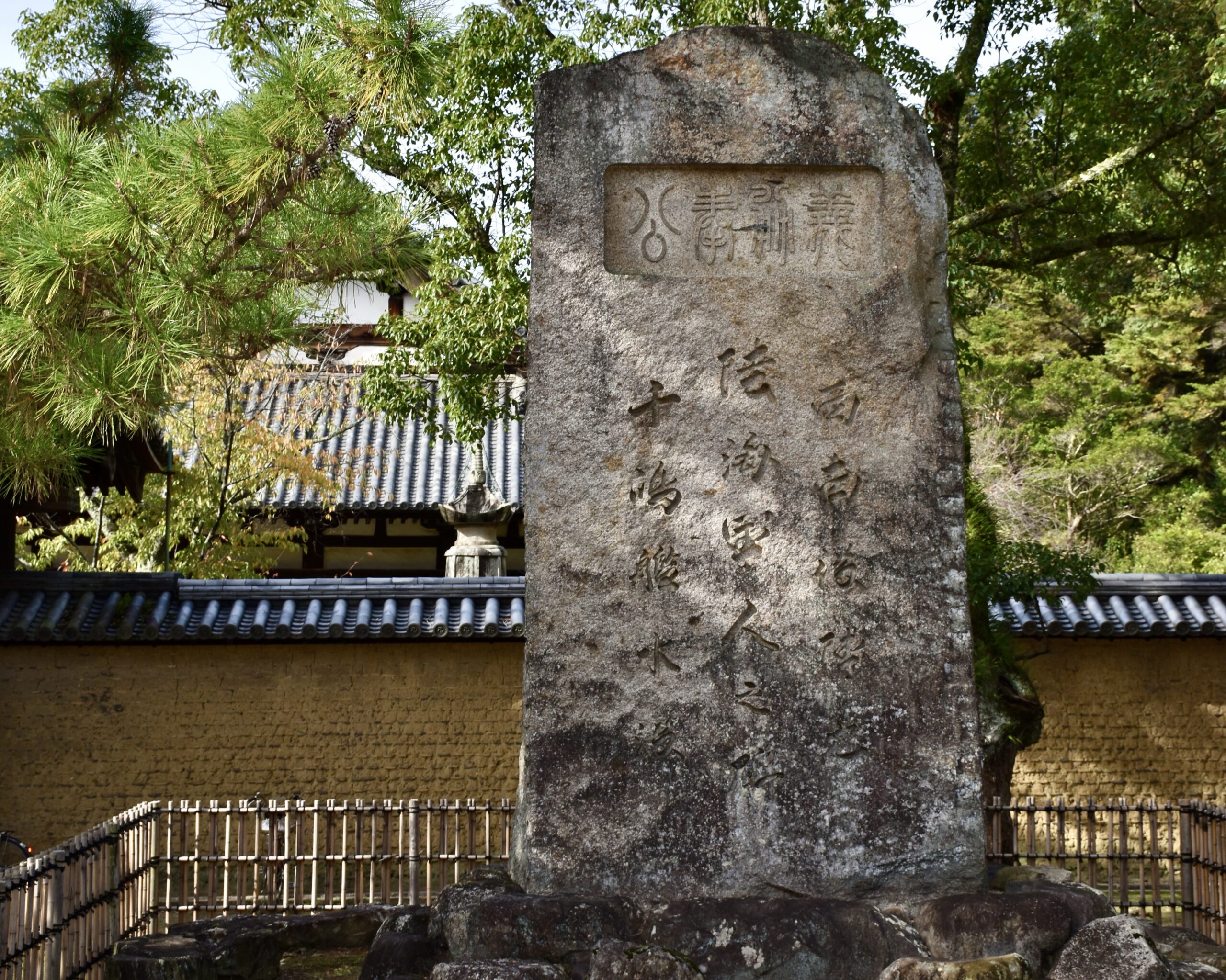
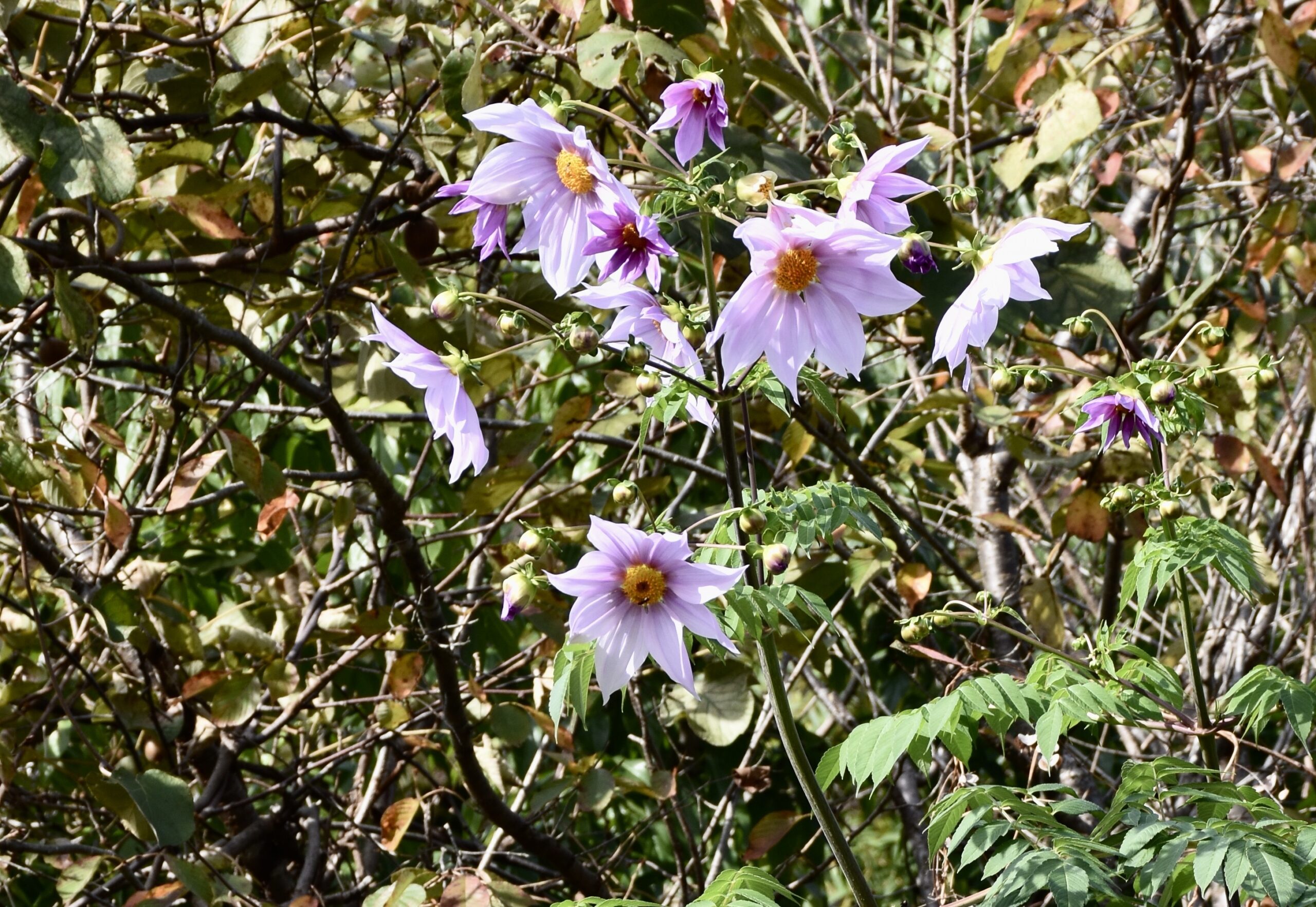
The temple grounds were busy with visitors and schoolchildren, but there were still small details to notice: stone monuments, the old rooflines, and flowers growing along the paths.
I had also hoped to persuade someone that we should visit Nara’s historic prison, which is being converted into a very fancy hotel. Alas, no takers. So that particular curiosity will have to wait.
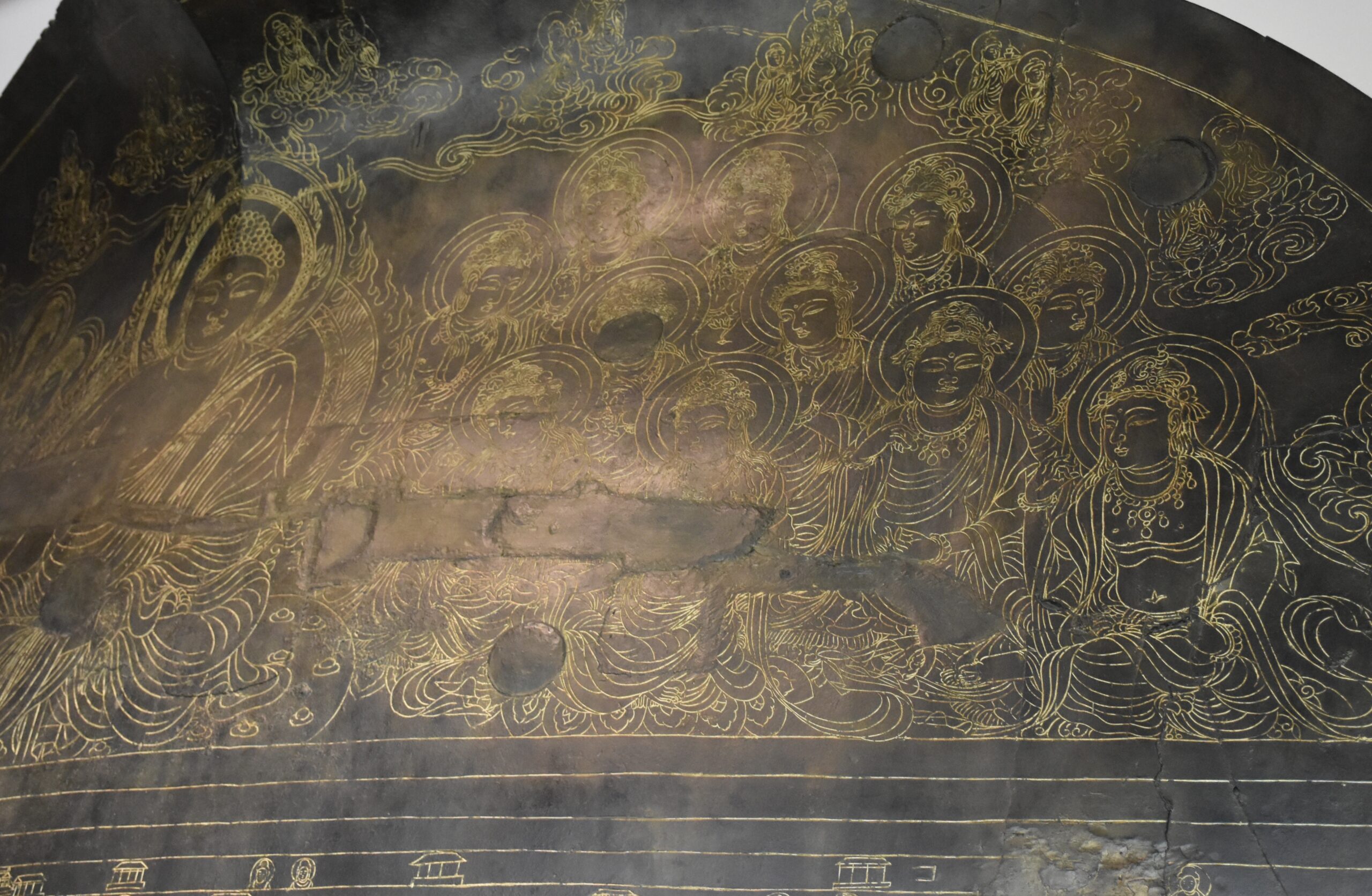
After our visit and a quick trip to the visitor center where I saw this lovely piece on the wall, we headed back toward Kyoto for an entirely different experience.
A Sword That Tells a Poem
The afternoon’s final activity was a demonstration of Kenbu, sometimes described as Japanese sword dancing.
I’d been curious about this one ever since I heard it was on the itinerary.
Kenbu uses a sword and a folding fan to interpret poetry, often poems associated with samurai history. According to our instructor, samurai once performed such pieces for one another, sometimes in informal gatherings, with the movements expressing the events and emotions of the poem.
Our performer had begun learning at age five, studying with his father, while his grandmother had been a grand master. He had been practicing for approximately thirty years and now taught at a dojo with more than a hundred students.
He certainly took his art seriously.
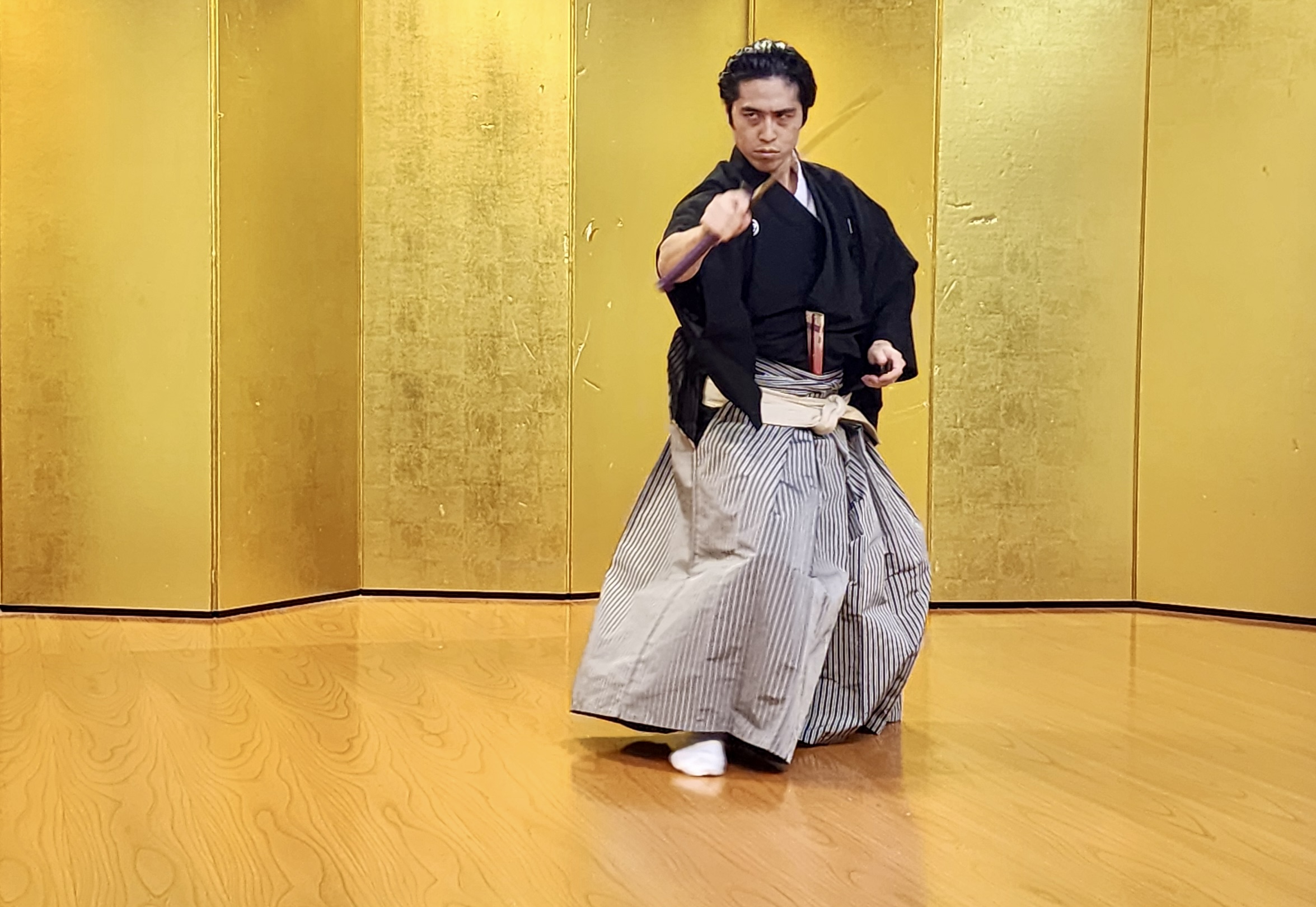
He performed in a black crested kimono and striped hakama, moving between kneeling and standing positions, sometimes wielding his sword, sometimes using his fan.


Now, I have to admit that I had rather mixed feelings about this.
Having spent some time studying iaido, I am accustomed to regarding sword movements as something very serious indeed. Each movement has a purpose; each cut and thrust is intended to be executed correctly.
Watching someone make exaggerated sword movements as part of what was essentially a dance made me a little uncomfortable. I even found the performance rather silly at first.
But then he did something very helpful.
After performing the entire piece, he stopped and explained what each movement represented. The sword was not necessarily intended to execute a technically perfect cut. It might signify a confrontation or a decisive moment in a story. The fan could represent an object, an action, or an event described in the poem.
Then he performed the piece again.
And suddenly I could SEE it.
Once I began thinking of the performance as a visual interpretation—or documentation—of a poem rather than a martial art, I became much more comfortable with it.
In fact, one of the women in our group asked whether Kenbu was a martial art. Our instructor, speaking through Utako-san, was quite emphatic that it was not. The movements were stylized representations of sword techniques, intended to tell a story rather than demonstrate precise fighting methods.
That distinction made a great deal of difference to me.
I still wouldn’t confuse it with iaido, but I could appreciate it for what it was: a separate art form, with its own traditions and discipline.
And I particularly appreciated the decision to perform the piece once, explain its elements, and then perform it a second time. There was real value in understanding the vocabulary before hearing the poem again, so to speak.
Five members of our group – of course including Michael and me – subsequently volunteered to try some of the movements ourselves. Although we apparently don’t have photographic evidence of our efforts, perhaps Lynn will come through with a picture, which I will edit in if so.

So that was Nara and Kyoto for the day: deer who bow, a Buddha who keeps an eye on us, a surprisingly athletic route to enlightenment through a wooden nostril, and a sword that wasn’t actually intended to cut anything.
I learned something from all of them.
I never get a percentage from any links I include – but! – if you are curious about Overseas Adventure Travel and want $100 off, call them at 1-800-955-1925 and request their amazing catalog, tell them you were referred by Sandy Shepard, customer number 3087257, and get $100 off your first trip! The catalog is what all good dreams are made of!