November 3–4, 2026 — Tokyo
Sometimes, a day in Japan contains an appropriate number of experiences.
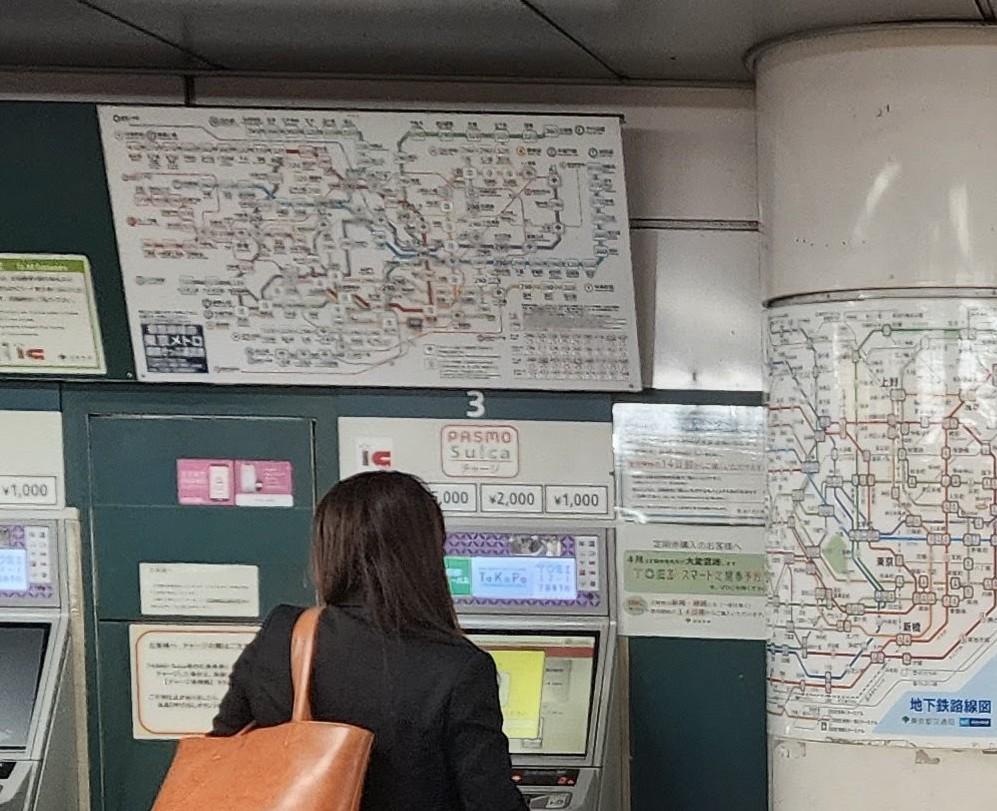
And then there are days when you attempt to knock over a sumo wrestler, discover that your hotel makeup mirror has been installed at approximately belt-buckle height, encounter a subway system resembling a plate of multicolored spaghetti, and find yourself giving impromptu lessons in Shinto purification to complete strangers.
All while collecting sacred calligraphy, contemplating the remains of a shogun’s castle, and trying to find a salad that doesn’t contain fish.
Welcome to Tokyo.
November 3: Culture Day, and an Unexpected Sumo Career
November 3 is Culture Day, a national holiday in Japan, Emperor Meiji’s birthday.
And we were going to celebrate it in style.
By wrestling.
Well, not exactly.
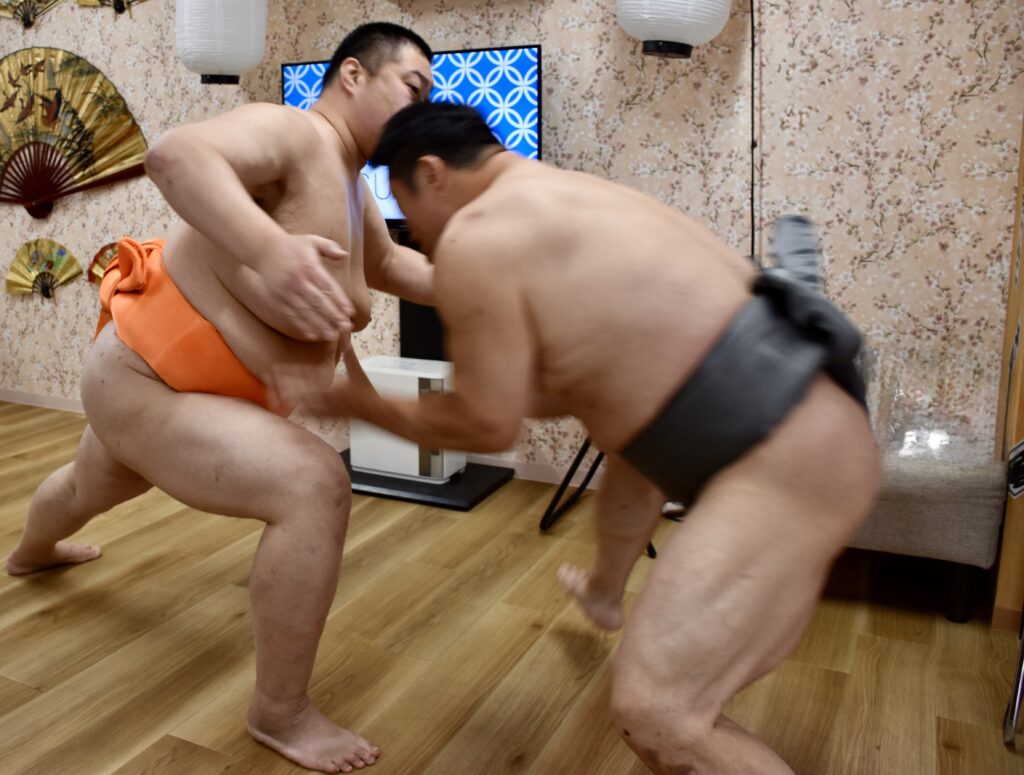
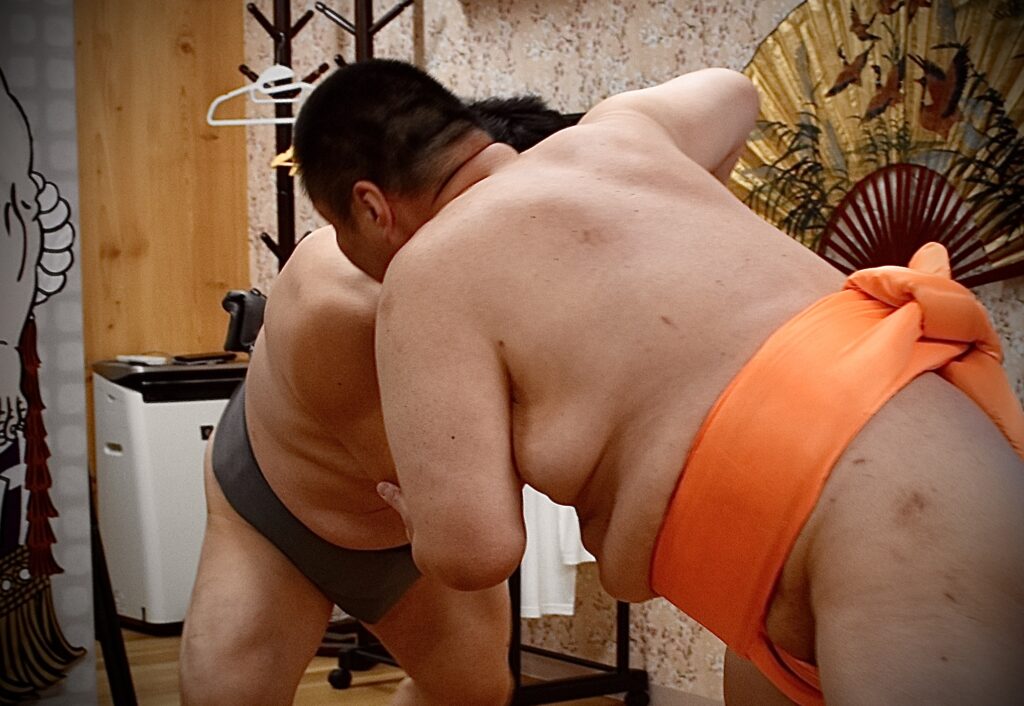
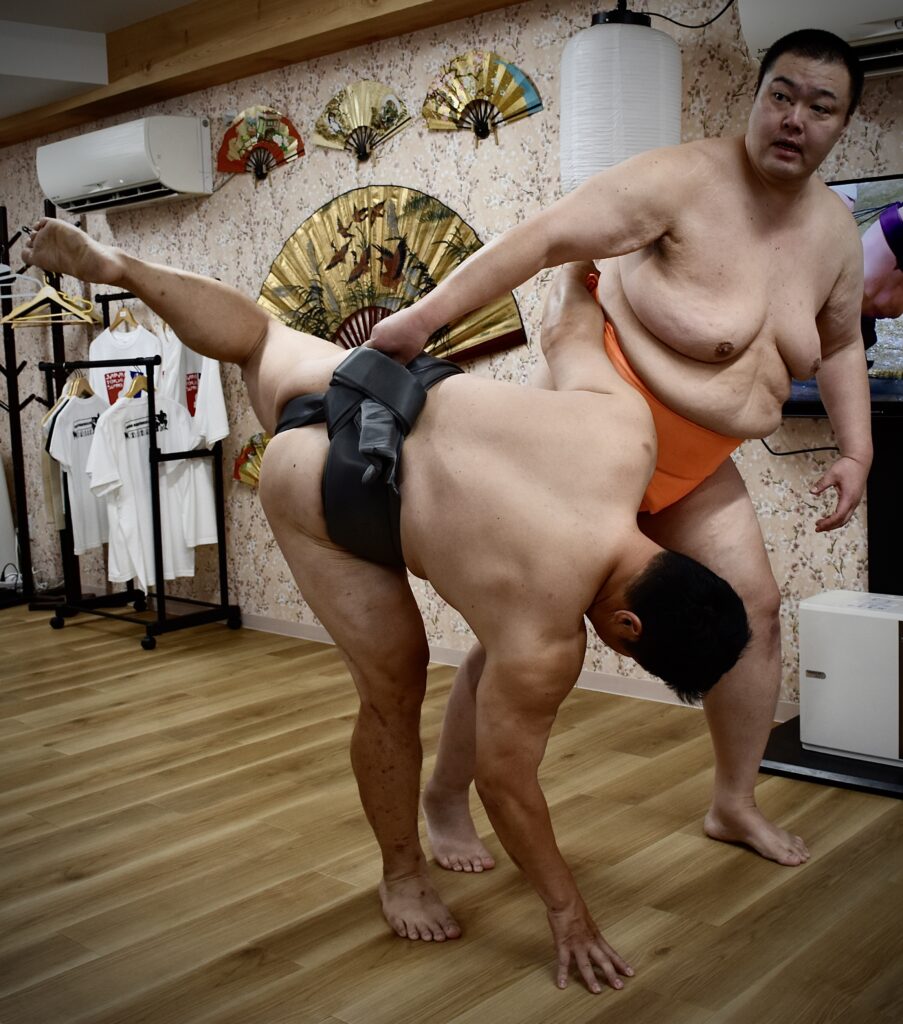
Our first stop was a sumo demonstration, where two enormous, cheerful wrestlers introduced us to the rituals and techniques of Japan’s national sport.
Sumo, of course, is considerably more complicated than two very large men trying to push each other out of a circle.
There are ceremonial movements, precise rules, elaborate techniques, and a great deal of training behind what looks, to the uninitiated, like an extremely enthusiastic collision.
Fueled by amazing food (which they cooked for us at lunch) . . . And, if you’re in training, 10 pounds of white rice per meal, per day.
The wrestlers demonstrated various holds, throws, and methods of upsetting an opponent’s balance.
They were astonishingly quick.
They were also funny, charming, and clearly enjoyed showing us what they could do.





Then came the invitation for volunteers.
Well.
I was the first person to step forward, and almost the only one.
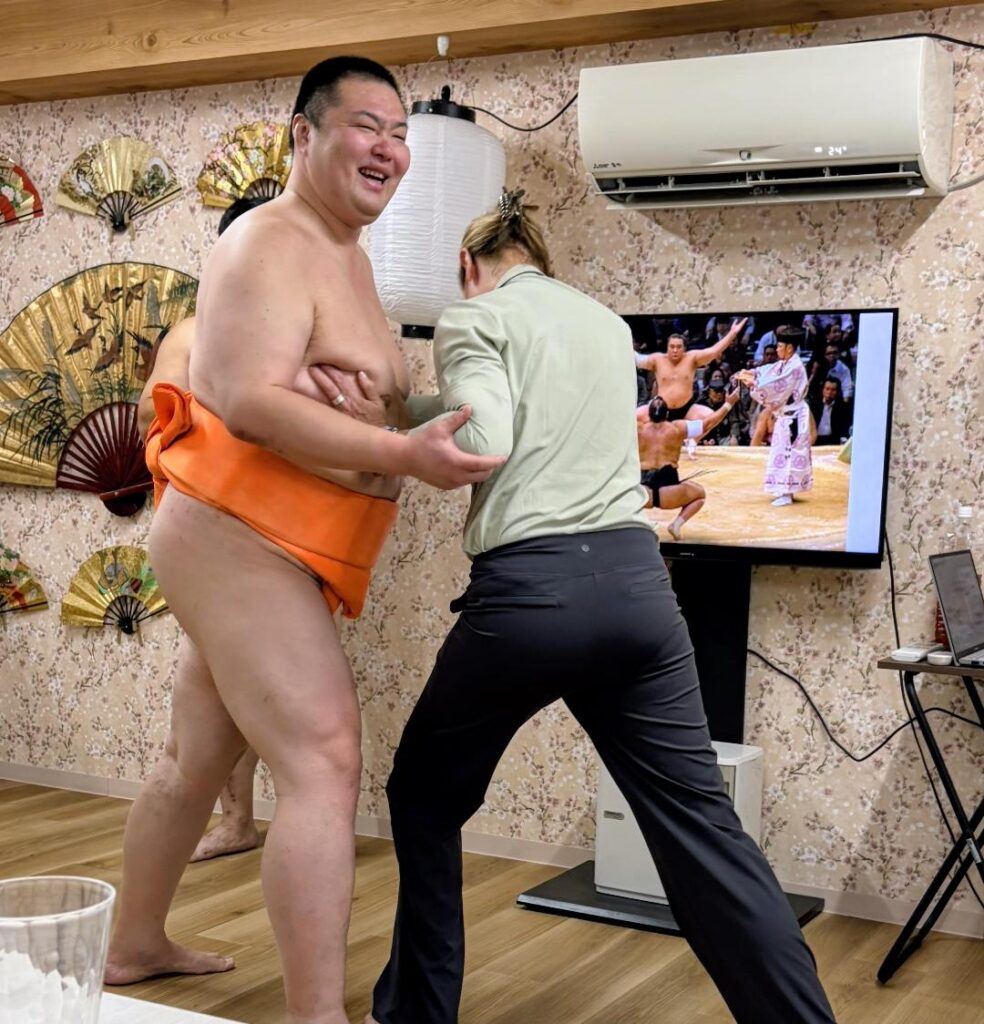
After all, how often does one have the opportunity to try to knock over a sumo wrestler?
The answer, as it turns out, is that one can try as often as one likes.
Actually succeeding is another matter.
First, I attempted the obvious approach: pushing.
My hands sank into an astonishingly substantial layer of flesh, which was also extremely sweaty.
There was simply nothing solid to push against.
It was like trying to move a very large, very cheerful waterbed.
And the waterbed was considerably stronger than I was.
I pushed harder.
Nothing.
He grinned.
I reconsidered my strategy.
Now, I study iaido, not sumo, but I do understand that balance is important. And if brute force wasn’t going to accomplish anything, perhaps a little ingenuity might.
So I decided to hook his leg.
That caught him off guard!
It didn’t actually bring him down, but it certainly surprised him, and the other wrestler absolutely roared with laughter.
I considered that a moral victory.
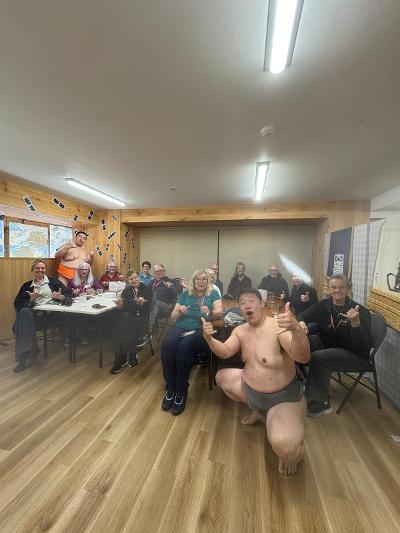
I came away with a much greater appreciation for the skill involved in sumo, along with the realization that my future career in the sport is probably limited.
Still, not everyone can say they’ve tried to trip a sumo wrestler.
Meiji Shrine: Chrysanthemums, Archers, and a Holiday Crowd
Next came Meiji Jingū, the great Shinto shrine dedicated to Emperor Meiji and Empress Shōken.
The shrine is surrounded by an enormous wooded sanctuary, and walking toward it feels almost like leaving Tokyo behind.
Tall trees form a green corridor, and enormous wooden torii gates mark the transition into sacred space.


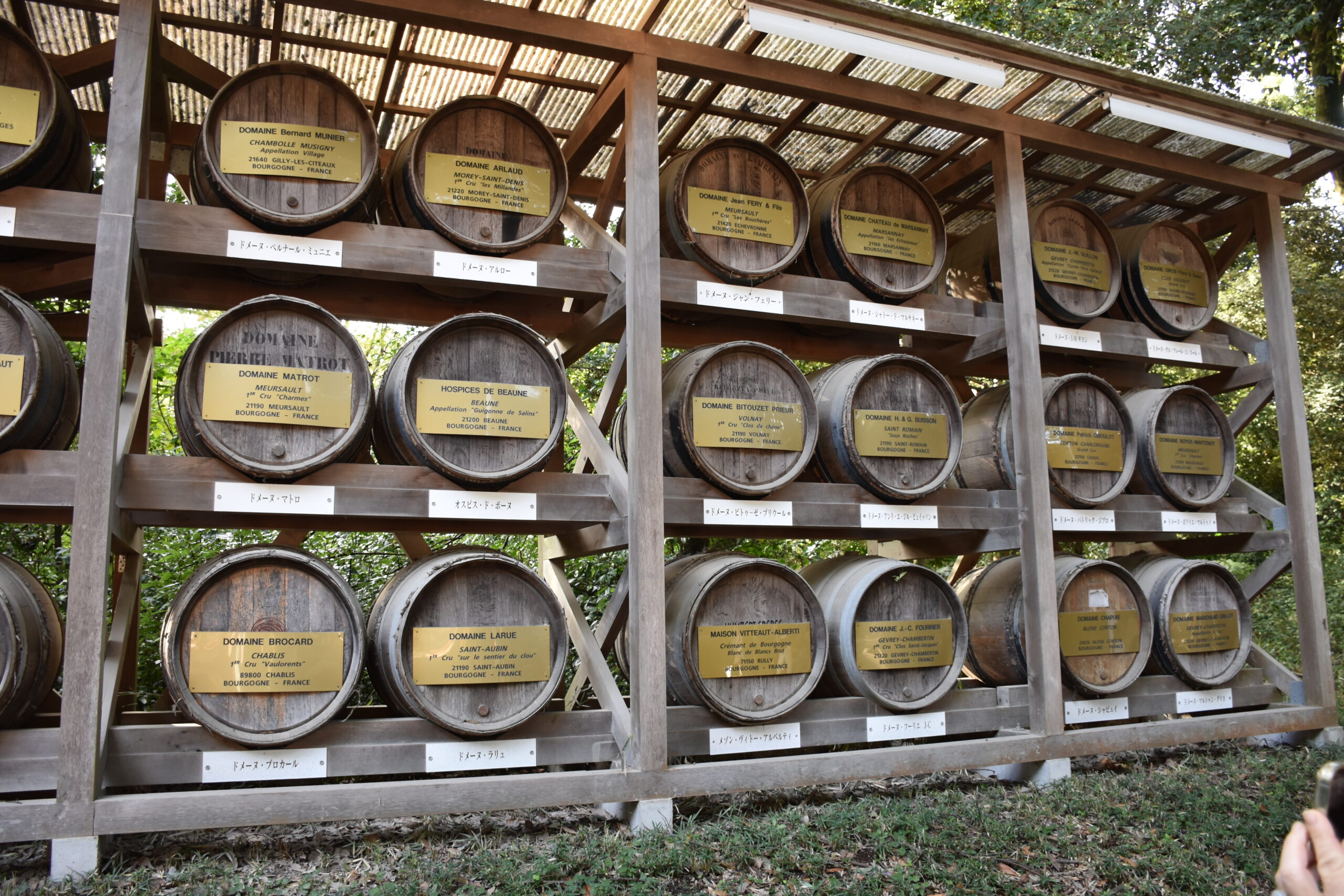
Along the way, we passed an extraordinary display of barrels.
But unlike the huge rack of sake barrels across from them – similar to what we’d seen at Kamakura – these were barrels of French Burgundy wine!
Emperor Meiji encouraged Japan’s engagement with Western culture, and the wine barrels commemorate that connection.
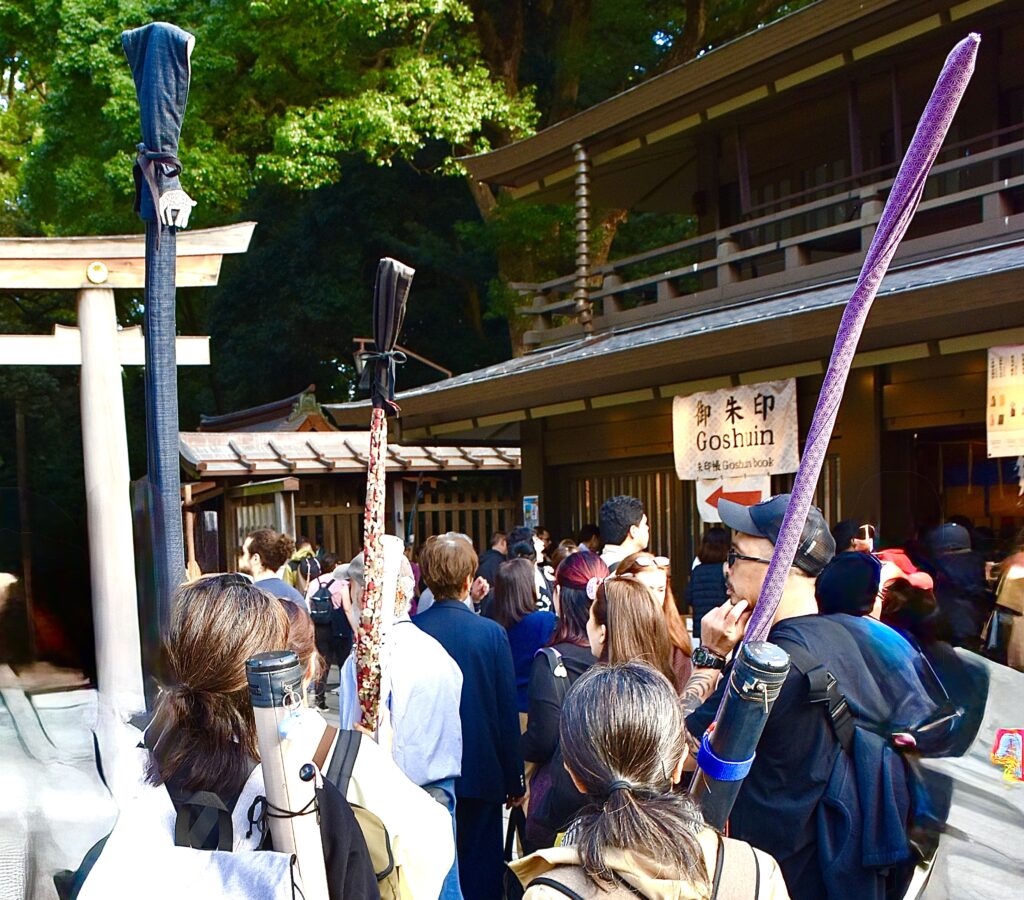
Culture Day brought special celebrations to the shrine, including traditional martial arts and archery demonstrations.
I’d particularly hoped to see yabusame, the spectacular Japanese art of horseback archery.
Unfortunately, so had approximately half the population of Tokyo.
The crowds were simply overwhelming, and there was no realistic way to get close enough to see the performance.
Boo hoo.
But we did see several archers moving through the grounds, carrying their extraordinarily long Japanese bows, or yumi.


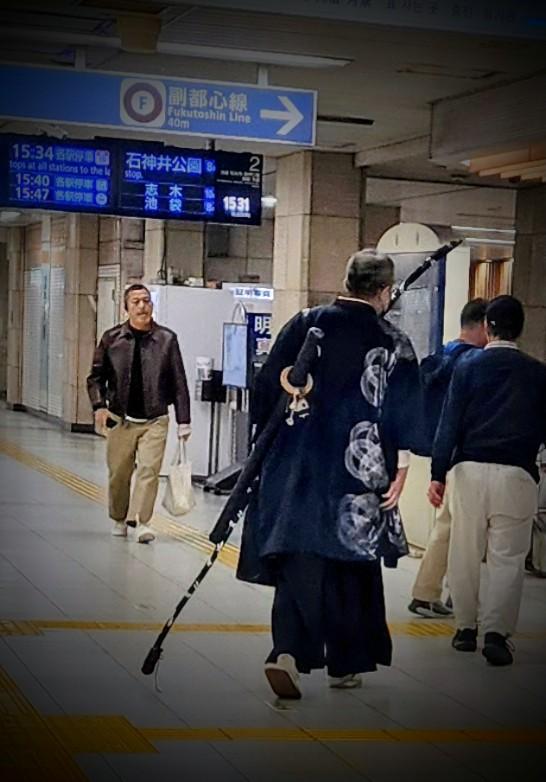
Later, I even encountered an archer carrying a bow on the subway.
There’s something rather wonderful about seeing a centuries-old martial tradition traveling on a modern Tokyo train.
The shrine was also hosting an extraordinary exhibition of chrysanthemums.
Not merely flowers in pots.
These were living sculptures.
Some were trained into miniature trees, with thick little trunks, carefully arranged branches, and blossoms balanced above moss-covered bases.
Others were elaborate arrangements of yellow, pink, red, and white flowers, each apparently determined to outdo its neighbor.


Having visited the Shunkaen Bonsai Museum earlier in the trip, I found myself particularly interested in how these plants had been trained.
There is something wonderfully Japanese about taking a plant that wants to grow in one direction and patiently persuading it to become a work of art.
And doing so without losing the sense that it is still very much alive.
Shibuya: The World’s Largest Pedestrian Puzzle
Somewhere in all of this, Lynn and I also embarked on a quest to find a camera shop.
This sounded straightforward.
Google Maps certainly thought so.
Unfortunately, Google Maps had apparently not received the memo about the extensive construction transforming parts of Shibuya.
We followed its instructions faithfully.
Up onto elevated pedestrian walkways.
Down into underground passages.
Across intersections.
Back up again.
Through buildings.
Out of buildings.
And, naturally, across Shibuya Crossing.
More than once.
Shibuya Crossing is one of the world’s most famous pedestrian intersections, where enormous crowds cross in every direction simultaneously.
It is an astonishing sight.
It is also a particularly interesting place to find yourself when you’re not entirely sure which direction you should be going.
At some point I remembered Baraka, the extraordinary 1992 film by Ron Fricke that H loved.
It’s a film without dialogue, composed of remarkable images from around the world set to music: nature, cities, religious ceremonies, human movement, and even Japanese snow monkeys.
The great urban crowds of Tokyo were also included in a kind of visual symphony.
Although I suspect the filmmakers would have preferred not to include two increasingly exasperated women trying to find a camera store.
By the time we’d finished our expedition, we’d walked approximately 11,000 steps.
And that was just the camera-shop adventure.
I am beginning to suspect that Tokyo measures distances differently from the rest of the world.
And then we had to find our way back.
The Ginza Line.
The doggone Ginza Line.
After another expedition through Tokyo’s subterranean labyrinth, we FINALLY found it.
Once on the subway, feeling rather pleased with ourselves, Lynn and I began discussing the evening ahead.
We had bought wine the night before, and were very much looking forward to returning to the hotel, putting our feet up, and polishing it off.
A lovely, quiet evening.
Well deserved, I thought.
And then my phone buzzed.
A text from Utako-san.
“Where are you? We are going to the welcome dinner.”
Lynn and I looked at each other.
WHOOPS!
The welcome dinner.
The dinner we had completely forgotten.
The dinner that was, apparently, happening RIGHT NOW.
So much for the wine.
We quickly obtained the restaurant’s address, figured out where we needed to go (luckily, the subway stop was on the Ginza Line!), and set off.
More walking.
More navigating.
More Tokyo.
And somehow, after all of that, we arrived at the restaurant before anyone else.
I have no idea how we managed it.
But I feel that should count as some sort of travel achievement.
A Lovely Welcome Dinner, and Thirteen Travelers
Our group was now complete: thirteen travelers.
The dinner was lovely, and it was an opportunity to begin getting to know the people with whom we’ll be sharing the next several weeks.
There’s something rather interesting about the beginning of a group journey.
Everyone arrives with their own histories, personalities, expectations, and reasons for traveling.
For the moment, we’re thirteen individuals.
Over the coming weeks, we’ll become something else.
A traveling little community.
And Lynn and I, despite our spectacular failure to remember the dinner, had managed to arrive first.
Which is perhaps the most astonishing part of the entire Shibuya adventure.
A Golden Beer, a Golden Carrot, and a Healthy Denny’s
Tokyo also has a marvelous ability to surprise you with architecture.
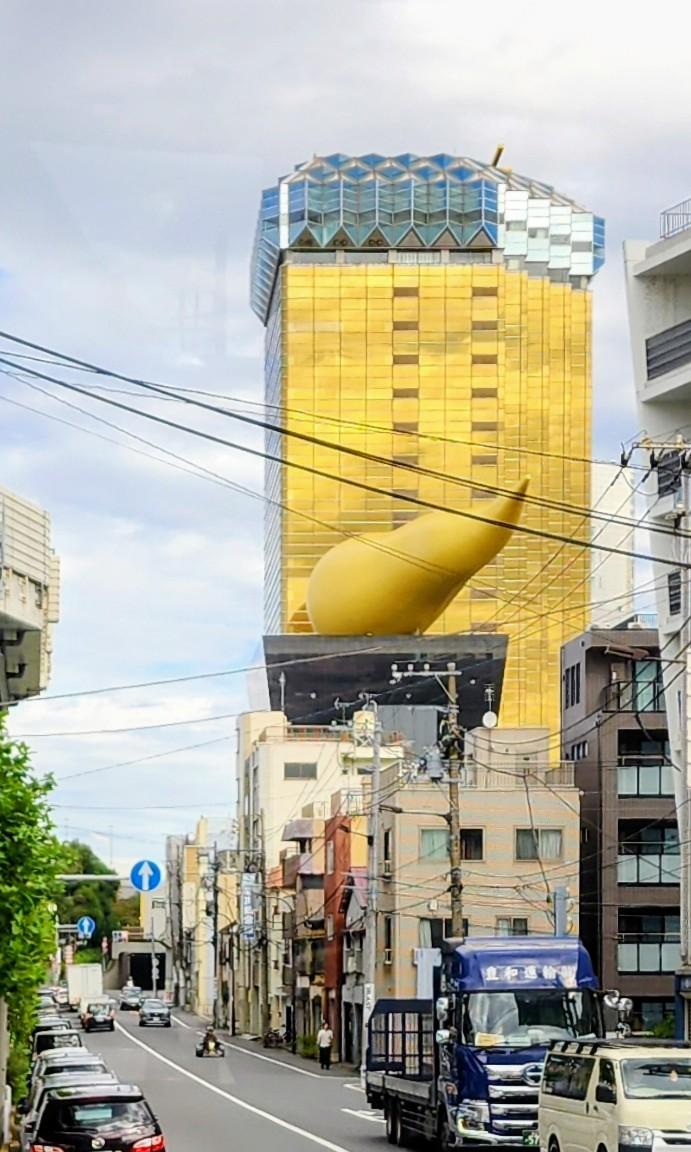
At one point we passed the Asahi Beer headquarters, where the tall golden building is designed to resemble a glass of beer, complete with a foamy head.
And next to it is an enormous golden object.
A carrot?
A flame?
Something considerably less printable?
Officially, it’s the Flamme d’Or, or Golden Flame, designed by Philippe Starck to represent the burning spirit of Asahi Beer.
Unofficially, it has acquired some rather less dignified nicknames.
I think I’ll stick with Golden Carrot.
then there was Denny’s.
Yes, Denny’s.
But not quite the Denny’s we know.
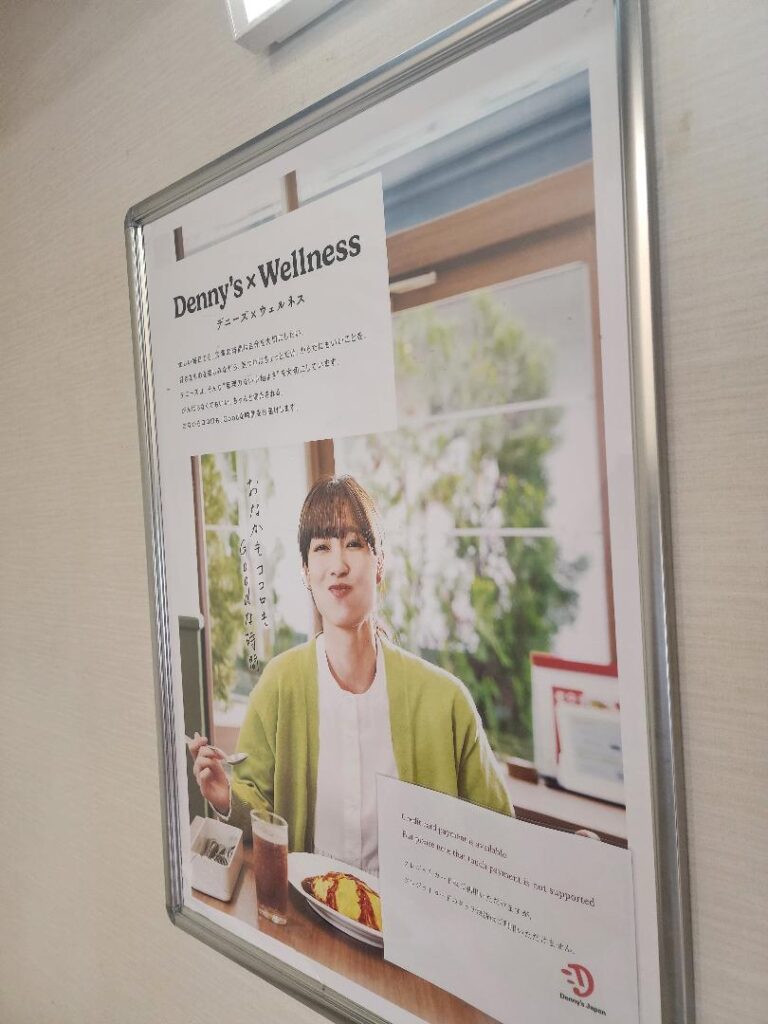
Apparently, Japanese Denny’s is promoting itself with a wellness initiative.
In America, Denny’s tends to conjure images of enormous breakfasts, late-night pancakes, and food that is not generally marketed as a pathway to optimal health.
But here in Japan?
Denny’s × Wellness.
Who knew?

And while we’re on the subject of Tokyo’s unexpected architecture, I must mention another building we passed.
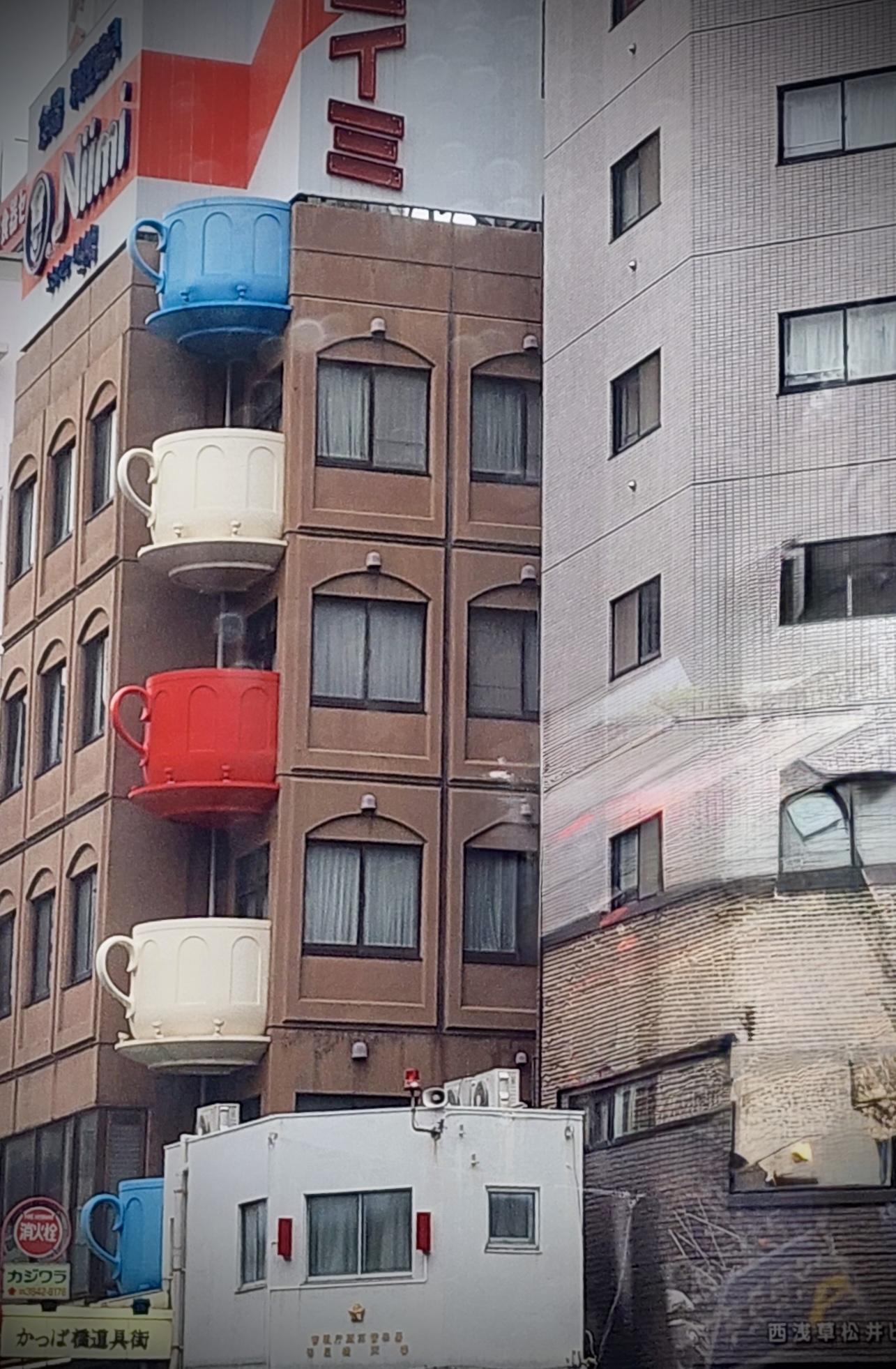
Its balconies looked like enormous teacups attached to the outside of the building.
Blue, white, and red teacups, stacked one above another.
I have no idea what architectural problem this was intended to solve.
But it certainly made the building memorable.
Asakusa After Dark: A Temple in Technicolor
After dinner, we headed back toward Asakusa.
Lynn had visited the area on her previous trip to Japan and remembered enjoying the shops and streets around the temple.
What surprised us was how close it actually was to our hotel.
Not necessarily a straight line, mind you.
More of a great big L.
But suddenly a place that had seemed like a separate excursion was practically in our neighborhood.
And we had arrived on a very special evening.
Because it was Culture Day, Sensō-ji Temple was illuminated with a spectacular projection-mapping light show.
The enormous Hōzōmon Gate, guarded by two fearsome Niō figures, had become a canvas for shifting colors, images, and patterns.
The ancient architecture seemed to come alive.
Even Utako-san said she’d never seen anything quite like it.
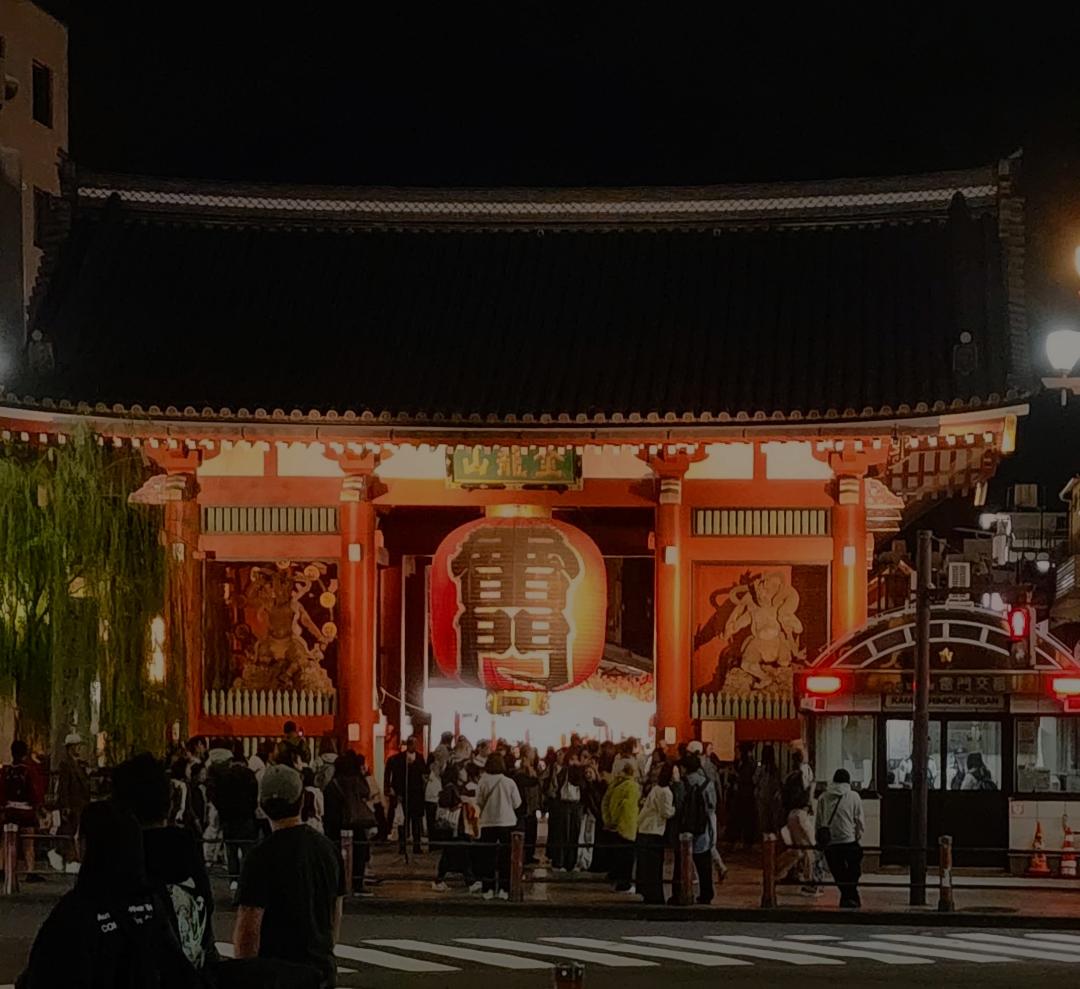
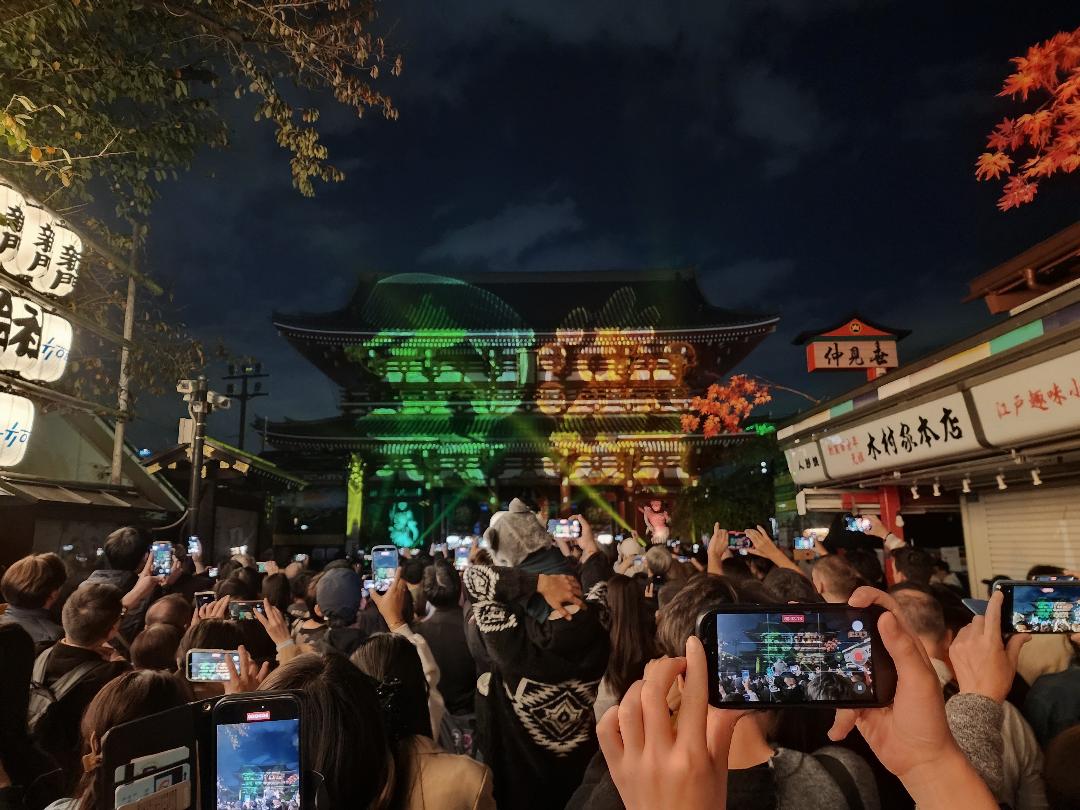
There were crowds everywhere, cameras and phones raised toward the illuminated buildings.
And there we were, watching a centuries-old Buddhist temple transformed by twenty-first-century technology.
Japan seems quite comfortable placing the ancient and modern side by side.
Sometimes literally on top of each other.
We resolved to return the following morning, when we could see the temple properly in daylight.
A Brief Architectural Complaint
Before moving on to November 4, I must mention our hotel room.
Specifically, the mirror.
There is a small, round “makeup mirror” mounted on the wall.
A very attractive little mirror.
Unfortunately, it has been installed at approximately the height of my belt buckle.
This presents certain practical difficulties.
For example, applying makeup generally requires being able to see one’s face.
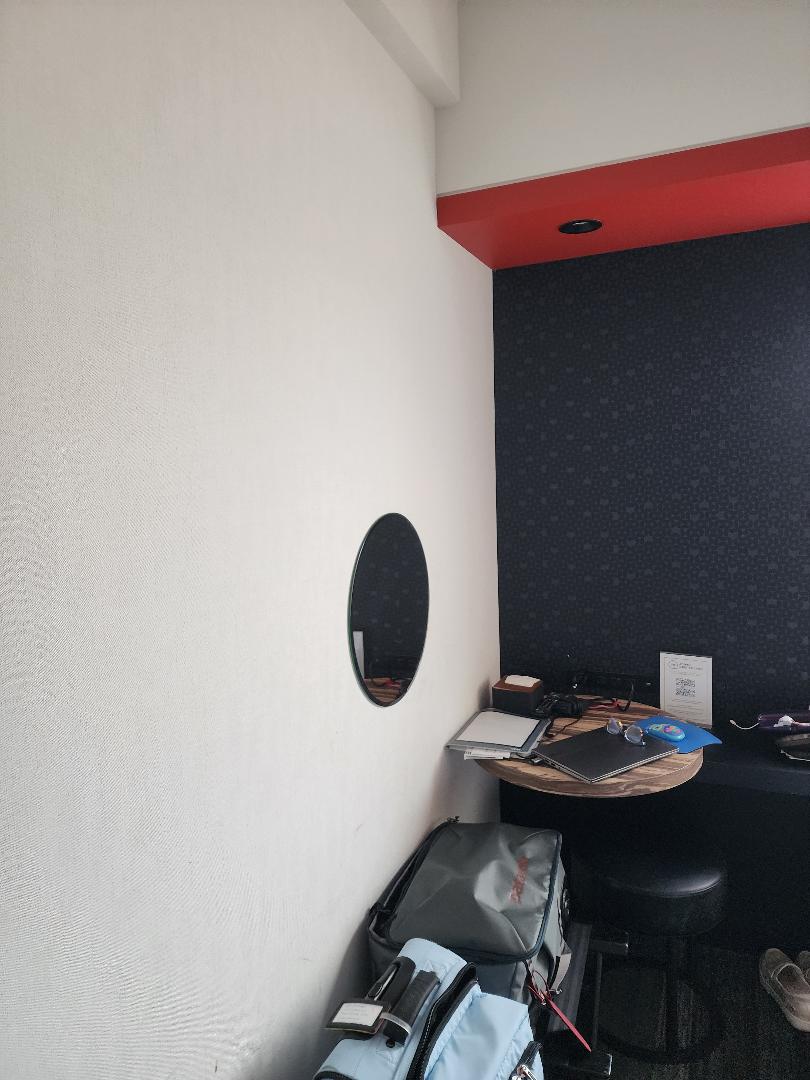
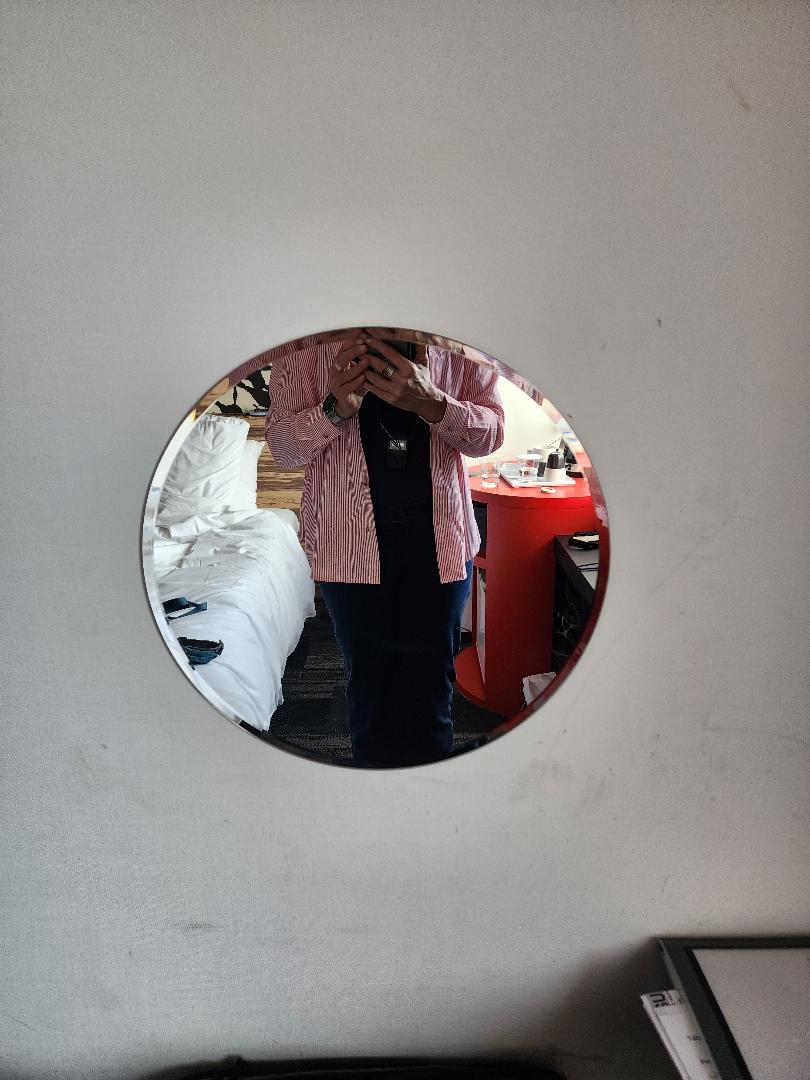
On the other hand, the shower is magnificent.
It’s tall enough for me, which is already a major accomplishment, and has THREE adjustable sprayers along the vertical stem, plus a handheld wand.
So apparently the bathroom designer was very concerned about the proper distribution of water over the human body.
Just not about the location of the human head.
One must take one’s victories where one finds them.
November 4: Drums, Dragons, and the Ghost of a Shogun
Back to Sensō-ji: An Unexpected Teaching Career

We returned to Sensō-ji the following morning.
In daylight, the temple was every bit as impressive as it had been under the lights.
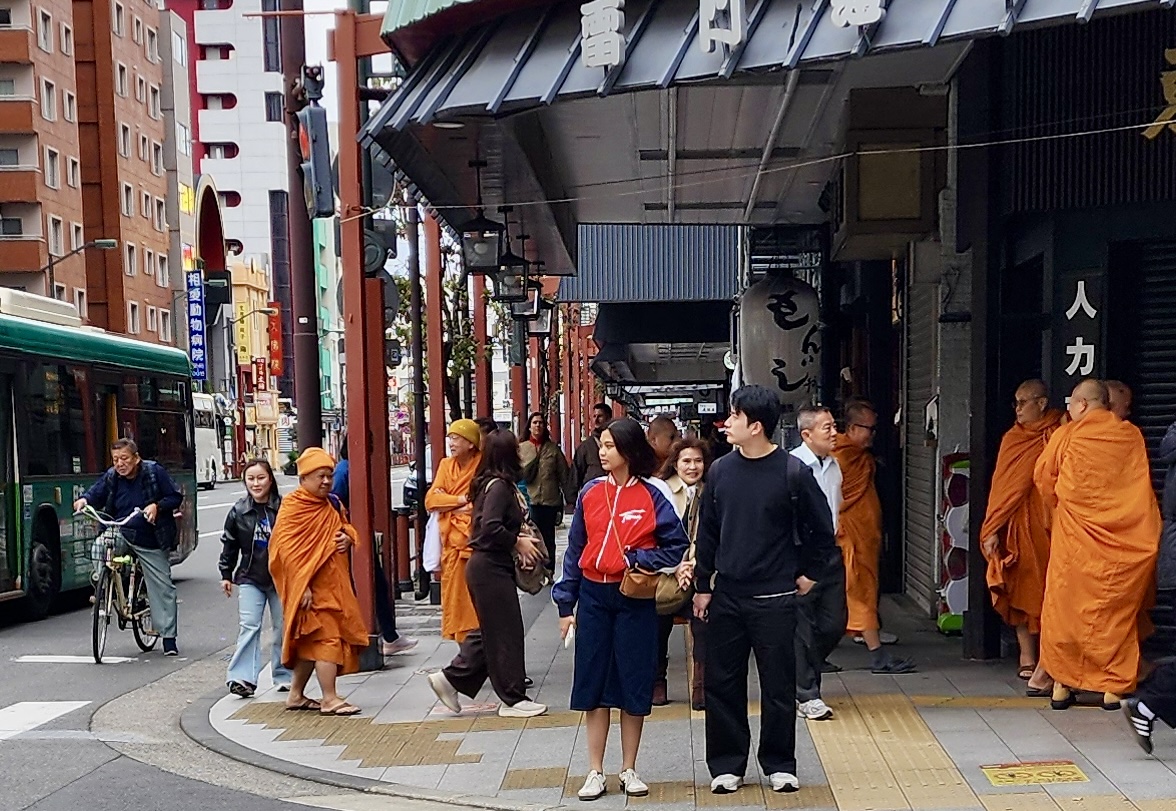
The enormous red lantern at Kaminarimon, the Thunder Gate, is one of Tokyo’s most recognizable sights.
It was donated by Kōnosuke Matsushita, the founder of Panasonic, after he recovered from an illness. A remarkable expression of gratitude.

We also saw the five-story pagoda, the richly decorated main hall, and beautiful painted ceiling panels.

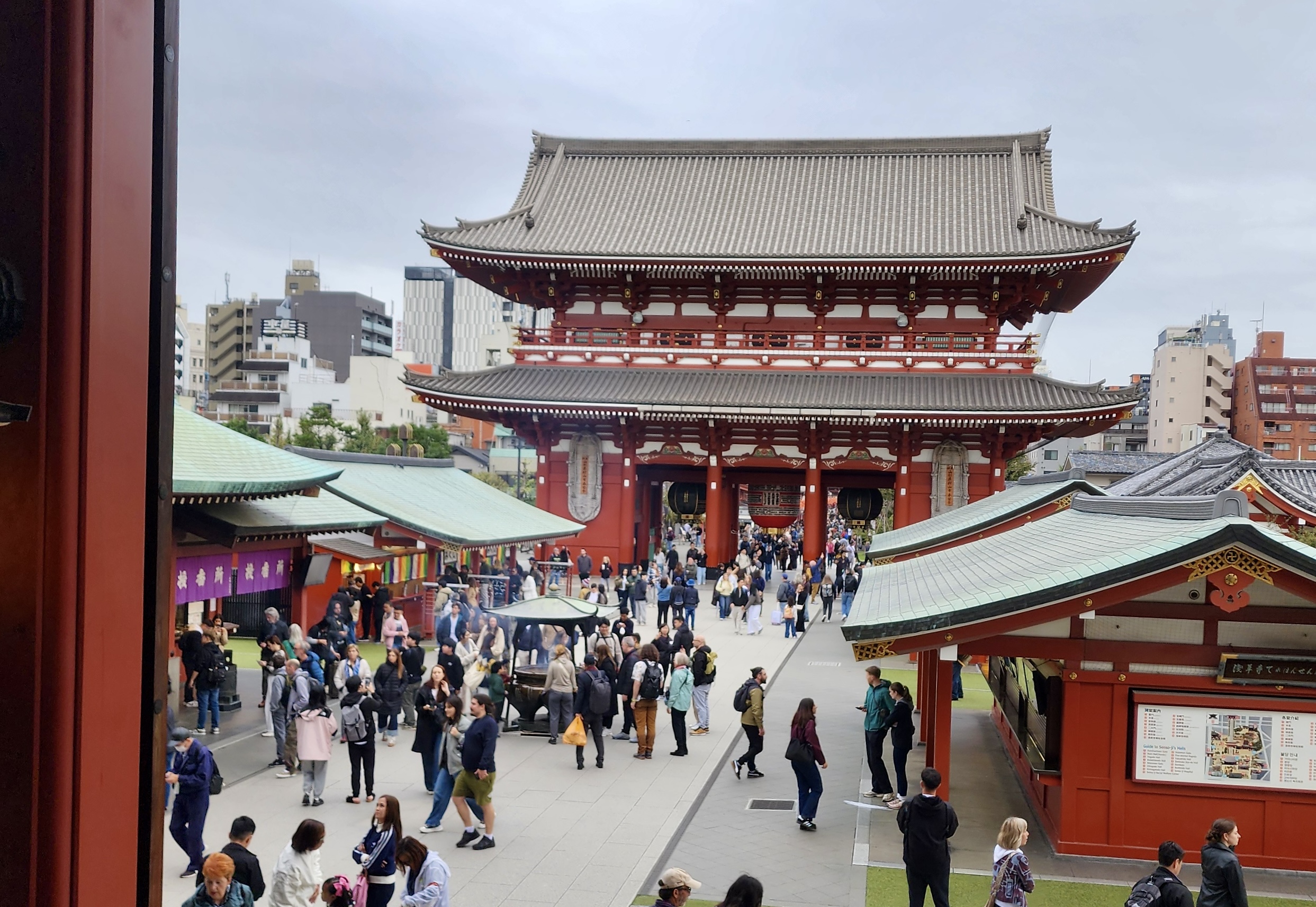

Sensō-ji traces its origins to a wonderful legend.
In 628 CE, two fishermen brothers pulled a small statue of Kannon, the Buddhist bodhisattva of compassion, from the Sumida River.
They returned it to the water.
And caught it again.
And again.
Eventually, a local village leader recognized its significance, and the statue became the sacred object around which the temple developed.
We saw a painting illustrating the story.

I had another important mission here.
Goshuin!
Having inaugurated my collection in Kamakura, I was now becoming positively enthusiastic about acquiring these beautiful calligraphic temple and shrine inscriptions.
At Sensō-ji I received two goshuin, including a special two-page inscription.
The process involved leaving my book and receiving a numbered chit so I could return to collect it.
And while waiting, I found myself at the fantastic dragon-headed purification fountain.
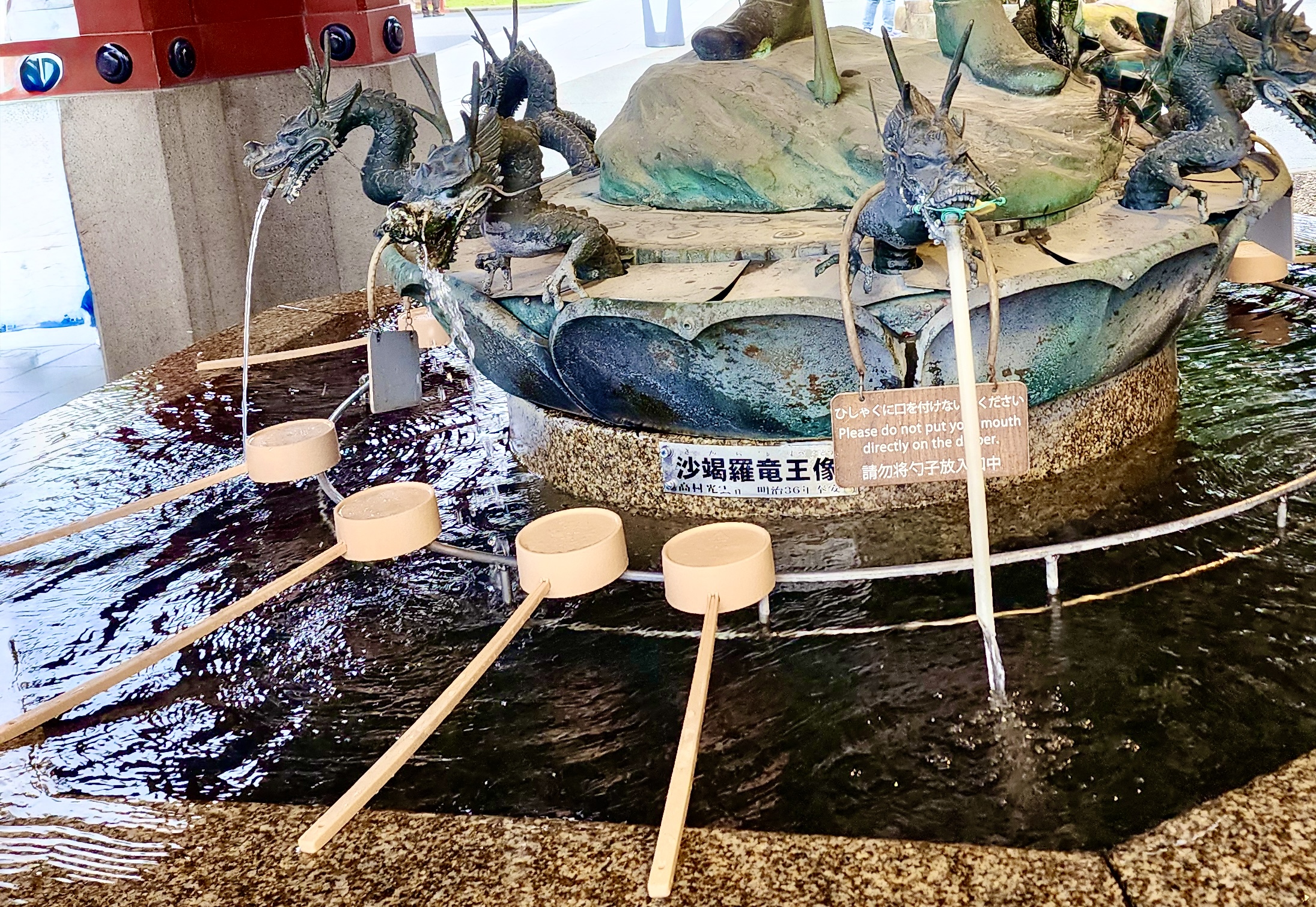

Now, thanks to Utako-san’s earlier instruction, I knew how to perform the purification ritual correctly.
Rinse the left hand.
Then the right.
Pour water into the left palm to rinse the mouth.
Rinse the left hand again.
And finally clean the ladle handle, allowing all the used water to fall outside the basin.
Simple enough.
Except that apparently I had acquired an audience.
There were a LOT of Western visitors around the fountain.
And after watching me, people began asking whether I could show them how to do it.
Again.
And again.
And again.
FOUR TIMES!
I had apparently become the unofficial instructor at the Sensō-ji Handwashing Academy.
I was eventually obliged to interrupt my teaching career because I needed to retrieve my goshuin.
Which led to another encounter.
A couple noticed the numbered chit in my hand and asked what it was for.
I explained the goshuin tradition.
They were on their very first day in Japan and had never heard of it.
They were intrigued.
So I took them over to the goshuin counter while I collected my book and showed them how it worked.
Another set of converts!
At this rate, the temples may have to start paying me.


Taiko: Jazz You Can Feel in Your Heart
Our next adventure was taiko drumming.
(Though first, we had to be fortified by small steaming-hot muffins filled with red bean paste.)
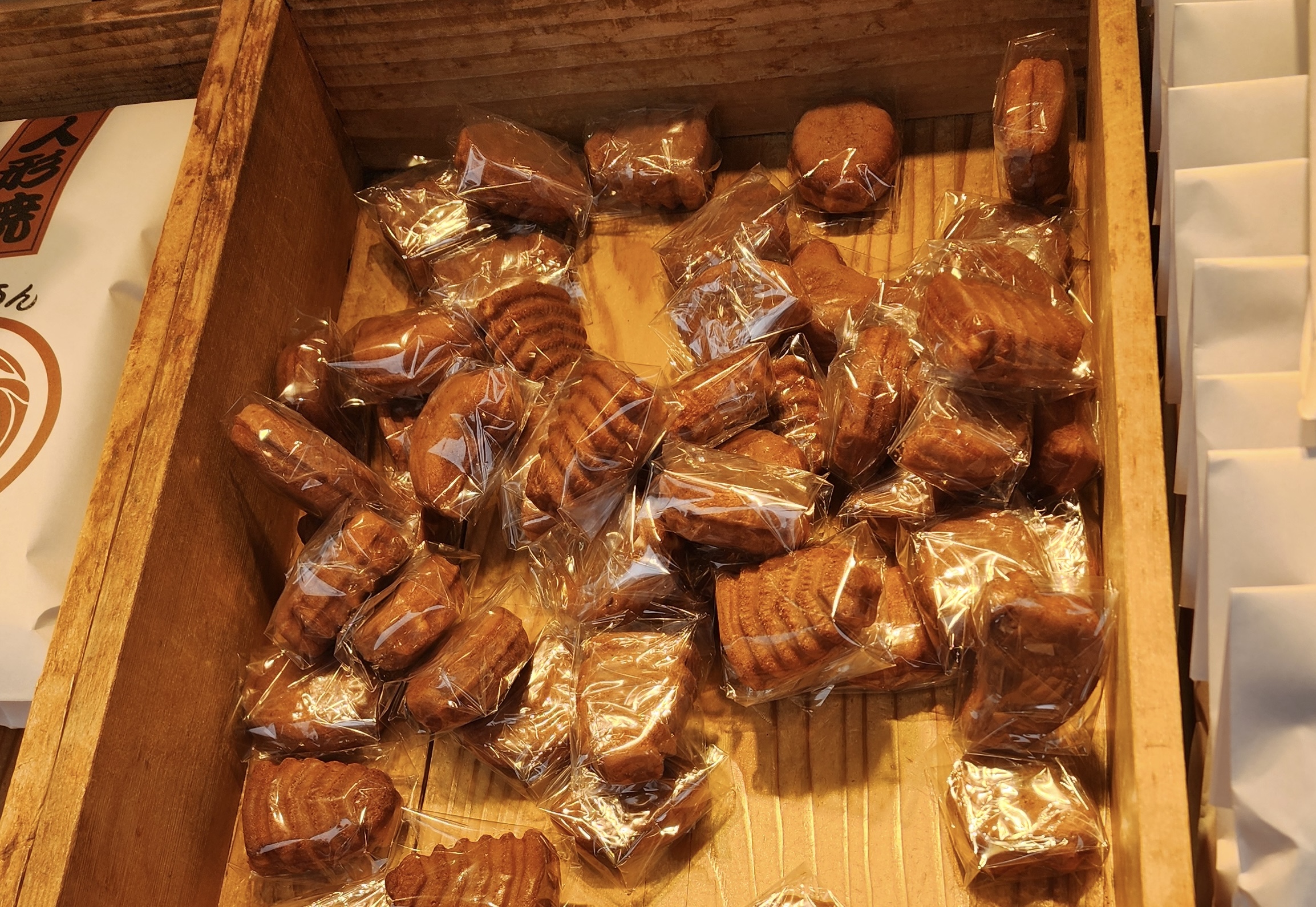
Lynn had done this experience on her previous visit to Japan, so she elected to stay behind while I went with the group.
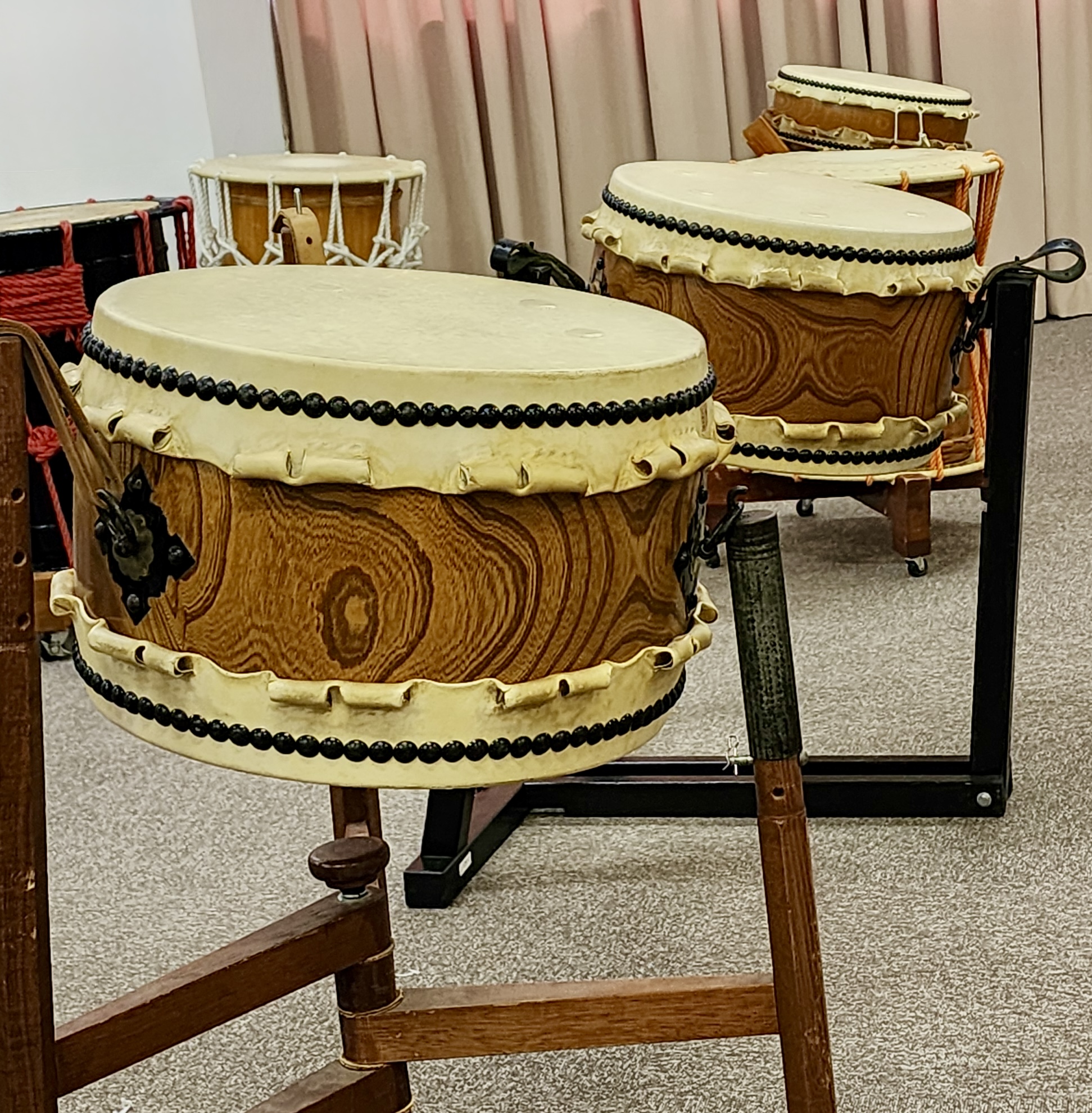
Taiko drums are traditional Japanese drums, played with wooden magnolia-wood sticks called bachi. They come in various sizes, and the larger ones produce a sound that you don’t merely hear.
You feel it.
Our instructor was a young woman who had been playing taiko since she was six years old. Her mother was also a taiko drummer, so this was something she’d grown up with. Nearly twenty years of practice, and she was still a young woman.
She taught us some of the basics: how to stand, how to hold the sticks, how to strike the drum, and how to coordinate our movements with the rhythm.
There is considerably more to this than simply hitting something very large with a stick.
(I will do my best to come back with photos from the experience once Utako-san posts them to our What’s App group.)
And she gave us a performance.
She positioned herself among three drums, moving between them as she played.
I was transfixed.
The only comparison I can make is to improvisational jazz.
Not the sort of jazz that seems determined to prove how many discordant notes can be played simultaneously.
I’m talking about the kind of jazz that makes you want to close your eyes and simply let the music flow through you.
The rhythms built, shifted, and answered one another. Sometimes delicate, sometimes powerful, sometimes almost conversational.
She moved among the three drums with extraordinary fluidity, creating something that felt both spontaneous and completely assured.
And the sound!
The largest drum produced a deep resonance that seemed to travel straight through my chest.
The music wasn’t merely flowing around me.
It was flowing through me.
Literally.
I could feel the drum reverberating in my heart.
I’ve heard taiko before. I’ve admired the precision, the energy, the spectacle.
But I had never experienced anything quite like this.
It was magnificent.
And it reminded me that sometimes the most extraordinary cultural experiences aren’t necessarily the largest or most elaborate.
Sometimes they’re a young woman, three drums, and nearly twenty years of devotion to an art.

The school also makes beautiful traditional portable shrines, or mikoshi, carried during Japanese festivals.
One of these was on display, richly decorated in black and gold
I found the connection fascinating.
The drums provide the pulse of a festival, while the mikoshi carries the sacred presence through the streets.
Sound, movement, craftsmanship, and religious tradition all woven together.
And another example of how Japanese culture preserves things that are meant to be experienced, not simply admired behind glass.
The Imperial Palace East Gardens: Where the Shogun Once Ruled
Next came the Imperial Palace East Gardens.
Although the name suggests the residence of Japan’s emperor, the history of this particular place begins with the Tokugawa shoguns.
These gardens occupy part of the former Edo Castle, the political center of Tokugawa Japan.
My First Eki Stamp! (Finally!)
There was another small milestone at the Imperial Palace East Gardens.
My very first eki stamp!
Well, technically, it was a kinen stamp, a commemorative stamp from a tourist attraction rather than a railway (“eki”) station. But I’ve been calling these “eki stamps”, and I’m not about to let technicalities interfere with my enthusiasm.
Especially because I finally had a use for the orange book from Dawn.
My friend Dawn, whose son lives in Japan, had given me this peculiar little book years ago, and for some reason I’d kept it all this time. I wrote a bit about it HERE. It isn’t an ordinary notebook. Its pages folded out in an accordion-like arrangement, almost like origami.
I’d never quite known what to do with it.
My collecting career, however, had gotten off to a rather unimpressive start.
At the Tokyo National Museum, there had apparently been THREE different stamps available.
Three!
Two of the women in our group had collected all three, although they hadn’t realized there was any particular significance to them. They’d simply thought they were fun things to stamp on paper.
Meanwhile, I had actually looked for the stamping station.
And missed it completely.
Drat.
So while my goshuin collection had been progressing beautifully, my orange accordion-fold book remained stubbornly unstamped.
Until today!
At the Imperial Palace East Gardens, I finally found a commemorative stamp and made my very first impression.
It wasn’t quite the spiritual experience of receiving my first goshuin at Kamakura, but it was enormously satisfying.
A little ink, a little paper, and a book I’d somehow kept for years finally finding its purpose.
And I am now officially on the lookout for stamping stations.
Preferably ones I can actually find.
Edo Castle: What Fire Couldn’t Destroy
The great castle keep was destroyed in the devastating Meireki Fire of 1657 and was never rebuilt.
But the enormous stone foundations remain.
And enormous is definitely the word.


I was immediately reminded of Sacsayhuamán, the extraordinary Inca stonework above Cusco, Peru.
Different cultures. Different construction techniques.
But the same astonishing ability to fit huge stones together with extraordinary precision.
Some of the castle stones are cracked, and Utako-san explained that the cracks were caused by fire damage.
Imagine the heat required to damage stones of that size.
The corners of the walls flare outward in a distinctive way, creating massive, sloping foundations for buildings that no longer exist.

We also saw a model showing what the original castle keep looked like.

Standing beside the surviving foundations, it was difficult to imagine just how enormous the original structure must have been.
And yet, where the shogun’s tower once dominated the landscape, a beautiful tree now grows.

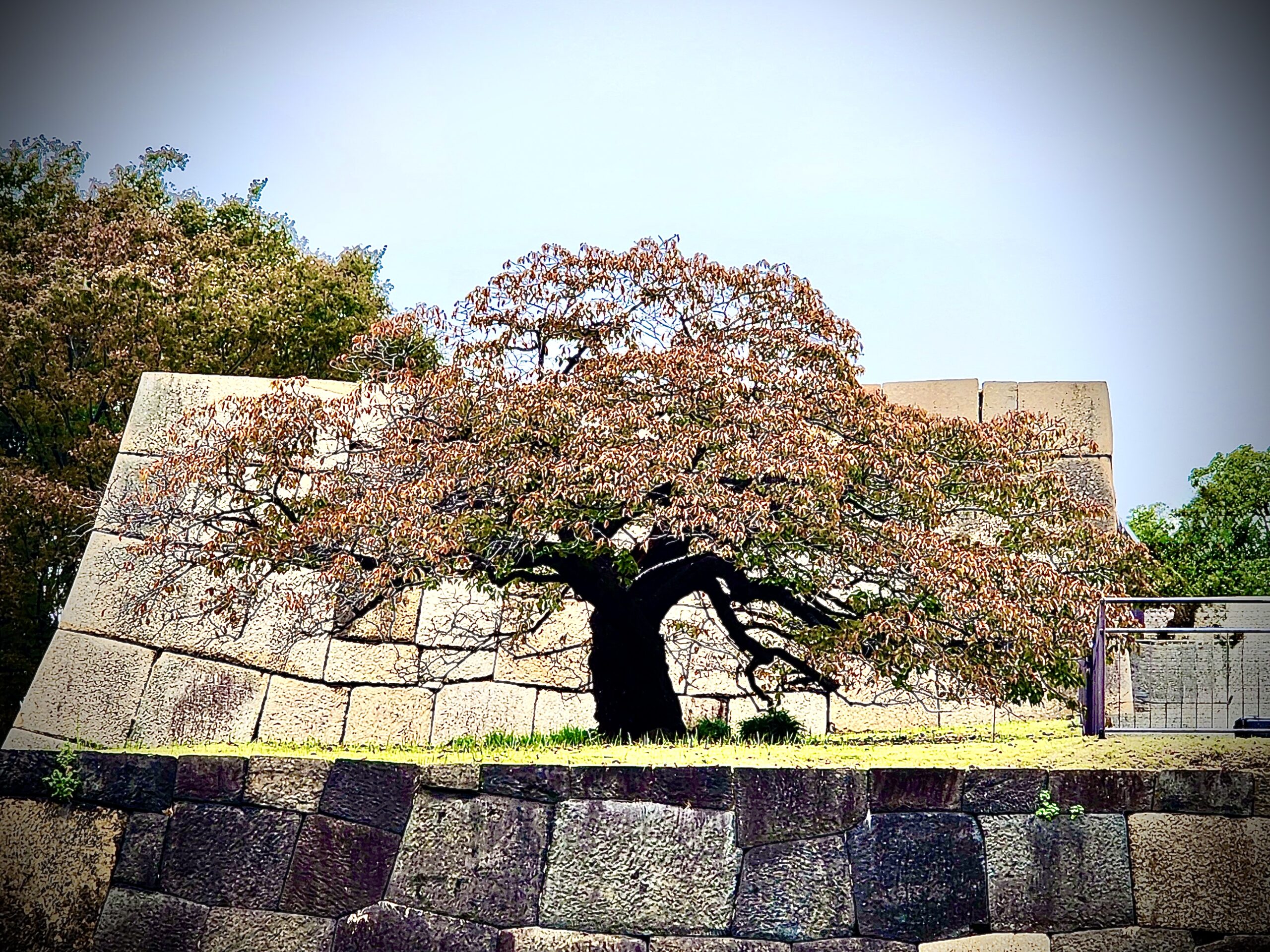
There’s something rather wonderful about that.
The castle is gone.
The shoguns are gone.
But the tree is doing very nicely, thank you.
Pines, Chrysanthemums, and a Garden Inside a City
The gardens themselves were extraordinary.
Beautifully shaped Japanese black pines spread their branches in carefully balanced forms.
Some leaned over ponds, their reflections almost as beautiful as the trees themselves.


There were camellias just beginning to bloom, with hundreds of tightly closed buds promising an extraordinary display in the coming weeks.
Not dozens.
Hundreds.
The plants seemed to be waiting for just the right moment.

And then there were the chrysanthemums.
Oh, the chrysanthemums!
These were not ordinary potted flowers.
They were extraordinary horticultural constructions, trained into great cascading arrangements called kengai-zukuri, or cliff-style chrysanthemums.
And here’s the astonishing part.
Each enormous cascade can be created from a single plant.
One stem, carefully trained and branched over a framework, eventually producing what looks like an entire waterfall of flowers.


The amount of patience and skill involved is almost beyond imagining.
It’s rather like bonsai, except that the final result is a glorious explosion of blossoms.
And then there was the garden itself.
A pond, sculpted trees, carefully placed rocks, and beautifully composed views.
Beyond the trees, modern Tokyo rose in glass and steel.

That juxtaposition seems to be one of Japan’s great gifts.
You can stand in a landscape designed to evoke centuries of quiet contemplation, while an enormous modern city continues its business just beyond the trees.
And somehow, both belong.
H is Here.
There is something else I haven’t mentioned yet.
At every temple we’ve visited, it seems that just as I arrive, a crow or raven settles into a tree above me.
Every single time.
Those who knew H will understand why this matters.
Ravens have long been one of the symbols I associate with him.
And here I am, halfway around the world, visiting places I’ve dreamed of seeing, and repeatedly hearing or seeing that familiar black bird overhead.
I even managed to photograph one.

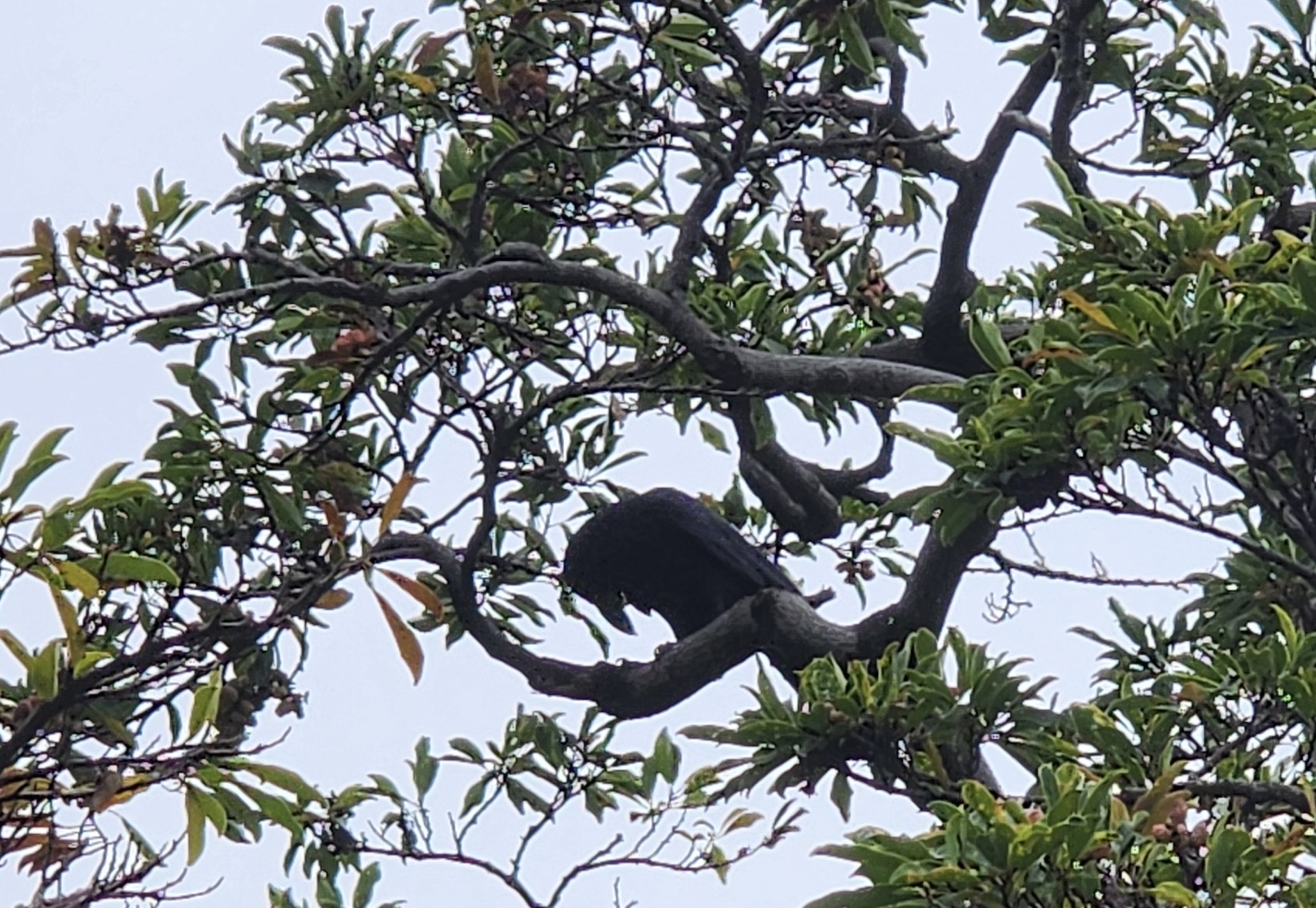
I don’t need to explain it further.
H is here.
An Exhausted Foot, a Grocery Store, and Ten Suspicious Salads
By midafternoon, my foot had had quite enough.
Even with wrapping, bracing, and every effort to be sensible, the cumulative walking was catching up with me.
At approximately 3:30, I declared the day’s sightseeing officially concluded.
I was IN.
But first, dinner.
After a taxi ride home from the Gardens with Linda, with a driver that insisted that we were staying at the exact wrong hotel (thankfully Linda had our actual correct hotel’s business card), I collected Lynn, and we made another expedition to the neighborhood grocery store.
This has become something of a ritual.
And I have discovered that Google Translate is one of the greatest inventions in the history of international travel.
Because buying food in Japan when you cannot eat fish is an adventure all its own.
You would think a salad would be safe.
Ha!
Apparently, fish can find its way into almost anything.
Dashi. Bonito. Fish extracts. Fish sauce.
Even a perfectly innocent-looking vegetable salad may have a surprise lurking in the ingredients.
So I stood there with my phone, translating one label after another.
And another.
And another.
I must have investigated ten different salads before finding two that appeared to contain no fish whatsoever.
One turned out to be a cold acorn-squash salad.
The other was essentially a selection of pickled radishes.
Not exactly what I would have predicted for dinner in Tokyo.
But no fish.
SOLD.
I added an egg-salad sandwich, a red bell pepper, an orange, and, naturally, a bottle of Cabernet Sauvignon.
A perfectly respectable international dinner.
And then we went home.
Tokyo, in All Its Contradictions
Looking back on these two days, I’m struck by how many different versions of Japan we’ve encountered.
Enormous sumo wrestlers and exquisitely trained chrysanthemums.
Archers carrying ancient weapons through modern subway stations.
A seventeenth-century castle reduced to stone foundations, surrounded by one of the world’s largest cities.
A temple illuminated with digital projections one evening, then filled with people quietly performing centuries-old rituals the next morning.
And a foreign visitor who came to collect a little sacred calligraphy and somehow ended up teaching handwashing.
There’s also the reality of travel.
Feet get tired.
Maps become confusing.
Hotel mirrors are installed in inexplicable places.
And sometimes dinner is a collection of supermarket discoveries eaten in your room.
But perhaps those are the things that make a journey feel real.
Not just the monuments, the ceremonies, and the extraordinary sights.
The little surprises.
The people.
The unexpected connections.
The moments when something you’ve read about or practiced at home suddenly becomes part of your day.
And the occasional enormous wrestler who discovers that the tall American woman is willing to try a leg hook.
Tomorrow, we leave Tokyo and head for Hakone.
I suspect there will be more stories.
But for tonight, my foot is resting, my Cabernet is poured, my suitcase is in the lobby waiting to be whisked away to Kanazawa, and I’m quite content to let the sumo wrestlers have the last word.
After all, I may not have won the match.
But I certainly surprised the competition.