
Goodbye, Tokyo — But First, a Little Shrine
After several wonderfully busy days in Tokyo, it was time to leave the city behind and head toward Hakone.
But before saying goodbye to Asakusa, I wanted to share one little discovery tucked beside our hotel, The B Asakusa.
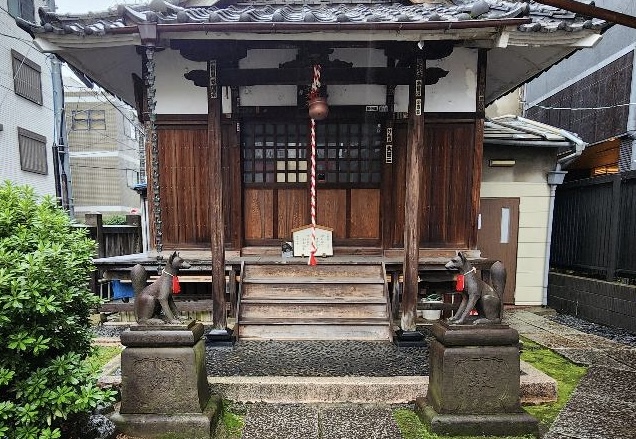
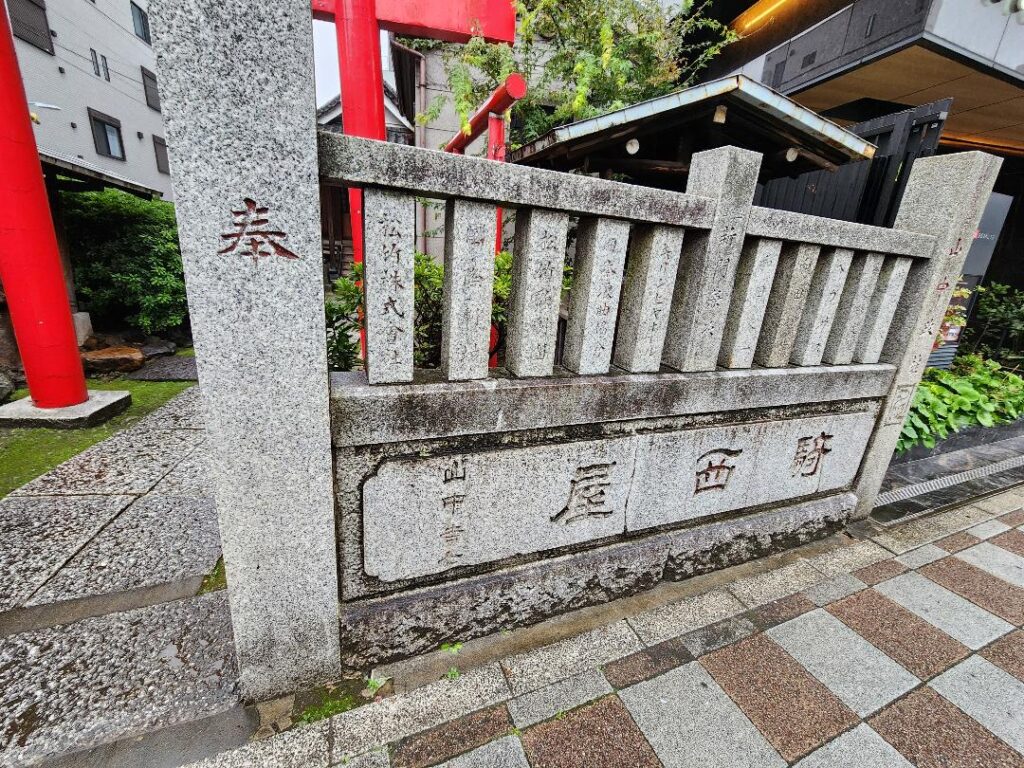
There, squeezed between modern buildings, was a tiny Shinto shrine, with a brilliant vermilion torii, a narrow stone approach, and a pair of foxes standing guard.
Foxes are traditionally associated with Inari, the Shinto deity connected with rice, agriculture, and prosperity, so we suspected it was an Inari shrine, although we never did learn its actual name.
I love these little discoveries in Japan. One minute you’re walking past contemporary hotels and busy streets, and the next you’re standing in front of a sacred space that seems entirely untroubled by the city growing around it.
A small, quiet farewell to Tokyo.

A Strong Little Boy Along the Way
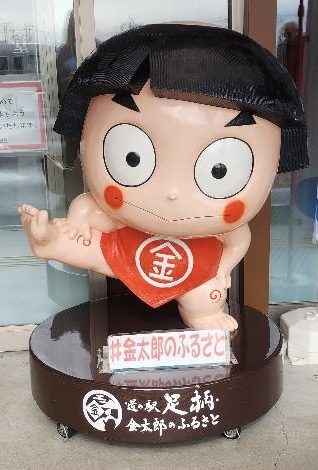
On our way out of Tokyo and toward Hakone, we stopped at a small grocery store, where we encountered a rather familiar-looking fellow standing outside.
A large, cheerful cartoon boy, one leg raised high in what looked suspiciously like a sumo warm-up stomp!
Turns out this was Kintarō, the legendary Japanese strong boy, famous for his extraordinary strength and associated with sumo wrestling. His pose reminded us immediately of the shiko exercise we’d watched the sumo wrestlers perform just two days earlier.
Apparently, even the grocery stores in Japan are determined to reinforce our cultural education.
A Day in the Life: Among the Tea Leaves
One of the things O.A.T. does particularly well is its “Day in the Life” experiences, where we get to spend time with local people and learn something about their everyday lives. Today’s visit was to a Japanese farmer who grows rice, vegetables, and, most importantly for our purposes, green tea.
And not just any green tea. He had recently won an award in Paris for his tea, so we were about to learn from someone who REALLY knew what he was doing!
The farm, Kaiseicha (Sunshine Tea), was nestled among the hills, with beautifully tended rows of tea bushes stretching across the landscape. We were introduced to the farmer and his helpers, then taken out into the fields to try our hands at harvesting.
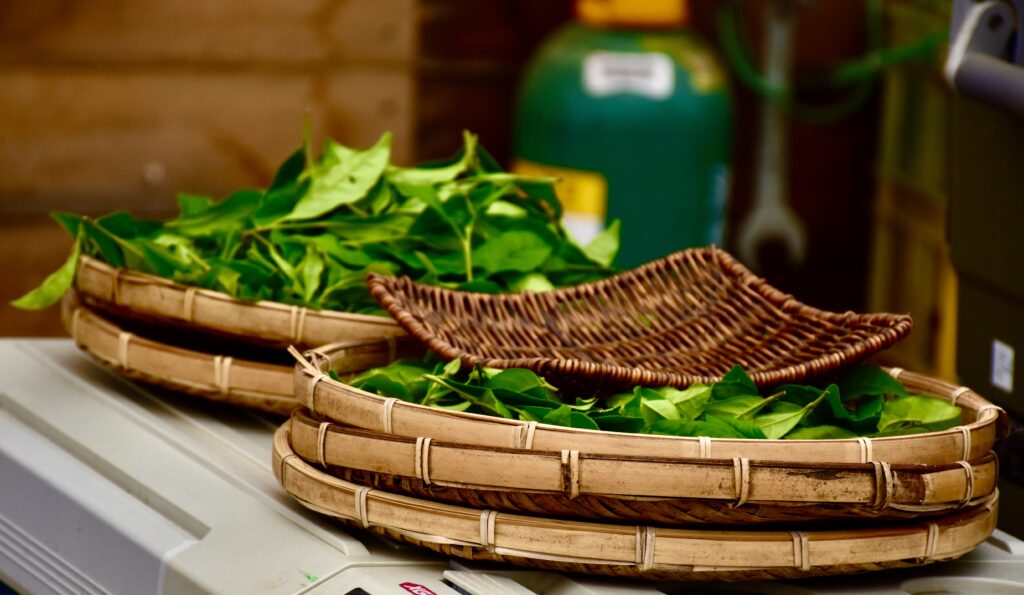
The secret, we learned, is to select the tender new growth at the very top of the plant — the top three leaves. These are the young, delicate leaves that produce particularly fine tea.
Sounds simple enough, doesn’t it?
But imagine doing that, bush after bush, row after row, day after day. Suddenly, that lovely cup of green tea begins to look like a rather remarkable achievement.
We each gathered a little collection of leaves, which would later make a surprise appearance at lunch — as tempura! (And yes, they were delicious. Nom nom.)


Mechanical Harvesting — and an Unexpected Lunch Guest
Of course, picking tea leaves individually is a rather labor-intensive business, so the farmer also showed us how the tea is harvested mechanically.
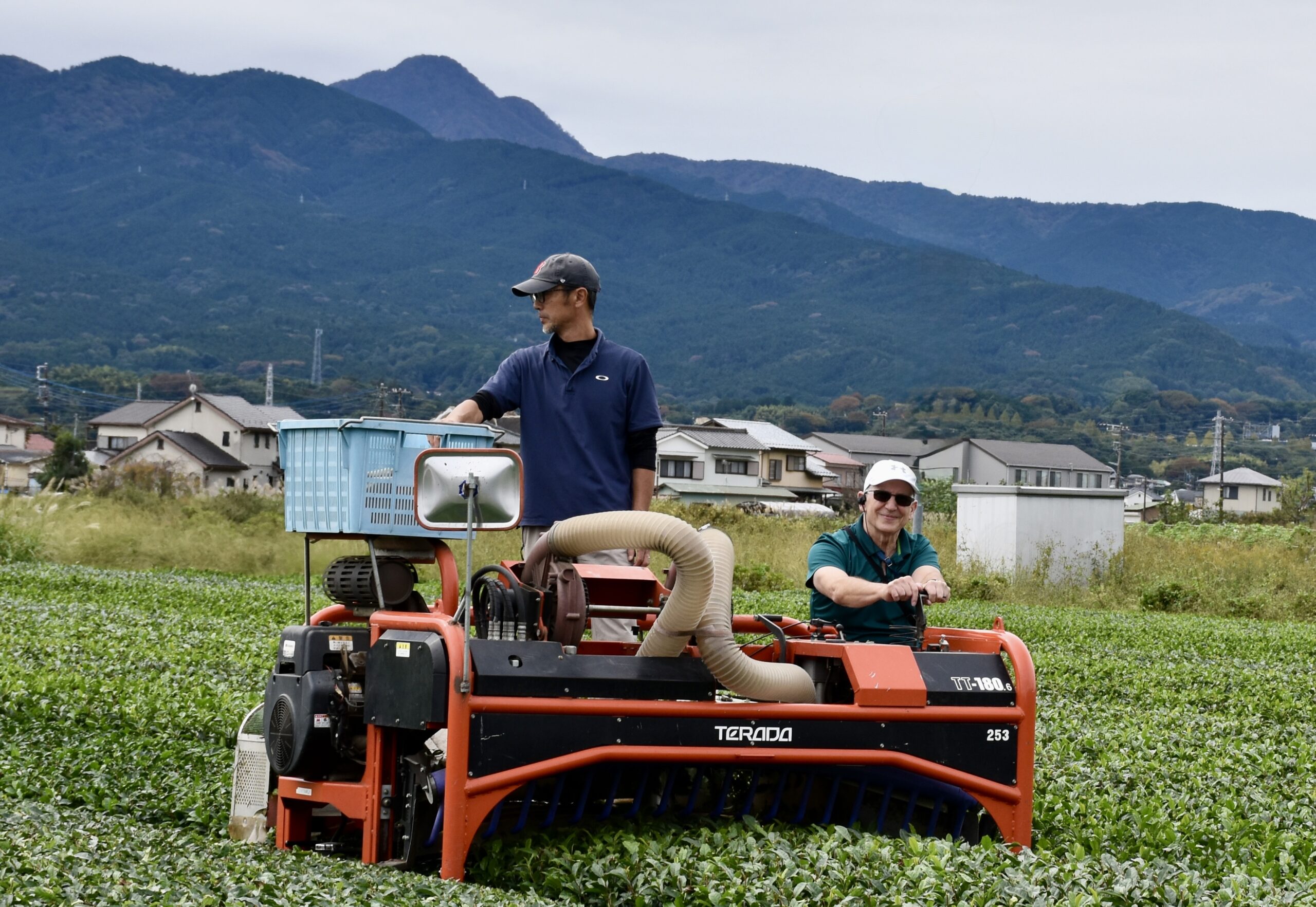
Michael even got to climb aboard the tea harvester, a wonderful contraption that travels along the neatly trimmed rows, shaving off the tender new growth. Rather more efficient than a bunch of tourists wandering around with little baskets!
But the machine wasn’t the only one benefiting from this arrangement.
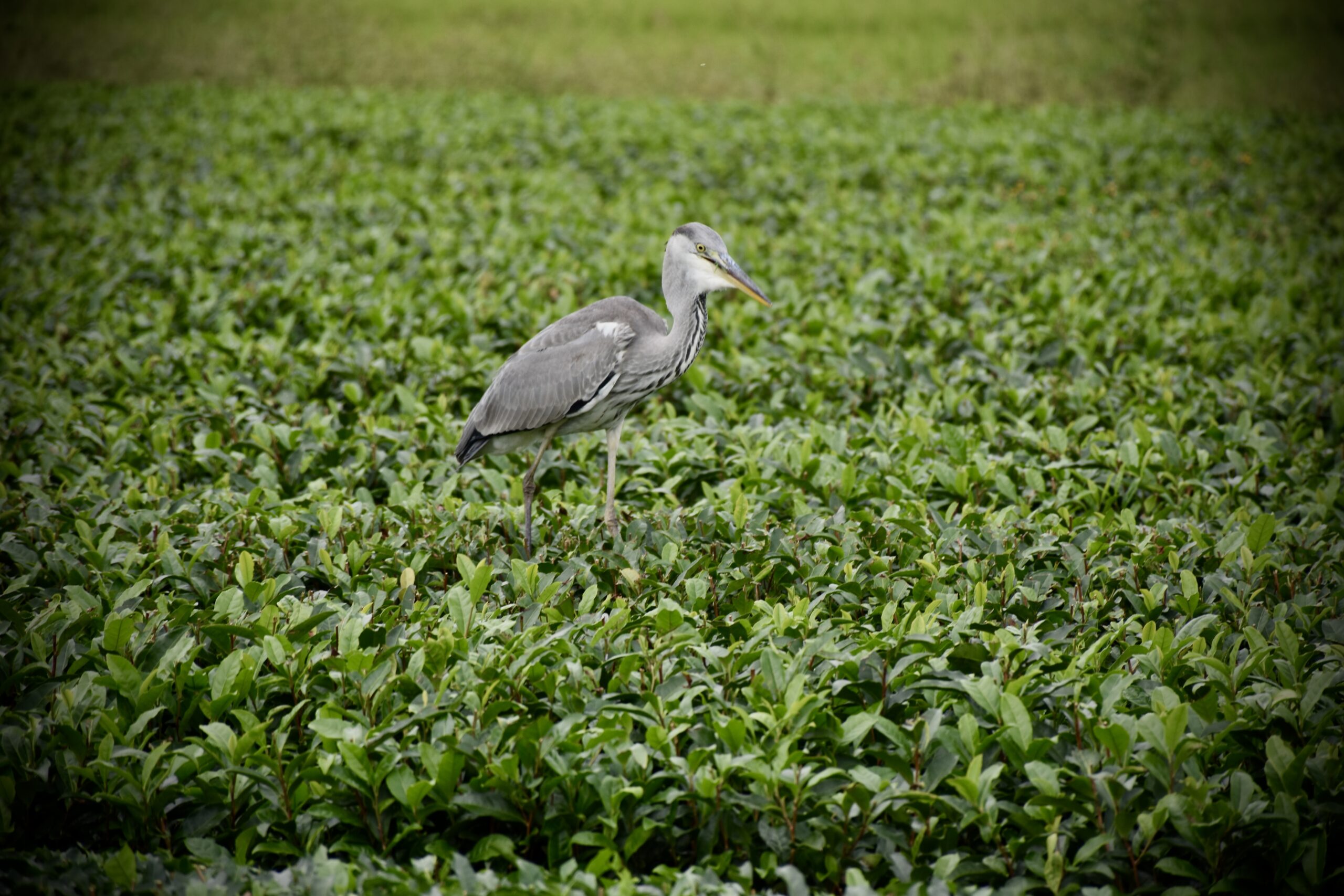
There was a beautiful gray heron standing among the tea bushes, looking rather dignified and entirely at home. I watched him apparently plucking something green from the plants and took several photographs, thinking I had captured a heron eating tea leaves.
It wasn’t until I downloaded the photographs and looked at them closely that I discovered what was really happening.
Those weren’t tea leaves. They were GRASSHOPPERS!
As the harvester moved through the bushes, it disturbed the grasshoppers hiding among the leaves, and our enterprising heron was deftly snatching them up for an afternoon snack.
Apparently, the farmer wasn’t the only one who had figured out how to make the most of mechanization.


B&B Tea: A Lesson in Leaf Manipulation
Having picked our tea leaves, it was time to learn how those innocent little green things become something worth drinking.
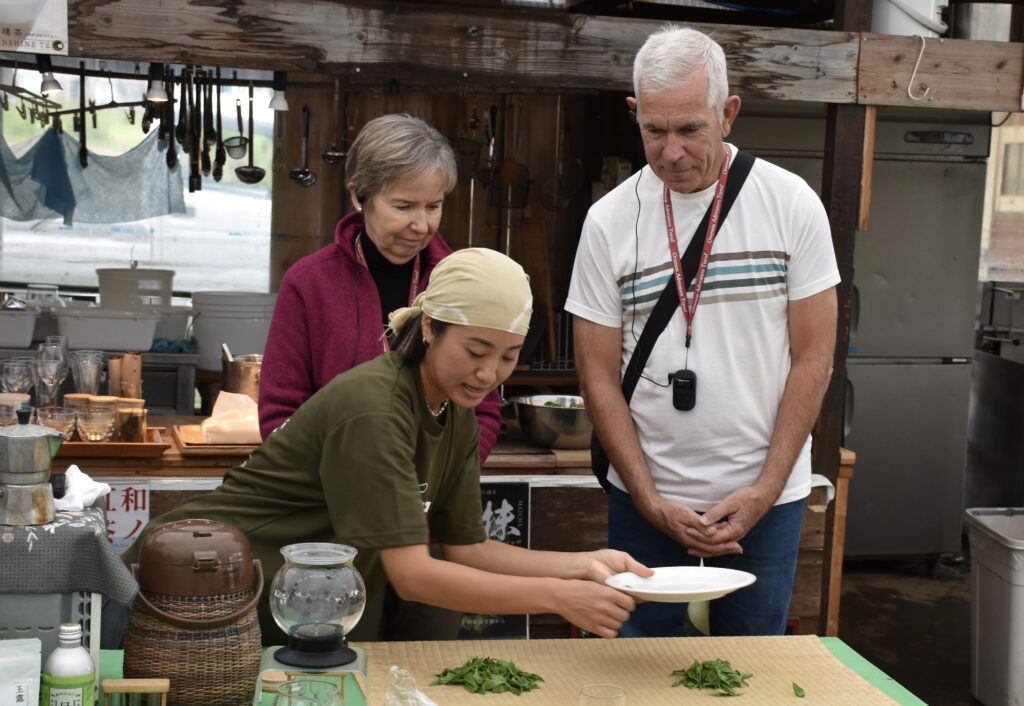
Our instructor explained that making Japanese green tea involves several steps, beginning with steaming the leaves to stop oxidation. For our demonstration, she employed a rather modern substitute for the traditional steaming equipment: a microwave, with the leaves covered in plastic film.
Then came the REALLY hard part.
Knead. Knead. KNEAD.
The leaves have to be rolled and worked repeatedly to break down their cell walls and release the compounds that give tea its flavor. This isn’t a gentle little massage. It’s serious leaf manipulation!
Bailey and Bernard volunteered to be our tea makers, and they attacked the job with admirable enthusiasm. After the first round of kneading, the leaves went back for more heating, followed by more kneading. And then another round.
Finally, it was time for the taste test.
First, we sampled “B&B” Tea, the product of all that enthusiastic leaf wrestling.
Well.
Let’s just say it was very vegetal.
Quite green. Quite leafy. Quite possibly still contemplating its former life on the bush.
Then we tasted the farmer’s professionally prepared, award-winning green tea.
WOW.
Smooth, beautifully balanced, rich with flavor, and absolutely delicious. The difference was extraordinary.
Apparently, there is rather more to making excellent green tea than squashing leaves with determination.
I suspect Bailey and Bernard may wish to keep their day jobs.




Tea-Leaf Tempura, Farm-Fresh Lunch, and a Perfect Little Discovery
After our adventures in tea production, we sat down to a lovely meal featuring produce grown right there on the farm: fresh persimmons, kiwis, salad, and other delicious things.
And remember those tender tea leaves we’d so carefully picked?
They returned to us as tempura!
Yes, you can eat tea leaves. And yes, they’re delicious. Light, crisp, and just a little bit green-tasting. Nom nom.
We also saw the delicate white flowers of Camellia sinensis, the tea plant, with their cheerful golden centers. It’s rather remarkable that this modest-looking plant gives us green tea, black tea, oolong, and so many other varieties, depending on how its leaves are processed.
But there was another little discovery that made me particularly happy.
The grandmother of one of the young women helping us in the tea fields had made a collection of things to sell — coasters, purses, little bags, and other handmade treasures.
And there, among them, was the PERFECT bag for my goshuinchō!
My precious shrine-and-temple stamp book had been traveling around in its original paper cover, which was becoming increasingly bedraggled in all this Japanese rain. The new bag had a drawstring top and fit the book beautifully.
I was ridiculously pleased. (Although, considering how much I love collecting these stamps, perhaps not so ridiculous after all.)
And then I found a second little drawstring purse, made from fabric decorated with dragonflies — tonbo in Japanese.
And made of the exact same fabric of the tabi shoes Dr. Scott Sensei gave me!
Well, obviously, that one had to come home with me too.
Sometimes the best souvenirs aren’t the ones you go looking for. They’re the ones that seem to have been waiting for you.
A 300-Year-Old Farmhouse: Persimmons, Hearths, and Harvests
After saying goodbye to our tea-farming hosts, we continued to a completely separate stop: a beautifully preserved Japanese farmhouse approximately 300 years old, offering a glimpse into traditional rural life.
It was something of a living-history exhibit, with its architecture and furnishings preserving the atmosphere of generations past.
Outside, persimmons hung in orderly rows beneath the eaves, suspended from bamboo poles and slowly drying into hoshigaki. As the peeled fruit loses moisture, its natural sugars become concentrated, eventually producing an intensely sweet, chewy delicacy.
It was an extraordinarily pretty sight: rows of glowing orange fruit against weathered dark wood. Functional food preservation, yes, but also an accidental art installation.


Inside the Farmhouse: A Little Window into Another Century
Stepping inside the farmhouse felt rather like stepping backward in time.
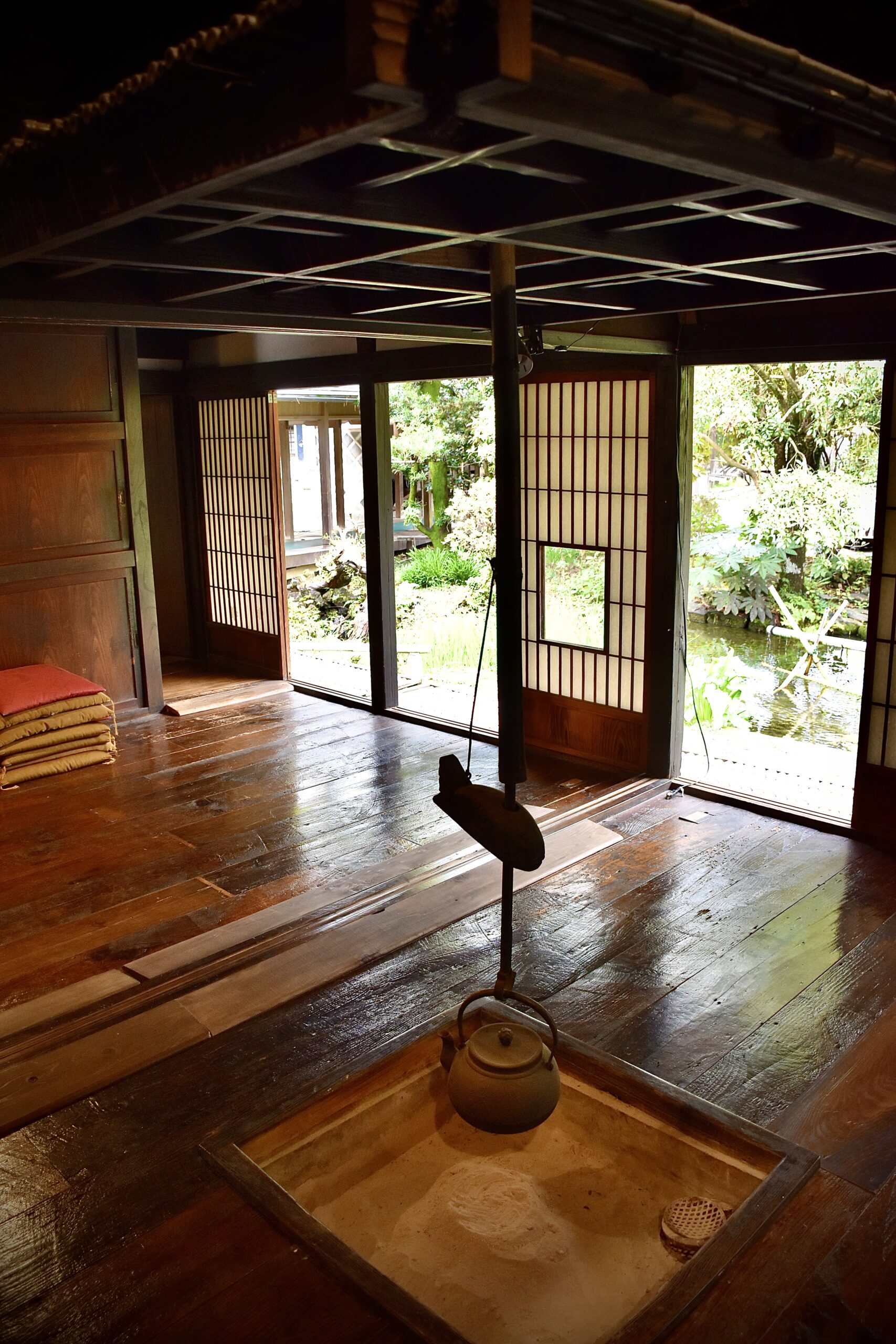
The beautiful dark wooden beams, polished floors, and traditional furnishings spoke of a very different way of living — one in which the hearth was quite literally the center of the home.
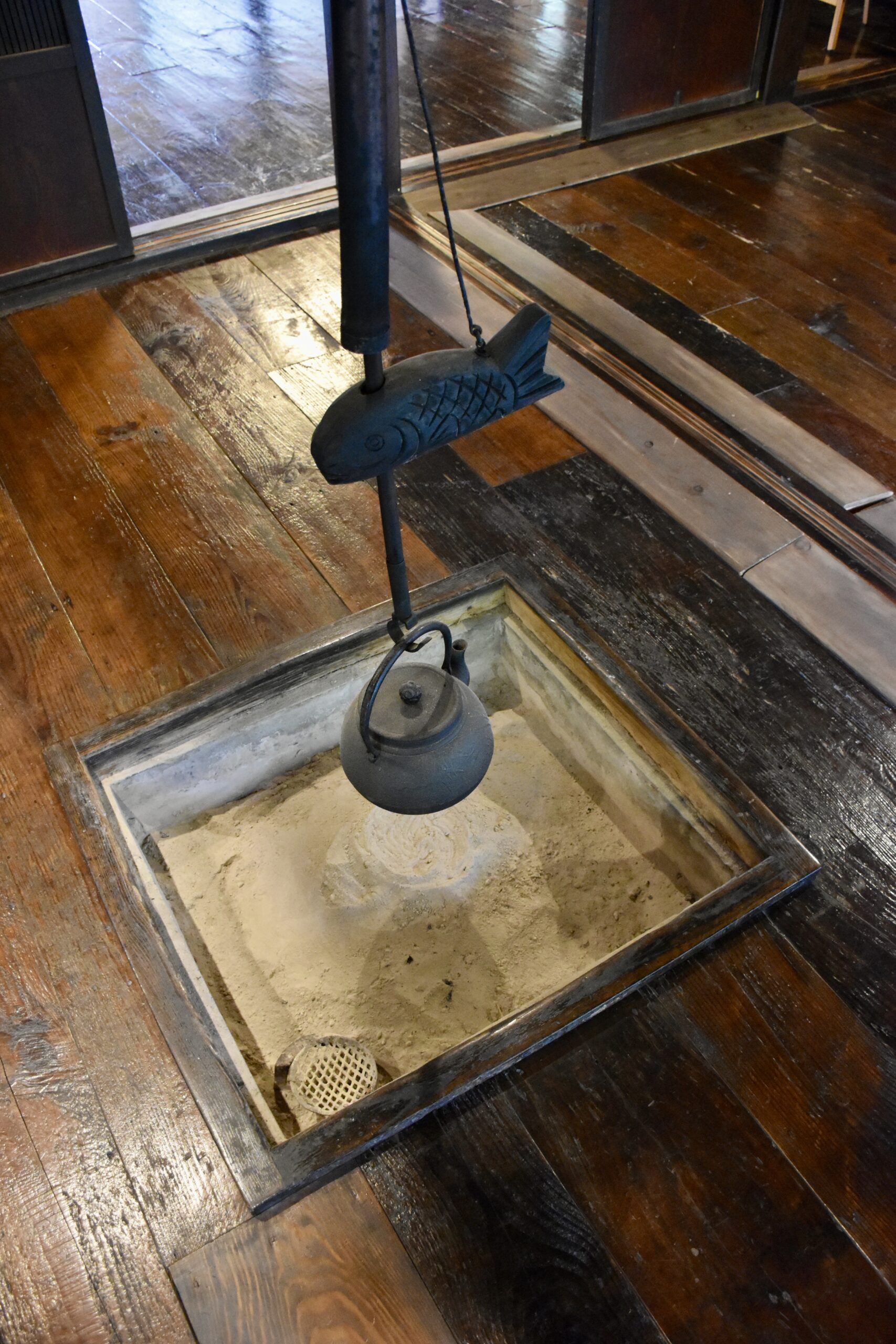
There was an irori, a traditional sunken hearth, with an iron kettle suspended above it from an adjustable hook called a jizaikagi. I particularly loved the fish-shaped ornament on the hook. Fish, being creatures of water, were traditionally associated with protection against fire — a very sensible bit of symbolism in a house constructed largely of wood!
There were also lovely seasonal arrangements, including chrysanthemums, gourds, and autumn vegetables, displayed in the traditional Japanese manner. Several occupied tokonoma, the special alcoves used to display flowers, scrolls, and other objects chosen to reflect the season.
Nothing seemed casually placed. Even the vegetables had been given an opportunity to be beautiful.


And then I found a particularly lovely spot.
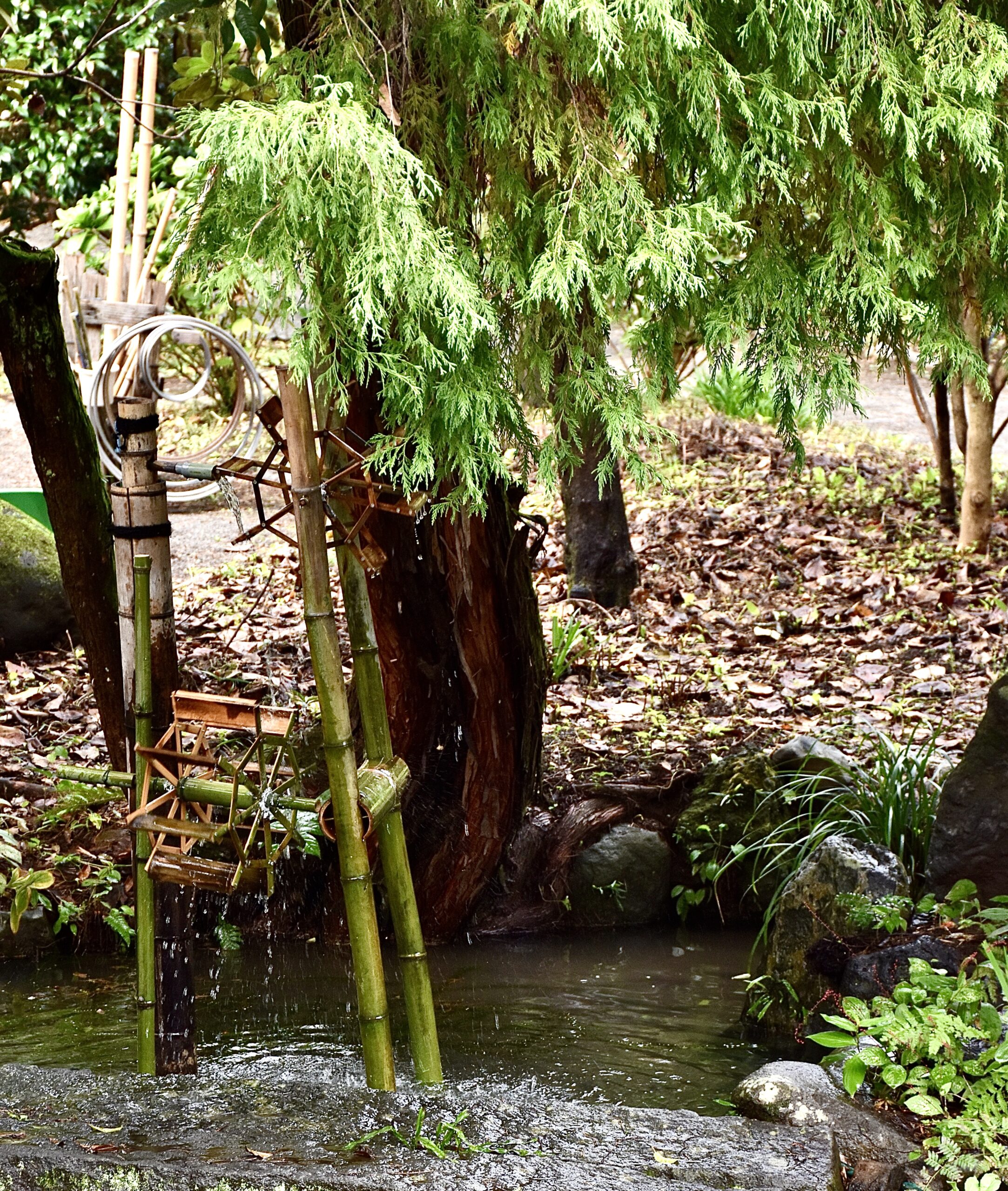
I was able to sit quietly on a pillow kindly placed on the tatami mats, and look out toward one of the waterwheels, enjoying a few minutes of stillness before it was time to return to the coach.
After days filled with extraordinary sights, crowds, temples, shrines, and the constant motion of travel, there was something deeply satisfying about simply sitting.
No photographs to take. No explanations to absorb. No place I needed to be for those few minutes.
Just an old farmhouse, a waterwheel, and a little pocket of peace.
Winding Roads and Remarkable Coincidences
Back on the coach, we began climbing higher into the mountains toward Hakone.
And climbing.
And turning.
And turning AGAIN.
The road seemed to consist almost entirely of hairpin bends, with the occasional short straightaway thrown in to give us false hope. Fortunately, there was good company to distract us from contemplating just how far up we were going.
I’ve been spending quite a bit of time with Deborah and Doug, a delightful couple from the Seattle area, and as we chatted, we discovered something rather extraordinary.
Deborah’s birthday is September 21. Mine is September 22.
Okay, that’s a fun coincidence.
But then we discovered that Doug’s birthday is February 22. Herbert’s was February 23.
WHAT?!
Two couples, with both partners’ birthdays just one day apart!
We had quite a laugh over that one. Sometimes the most unexpected connections happen halfway up a mountain, while everyone is trying very hard not to wonder about other cars coming down the slim road.
Getting Into Hot Water — Properly
Eventually, we reached our hotel, perched WAY, WAY up in the hills.
One of the pleasures of staying at a traditional Japanese-style hotel is the opportunity to enjoy an onsen, a bath fed by naturally heated mineral water. But, as with so many things in Japan, there is a proper way to do it.
Utako-san gave us a demonstration.
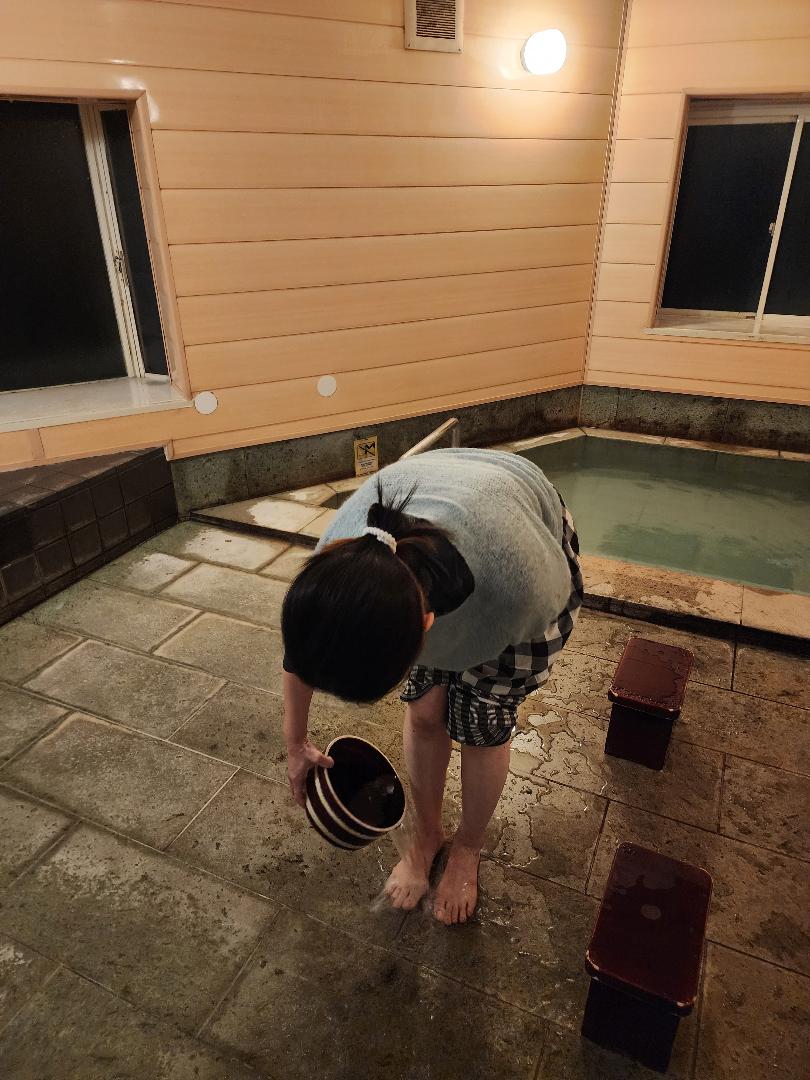
First, you scrub yourself thoroughly clean outside the bath. The soaking water is shared, so you must be very clean before you indulge.
Then, before stepping into the hot water, you scoop up some of that water and pour it over your feet and legs, gradually getting them accustomed to the temperature. This is part of a practice called kakeyu.
A very sensible idea, particularly if the bath is hotter than you’re expecting.
First Into the Onsen!
Now, Lynn and I had already come downstairs wearing our yukata — the Japanese cotton robes provided by the hotel — and slippers. We were READY.
And when Utako-san finished demonstrating the proper procedure, we noticed that only the private onsen baths were available.
So we waited.
Casually.
Until everyone else had departed.
Then we slipped inside, locked the door, and claimed the honor of being the first two people in our group to enjoy the private hot spring!
Ahhhhh.
The water was pleasantly warm, perhaps 94°F, rather than the scalding temperatures I’d half expected. We soaked, relaxed, and congratulated ourselves on our excellent timing.
Sometimes the early bird gets the worm. Sometimes she gets the entire onsen.
Kaiseki: A Little Dinner Theater
That evening, we gathered for a traditional Japanese kaiseki dinner, a beautifully presented succession of small dishes celebrating seasonal ingredients.
For the fish eaters, there was quite a selection, including puffer fish (fugu) — which I was perfectly happy to admire from a distance, thank you very much!
But one of the most entertaining parts of the meal was something we all received.
Each of us had a little ceramic cooking contraption, with a small solid-fuel burner underneath and a shallow bowl filled with chicken and vegetables. Another ceramic bowl sat upside down on top, forming a lid, complete with two little leather cords for lifting it.
The waiter lit the fuel, and we waited while our individual dinners quietly cooked away.
When the flame finally went out, he returned, lifted the lid by its leather cords, and poured beaten egg over the hot chicken and vegetables, allowing the residual heat to cook it as the final addition.
Dinner AND a science experiment!
We finished with a lovely pumpkin custard — a perfect autumn dessert.


Samurai Hats, Paper Cranes, and the Call of the Blog
After dinner, Utako-san gathered those who still had energy for a lesson in origami: folding paper into samurai hats and cranes.
A very Japanese way to finish the evening.
But Lynn and I had other plans.
We headed back to our room, leaving the paper-folding to the more industrious members of the group.
After all, there were photographs to sort, stories to remember, and a blog to write.
And after a day of tea picking, grasshopper-hunting herons, three-hundred-year-old farmhouses, winding mountain roads, hot springs, and a dinner that cooked itself, there was rather a lot to write about.
The blog called.
And, naturally, I answered.
(Although I suspect the onsen was the wiser choice.)