
Sunday, November 1, 2026
Well, THAT was an interesting night.
Last evening’s welcome dinner was at a yakitori restaurant, where everything is grilled on skewers. Because of my finfish intolerance, I confined myself to skewers with chicken with leeks, and asparagus. What could possibly go wrong?
Apparently, quite a lot.
I suspect something fishy had previously occupied the same grill, because my digestive system decided to stage what can only be described as The Big Expel.
I spent a substantial portion of the night in the room’s “little room,” becoming much more intimately acquainted with its facilities than I had ever intended. Thank goodness for Imodium, which is rapidly establishing itself as one of my more valuable traveling companions.
Nevertheless, morning arrived, and so did I. More or less.
Into Yanaka — With Utako Leading the Way
Our destination was Yanaka, one of Tokyo’s older neighborhoods, and getting there involved a subway ride preceded by a rather elaborate journey through the streets around our hotel.
There were turns, more turns, covered shopping arcades (shōtengai), crowds of Sunday shoppers, and at least one moment when I realized that, left to my own devices, I would probably still be wandering around Asakusa looking for the correct subway entrance.
Fortunately, we had Utako-san, our wonderful guide, identifiable by her red beret and her apparently inexhaustible knowledge of how to get from Point A to Point B in a city that seems determined to provide Points C through Z along the way.
Yanaka is particularly interesting because much of it escaped both the devastating Great Kantō Earthquake of 1923 and the firebombing of Tokyo during World War II. As a result, it retains something of the character of an older Tokyo: narrow streets, small shops, traditional buildings, and a wonderfully human scale.
It was busy — Sunday, after all — but nothing like the crowds around Asakusa.
And then there were the cats.
Yanaka has become rather famous for them, both real and artistic. The neighborhood is also home to the Asakura Museum of Sculpture, formerly the home and studio of Fumio Asakura, who was particularly known for his cat sculptures.
I photographed some delightful cat-patterned kimono fabric for Basia, and then spotted a white cat sculpture perched above a shop, its tail dangling down as though it were surveying the neighborhood and finding the entire business mildly amusing.
A very catlike attitude, really.


Rice Crackers, Courtesy of Utako
At one little shop, Utako treated us to Japanese rice crackers, or senbei.

These came in a rather astonishing variety of flavors: chili pepper, matcha, sesame, seaweed, and sugar-dusted, among others.
I selected the sugar-dusted variety.
What I especially loved was seeing the woman behind the counter who had made them. There is something so appealing about buying a small treat from the person responsible for creating it, rather than picking up an anonymous package from a supermarket shelf.
And, of course, there was Utako, in her red beret, making sure we all had something tasty.
A Cemetery, a Love Hotel, and an Extremely Hasty Retreat
One of our stops was a small neighborhood cemetery, where Utako explained some of the traditions surrounding Japanese burials.
Japanese funerary practices are generally Buddhist, and cremation is overwhelmingly the norm. Families often maintain a grave that holds the cremated remains of several generations, with descendants returning to clean the grave, leave flowers, burn incense, and pay their respects.
It is a different relationship with burial grounds than the one many of us are accustomed to in the United States. Rather than being simply the resting place of one individual, a family grave can become a continuing point of connection between generations.
And then, shortly after discussing death and the ancestors, Utako introduced us to an entirely different aspect of Japanese life.
A LOVE HOTEL.
Specifically, Hotel Ai.
Now, ai (愛) means “love” in Japanese, so the name is rather wonderfully straightforward.
Utako explained that love hotels developed partly in response to the realities of Japanese housing, where several generations might live together and privacy could be in rather short supply.
After all, romance becomes a little more complicated when otōsan and okāsan — Dad and Mom — are on the other side of a very thin wall.
Love hotels provide private rooms, often with soundproofing, which couples can rent for a few hours or overnight.
Hotel Ai’s sign advertised two-hour “SHORT TIME” visits, three-hour “REST” periods, and overnight accommodations.
I particularly enjoyed the terminology.
“Rest.”
Yes, of course.
And then came the moment that made the entire stop unforgettable.
As Utako was explaining the establishment to our little group of curious tourists, a man walked out of the hotel.
He took one look at us — a group of foreigners standing outside, listening with great interest to an explanation of exactly what this hotel was for — and promptly turned on his heel and walked STRAIGHT BACK INSIDE.
WHOOPSIE.
Apparently, our educational field trip was not quite the discreet atmosphere he had been expecting.
I don’t know whether he was waiting for us to leave or contemplating a more elaborate escape route.
But I do hope he eventually managed to get out.


And Now a Commercial Break/a TikTok Production
Part of the entertainment waiting for our dinner last night was another form of entertainment — a young woman in an alley who was clearly filming some sort of TikTok video.


She was entirely absorbed in her performance, apparently oblivious to the fact that an entire group of people was waiting nearby to get into the restaurant.
There she was, doing her thing.
With her cat ears.
And her tail.
And there we were, standing patiently while the production continued.
I have no idea whether we eventually appeared as bewildered background extras in somebody’s viral masterpiece.
But I suppose there are worse ways to make one’s TikTok debut.
Back to Today, and Lunch, or: Lynn Versus the Volcano
Utako had arranged lunch at a local restaurant, and once again she worked her magic with my dietary restrictions.
My special, off-menu lunch consisted of a bowl of white rice and an absolutely ENORMOUS salad.
And I do mean enormous.
It contained green and red grapes, hard-boiled egg, melon, cucumber, cherry tomatoes, and a few pieces of grapefruit cleverly disguised as melon. I discovered those by surprise.
Several of the other women regarded my salad with what I can only describe as considerable envy.
Meanwhile, Lynn had ordered something advertised as coming with “hot pebbles.”
This turned out to be a sizzling beef dish served in a stone bowl heated to approximately the temperature of the Earth’s core.
The beef was still cooking against the inside of the bowl. The bowl itself was so hot that Lynn had to wrap the little restaurant washcloths around her hands to maneuver it.
And even then, she kept accidentally touching the sides.
There was sizzling from the beef, occasional startled reactions from Lynn, and the distinct possibility that lunch might require either oven mitts or emergency services.
I am not entirely certain whether the bowl was intended to cook the beef or the customer.
Possibly both.
Ueno Park, the Valkyries, and the Swords
After lunch, we boarded a local bus for Ueno Park.
It was slow, crowded, and full of people, but I was struck again by how considerate everyone was of one another. Even when public transportation is packed, there seems to be a remarkable awareness of the people sharing the space.
Linda (from Atlanta) and I spent the entire ride crouched over her phone, keeping track of the Valkyries/Dream game. We could only get to the live score updates, so it will be amazing to see the YouTube “best moments” later. The Valkyries managed to pull it out, in what (from our Japanese local bus, score only vantage point) seemed like a Heck of a game. Go Valkyries!
After a walk through Ueno Park, serenaded by a steel drum band playing Beethoven (!) at break neck speed, we ultimately reached the Tokyo National Museum.
Now, for someone who practices iaido, the opportunity to see actual Japanese swords — not reproductions, not photographs, but the real things — is irresistible.
Naturally, I made a beeline for the sword gallery.
There were blades hundreds of years old, displayed with extraordinary care. What is remarkable about them is how deceptively simple they can appear at first glance. A long, beautifully curved piece of steel, perhaps with only the faintest suggestion of a tempering pattern along its edge.
And yet every detail represents generations of accumulated knowledge.
One particularly beautiful tachi blade was made by Tomonari in the thirteenth century, during the Kamakura period. According to the museum, it probably belonged to Tokugawa Ieyasu, the warlord who established the Tokugawa shogunate.
Imagine that: a sword already centuries old when Ieyasu possessed it, and still here for us to admire.
The museum explained that Tomonari came from Bizen Province, one of Japan’s great centers of sword production. The blade’s graceful curvature and subtle steel pattern were lovely.
There were also magnificent sword mountings, including one with elaborate gold decoration and striking turquoise-blue accents. Another had a beautifully wrapped brown handle, with diamond-shaped openings revealing the ornamentation beneath, and wonderfully intricate metal fittings.
Given that I have spent rather a lot of time recently designing my own second iaito, Acala, I found myself examining the handle wrapping, guards, and decorative details with more than casual interest.
It is one thing to select fittings from a catalog.
It is quite another to stand in front of examples of the artistry that inspired them.
And of course, while my own swords are used for the practice of iaido rather than combat, seeing these historical blades makes the connection between our movements and their origins feel much more immediate.
The swords we practice with are not simply equipment.
They belong to a tradition stretching back hundreds of years.


But another sword captured my attention for an entirely different reason.
It was also a thirteenth-century blade, probably made by a swordsmith of the Taima school in Nara. Centuries later, it came into the possession of Ōkubo Ichiō (1818–1888), a samurai and statesman who was also a poet.
And what did he do?
He inscribed one of his poems directly onto the tang of the sword.
There it was, visible in the display: delicate gold-colored writing running along the old steel, a personal expression preserved on a weapon that had already survived centuries of history.
A sword and a poem.

Once the blade was fitted into the handle, only he would know it was there. I found that moving.
There was also a naginata blade, displayed without the long pole on which it would originally have been mounted.
A naginata is a Japanese polearm, with a curved blade attached to a long shaft. It is quite different from the swords we use in iaido, although it belongs to the same broad world of Japanese martial traditions. It was generally used by samurai women, to protect their homesteads.
Seeing the blade on its own was particularly interesting because it allowed me to concentrate on the shape and craftsmanship of the steel rather than the weapon as a whole.

Two Scrolls, Two Very Different Voices
From the swords, I moved into the galleries devoted to Japanese painting and calligraphy.
And this was another part of the museum I had particularly wanted to see.
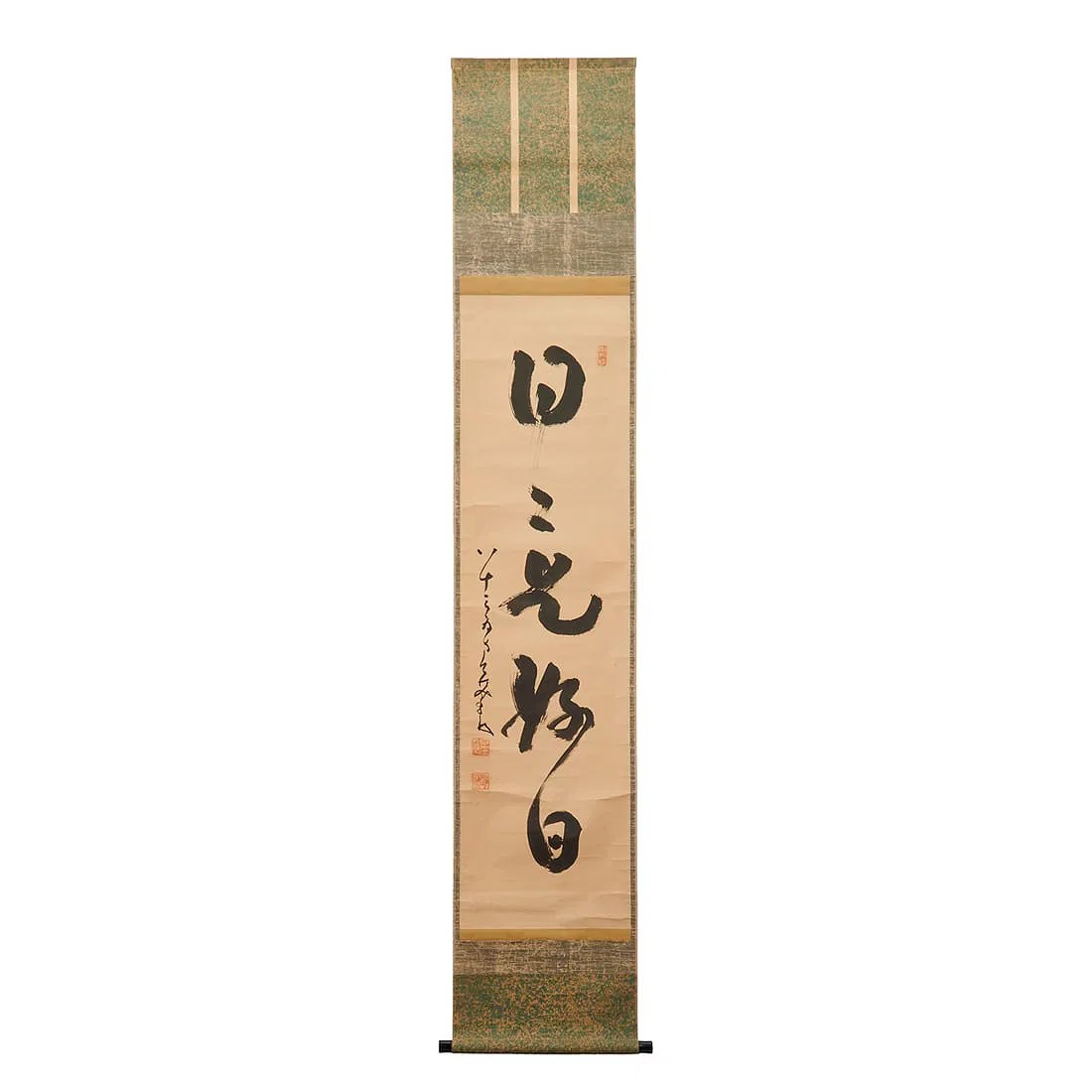
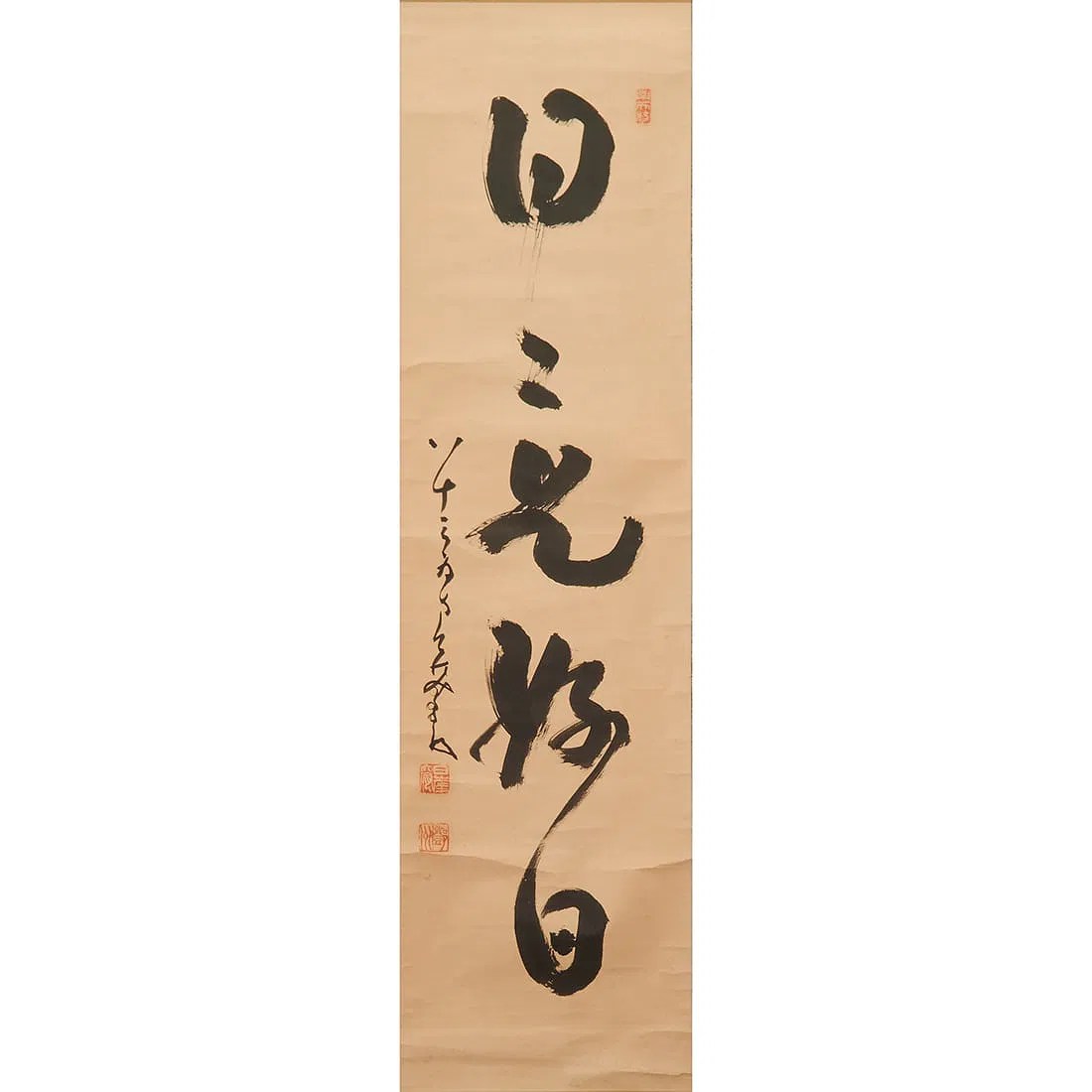
Recently, I acquired a large hanging calligraphy scroll by Nakahara Nantenbō (1839–1925), a Rinzai Zen master who was born into a samurai family and became famous for his vigorous, almost explosive brushwork.
My scroll was painted when he was 83 years old, using traditional Japanese age reckoning.
It consists of five enormous characters expressing a famous Zen teaching:
Every Day Is a Good Day.
The phrase is associated with the Chinese Chan master Yunmen Wenyan, and its meaning is rather more interesting than the cheerful sentiment it might initially suggest.
It does not mean that every day is pleasant, or easy, or free from difficulties.
It means that each day is the day we have, and that we should meet it fully rather than insist it become something else.
Nantenbō believed that large calligraphy should be executed in a single breath, drawing its energy from the hara, the center of the body.
When you look at his work, you can almost feel that energy coming through the brush.
It is bold, immediate, and utterly unafraid of taking up space.
So I was particularly interested in seeing the museum’s own large calligraphy scrolls, some of them over six feet tall like mine, with characters that seemed to leap off the paper.
There is something thrilling about standing in front of writing that is not merely meant to be read, but felt.
And then there was the other kind of scroll.
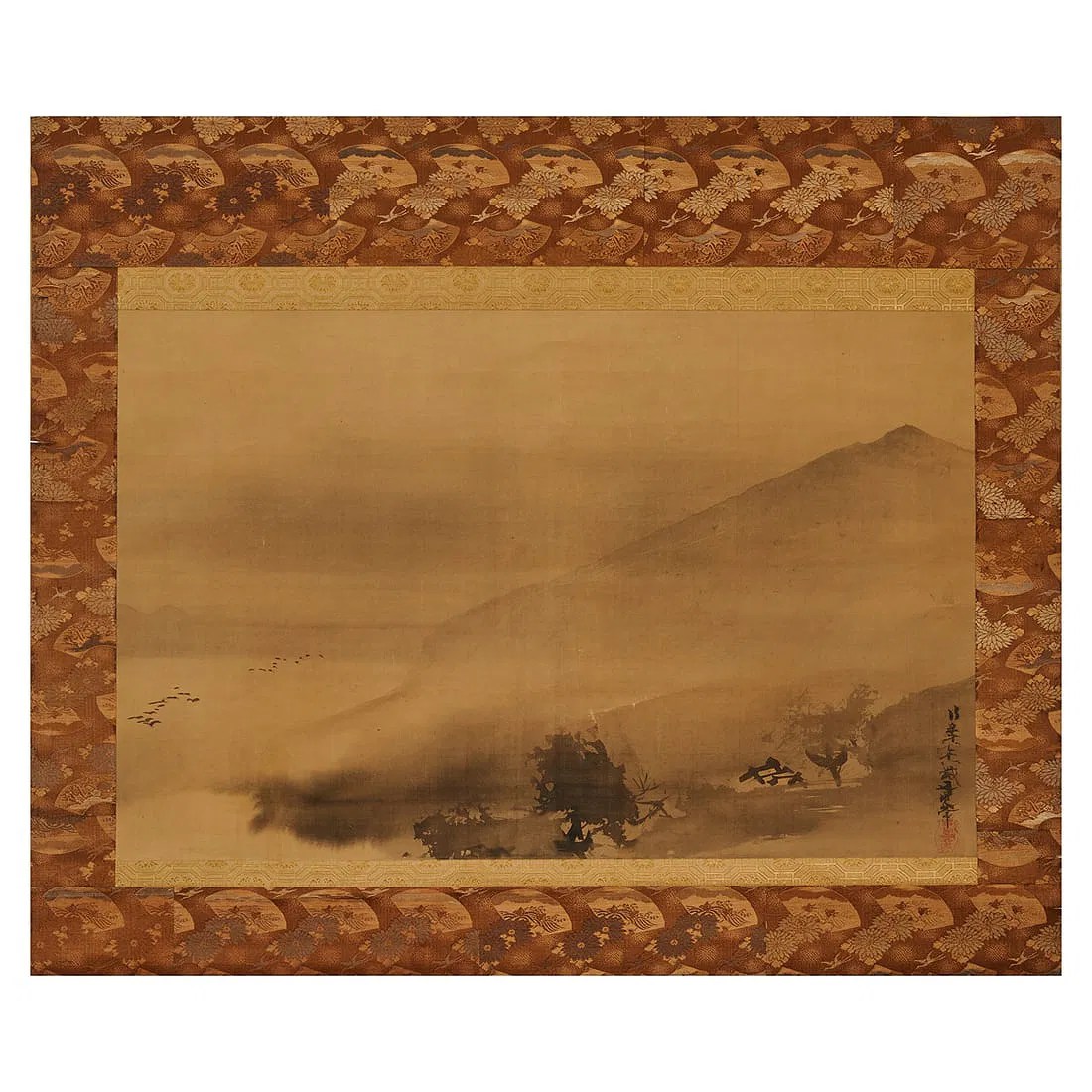
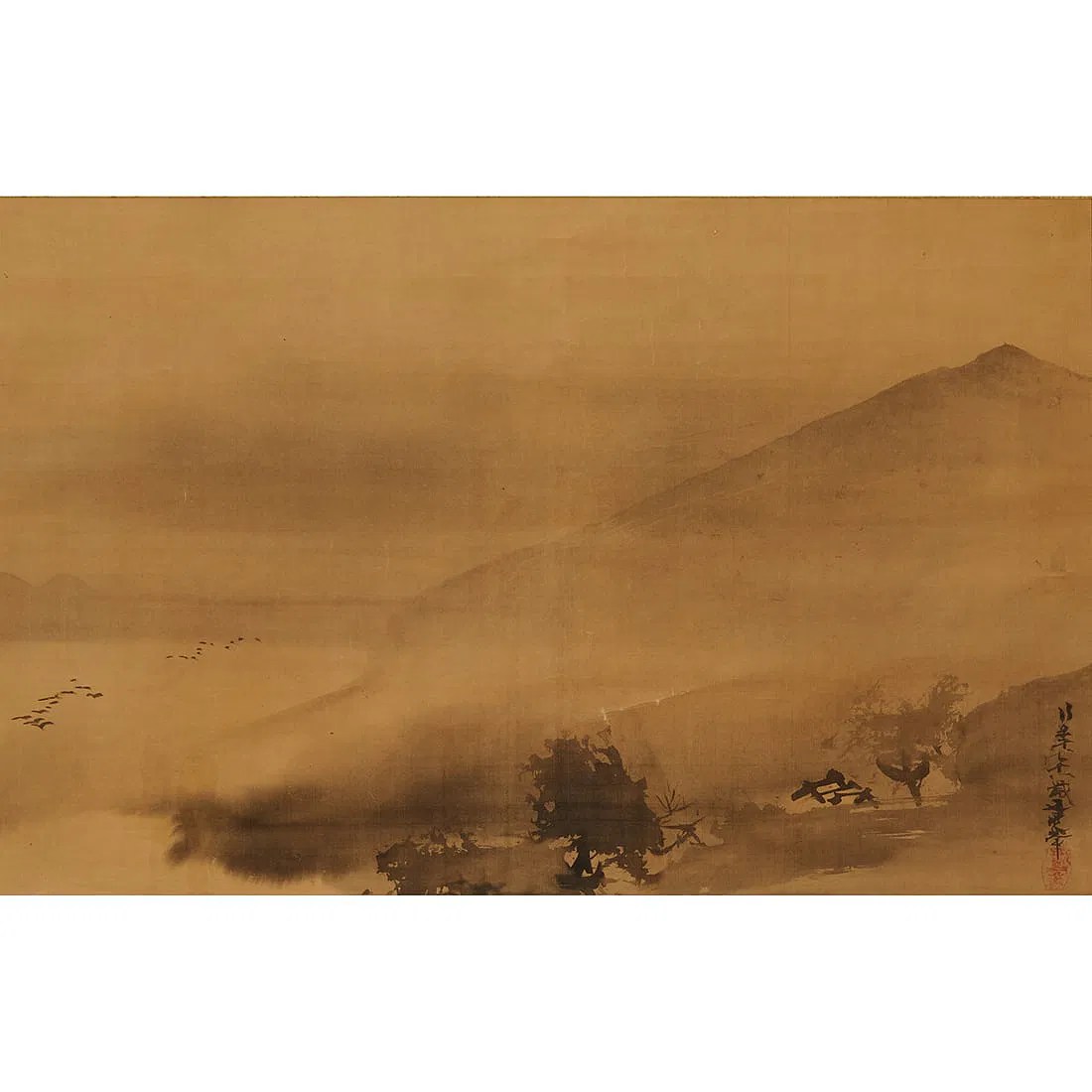
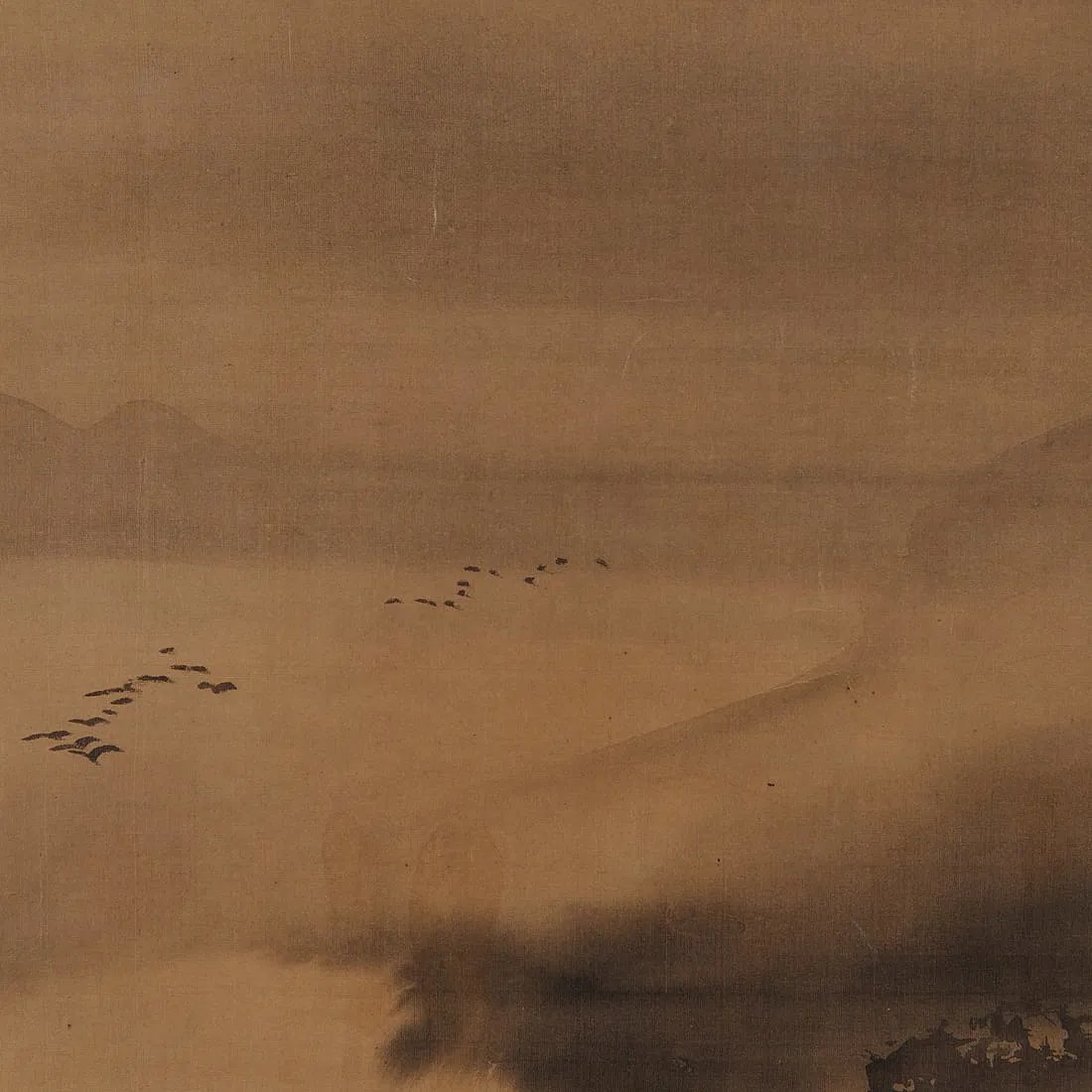
I also recently acquired a beautiful Japanese landscape painting, almost the opposite of Nantenbō’s explosive calligraphy.
In this one, mountains dissolve into mist. Dark trees frame a tiny dwelling near the water. Two little flocks of wild geese cross a vast, open sky.
Much of the painting is, in a sense, nothing.
Empty space.
Mist.
Distance.
But that emptiness is precisely what gives it its power.
I found myself looking at the museum’s landscape scrolls, hoping to encounter something that spoke to me in the same way.
There were certainly beautiful examples.
But none quite did.
Which was rather a lovely realization, actually.
I have two Japanese scrolls at home, and they could hardly be more different.
One is all force and presence, an old Zen master throwing his entire being into five enormous characters.
The other is almost a whisper: mountains, mist, birds, and the suggestion of a world continuing quietly beyond the edges of the paper.
And somehow, I love them both.
Perhaps they represent two ways of approaching the same thing.
Sometimes we meet the world with all our energy.
And sometimes we simply become still enough to see it.
The Museum Shop — And Lynn’s Timely Intervention

Before leaving the museum, we wandered into the gift shop.
Now, most museum shops are dangerous places for me under the best of circumstances.
But this one had something especially alarming.
A ramp leading up to an entire SECOND FLOOR.
DEVOTED TO BOOKS.
Just books.
Beautifully arranged shelves and shelves of them.
I looked up.
Lynn looked at me.
And Lynn, displaying the sort of practical judgment that has probably saved us both considerable time and expense during our travels, informed me that I was NOT going up there.
Apparently, she was concerned that if I disappeared into an entire second floor of books, she might never see me again.
She may have had a point.
But I still think it was a little harsh. 🙂
A Diabolo, a Camera, and the Continuing Adventures of Technology
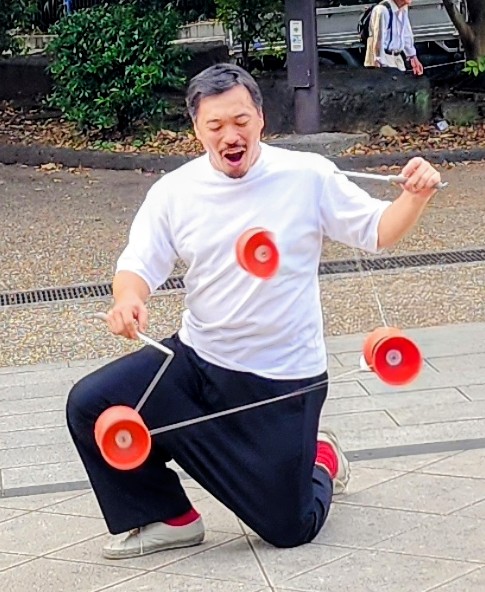
On our way back through Ueno Park, we stopped to watch a street performer doing astonishing tricks with diabolo — hourglass-shaped spools that spin on a string stretched between two sticks.
He sent them flying, caught them, spun them, and generally persuaded them to do things that seemed to defy several established laws of physics.
At one point he was balancing on one leg; at another he was practically kneeling, all while keeping the diabolo spinning and flying through the air.
And that enormous grin!
He was clearly having as much fun as the people watching him.
I took a whole series of photographs, and this is one occasion when I think they tell the story better together than individually.




Speaking of cameras…
You may recall that H’s camera suffered another broken protective lens filter, just as it did in South Africa.
The camera itself is fine, thank goodness, and is safely tucked into my big black puffer tote. But I need a replacement filter.
Utako actually found a camera shop near Ueno that carries them.
Unfortunately, in the excitement of the museum and everything else, we forgot to go.
We will be back in the area Tuesday.
At which point I intend to purchase TWO FILTERS.
One to use, and one to have ready for the next occasion when the universe decides that H’s camera needs another little adventure.
After a couple of subway stops and a walk back to the hotel, Lynn headed off to Don Quijote — affectionately known as Donki — in search of a replacement charging dongle for her Fitbit.
Unfortunately, she also discovered that Jim’s Android phone appears to have fallen out of an unzipped pocket.
That was genuinely upsetting.
Like me, Lynn travels with two phones: her own iPhone and the Android that belonged to her late husband. I have my Android and H’s iPhone.
These are not just spare pieces of technology.
They are little connections to people we love.
We talked about the possibility of her getting a Pixel Watch, which I have come to appreciate enormously. Google now owns Fitbit, so the transition makes some sense, and I love having notifications, Maps, Gemini, and fall detection right on my wrist.
I do still miss the elegance of my Withings watch.
But the Pixel does an astonishing number of things, and at least it doesn’t look like a petit-four strapped to your wrist.
There is that.
Tomorrow, Kamakura
Tomorrow’s optional excursion is to Kamakura, and the weather forecast is more than suggesting rain.
So the elegant haori I have been wearing will give way to my thoroughly practical REI rain jacket.
Not quite the same aesthetic, but then neither is arriving at a temple looking like a drowned rat.
Mostly, I am hoping for a good night’s sleep.
After last night’s gastrointestinal extravaganza, that would be a very welcome development.
Still, as I think back over the day — the old streets of Yanaka, the cats, the rice crackers, the cemetery, the love hotel (and its startled customer), Lynn’s volcanic lunch, the magnificent swords, the calligraphy, the quiet landscapes, the diabolo performer, and all the little mishaps along the way — I keep coming back to the words on my Nantenbō scroll.
The day certainly wasn’t perfect.
It began with a decidedly un-Zen amount of time spent in the bathroom.
But it was full of things worth seeing, learning, laughing about, and remembering.
And perhaps that is exactly the point.