
Sunday, November 8, 2026 — Gokayama, Toyama Prefecture
Today we left Kanazawa to venture into the mountains of Gokayama, where people have been living, working, and adapting to some fairly formidable winters for centuries.
Our itinerary promised a UNESCO World Heritage village, mochi pounding, traditional Japanese papermaking, and a visit to a 300-year-old house. What it delivered was all that, plus potential encounters with bears, some very slippery stairs, a lesson in how to make a tremendous racket with 108 pieces of wood, and yet another discovery about fish hiding where fish has absolutely no business being.
But first, the mountains.
Ainokura: A Village of Praying Hands
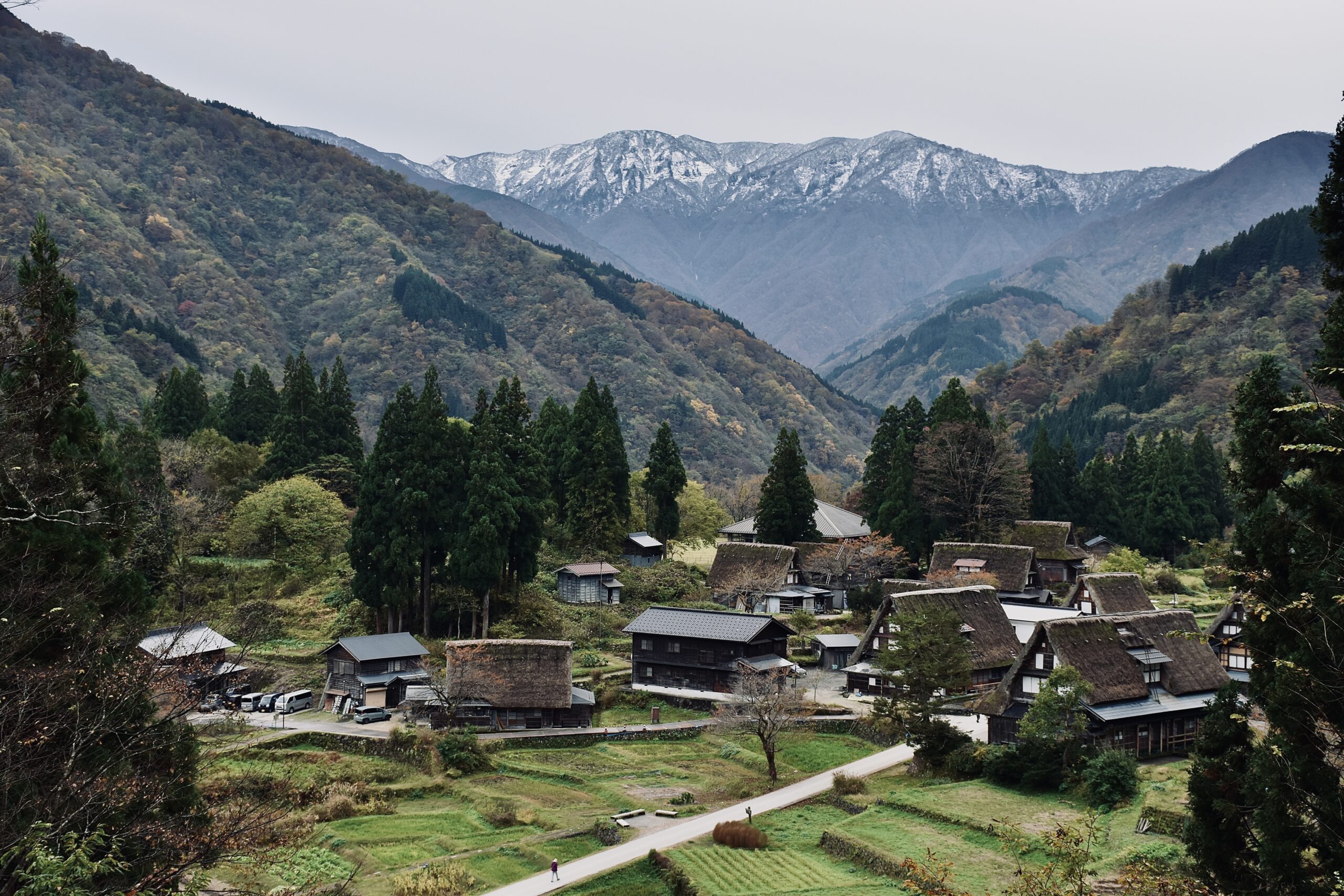
Ainokura is a small mountain village containing approximately 20 traditional gassho-zukuri houses. The name translates roughly as “constructed like hands joined in prayer,” referring to the extraordinary steeply pitched thatched roofs, which resemble two hands pressed together.
And indeed they do.
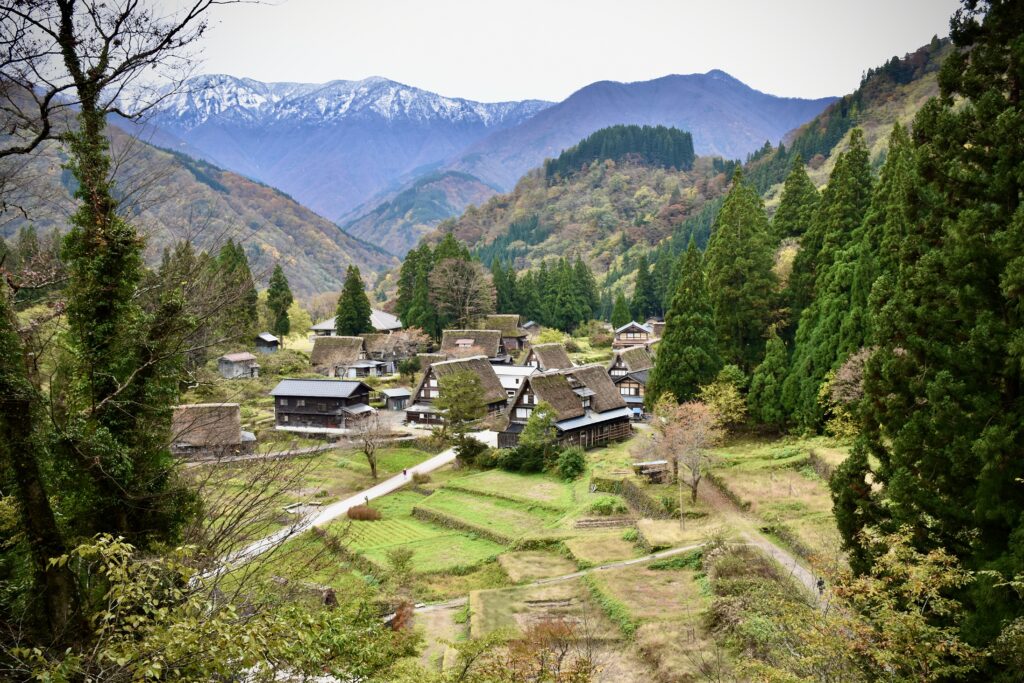
But these remarkable roofs aren’t merely picturesque. They evolved to cope with the enormous snowfall this region receives every winter. The steep angle, sometimes approximately 60 degrees, encourages the snow to slide off rather than accumulate until the roof collapses.
The houses were also much more than family homes. Their upper floors provided workspace for industries such as silkworm cultivation and papermaking. In a region where winter could effectively shut down much of the outside world, people made astonishingly productive use of the space beneath those huge roofs.
Ainokura is part of the UNESCO World Heritage designation shared with other historic gassho-style villages. What makes it especially remarkable is that people still live here.
This isn’t a movie set or a collection of buildings moved into an open-air museum. It is a living community, with residents going about their ordinary lives in houses that visitors have come from around the world to admire.


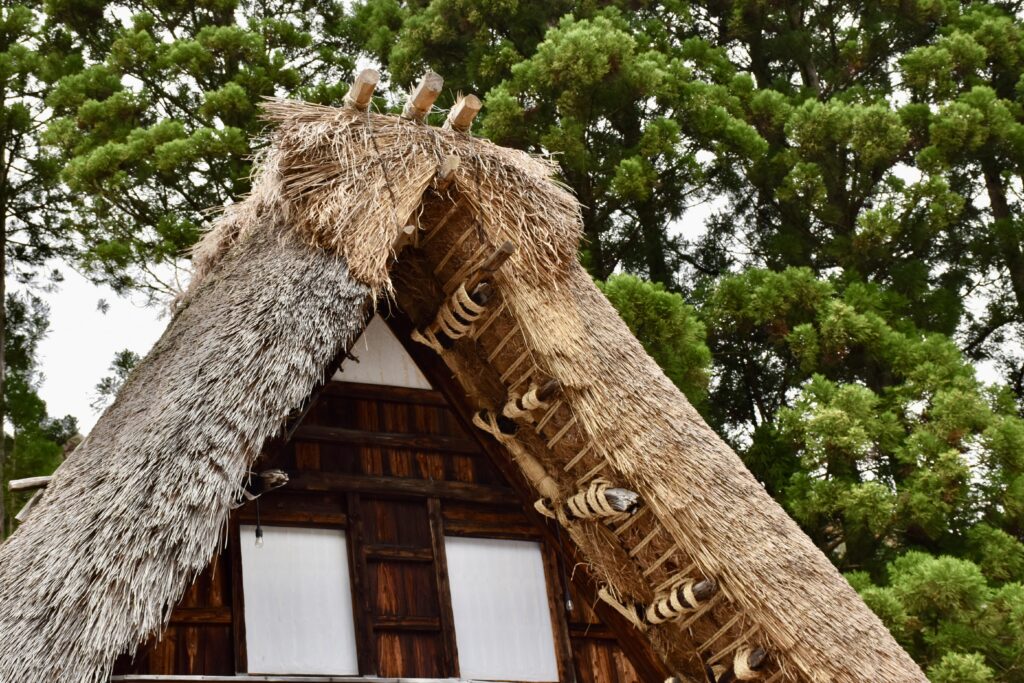
And there were reminders everywhere that these houses are both ancient and very much alive.
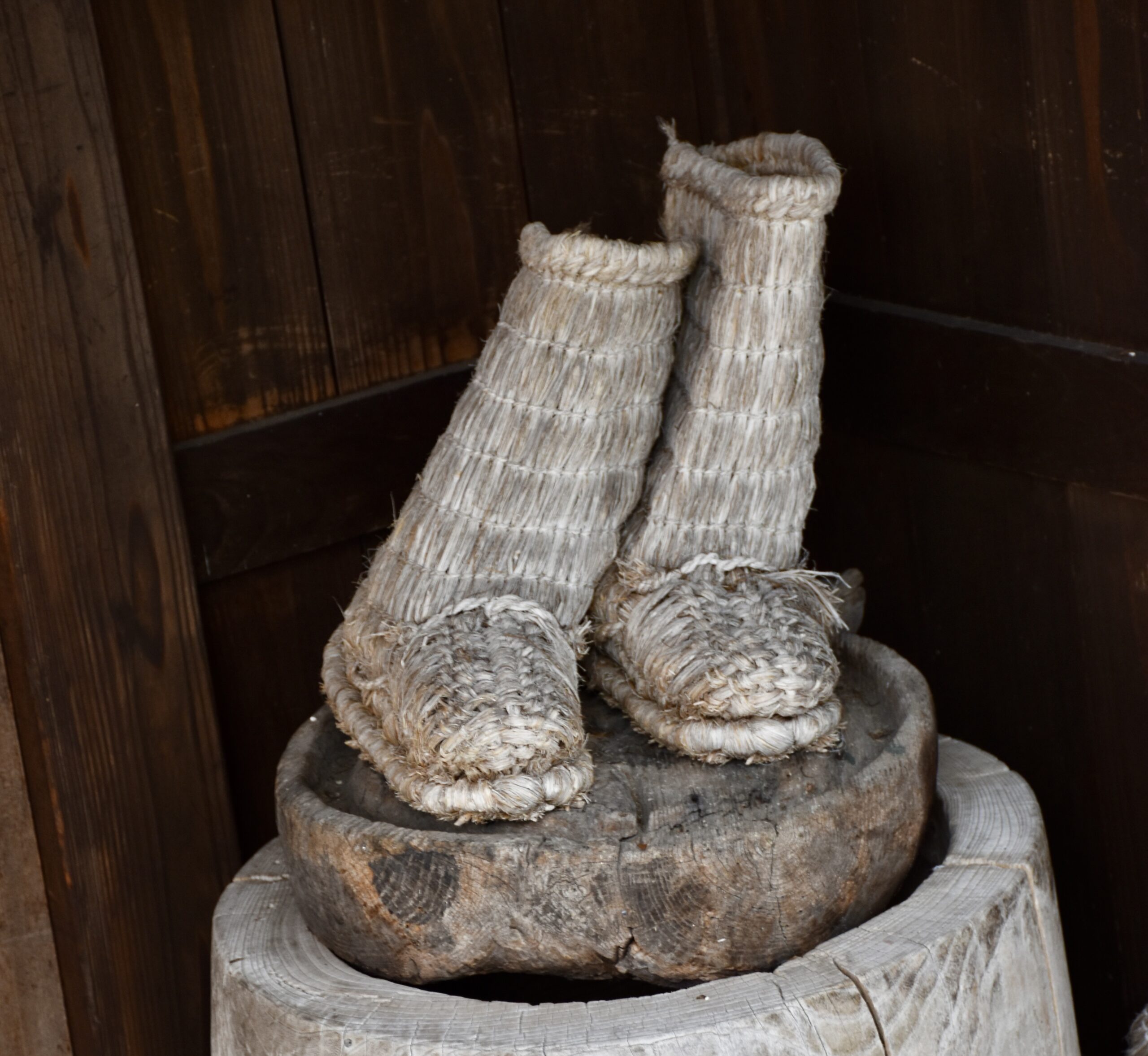
Persimmons were hanging to dry outside windows, turning into sweet winter treats. Traditional straw snowshoes and boots hung beside doorways. Bundles of thatching material were stacked outside buildings, ready for use. And, tucked discreetly into the eaves, there were occasional concessions to modern living (see if you can find it, above).
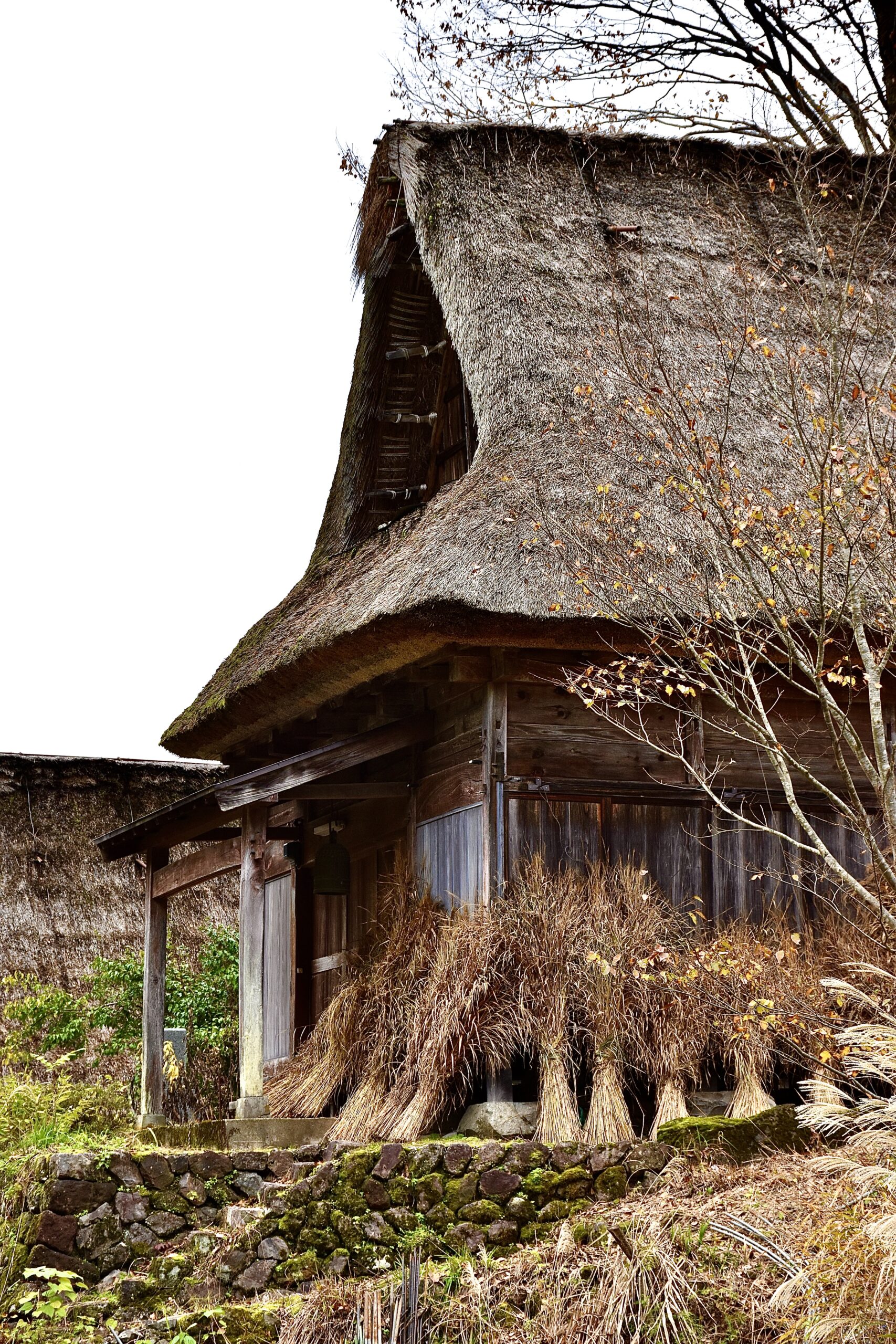
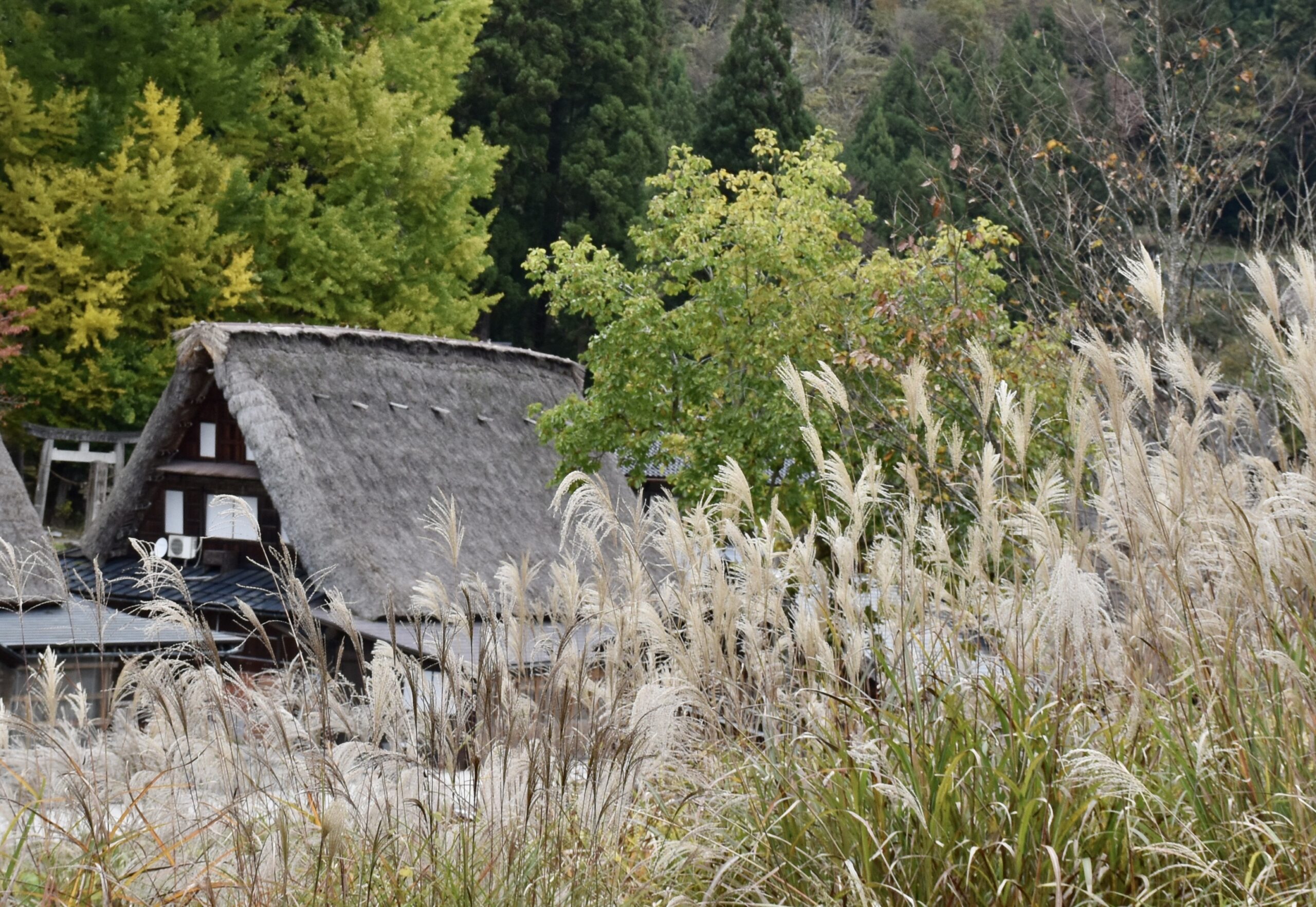
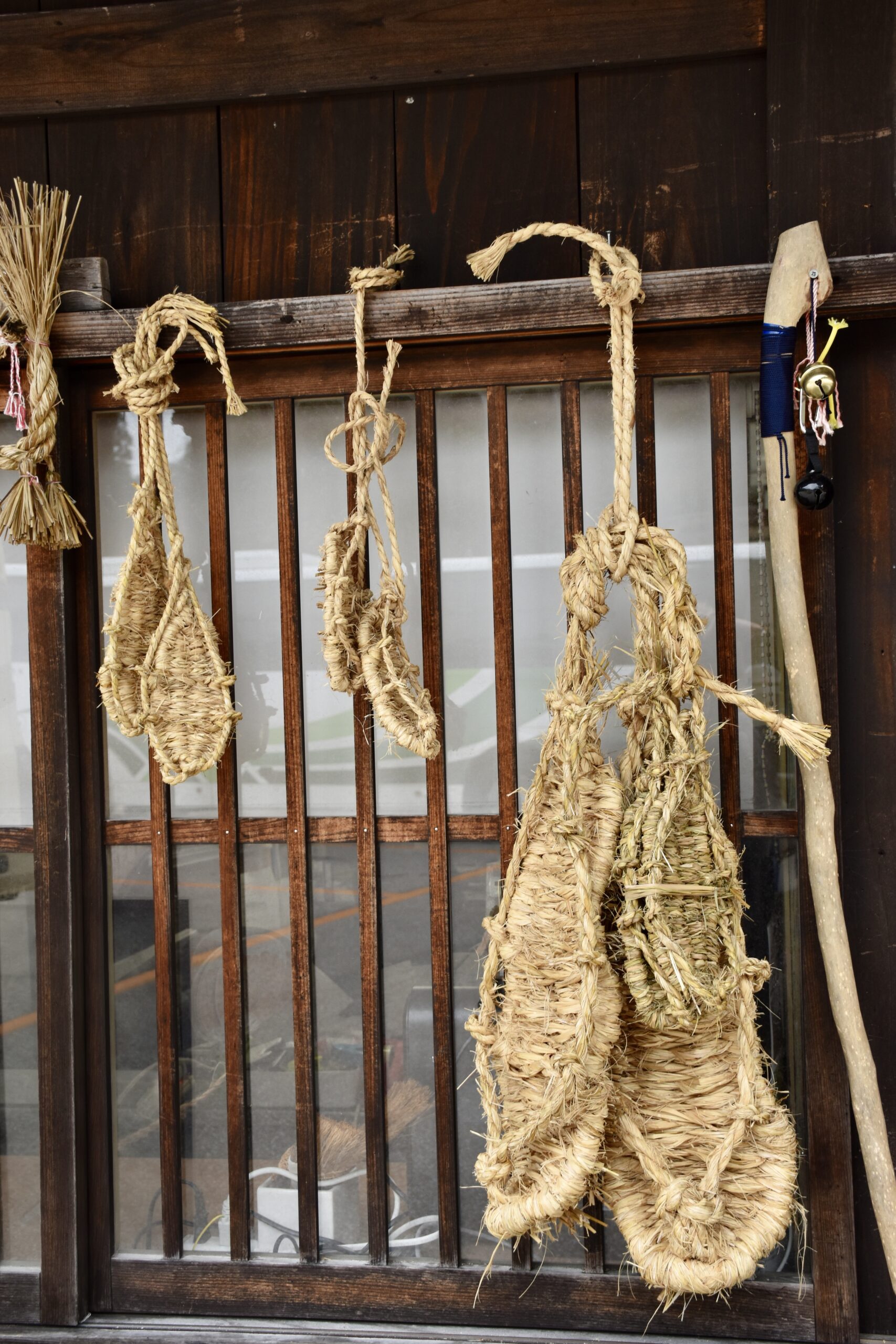
I especially loved the combination of the traditional and the practical. You can preserve a centuries-old way of building a house and still want television.
There was also a legendary curiosity called the Tengu’s Footprint: an indentation in a large stone supposedly left by a tengu, one of Japan’s long-nosed supernatural creatures, as it leaped from one mountain to another.
Apparently the tengu had quite a stride.
Ringing the Dinner Bell for Bears
Utako-san had warned us that bears and wild boars live in these mountains.
Naturally, I decided to take the path up the hillside to the viewpoint overlooking the village.
Along the trail were signs explaining a rather charming system for discouraging unwanted encounters with wildlife. A rope runs beside the path, with little bells attached at intervals. Walkers are encouraged to shake the rope so the bells ring and alert animals to their approach.


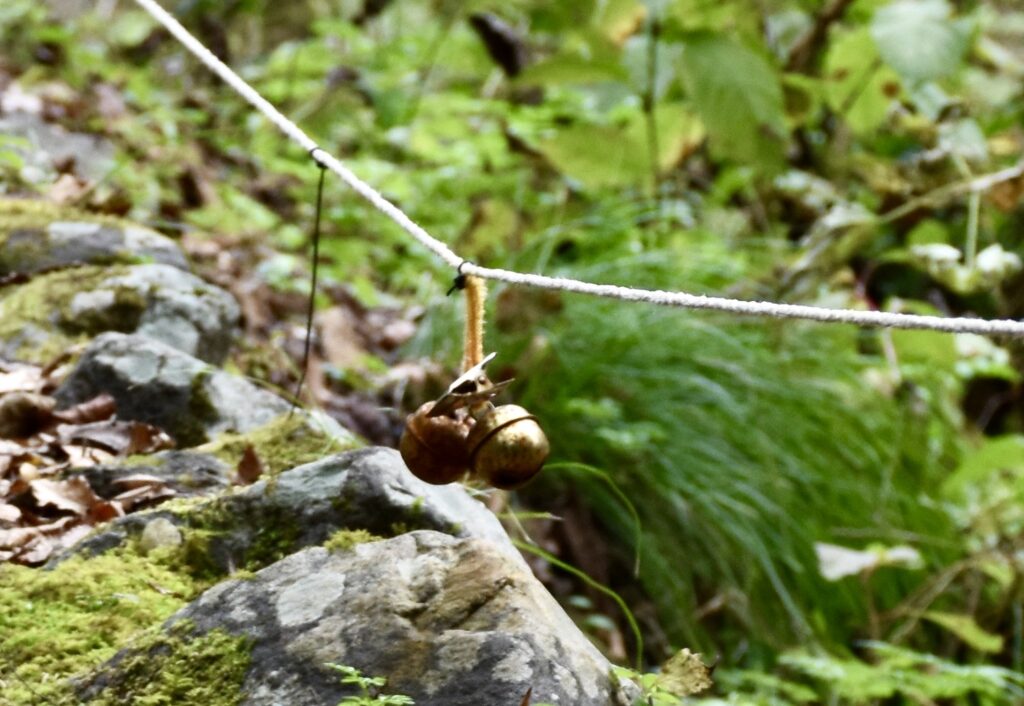

The bells, however, did not produce the robust clang I might have expected of a serious bear-warning system.
They tinkled.
Very sweetly.
I couldn’t help wondering whether, rather than frightening bears and boars away, we were actually announcing:
“DINNER IS SERVED!”
Fortunately, no bears or boars appeared to test my theory.
The walk itself was wonderful. The mountain air was cool, the forest full of moss-covered stones and autumn color, and the village below looked almost impossibly peaceful beneath its backdrop of snow-dusted peaks.
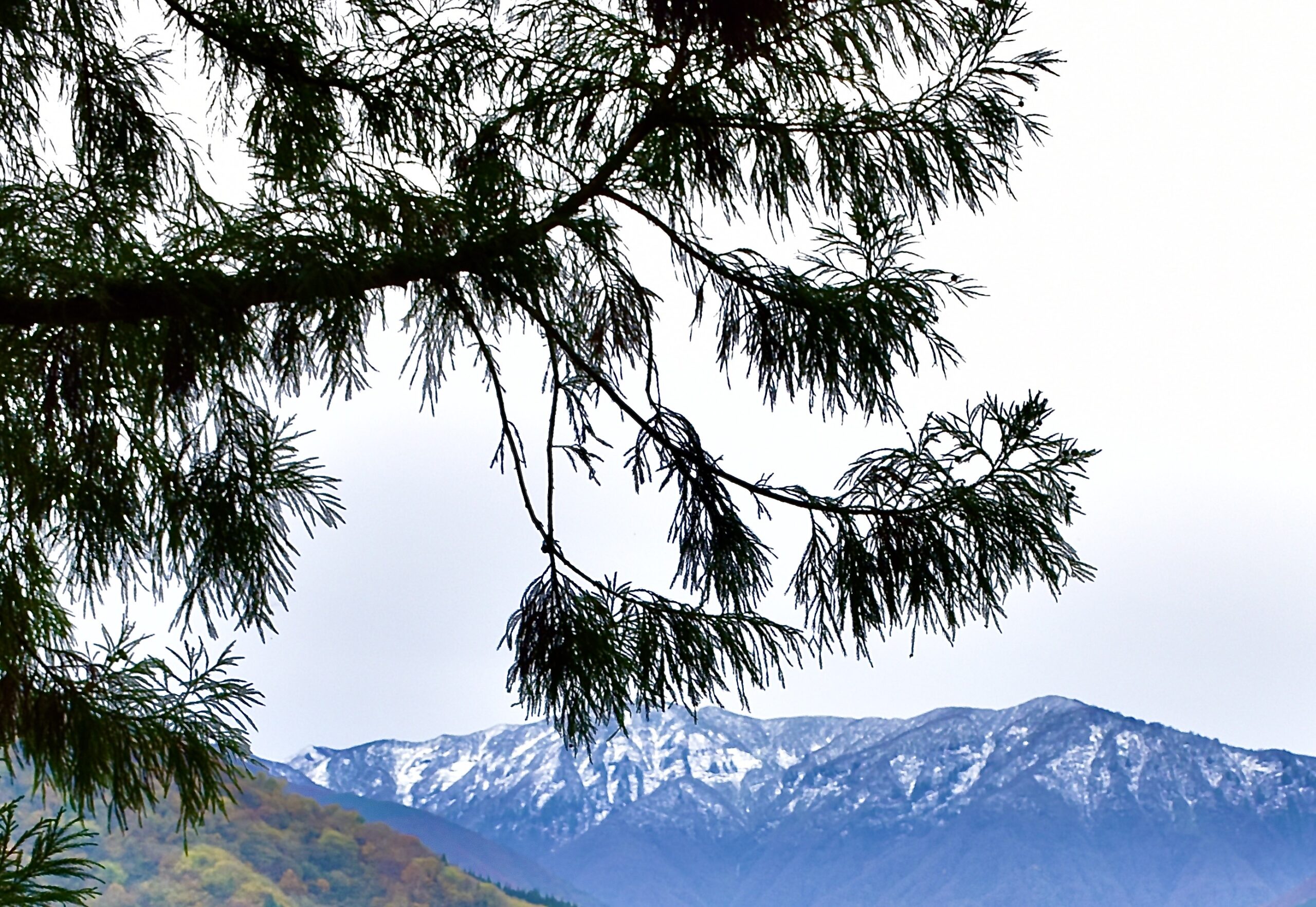
Along the way I discovered a tiny, seemingly abandoned stone shrine, nearly swallowed by moss and vegetation. I also stopped to photograph some purple thistle-like flowers, a visiting bee, rice on the stalk, and a vine whose leaves had turned an extraordinary buttery yellow.


It was one of those walks where the little things were every bit as rewarding as the grand view.
Old Crafts, New Craftspeople
Seeing the bundles of thatching material reminded me of an NHK program I’d watched before leaving home.
It was about traditional Japanese crafts that had been in danger of disappearing as their practitioners aged and younger generations pursued other careers.
But something interesting is happening.
Some younger people are returning to these crafts, learning to make roof tiles by hand, repair historic buildings, and thatch roofs using techniques passed down over generations. One former school featured in the program had even been repurposed into a training center where students learned the entire thatching process, from cutting the grasses to bundling and installing them.
There’s an interesting parallel here with developments back home.
At a time when so much attention is focused on jobs that artificial intelligence might replace, there is renewed recognition of the value of work that requires experienced hands, judgment, physical skill, and an intimate knowledge of materials.
AI can do some remarkable things.
But I would like to see it climb onto a steeply pitched roof in a Japanese snowstorm and replace the thatch.
Mochi Mayhem at the Former School
Our next stop was the former Tiara Mountain School, once an elementary school but now closed because there simply aren’t enough children in the area to keep it operating.
Today, however, the building was very much alive with activity.
We were going to make mochi, the wonderfully chewy Japanese rice cakes.
And not by pressing a button on a machine.
Oh, no.
We were going to pound the living daylights out of some rice.
The process begins with a special variety of glutinous rice, which is steamed for approximately an hour until the grains become soft. The rice is then placed into an enormous wooden mortar, called an usu, and pounded with a substantial wooden mallet, or kine.
And when I say substantial, I mean HEAVY.


The procedure requires two people working in remarkably close coordination.
One raises the mallet and brings it crashing down into the rice.
The other reaches into the mortar BETWEEN blows to turn and fold the increasingly sticky mass.
Think about that for a moment.
One person is swinging a very large wooden mallet.
The other is putting her HANDS exactly where that mallet is going to land.
What could possibly go wrong?
Our instructor made this look perfectly natural, although I suspect she possesses a degree of timing, confidence, and nerve that most of us do not.
Soon it was our turn. We chanted and clapped as instructed to egg the pounders on.
Bailey gave it a try, followed by Deborah and Lynn. There was considerable enthusiasm, a little concentration, and a lot of laughter.


Ultimately it was my turn.
We’d been specifically instructed NOT to make a gigantic, exaggerated swing with the mallet.
So, naturally, I pretended to do exactly that.

The looks on their faces were priceless.
I was kidding, of course. (I’m such a jerk 🙂 ) But apparently my little performance was convincing enough to cause momentary alarm.
After demonstrating that I had no intention of actually flattening anyone, I got down to the more modest business of pounding rice.


Eventually the individual grains disappeared, and the mass became smooth, elastic, and shiny. Apparently, that glossy appearance is how you know the mochi is ready.
And then came the best part.
Eating it.
We were served freshly made mochi in two preparations. One had a sweetened soy sauce glaze; the other was rolled in roasted soybean powder (kinako) mixed with a little sugar.

Both were absolutely delicious.
The staff kept coming around offering more.
And I kept accepting.
I mean, it would have been terribly impolite to refuse, wouldn’t it?
They also served a particularly delicious o-cha, Japanese tea, which went beautifully with the warm, chewy mochi.
One other thing caught our attention in that room: the extraordinary pictures displayed on the walls.
The top big ones had been made by children using collaged pieces of handmade washi paper, while the lower one of roosters had been created by a teacher. There was even a competition associated with this art form, with one wonderfully challenging rule:
No scissors allowed.
Linda and I went up for a closer examination, and the level of detail was astonishing. It was difficult to believe that these pictures had been assembled from pieces of torn paper rather than painted.
Which was a particularly appropriate introduction to our next adventure.
Washi: Paper Made from Trees, Water, and Patience
I had been looking forward to our Japanese papermaking workshop, but I really hadn’t understood quite how fascinating it would be.
Traditional washi is generally made from the long inner-bark fibers of plants such as kozo, the paper mulberry.
And getting from a tree to a sheet of paper is a rather extraordinary undertaking.
The branches are harvested and steamed, their bark is stripped away, and the dark outer layers are removed to reveal the pale inner fibers. Those fibers are then cleaned, sometimes bleached using the region’s snow and cold water, boiled, and beaten to separate and soften them.
The result is a fibrous mixture that can be suspended in water.
But here’s where things become especially interesting.
A small amount of a plant-derived substance called neri, extracted from the roots of tororo-aoi, is added to the mixture.

The extract is extraordinarily slippery and viscous, almost like glue. It helps keep the fibers suspended and allows them to spread evenly rather than clumping together.
That photograph gives you some idea of its consistency, although you really had to see it in motion.
It just kept stretching.
And stretching.
It was quite mesmerizing (and a little gross).
The papermaking technique itself looked deceptively simple when our instructor demonstrated it.
We each received a wooden frame fitted with a screen, divided into three postcard-sized sections.
The idea was to hold the frame upright, dip it into the cold, milky-looking water, scoop it toward yourself and up, and then gently shake the frame to distribute the fibers evenly.
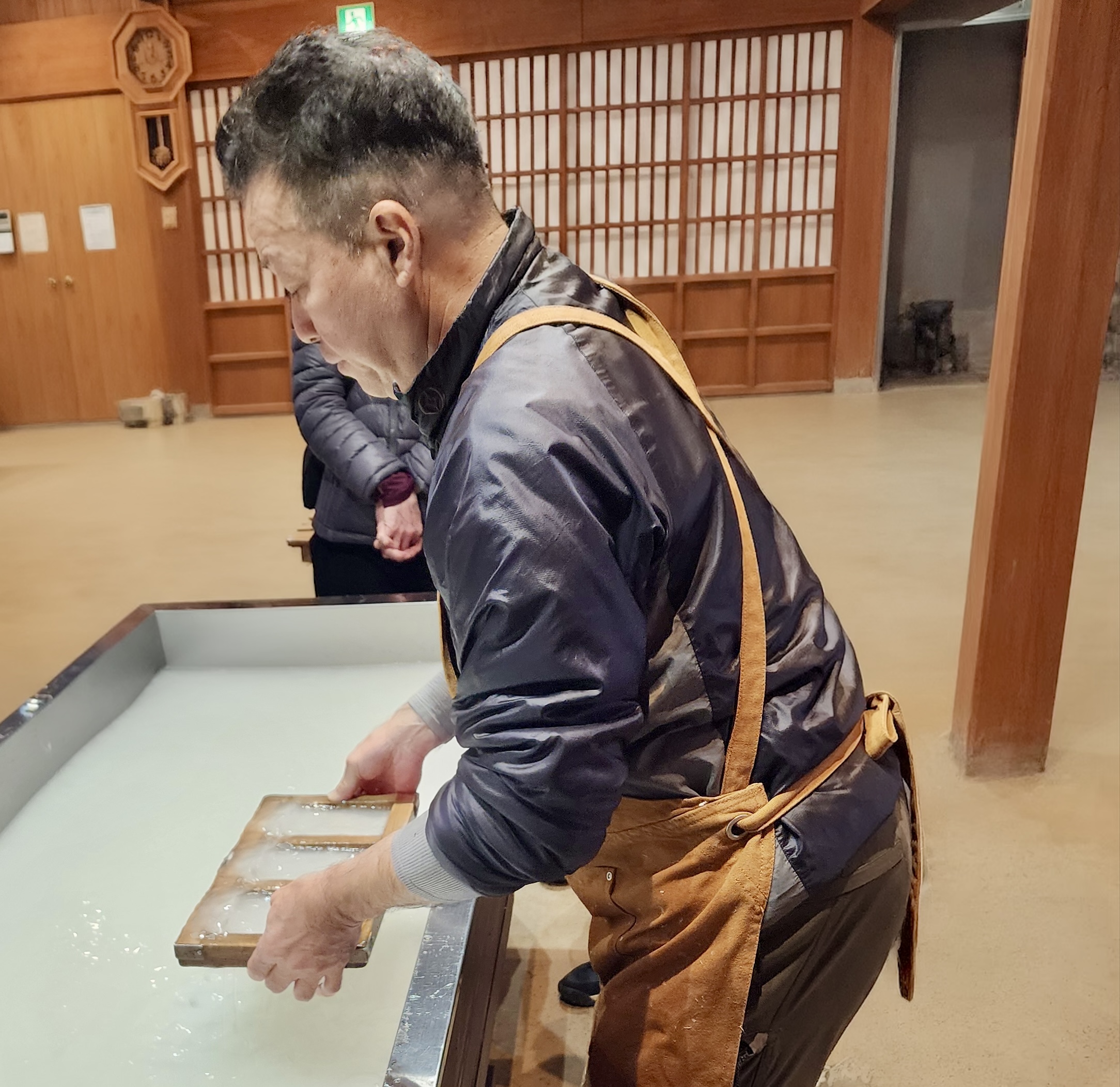

The direction matters. The timing matters. The shaking matters.
Get it wrong and the fibers won’t lie properly.
Then you lift the frame out of the bath and continue the delicate shake-shake-shake until much of the water has drained away.
Then you stand there, dripping.
Well, the frame is dripping. You are merely waiting.
And then you repeat the process.
Three times, in our case, to produce paper thick enough for postcards.

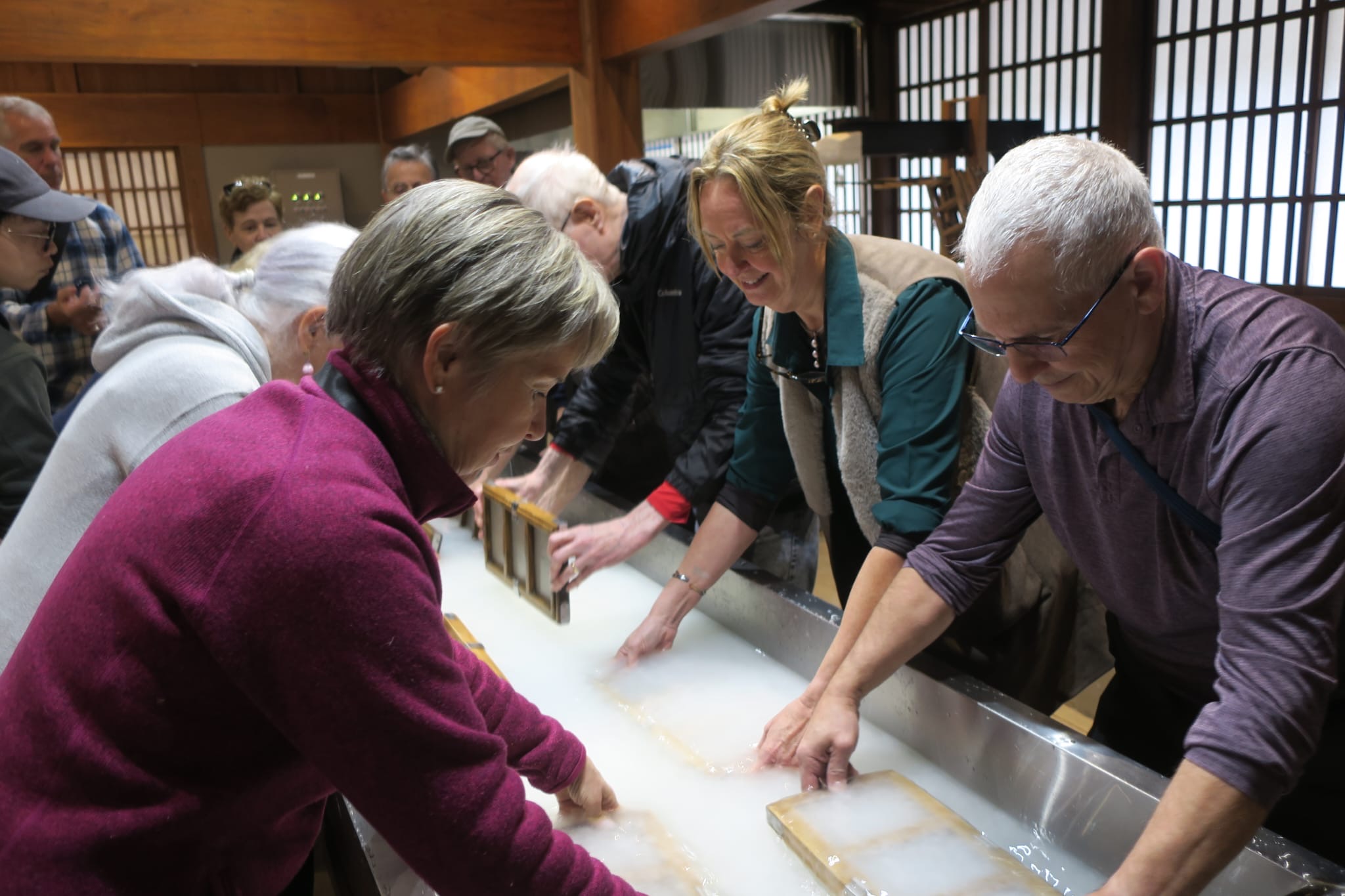
There is something satisfying about watching what looks like cloudy water gradually become an actual, coherent sheet of paper.
Once we had created our sheets, we could decorate them with little colorful paper shapes.
I made three postcards: an orange cat for Sharon, an autumn leaf, and a butterfly for Leann.

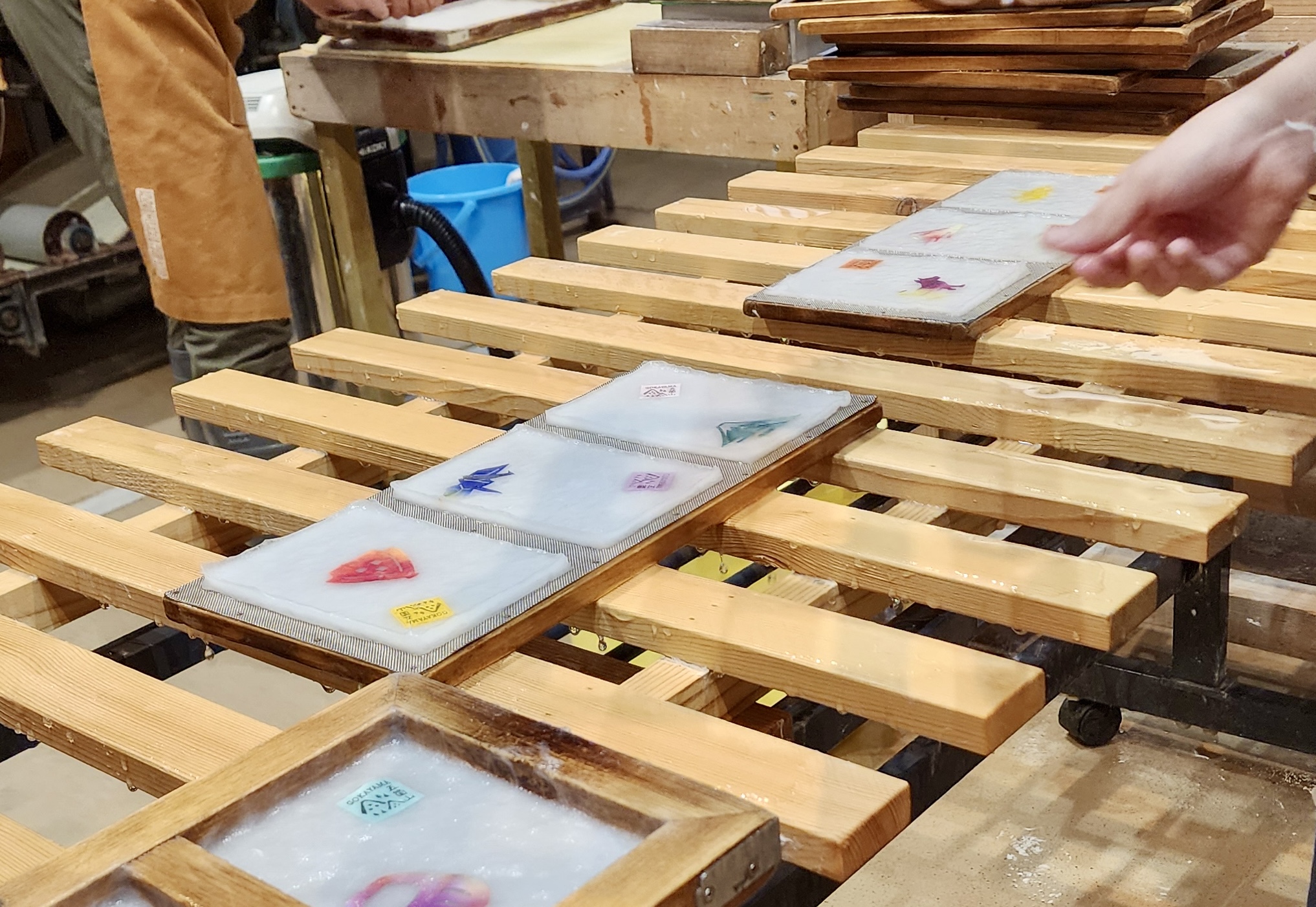
After we placed the decorations where we wanted them, the workshop staff took over.
They secured another frame on top, turned the whole assembly over, and carefully separated the still-wet postcards from the screen.
The paper was very delicate at this stage.
After a little initial draining, the cards were placed against a very hot metal wall to dry completely.


And there they were.
Three little pieces of handmade Japanese paper, created from plant fibers and water, each with its own small design.
I also bought Dr. Scott Sensei a beautiful handmade washi scroll decorated with painted dragonflies.
It seemed exactly the right sort of gift: traditional, artistic, and connected to a craft that has survived for centuries.
Lunch — and Another Fishy Discovery
Somewhere between all this pounding and papermaking, we stopped for lunch at a soba noodle shop.
You would think that with all the precautions I have been taking about my food allergies, a bottle of soy sauce sitting innocently on the table would be fairly straightforward.
Soybeans. Wheat. Salt. Water.
Right?
Wrong.
Thanks to Google Translate, I discovered that the bottled soy sauce contained two different kinds of fish.
TWO.
In soy sauce.
At this point, I’m beginning to suspect that fish in Japan operates an extensive undercover network.
It was another excellent reminder that even the most familiar-looking condiment can contain ingredients I absolutely cannot eat.
And another heartfelt thank-you to Google Translate.
Iwase House: Three Hundred Years Under One Roof
Our final major stop was Iwase House, one of the largest surviving examples of gassho-zukuri architecture in Japan.
And what a house.
The house was constructed approximately 300 years ago by Choemon Fuji, reportedly taking eight years to complete. Ownership passed to the Iwase family around the beginning of the Meiji era, and in 1958 it was designated an Important Cultural Property of Japan.
It is enormous: approximately 26.4 meters long, 12.7 meters wide, and 14.4 meters high.
At one time, some 35 or 36 family members and workers lived here.
Imagine the family dinners.
And the laundry.
But this was much more than a residence.
The house was a workplace, a manufacturing center, a place for raising silkworms, and an important part of the local economy.
One of its principal historical functions was connected to the production and collection of saltpeter, or potassium nitrate, an essential ingredient in gunpowder.
The powerful Maeda clan, rulers of the Kaga domain, needed saltpeter for firearms, and Gokayama became an important center of production. The Iwase family played a significant role in that industry.
The house was designed to accommodate many people working and living under one roof, sometimes in shifts.
The structure itself is quite extraordinary.
Rather than relying on nails and metal fasteners, the upper framework was assembled with carefully fitted timber and lashed connections using natural materials, including vines and straw ropes.
Massive beams of keyaki, Japanese zelkova, support portions of the structure.
This is the same wonderfully durable wood we encountered earlier in connection with taiko drums.
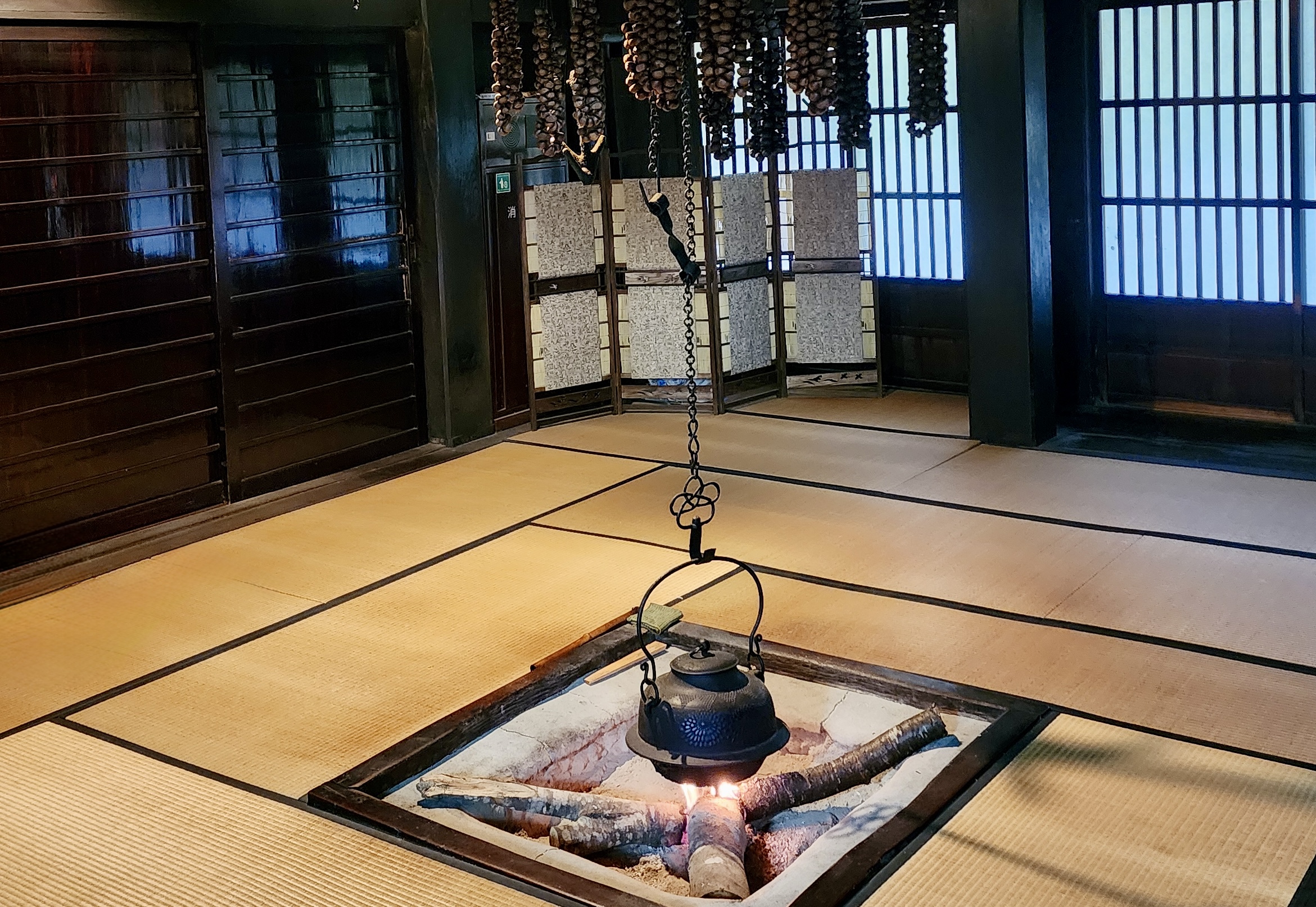
Our host showed us how the wood’s appearance had changed through centuries of exposure to smoke from the open hearth.
Originally much lighter in color, it had become almost completely black.
And not merely blackened with a superficial coating of soot.
The darkening seemed to have penetrated the timber itself.


Four Floors Up, and Watch Your Step
The upper floors were once used extensively for silkworm cultivation.
Silkworms were raised on trays arranged on tiers, sometimes stretching nearly to the ceiling. The arrangement exploited one of the house’s most ingenious features: warmth from the central hearth below could rise through gaps in the wooden floors and heat the upper work areas.

We climbed through the upper levels, where the spaces became increasingly narrow and the historic construction was visible all around us.


In the above photo on the left, I’m standing on the ladder between the 3rd and 4th floors. You can see the part of the flooring where the planks are separated, on both floors. This is where the silkworm racks used to stand.
The floors and stairways were an adventure of their own.
Some of the boards were deliberately spaced apart to allow heat to travel upward.
And the stairs?
Oh, my.
Hundreds of years of people climbing up and down had worn the steps into noticeable depressions.
You could actually see—and feel—the places where generations of feet had landed.
Unfortunately, some of those worn areas sloped downward, making the already steep stairs a little treacherous.
Most of our group were in socks, which offered relatively little traction.
I was very glad to be wearing the tabi shoes Dr. Scott Sensei had given me.
Coming down required some concentration.
One foot.
Find the worn spot.
Check your balance.
Next foot.
Repeat.
This was not the place to be thinking about what you wanted for dinner.
There were also examples of traditional straw footwear, including shoes made for oxen. The animals were used in the region’s agricultural and industrial work, and the handmade coverings helped protect their hooves.

The Hearth at the Heart of the House
But back to the main living area, where a beautiful open hearth occupied the center of the tatami room.
A black iron kettle hung over the fire from an elaborate suspended chain, and bunches of chestnuts were hanging above.
This hearth was not merely for cooking or keeping warm.
It was the heart of the entire house.
Heat rose through the open construction to the workspaces above, helping sustain the silkworm industry through the cold mountain seasons.
The space felt both intimate and enormous: a place where many generations had gathered, eaten, talked, worked, and endured winters that must have been almost unimaginably difficult.
And although the building is now a historic property open to visitors, it remains connected to the family that has cared for it for generations.
Our host told us that his mother still lives in a modernized portion of the house, while he and his wife live nearby. His son has agreed to carry on the family’s stewardship.
There was something deeply reassuring about that.
A building like this needs more than preservation.
It needs people who care enough to keep it alive.
The Dance, the Hat, and 108 Earthly Desires
Then our host treated us to a traditional performance.
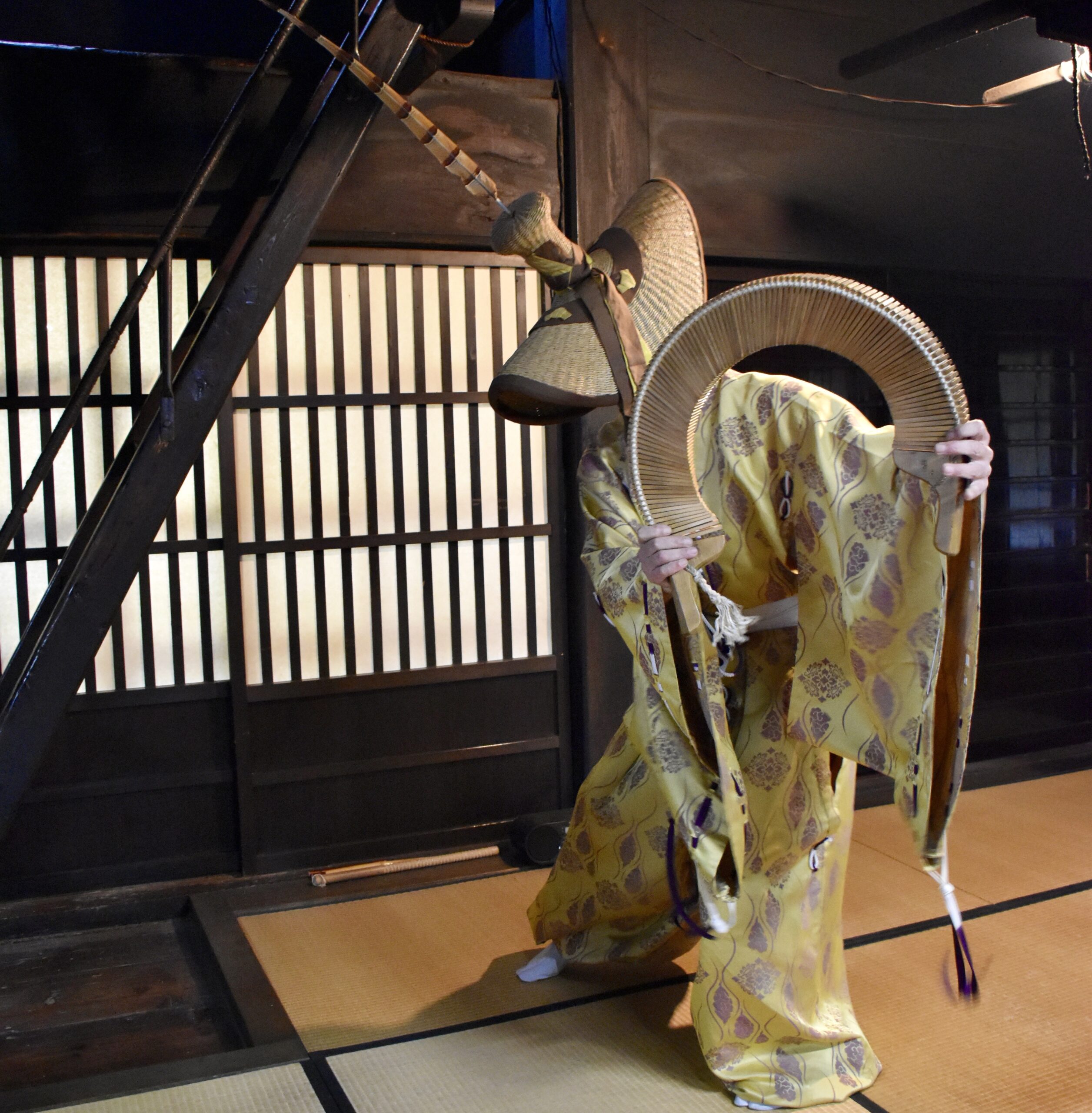
He appeared in a beautiful golden-yellow outfit, with a patterned upper garment and hakama, the pleated trousers associated with traditional Japanese dress.
Naturally, this caught my attention because of my iaido practice.
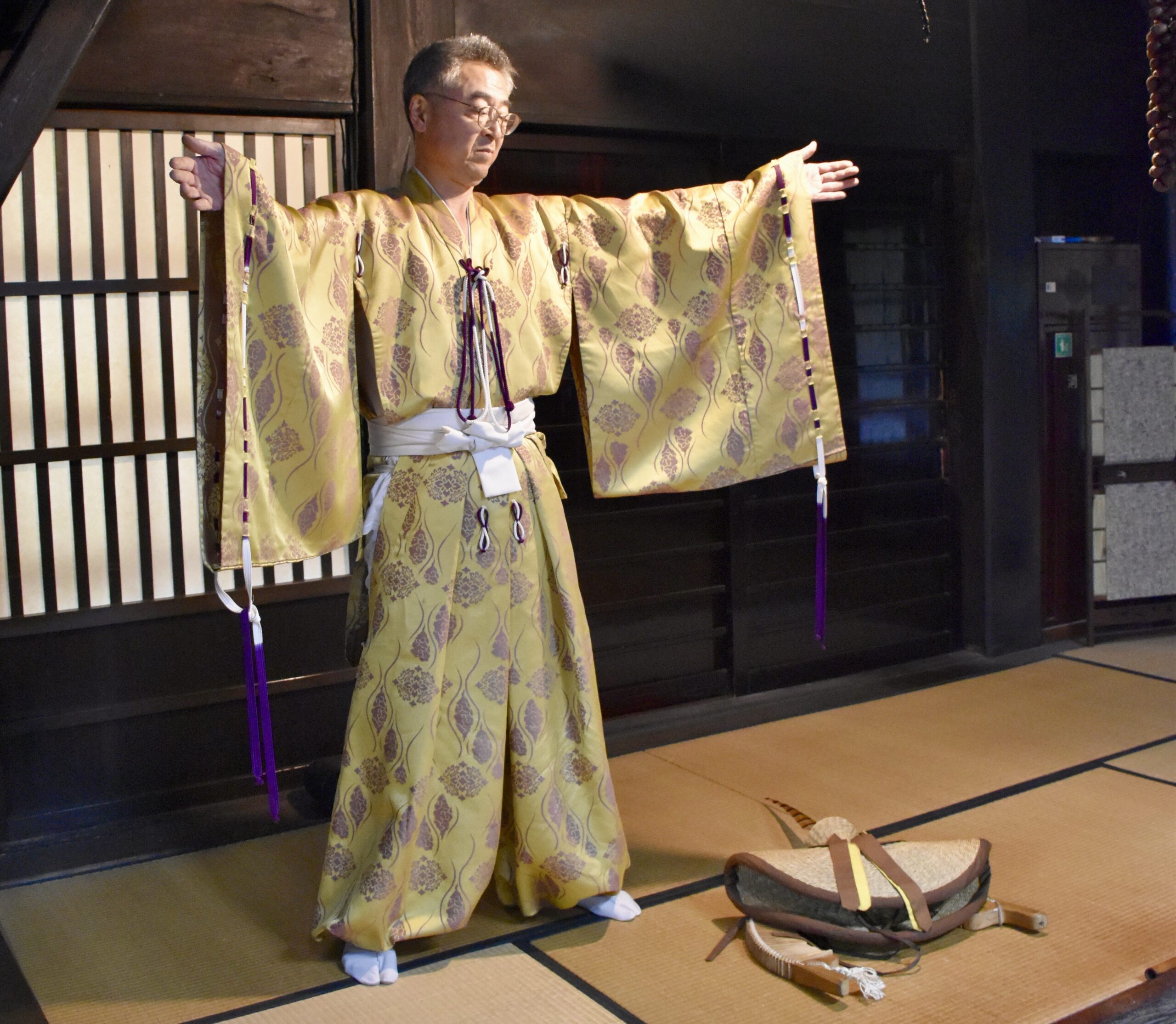
He demonstrated how the long sleeves could be gathered by pulling on cords hanging from their ends and tying them around the wrists. The lower portions of the hakama could likewise be secured around the ankles.
The design allowed freedom of movement for activities such as hunting and riding.
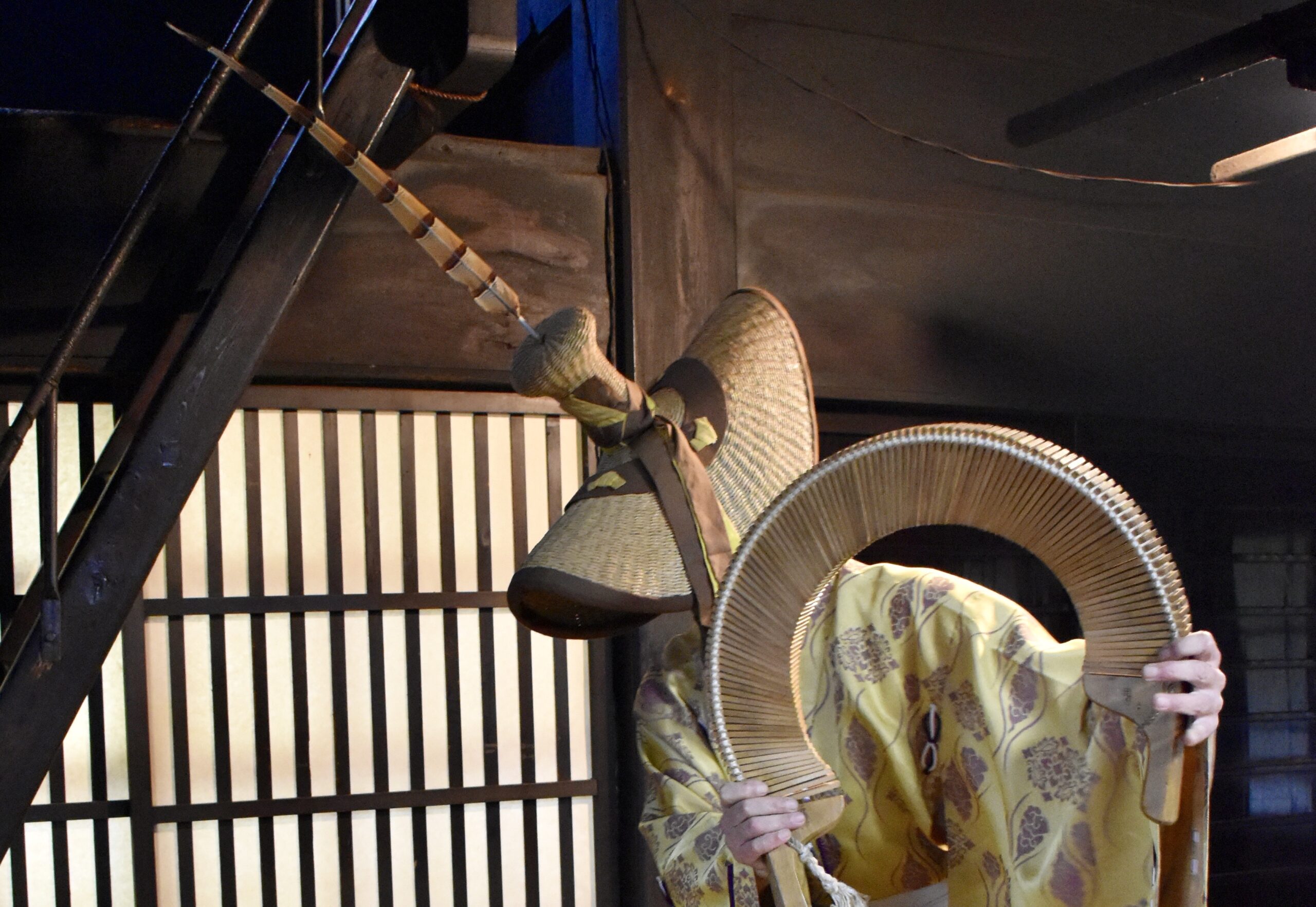
He also showed us an extraordinary traditional hat, broad enough to shield the face from both sun and rain.
The tall feather projecting upward came from a male pheasant. We were told that its length was associated with the hunter’s accomplishments.


But perhaps the most fascinating object was the musical instrument he used.
It looked almost like a long, flexible wooden ladder—or a very elaborate collection of narrow wooden slats.
This was a sasara.
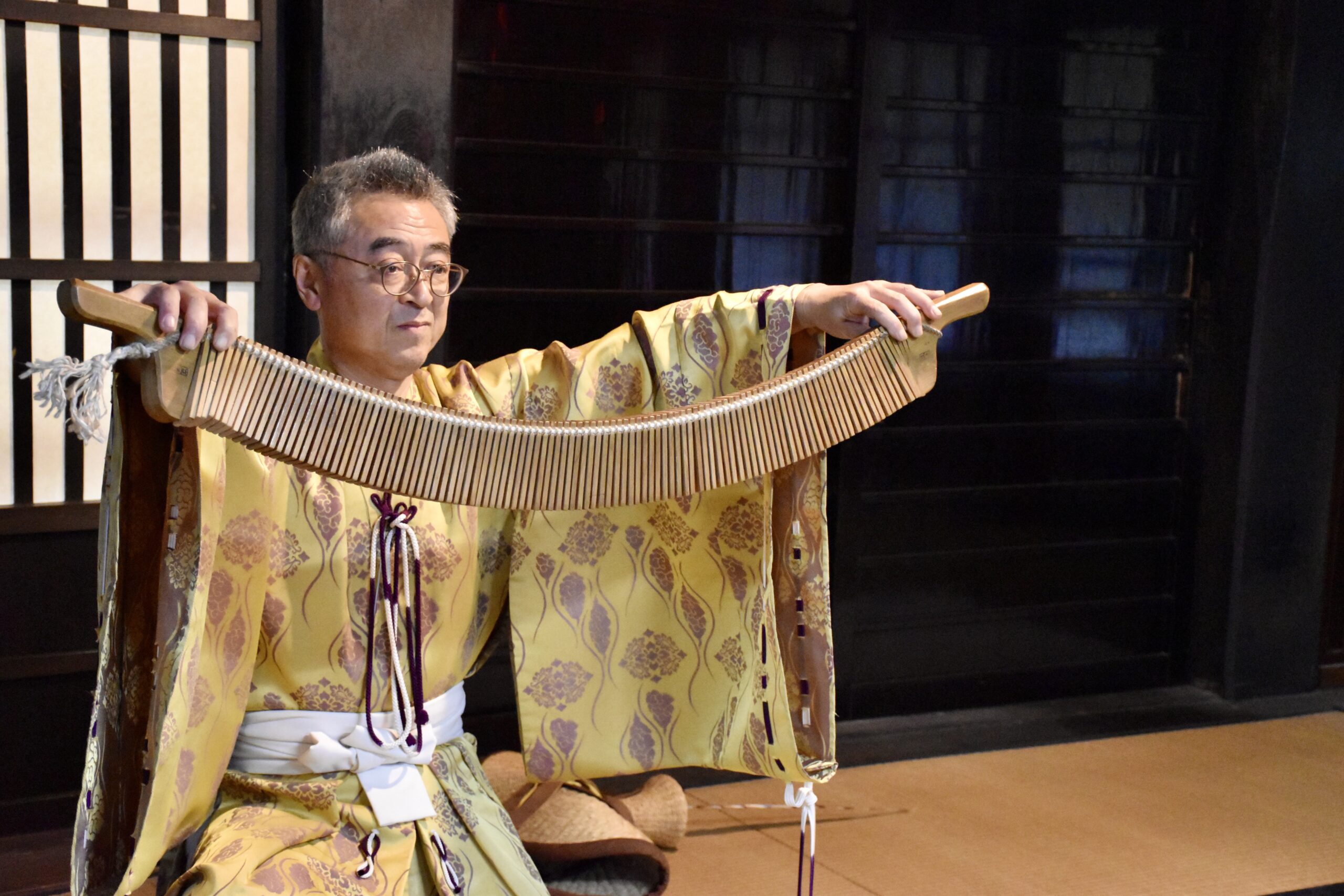
A traditional sasara used in the region’s Kokiriko folk dance is made from 108 small pieces of hinoki, Japanese cypress, joined together by cords.
Why 108?
In Buddhist tradition, 108 is associated with the earthly desires or attachments that bind human beings to suffering.
Our host’s wife explained the spiritual symbolism of the instrument and its clacking sound, connected with dispelling or overcoming those worldly desires.
We were also told that Buddhist sutras were associated with the wooden pieces.
The instrument produces its sound through a surprisingly simple motion: hold the handles, flex the arrangement, and flick one wrist.
The wooden slats snap against one another in rapid succession.
CLACK-CLACK-CLACK-CLACK!
Or, with a more practiced flick, one wonderfully emphatic, rattling flourish.
And then he performed a traditional Kokiriko dance for us.
Suddenly, everything he had demonstrated—the enormous sleeves, the gathered hakama, the elaborate hat with its pheasant feather, and that extraordinary clacking instrument—came together.
The movements were deliberate, the costume becoming part of the dance as he moved and manipulated the sasara. And the setting made it even more special: a traditional folk performance in a 300-year-old house, surrounded by the very history it represents.
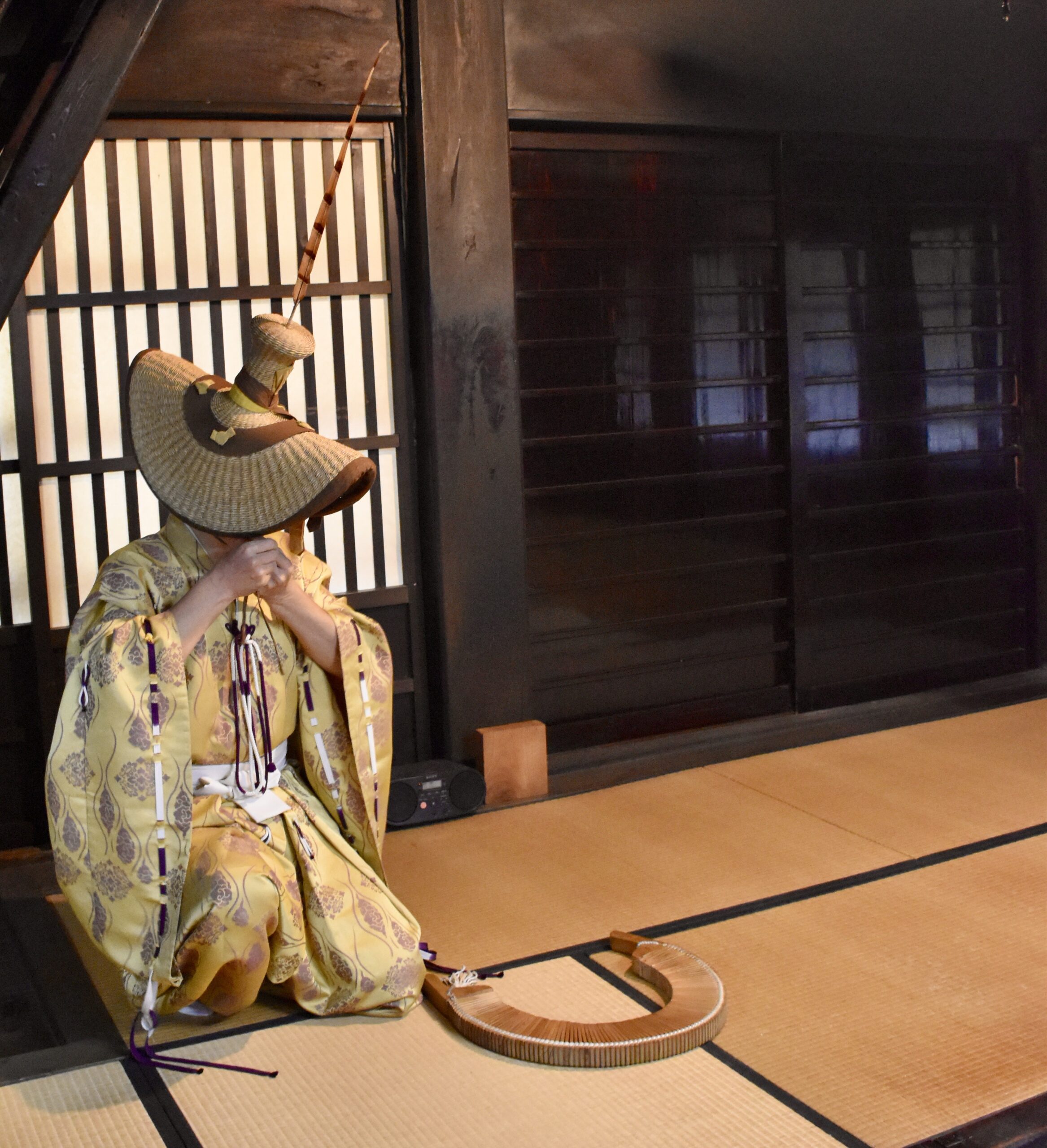

Afterward, we were each given a smaller version of the sasara to try while our hosts sang. The trick was in the wrist movement, which made the wooden slats snap together in a rhythmic clatter.
Whether we managed to eliminate any of our 108 earthly desires remains uncertain. I suspect I still have most of mine.

A Butsudan Worthy of a Temple
There was one more remarkable sight inside the house.
A butsudan—a Buddhist household altar.
And not just any butsudan.
This one was absolutely spectacular.

I have seen beautiful Buddhist altars before, including H’s own Nichiren butsudan, but the workmanship of this one was extraordinary.
The intricate gold detailing, carved columns, miniature architectural features, elaborate doors, hanging ornaments, and layered interior gave it the appearance of an entire temple in miniature.
I apparently said “WOW” rather a lot.
Our host’s wife seemed very pleased by my enthusiasm.
And I meant every single WOW.
There were also two wonderful ranma, carved wooden transom panels positioned above the interior doorways.


One depicted an exquisite landscape with a bridge, pavilion, and trees. The other featured a complex architectural scene.
But what made them particularly remarkable was that the carvings were two-sided.
These were not merely wooden pictures intended to be viewed from one direction. They were intricate openwork compositions that could be appreciated from either side.
The patience and precision required were staggering.
It was yet another reminder of something this day had been teaching us repeatedly: in traditional Japanese craftsmanship, beauty and function are often inseparable.
A House Built to Last
One of the stand-out things about Iwase House is that its huge thatched roof still requires regular renewal.
The thatching material is kariyasu, a type of Japanese grass. Each side of the roof is replaced separately, generally on a cycle of approximately 25 years.
We were told that the most recent work on one side cost approximately $250,000.
Yes, you read that correctly.
A quarter of a million dollars.
Fortunately, the building’s protected historic status means public funding can cover much of the cost. Our host told us that approximately 90 percent of the recent roofing expense had been subsidized.
The need for skilled thatchers brought me right back to the NHK program I’d watched before leaving home.
These crafts may be ancient, but they are not obsolete.
Every carefully tied knot, every thatched bundle, every hand-cut wooden joint, every sheet of paper made from mulberry fibers represents knowledge that has to be learned, practiced, and passed along.
The buildings can survive for centuries.
But only if the skills survive with them.
The Bus Ride Home, Then Tomorrow, Kyoto
One more architectural detail I noticed throughout the region, and was able to photograph on our coach ride back to the hotel, were the black-tiled roofs on many of the ordinary houses.

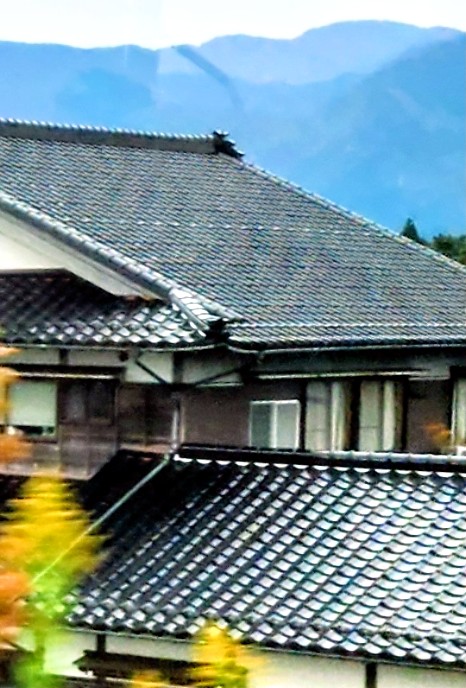
Utako-san explained that the dark tiles absorb sunlight, helping warm the roofs and melt accumulated snow. So even these handsome, almost glossy roofs have a practical purpose.
Different from the enormous thatched roofs of Gokayama, of course, but another example of Japanese architecture adapting to the challenges of winter.
And rather lovely against the autumn countryside and distant mountains.
By the time we returned to Kanazawa an hour later, it had been an extraordinarily full day.
We had wandered through a living World Heritage village, considered the possibility that bear-warning bells might actually be bear-attracting bells, pounded rice into submission, made paper from trees, discovered yet more clandestine fish, explored a 300-year-old house, played a 108-piece musical instrument, and admired craftsmanship of astonishing beauty.
Not bad for one day.
Tomorrow we say farewell to Kanazawa and head for Kyoto.
Before leaving, we’ll have a home-hosted visit with local families, then travel by train, changing at Tsuruga for the Thunderbird service to Kyoto.
Our larger suitcases are going ahead separately, so we’ll be traveling with overnight bags until they catch up with us.
I just finished wrapping a little gift for our host family of Ghirardelli chocolates in a box featuring the Golden Gate Bridge, complete with a pretty knot I learned to tie by watching YouTube. I also tied Lynn’s gift of a tea towel in a standard furoshiki knot – she had received the pretty floral cloth last year in Japan, so it was making a round trip!
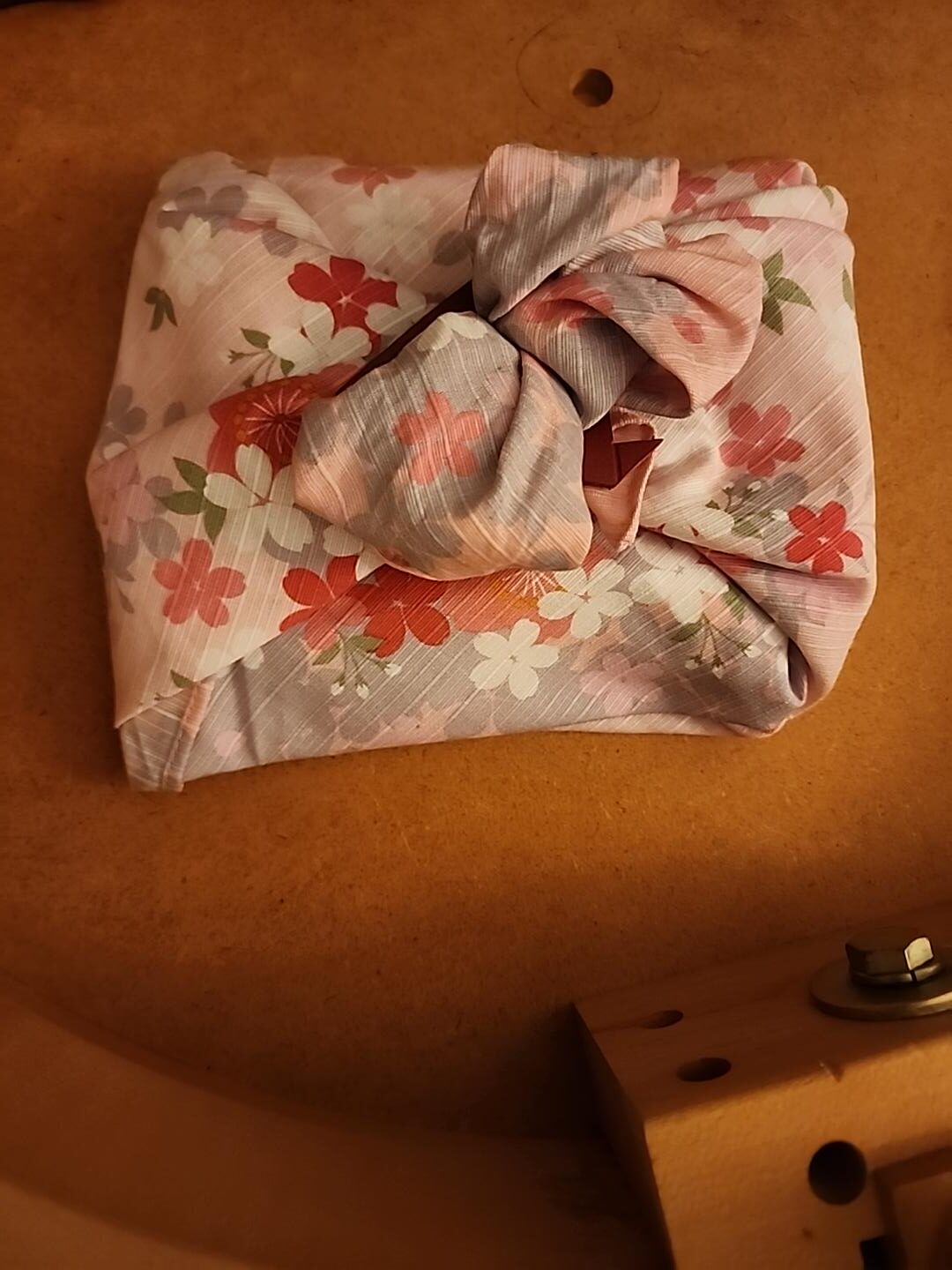
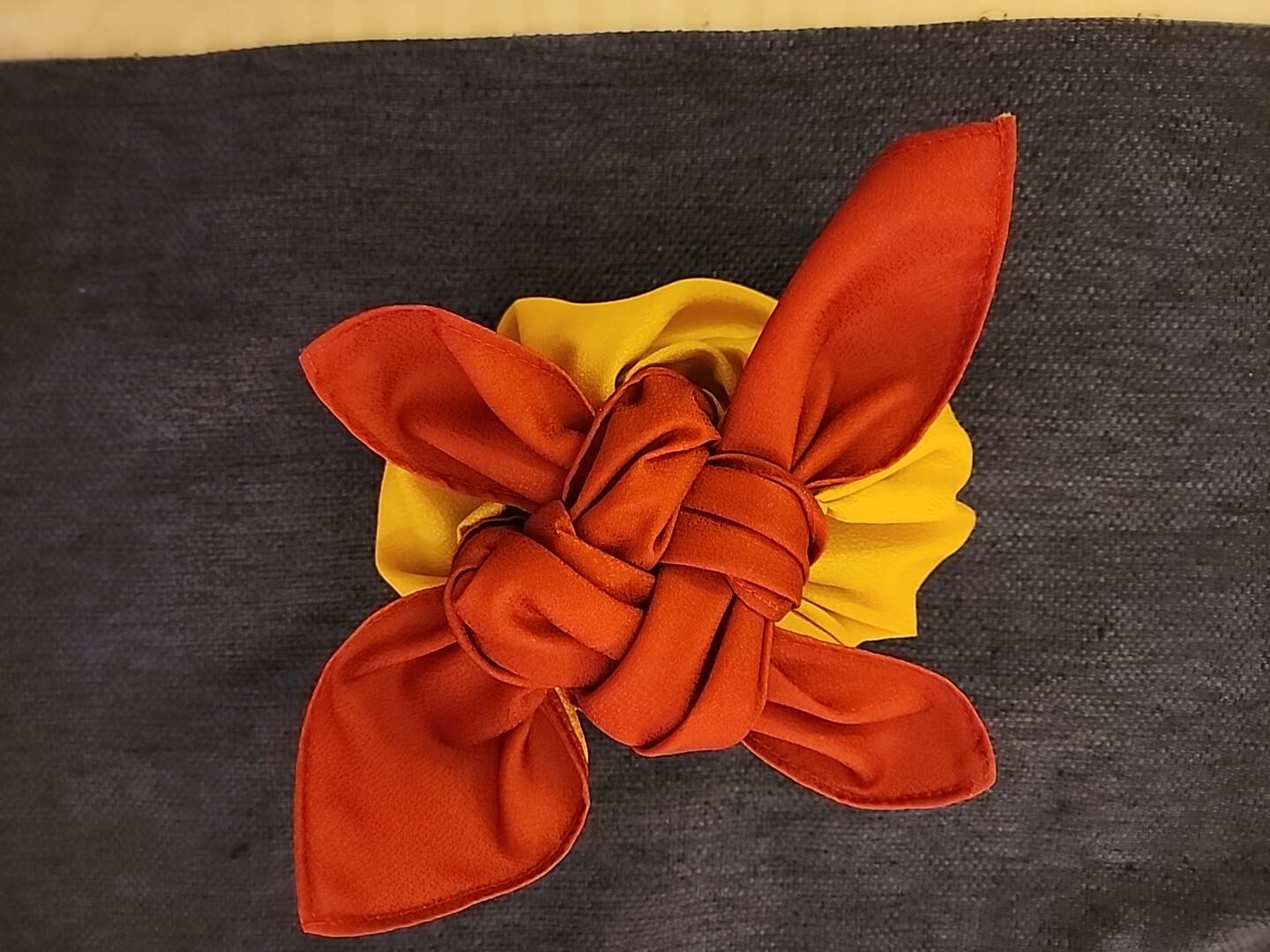
Whether the knots survive the journey remains to be seen.
But after today’s lessons in traditional craftsmanship, I feel that even a small, reasonably successful piece of fabric-tying deserves to be celebrated.
And as for the trip itself?
Once again, Japan has managed to fit about three days’ worth of experiences into one.
I wouldn’t have it any other way.