
November 8, 2026 — Kanazawa
For those of you keeping track of the days (and wondering whether I’ve forgotten how to count), a little housekeeping!
Full Day 6 was our travel day from Tokyo to Hakone, and Full Day 8 was our journey from Hakone back through Tokyo Station and then on the Shinkansen to Kanazawa. Both were full days in Japan, but neither got its own blog post.
So, yes, we’ve reached Full Day 9. No days have gone missing, although at this point I occasionally have to check my calendar to remember where I am!
And what a day this one turned out to be.
Today managed to combine extraordinary beauty, centuries of history, traditional craftsmanship, a little shopping, some decidedly unusual food, and a rather macabre glimpse into the life of a samurai.
Oh, and I ate gold.
But I’m getting ahead of myself.
Kenrokuen: A Garden That Refuses to Give Up on Its Trees
We began at Kenrokuen Garden, considered one of Japan’s Three Great Gardens.
The garden was developed over generations by the Maeda family, the powerful daimyo who ruled the Kaga Domain from nearby Kanazawa Castle. Its origins go back to the seventeenth century, and successive lords expanded and refined it.
Kenrokuen is famous for combining six qualities traditionally considered essential to a perfect landscape garden: spaciousness, seclusion, artifice, antiquity, abundant water, and broad views.
What struck me, however, was something rather different.
The extraordinary lengths the Japanese go to in order to keep their trees alive.





Kanazawa gets a great deal of snow. Heavy, wet snow. The sort that can snap the branches of even very large trees.
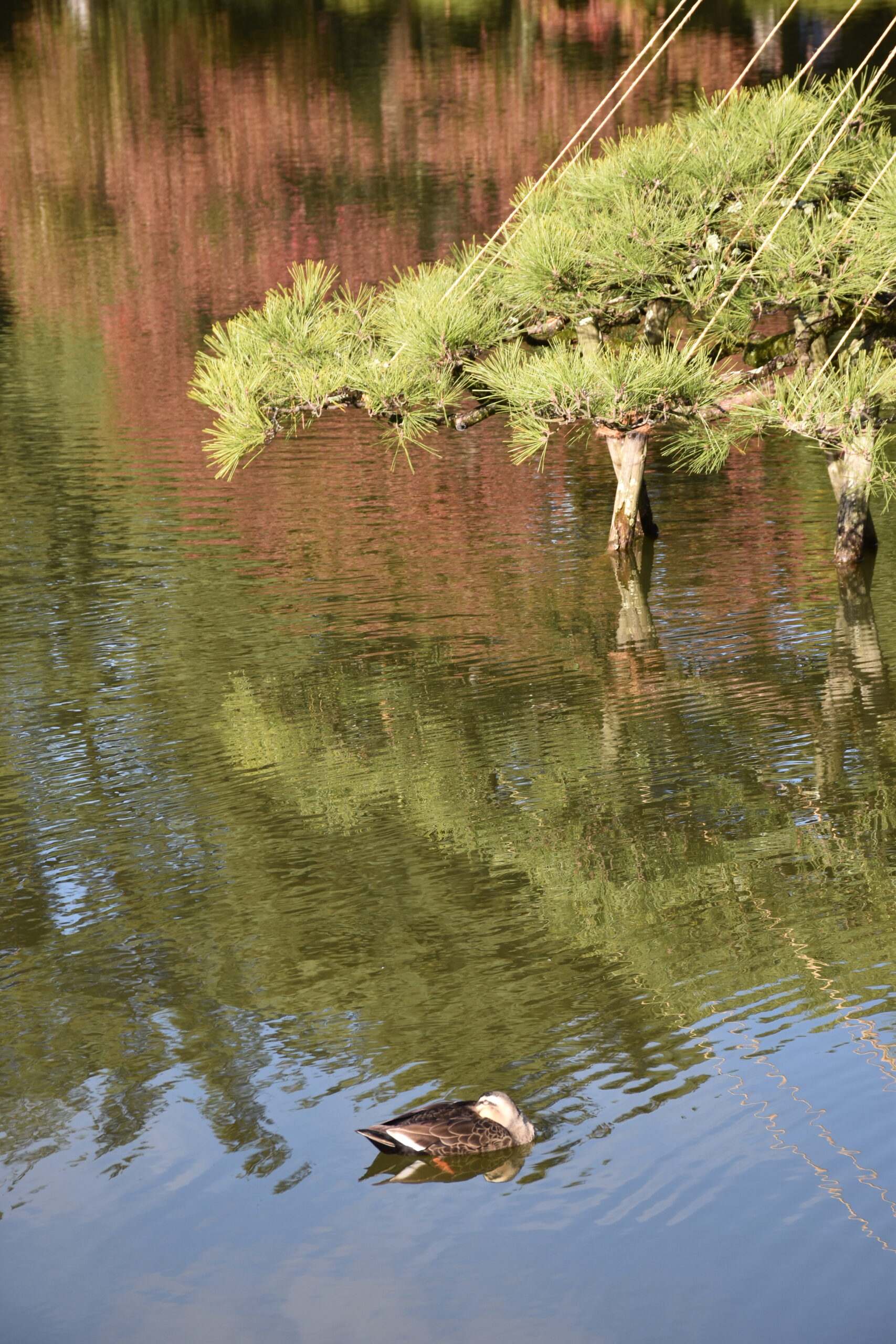
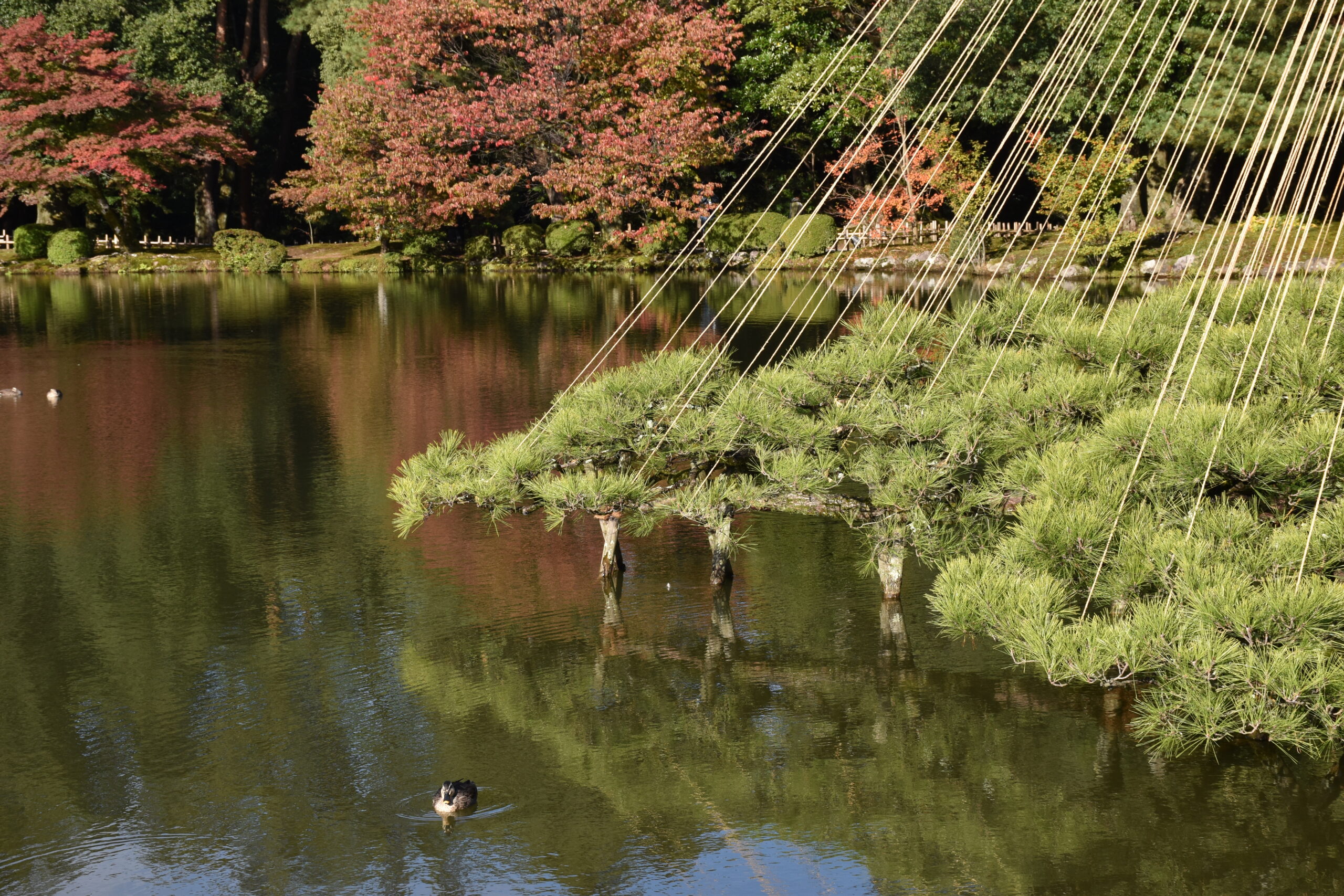
Rather than allow that to happen, gardeners erect enormous wooden poles above the trees, with ropes radiating down to support individual branches.
The technique is called yukitsuri, or “snow suspension.”
The result looks rather like a collection of enormous rope teepees.
Except that each one is protecting a living tree.
And here’s the remarkable part: these aren’t permanent installations.
The central support poles may remain in place, but the elaborate arrangements of ropes are installed afresh each autumn and removed when the danger of heavy snow has passed.
In fact, we arrived just after the annual installation work had begun on November 1. Some of the enormous rope arrangements we were admiring had been completed only days before our visit.
Imagine doing all that work every single year!
What impressed me was that something so practical — protecting trees against winter damage — had itself become a beautiful seasonal tradition.


And then there were the other supports.
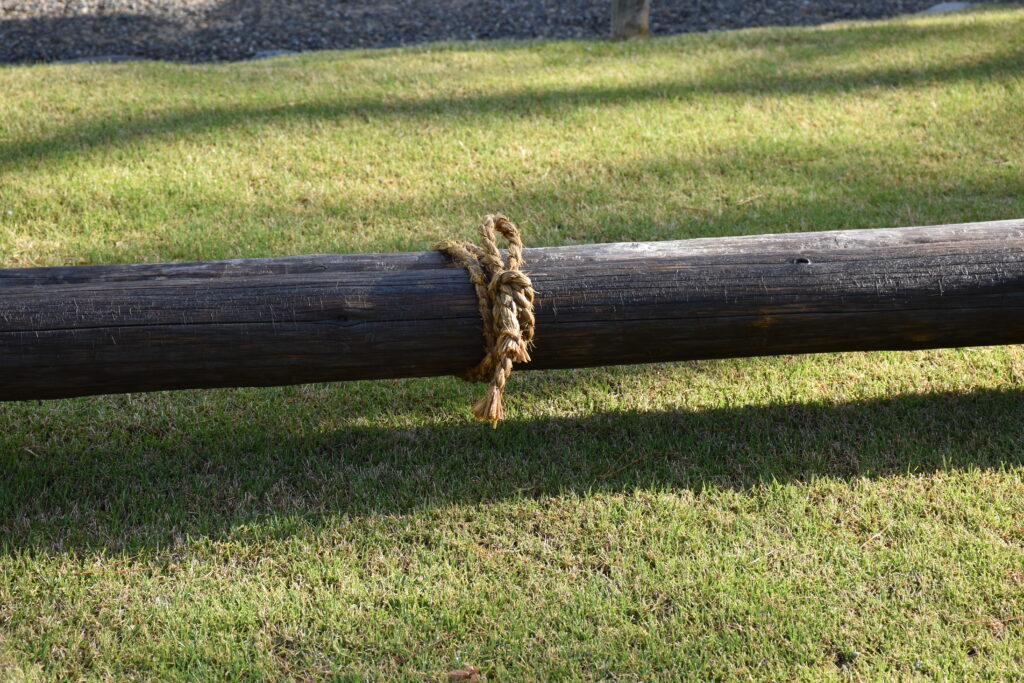
Many of the older trees had branches held up by wooden posts. Sometimes a single branch was supported. Sometimes an entire tree appeared to have its own architectural support system.
At home, I suspect someone would simply announce, “Well, that one’s getting old,” and cut it down.
Not here.
Here, they build it a crutch.
Or ten.




There was a particularly remarkable pine tree called Neagari-no-Matsu, or the Raised-Root Pine.
Its roots had been deliberately exposed by removing the surrounding earth, creating an extraordinary sculptural structure at the base of the tree.
This sort of root exposure is also used in bonsai, but seeing it on such a large tree was something else entirely.


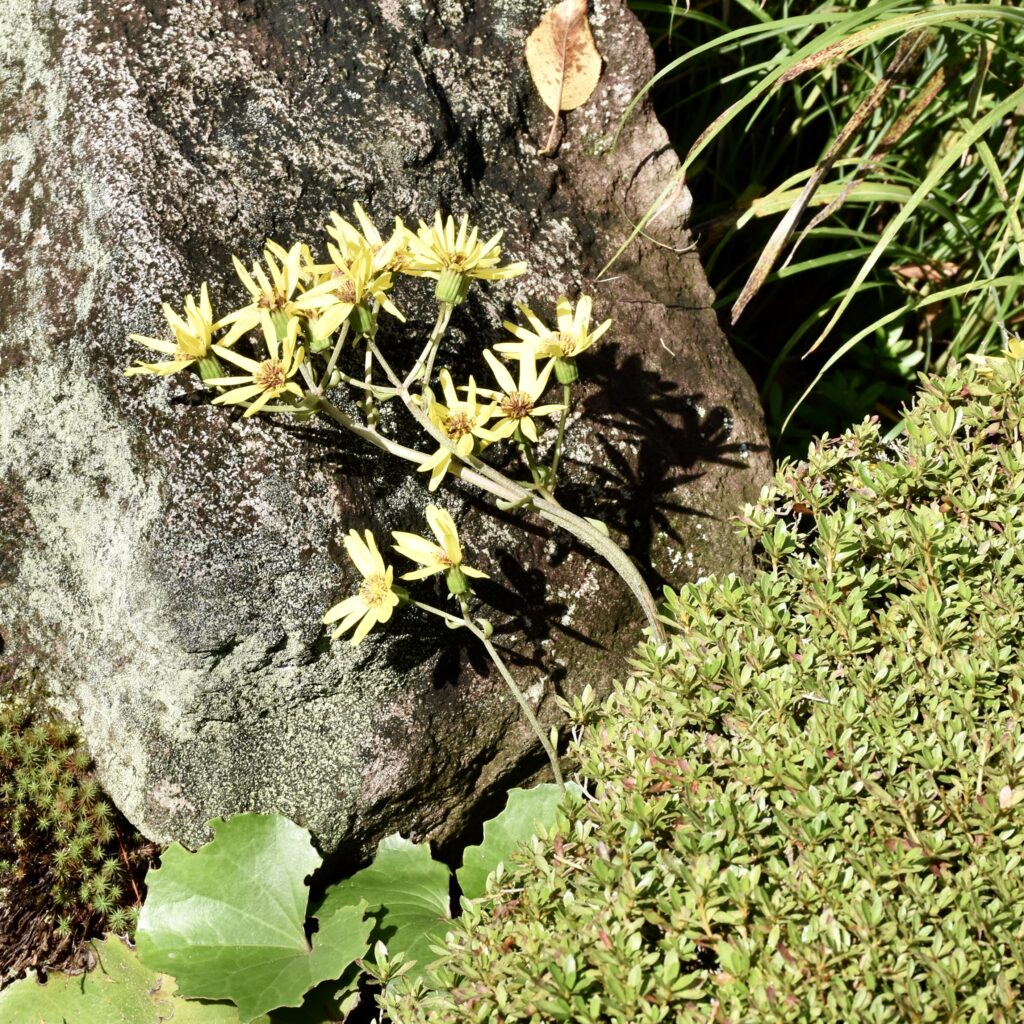
The garden is filled with sculptural pines, little streams, ponds, stepping stones, stone lanterns, and beautiful moss.
One of the ponds even had a duck apparently enjoying a peaceful morning all by itself.
The Bridge of Flying Geese
One particularly unusual bridge caught my attention.
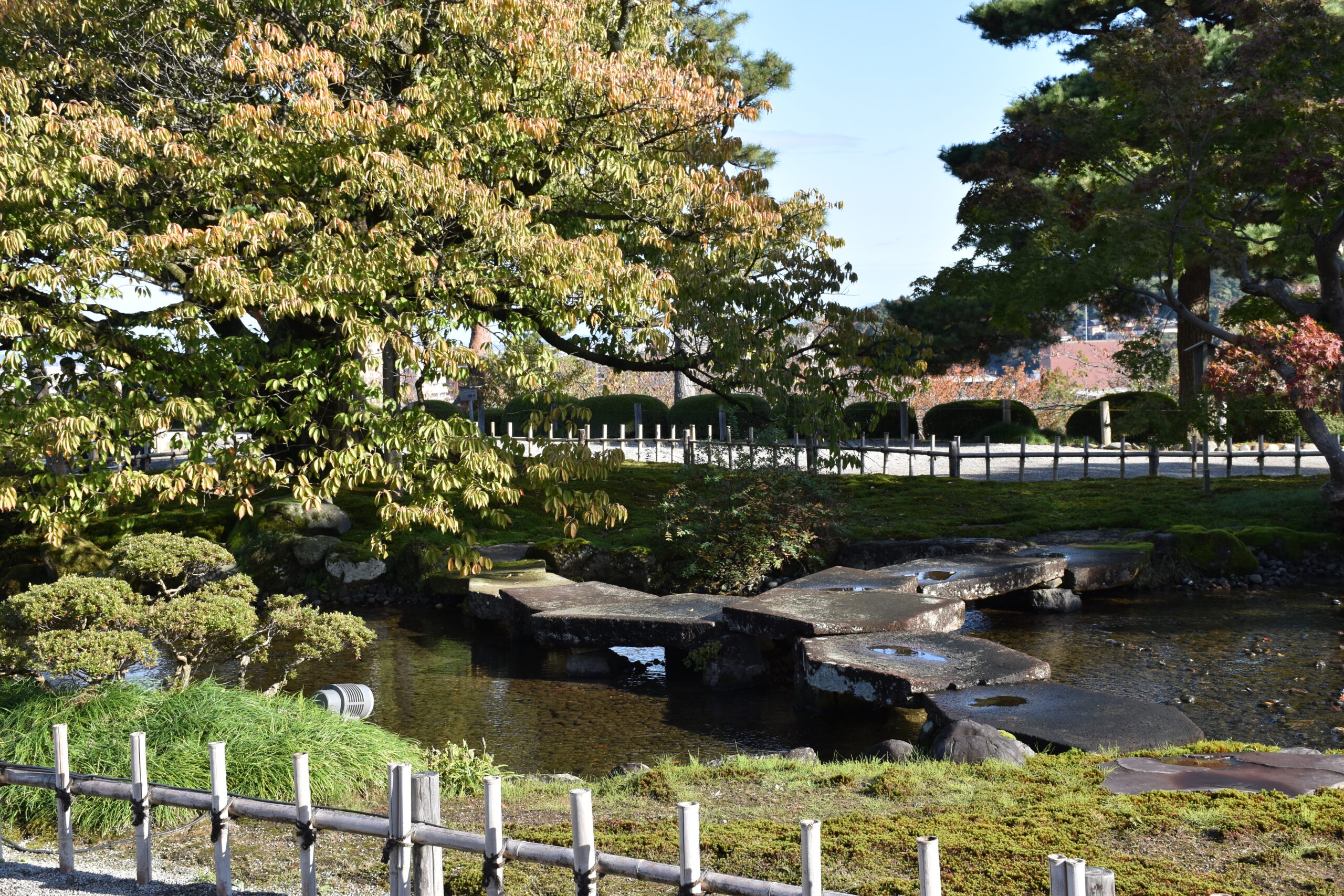
It was made of eleven flat stones, arranged in a shape that looked rather like a shallow V.
This is Gankō-bashi, or the Flying Geese Bridge.
The stones were deliberately arranged to suggest a flock of wild geese flying in formation.
They are also shaped rather like tortoise shells, giving the bridge another name: the Tortoise Shell Bridge.
In Japanese symbolism, tortoises are associated with longevity. In fact, it was once believed that crossing this bridge could help one live a long life.
Unfortunately, so many people walked across it that the stones gradually wore down. The bridge has been closed to pedestrians since 1969 to preserve it.
So you can admire the flying geese, but you can’t join them.
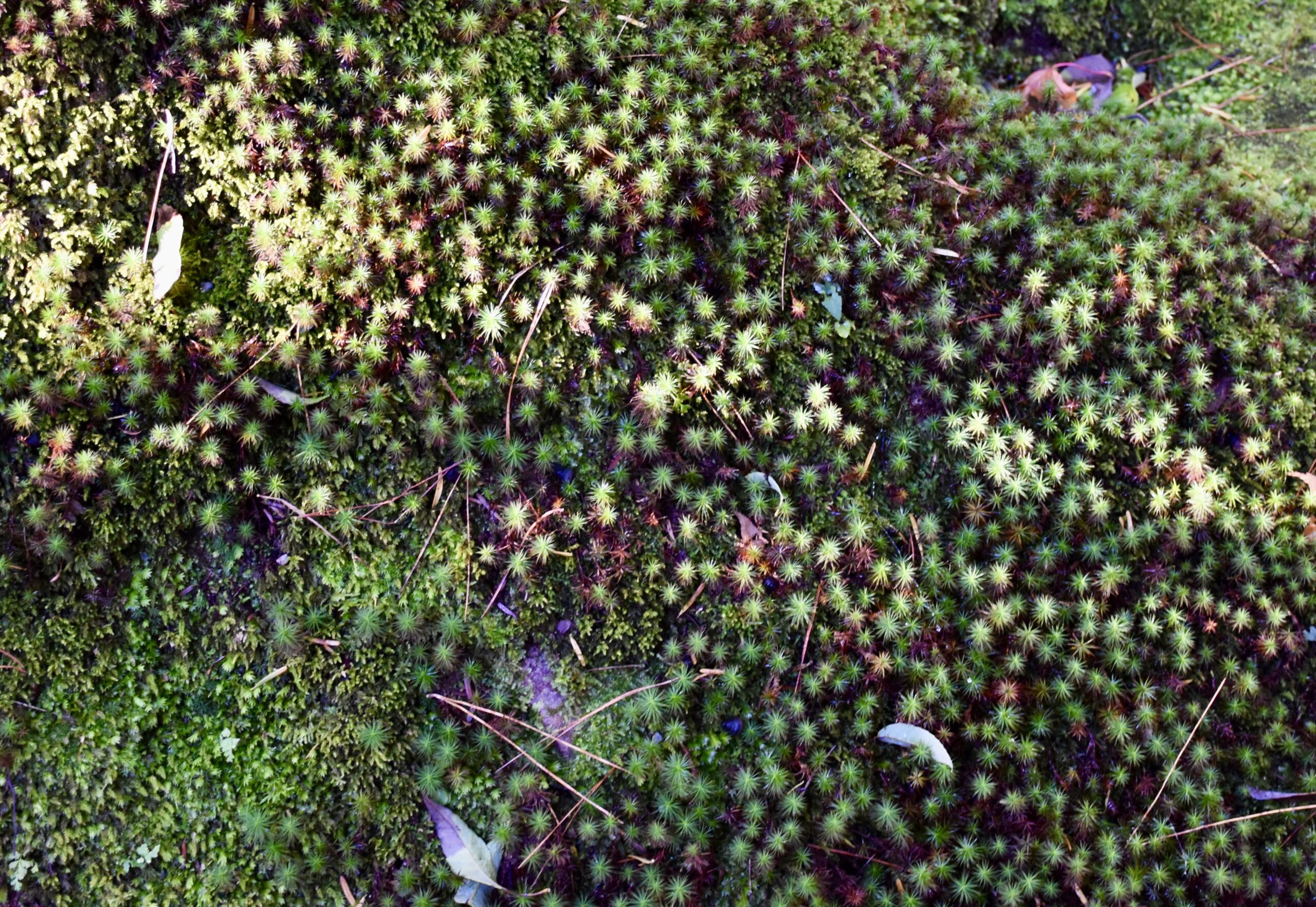
I also discovered that moss is a photographic subject in its own right.
Up close, some of the tiny plants looked like miniature green starbursts.
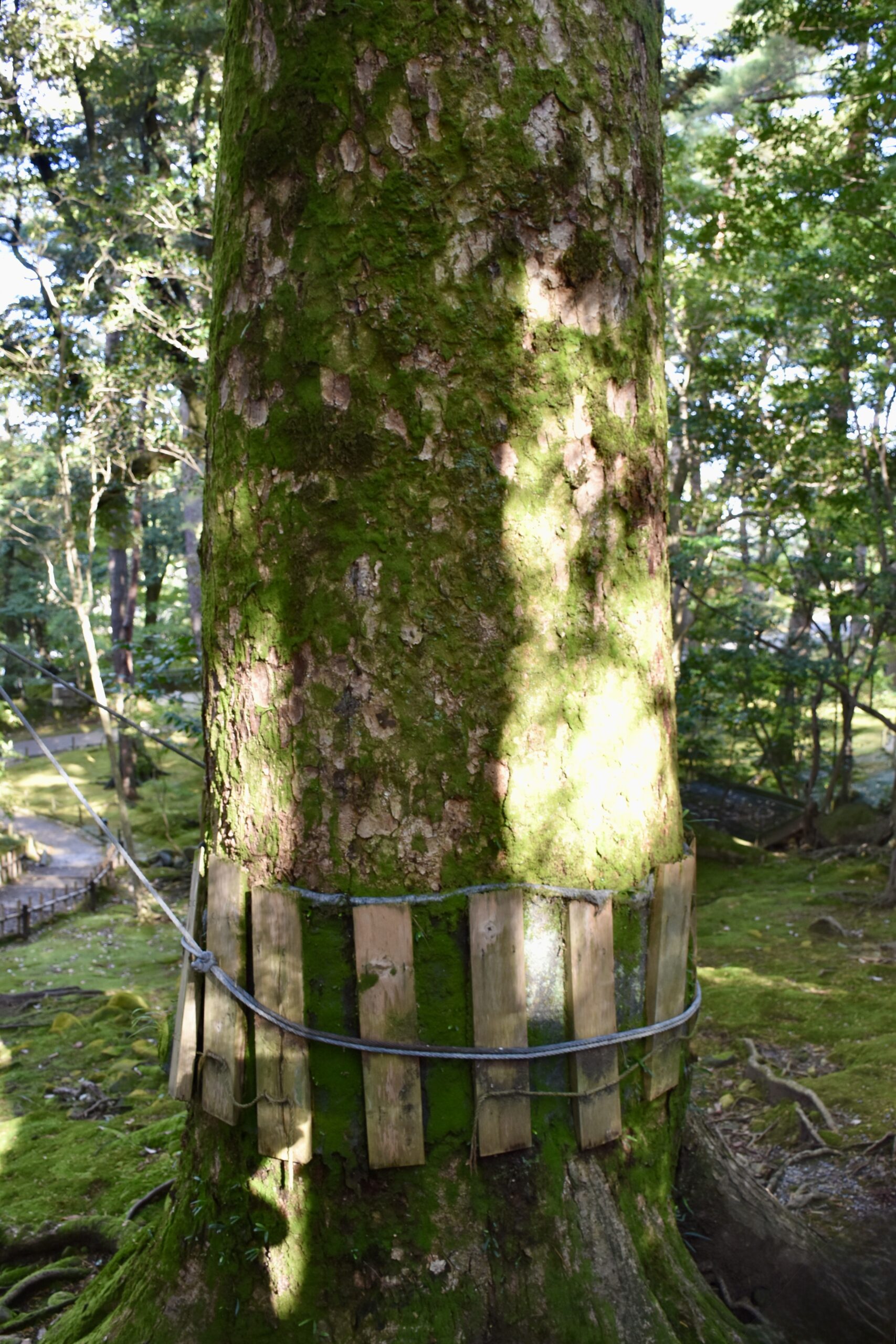
Another tree wore what looked like a protective wooden corset.
Utako-san explained that when the garden’s tree doctors discover a bacterial or other problem affecting a tree, they sometimes apply protective wooden slats around its trunk as part of its treatment. The covering can also help protect the tree during the cold winter months.
Once again: don’t cut down the tree. Figure out how to help it survive.
A Legendary Warrior in the Garden
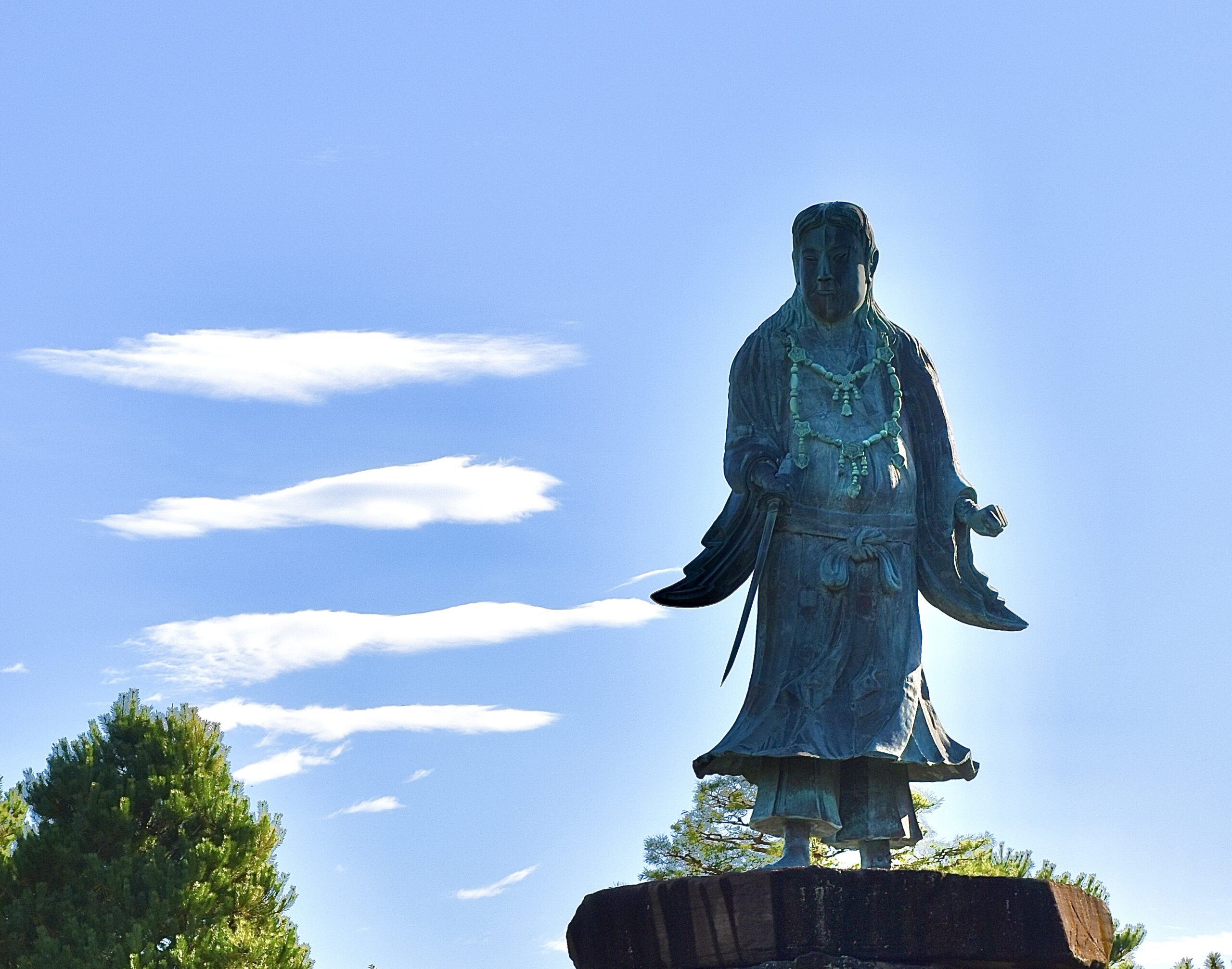
We also came upon an impressive bronze statue, although the sun was shining so directly behind it that getting a decent exposure was a challenge.
At first, I thought the figure was Kannon, the Buddhist bodhisattva of compassion.
But it turns out the statue represents someone quite different: Yamato Takeru, a legendary Japanese prince and warrior.
The statue was erected in 1880 as part of the Meiji Memorial, honoring soldiers from Ishikawa Prefecture who died during the Satsuma Rebellion of 1877.
That rebellion was a final, bloody confrontation between the new Meiji government and disaffected former samurai, following the dismantling of Japan’s feudal order.
So this wasn’t simply a decorative figure in a garden. It commemorated a pivotal moment in Japan’s transition from the age of samurai to the modern nation.
The bronze is also considered Japan’s first outdoor statue of a human figure.
And here’s a curious little detail I discovered: for years, people apparently noticed that birds seemed reluctant to perch on the statue. A researcher investigated and found that its metal contained an unusually high amount of arsenic, which might explain the phenomenon.
That research even received an Ig Nobel Prize!
So apparently Japanese birds can distinguish between an unwelcoming bronze statue and the perfectly comfortable anti-bird spikes I photographed later in the day.
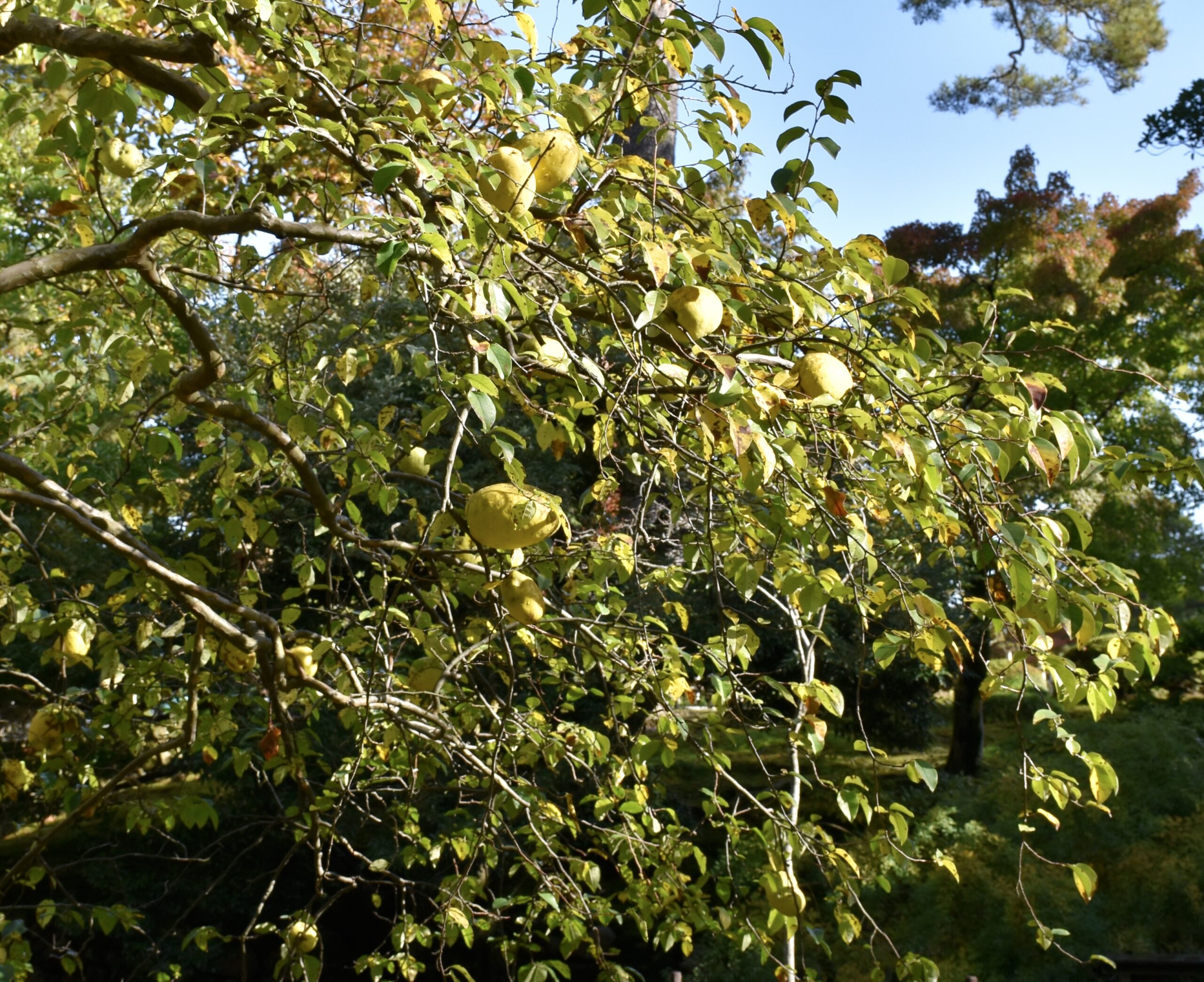
And there was a quince tree covered in enormous, yellow, rock-hard fruit.
Which made me think:
Who was the first person to look at one of these things — hard enough that you could probably kill someone by throwing it — and decide to boil it for an entire day to see what happened?
Because the result, improbably, is delicious quince jelly.
I think that person deserves a medal, too.
An Old Fountain with No Pump
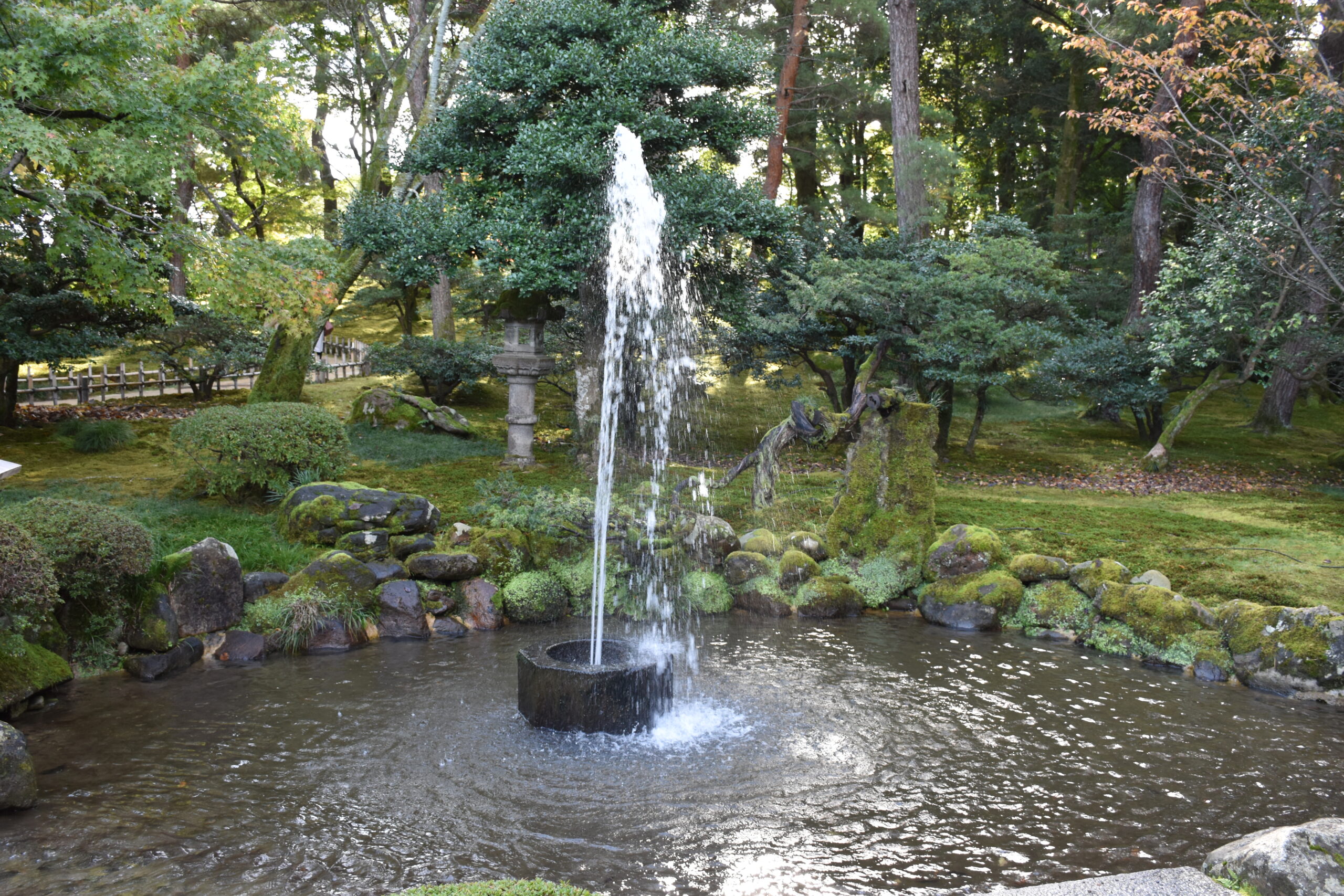
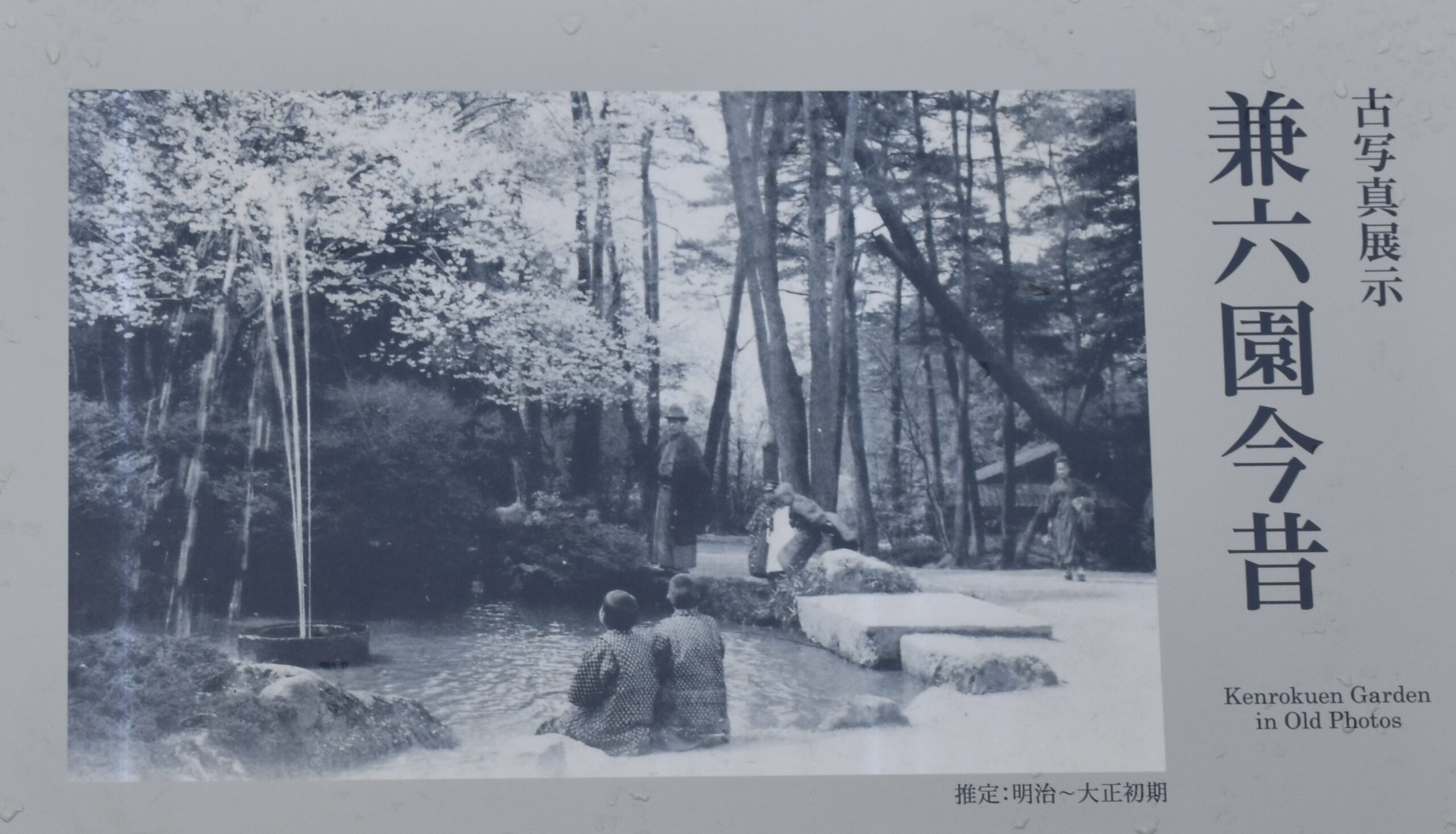
One of the garden’s other curiosities is a fountain considered the oldest in Japan.
Dating to the nineteenth century, it uses the difference in elevation between the upper pond and the fountain below to propel the water upward.
No mechanical pump required!
The water rises approximately 3.5 meters, powered entirely by natural water pressure.
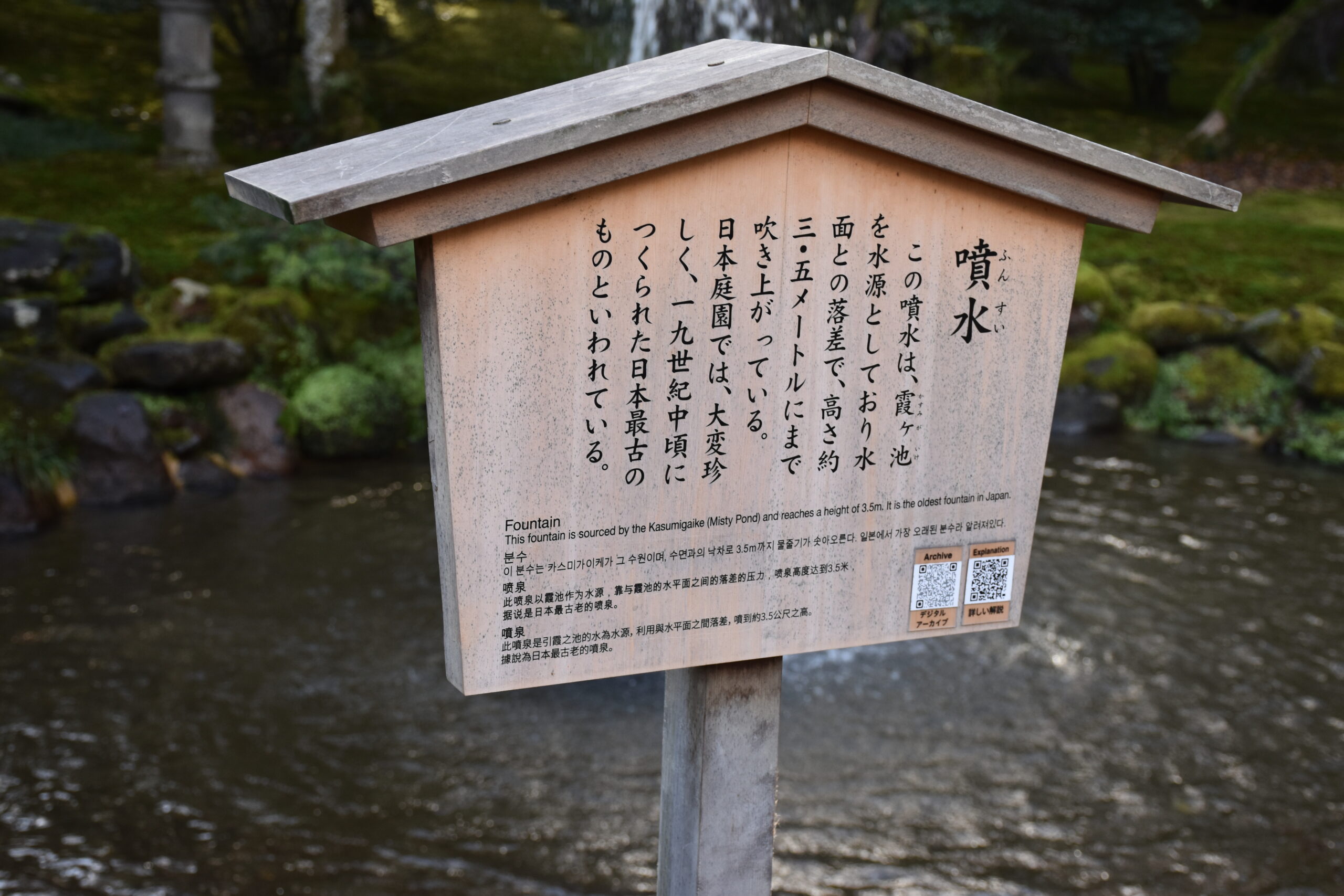
There was also an old photograph showing the same fountain in an earlier era.
I love those moments when you can look at something standing in front of you, then look at an old photograph and realize that people were enjoying essentially the same scene generations ago.
Before leaving, I visited the gift shop, which had some extraordinary ceramic work.
I managed to escape with only two pieces: tall, rough-textured ceramic drinking glasses, each decorated with a gold-inlaid tree.
They’re intended for plum wine and similar drinks, rather than being the small cups usually associated with sake.
I loved their texture and their combination of earthy ceramic and delicate gold.
A lovely remembrance of a garden where caring for trees seems to be something approaching a sacred duty.
Kanazawa Castle: Samurai, Daimyo, and Shogun — Who’s Who?
From the garden we continued to Kanazawa Castle, the seat of the Maeda family.
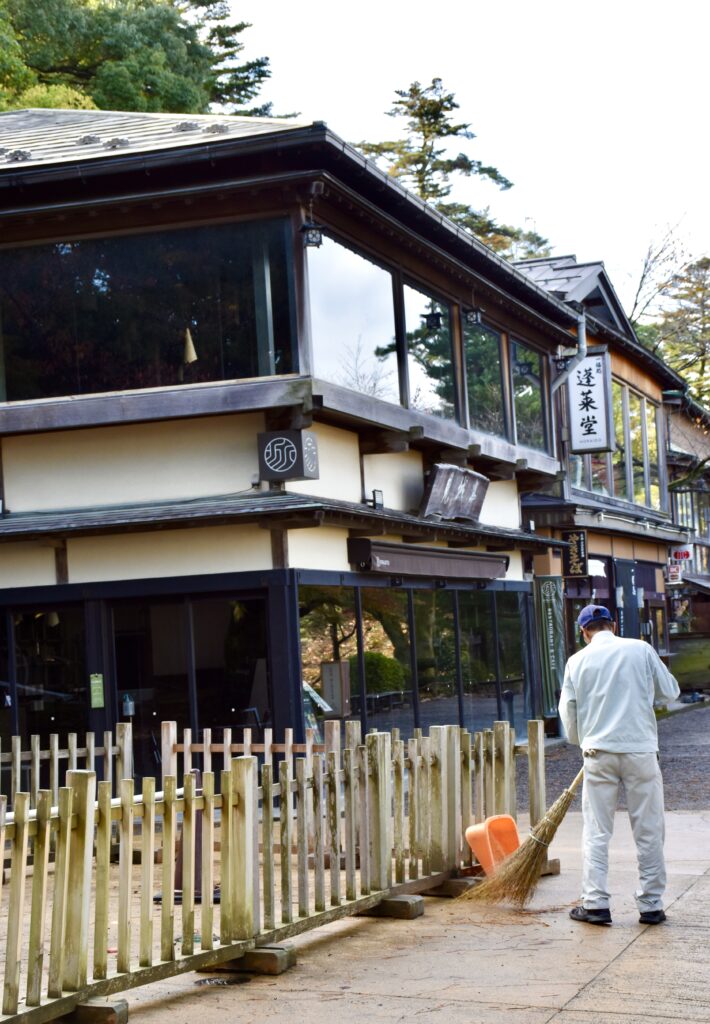
The buildings are striking: brilliant white walls, dark tiled roofs, massive stone foundations, and enormous wooden gates.
What particularly caught my attention was the construction of the gateways.
The lintels and beams were tremendous, as were the huge wooden doors.


There is something about Japanese castle architecture that manages to look elegant and formidable at the same time.
The white walls and sweeping roofs are beautiful, but the size of the stone foundations and the weight of those doors leave no doubt that these were defensive structures.
And since the terms samurai, daimyo, and shogun have been getting a little muddled among our traveling companions, perhaps a short explanation is in order.
A Little Samurai 101
In Japan’s feudal system, the shogun was the country’s supreme military ruler, exercising national authority in the name of the emperor, who remained the traditional sovereign.
The daimyo were powerful territorial lords, controlling domains with their own administrations, castles, and military retainers. They were subject to the shogun’s authority, although their relationships with the central government varied considerably over time.
And the samurai were the hereditary warrior class who served these lords. Although we tend to picture samurai as swordsmen, many also performed administrative and governmental duties, especially during the long peace of the Edo period.
So, in simplified form:
Shogun → Daimyo → Samurai.
And then there were the ronin.
A ronin was a masterless samurai.
If a daimyo lost his domain, was dispossessed, or otherwise ceased to maintain his retainers, his samurai might suddenly find themselves without a lord, employment, or the position that had defined their lives.
That was no small matter in a society where identity, status, and loyalty were so deeply connected.
I tried explaining this to some of our group.
I believe I actually saw their eyes go TILT.
But I find the whole system fascinating, especially the question of what happens to a warrior whose entire identity depends on serving someone who suddenly isn’t there anymore.
And the Maeda family, whose castle we were now visiting, occupied a very important position within that hierarchy.
Market Mayhem: What Can You Buy for ¥1,000?
Next came Ōmichō Market, Kanazawa’s famous food market.
And Utako-san had a challenge for us.
She divided us into three groups, gave each group ¥1,000, and instructed us to find something unusual — preferably something we’d never seen before.
We were then to present our discoveries.
This was great fun.
One group came back with delicious little cookies shaped like torii gates, lanterns, and other Japanese objects.
We ate them later at lunch, and they were excellent.
Another group found dried persimmons, prepared in the traditional manner we’d seen earlier at the farmhouse during our tea-farm day.
I was particularly interested in those, because I remembered seeing a segment years ago — possibly on Bay Area Backroads — about a Japanese farm in Sonoma County making them the same way.
I wonder whether they’re still doing it.
That group also found something that looked remarkably like bagel chips.
Except they weren’t bagel chips at all.
Utako-san explained that they were meant to be soaked in soup.
They were fu, a Japanese wheat-gluten food that absorbs broth.
That group won.
Apparently their selections were considered particularly seasonal.
Which was all very well, except that seasonality wasn’t one of the announced judging criteria!
I believe a protest would have been justified.
Because OUR group had found something much more interesting.
A local seasoning made with nori and, according to Google Translate, flying-fish jaws.
Flying. Fish. Jaws.
How could we possibly lose?
And we even managed to have enough money left over to buy a little packet of coffee with gold leaf in it.
Utako-san gave the coffee to me, and I’m bringing it home for Melissa, who likes black coffee. I think she’ll get a kick out of it.
So, really, one could argue that we had the most interesting item AND a bonus gift.
One could.
I’m just saying.

A Few Black Birds Who Didn’t Read the Instructions
At some point during our travels, I spotted several black birds perched on overhead wires.
Not unusual in Japan. Crows seem to be everywhere.
But these particular birds had chosen to perch directly on the little spikes installed to PREVENT birds from perching.
There they sat, perfectly content.
Perhaps the spikes provide a pleasant foot massage?
A little avian acupressure?
Or perhaps black birds simply enjoy demonstrating the limitations of human ingenuity.
Black birds always make me think of H, and I love encountering them during my travels.
This particular group seemed to have inherited his sense of humor.
Higashi Chaya: Old Wooden Houses, Sake, and a Goshuin Detour

We next explored the Higashi Chaya District, which Utako-san described as Kanazawa’s geisha district.
Historically, the neighborhood was home to traditional teahouses, or chaya, where geisha entertained guests through music, dance, and conversation.
The narrow streets are lined with old wooden buildings, many with distinctive latticework.
There is a wonderfully atmospheric quality to the place, especially when you turn down one of the smaller streets away from the main flow of visitors.
One building had a large brown ball hanging outside.
This is a sugidama, a ball made from cedar branches, traditionally associated with sake breweries.

When the season’s new sake is ready, a fresh green cedar ball is hung outside.
As the sake matures, the cedar gradually dries and turns brown.
A kind of seasonal announcement system, made entirely from a tree.
But look carefully at the upper right of that photograph.
There’s also an ear of corn hanging there.
We were told this was intended to ward off evil spirits.
Which reminded me of an old European superstition I’d heard: if you put a pile of salt in the corner of a room, a witch entering the house would be compelled to count every grain. With luck, she wouldn’t finish before dawn, when she’d have to leave.
I wondered whether the corn served a similar purpose.
Perhaps evil spirits would be forced to count the kernels?
Utako-san didn’t know whether the traditions were related, but I loved the idea.
Apparently, even supernatural troublemakers can be defeated by tedious arithmetic.
We also passed a beautiful little shrine, Higashiyama Sugawara Shrine, tucked among the traditional buildings.

And then, somewhere farther along our walk, I spotted something.
A sign for goshuin!
Now, for those who haven’t been following my continuing adventures in the acquisition of Japanese temple and shrine calligraphy, a goshuin is a special commemorative seal and inscription traditionally obtained when visiting a shrine or temple.
Some are written directly into your goshuincho — an accordion-paged book specifically designed for collecting goshuin — by a calligrapher. Others are prepared in advance.
This particular shrine had a self-service arrangement.
I had to work out which box contained the goshuin, where to put my ¥600, and — importantly — which was the payment box rather than the prayer-offering box!
I successfully acquired two beautiful, already-calligraphed goshuin.
There was just one little problem.
The group had kept moving.
And for a moment, I was afraid I’d lost them.
The narrow streets and alleyways were not particularly helpful.
Fortunately, I knew what I was looking for:
Utako-san’s ubiquitous red beret.
And eventually, there it was.
Utako-san hadn’t even noticed the goshuin sign.
When she saw what I had in my hand, she simply shook her head and laughed.
Apparently, my ability to locate goshuin has now become something of a running joke.
I may not always know where the group is going, but I certainly know where to find temple calligraphy.
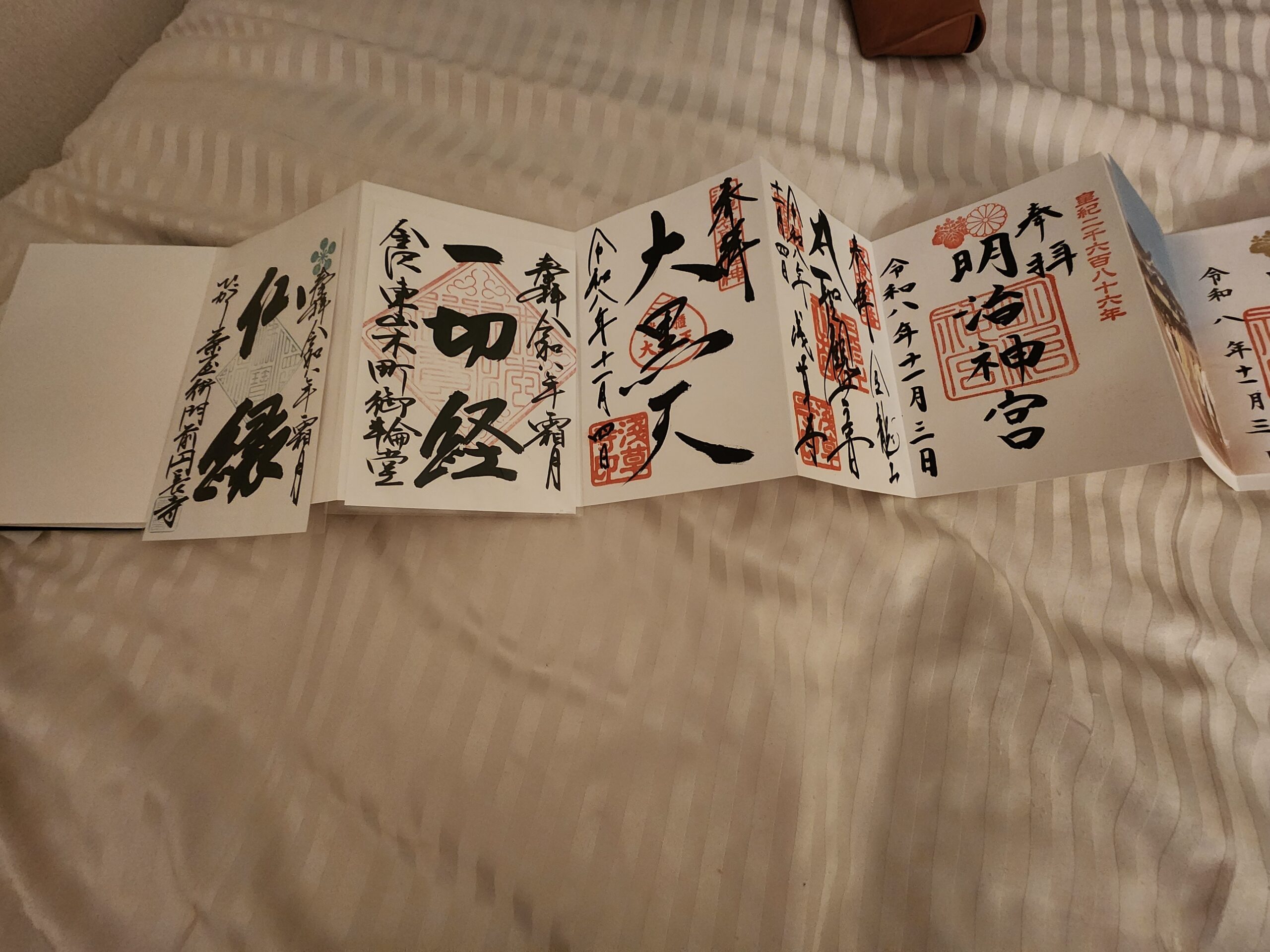
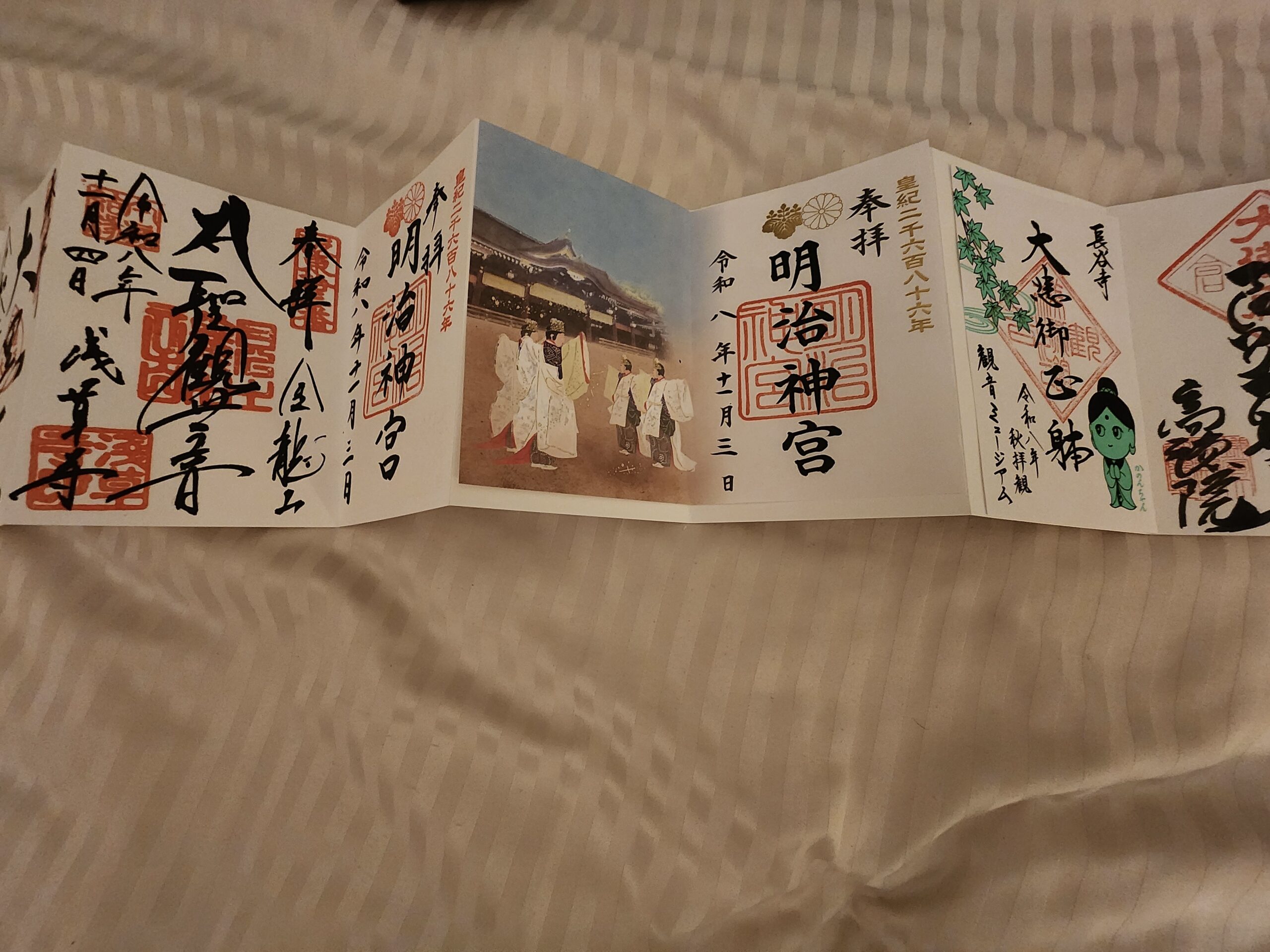
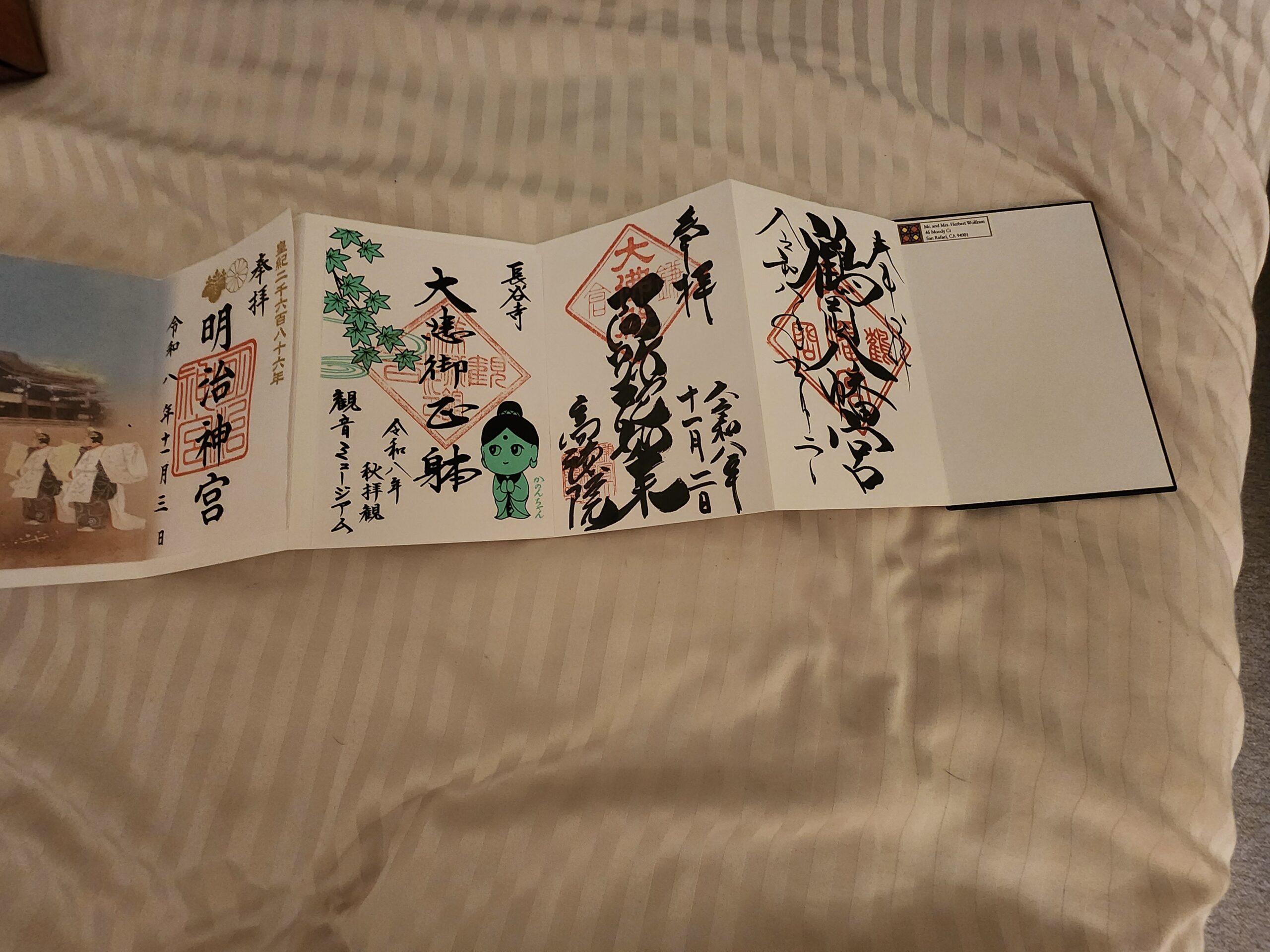
In writing the above, back at the hotel many hours later, I opened my goshuincho (my accordion-paged goshuin-collecting book) all the way out for the first time, to photograph it.
WOW.
It took three photos.
I’d been so busy collecting individual goshuin that I hadn’t appreciated what they looked like together. The bold black brushwork, brilliant red seals, little illustrations, and beautifully varied designs had become a continuous work of art.
And to think that I’m not even half way through this trip!
(I guess I’m glad I did buy that other goshuincho at the marquetry shop!!)
Karaoke, Rent a Car . . . and Laundry?

Driving to our next destination, I spotted this sign at a mall . . .
Well, of course.
Because those two activities are such a natural combination.
And next door was a coin laundry.
So apparently you could sing, rent a car, AND do your washing, all in one convenient location.
Perhaps you need the rental car to escape after an especially unfortunate performance?
Kanazawa Gold Leaf: The Art of Pounding Something Almost Out of Existence
Our next stop was Hakuichi’s Hakukokan, where we learned how Kanazawa’s famous gold leaf is made.
Kanazawa produces almost all of Japan’s traditional gold leaf, and the craft has been practiced here for centuries.
I had always thought of gold leaf as something rather delicate, which of course it is.
What I hadn’t appreciated was the astonishing amount of POUNDING required to make it.
We watched a craftsman working at a large machine that repeatedly hammered packets containing tiny pieces of gold.
He was in a soundproofed room.
And then, briefly, they switched off the soundproofing so we could hear the machine.
DEAFENING.
I cannot imagine working alongside that racket all day.


The process begins with gold alloy, traditionally containing small amounts of silver and copper.
The metal is rolled into thin strips, cut into pieces, and placed between sheets of specially prepared washi paper.
The paper itself is critical.
Traditional washi is often made from the fibers of kōzo, or paper mulberry. But the special paper used in gold-leaf production isn’t simply ordinary mulberry paper.
It undergoes additional preparation and treatment, traditionally involving ingredients such as persimmon tannin, ash-derived liquid, and egg.
The resulting paper has to be extraordinarily smooth, resilient, and strong enough to survive repeated hammering.

And THEN comes the pounding.
We watched a video showing how the small piece of gold spreads under repeated blows, moving outward toward the edges of its paper enclosure.
It’s removed, cut into smaller squares or transferred to new sheets, rearranged, and pounded again.
And again.
And AGAIN.
At different stages, the gold is transferred between different grades of paper as it becomes progressively thinner.
We were told about a cycle of pounding and resting because the process generates heat.
Eventually the gold becomes approximately one ten-thousandth of a millimeter thick.

Think about that for a moment.
That is roughly 0.1 micrometer.
Practically nothing!
One of the displays demonstrated this in an absolutely extraordinary way.
There was a tiny Japanese coin, and behind it an enormous sheet of beaten gold, approximately the size of a tatami mat.
We were told that just three coin-sized pieces of gold could be beaten into that great sheet.
I didn’t catch the denomination of the coin, unfortunately.
But the comparison was astonishing.
The traditional decorative gold alloy contains small amounts of silver and copper, while the edible version we were shown omitted copper.
The decorative material may be described as non-toxic, but as we discussed, that doesn’t necessarily make it something one ought to eat!
And the finished material is so delicate that even a little puff of air can cause problems.
Which explains the extraordinary patience and dexterity required to work with it.
There were rooms full of beautiful gold-leaf artworks: screens, calligraphy, kimono decorations, paintings, and ceramic pieces.


Some of the vases particularly caught my attention. One had a marvelous mottled green-and-gold finish, almost like an ancient bronze vessel.
There was even an impressive suit of samurai armor displayed in a room whose walls were entirely covered in gold leaf.
As was the armor.
Very dramatic indeed.

It was quite an extraordinary contrast.
Tremendous force, deafening machinery, and endless pounding — all to produce something almost weightless.
My Great Gold-Leaf Artistic Career
We then had an opportunity to try working with gold leaf ourselves.
Our project was to create postcards decorated with gold leaf.
I chose a relatively small design.
Which meant that I had some gold leaf left over.

Now, I ask you: what is a person supposed to do with extra gold leaf?
Obviously, PUT IT ON HER FINGERNAILS.
So I did.
This caused considerable amusement among the group.
But why waste perfectly good gold?
Besides, it looked rather festive.
And I suspect it may be the only time in my life that I’ve had genuinely gold-plated fingernails
And Then I Ate Gold
Of course, I couldn’t leave without trying the famous gold-leaf soft-serve ice cream.
The woman behind the counter carefully lifted an entire sheet of edible gold leaf with special bamboo tools and laid it across the top of my vanilla ice cream.
It was quite a production.


And there it was.
A vanilla ice cream cone wearing a shimmering golden cape
Naturally, photographs were required.
Including photographic evidence of me actually eating the gold.


And the verdict?
Gold tastes like absolutely nothing.
Which makes sense, I suppose.
But it certainly improves the appearance of an ice cream cone.
And between my fingernails and my dessert, I was probably the most gilded person in our group.
The Nomura Samurai Residence: A Beautiful House with a Rather Dark History
Our final major stop was the Nomura Samurai Residence, in Kanazawa’s Nagamachi samurai district, within walking distance of our hotel.
The Nomura family served the Maeda lords for eleven generations, holding important positions within the domain.
The property has an interesting history of its own.
After the collapse of the feudal system, much of the original residence was lost. The house we visited has been restored and reconstituted, incorporating historic architectural elements relocated from another substantial residence.
In other words, it isn’t entirely the building that stood here during the Nomura family’s heyday.
But it preserves the atmosphere of a substantial samurai household.
And substantial it was!
This was no tiny little cottage.
The rooms were beautifully appointed, with polished wood, tatami mats, sliding doors, and lovely tokonoma alcoves.
These alcoves held calligraphy scrolls and small flower arrangements, each carefully placed.


There was also an extremely elaborate Buddhist family altar, or butsudan.
Its black lacquer, gold ornamentation, and intricate carvings suggested considerable wealth.
I found that particularly interesting, given my recent experiences with traditional Japanese Buddhist altars.

In one room, I noticed a little decorative metal fan mounted above the lintel.

There seemed to be one above each doorway.
I wondered whether they were simply ornamental, or perhaps intended to draw attention to the lintels so that visitors wouldn’t clobber their heads.
Although if you DID clobber your head, I suppose you’d at least receive a decorative imprint as a souvenir.
A Garden Within a Garden
The residence also has its own extraordinary garden.
Although much smaller than Kenrokuen, it was every bit as carefully composed.
There were little streams, mossy rocks, stone lanterns, trees supported by wooden poles, and an intimate pond visible from several of the rooms.


One especially lovely feature was a small stone water basin with a bamboo ladle and delicate flowers.
And nearby was a curious little stone tied with black cord.
Utako-san explained that this is called a sekimori-ishi, a traditional barrier stone.
It means: Do not go this way.
That’s it.
No sign.
No fence.
No threatening warning.
Just a little rock tied with cord, politely informing you that the path is closed.
And apparently everyone is expected to know what it means!
Utako-san said we’ll probably encounter quite a few more of these in Kyoto.
I’m very glad she told us.
Because I can easily imagine tourists seeing a cute little gift-wrapped rock, deciding it’s charming, and proceeding directly into someone’s private garden.
D’oh!


The Very Unusual Route to the Tea Room
The house also had a second-floor tea room, called Fubaku–an, with a separate waiting room for guests.
But getting there was an adventure in itself.
I originally thought to describe the approach as a staircase, but that really doesn’t do it justice.
It was more like an inclined stone pathway, made of very large, irregular, natural stones, with gravel filling the spaces between them.
The route bent around in an L-shape and climbed quite steeply through a partially enclosed passage to the tea room above.
These weren’t conventional stairs, with neat, evenly spaced treads and risers.
The stones were BIG.
Some were large enough that someone coming down could occupy the same stone as someone going up.
And the surfaces had been worn smooth by generations of visitors.
It was atmospheric, certainly.
But coming DOWN?
Oh, my.
Between the incline, the uneven surfaces, and those slippery, worn stones, I found the descent decidedly more challenging than the ascent.
Not a place to be distracted by the scenery!
I kept thinking of the samurai household’s guests, making their way along that same unusual route to the tea room and its waiting area.
It’s one thing to imagine tea ceremonies as graceful, serene occasions.
It’s quite another to imagine getting there without slipping on the approach.
Swords, Armor, and the Business of Being a Samurai

Naturally, I was particularly interested in the swords on display.
There was a katana and a shorter sword, both beautifully presented.
There was also a suit of armor associated with the Nomura family.
Unlike the dazzling gold armor we’d seen earlier, this one was dark and substantial, with blue cords and a striking helmet ornament.
It looked decidedly more businesslike.

And then we came to the historical documents.
Oh, my.
There were several letters addressed to members of the Nomura family, complete with English translations.
One, attributed to Akechi Mitsuhide, thanked a samurai for his hard work, expressed concern about his wounds, and advised him to rest and recover.
Rather touching, actually. (I particularly liked the apology for procrastination.)

Then there was another letter, dated October 9, 1566, from Yoshikage Asakura to Nomura Shichirogoro.
It thanked him for his efforts during a battle.
Specifically, for killing an important enemy soldier.
And bringing back his head.
The museum’s English translation concluded:
“We are very happy that you brought us his head.”


WELL.
There’s a thank-you note you don’t see every day.
Imagine receiving that in the mail.
“Dear Samurai: Thank you so much for the severed head. Just what we needed. Your thoughtfulness is greatly appreciated.”
It certainly provides a rather different perspective on the romantic image of samurai life.
These were not simply gentlemen sitting around beautifully appointed houses, arranging flowers, appreciating gardens, and practicing tea ceremonies.
There was a much bloodier side to the profession.
And here it was, documented in lovely calligraphy.
I found the juxtaposition rather extraordinary.
Dinner? Not Tonight.
By the time we finished, we’d had a very full day.
Dinner tonight was on our own.
But I decided to return to the hotel and work on this blog instead.
Lynn went to happy hour with the others, but came back afterward and didn’t go out for dinner either.
Sometimes, after a day like this, staying in is exactly the right choice.
Apparently the group has made a reservation for tomorrow night at a hibachi restaurant.
I’m not quite sure how I feel about that.
After my experience on the first night, when fish was cooked on a shared grill and my asparagus was then put onto the same cooking surface, I’m understandably cautious.
I suspect the restaurant may have a communal grill, which could make it difficult to avoid cross-contact with fish.
And with my allergies, that’s simply not something I can take a chance on.
I’ll see what the arrangements actually are, but I may have to give that one a pass.
There are plenty of other things to eat in Japan — assuming, of course, that I can find them without fish hiding somewhere in the ingredients!
A Few Final Thoughts
One of the things I most enjoy about Japan is the way beauty appears in unexpected places.
A tiny arrangement of autumn leaves in a little window overlooking a back staircase.

A carefully placed flower beside a scroll.
A polished wooden beam with a small decorative ornament.
A stone placed across a garden path to communicate an entire instruction without a single word.
And even the flower arrangement in our hotel lobby — yellow chrysanthemums, arching branches with golden berries, and extraordinary curling pink-orange flowers that appear to be Gloriosa lilies.

And then there is the other side of Japan.
The extraordinary technical ingenuity required to make gold leaf a fraction of the thickness of a human hair.
The enormous labor involved in protecting ancient trees from winter snow — a process repeated year after year.
And the historical documents that remind us just how different the values of earlier centuries could be.
Today we experienced all of it.
From a garden where elderly trees are lovingly supported rather than removed, to a samurai residence where a letter thanking someone for delivering a severed head is displayed with complete historical seriousness.
From gold leaf hammered almost into nothingness, to gold leaf delicately draped over a perfectly ordinary vanilla ice cream cone.
And from an exquisite arrangement of flowers in a tiny alcove to a group of black birds happily perching on the very spikes meant to discourage them.
What a fascinating country.
And what a day.
Tomorrow: More Kanazawa adventures.
Including making mochi, a visit to a World Heritage Site of thatched homes, and an opportunity to make traditional Japanese washi paper — even more interesting, now that we’ve seen how important that paper can be to an entirely different art.
Possibly followed by a hibachi dinner.
Or possibly not.
I suppose that depends on whether the chef can keep the fish away from my asparagus.