
Hakone Day 2 – November 6, 2026
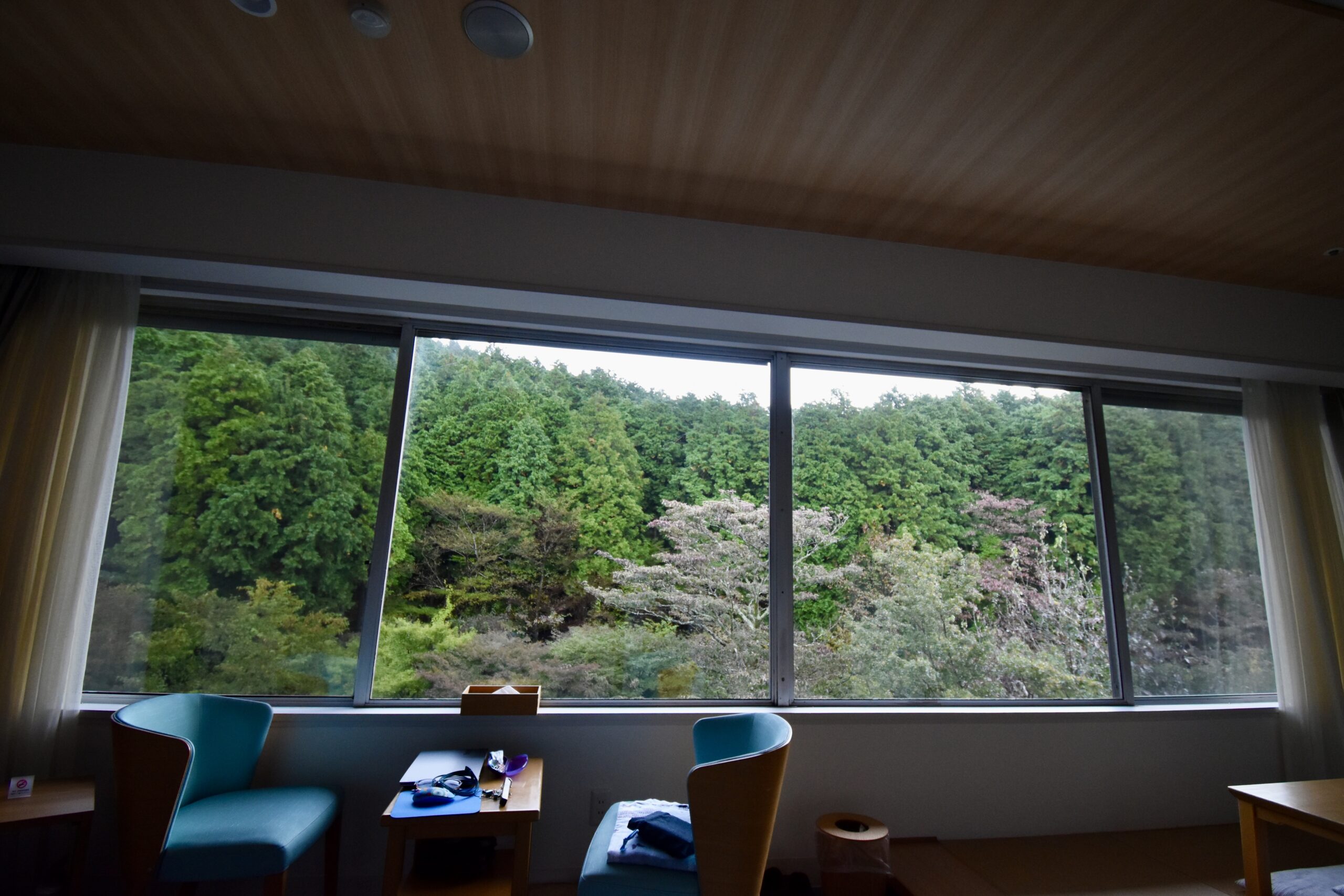
There are days when Japan seems determined to show you just how many completely different experiences it can squeeze into a single itinerary.
Today we had a boat ride across a volcanic lake, an introduction to exquisite traditional woodworking, a lunch that required cooking our own food, an encounter with geishas, a mountain that smelled as though 10,000 eggs had gone very, very wrong, and a spectacular sunset view of Mount Fuji.
And then, because apparently we hadn’t done quite enough walking, there was an uphill hike back to the hotel.
But I’m getting ahead of myself.
Lake Ashi: A Boat Ride Through the Mountains
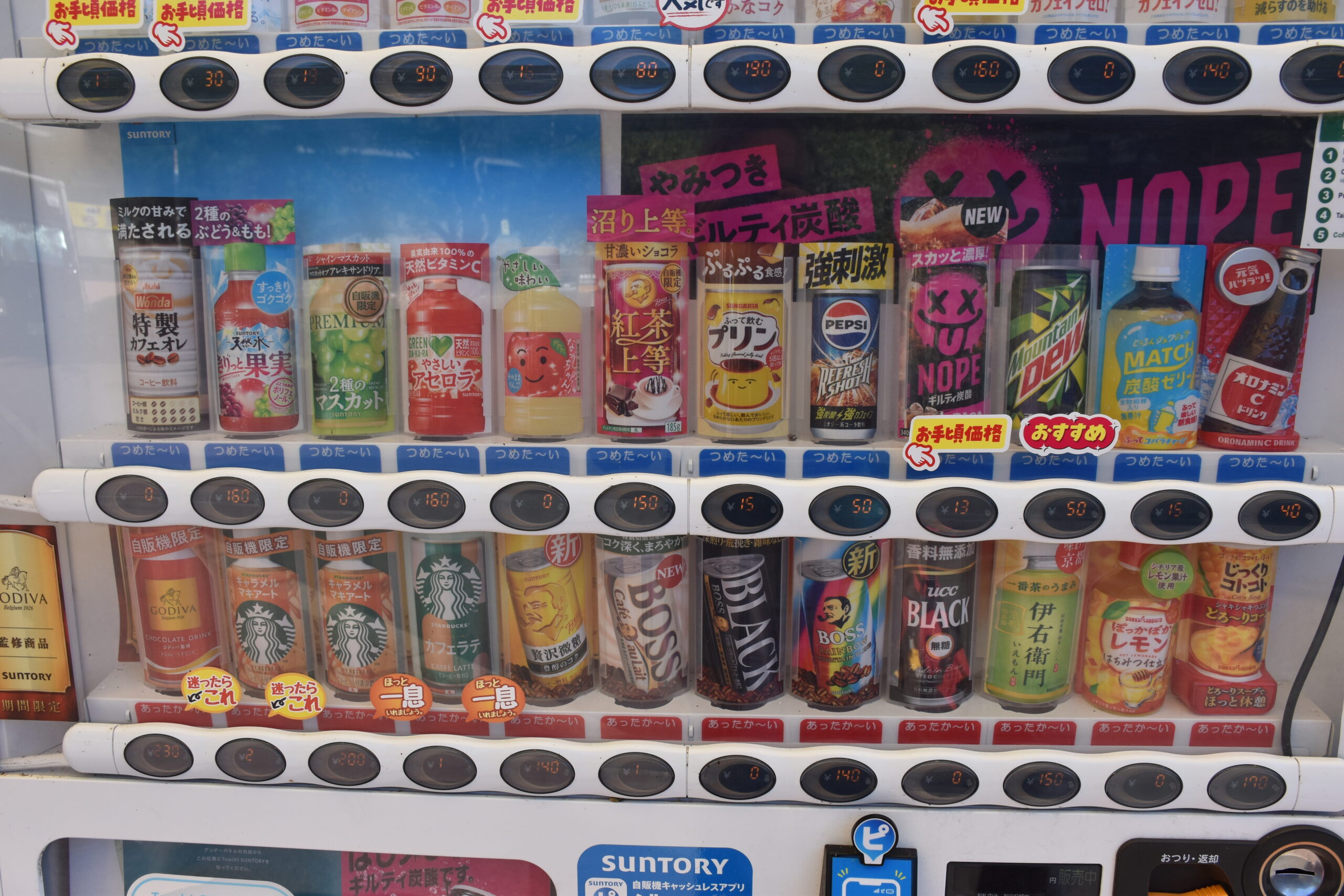
My first adventure of the day was getting a piping-hot latte out of a vending machine!
I have wanted to try this ever since I saw it on a TV show, and it definitely lived up to the hype. And at only ¥160, a good deal, too.
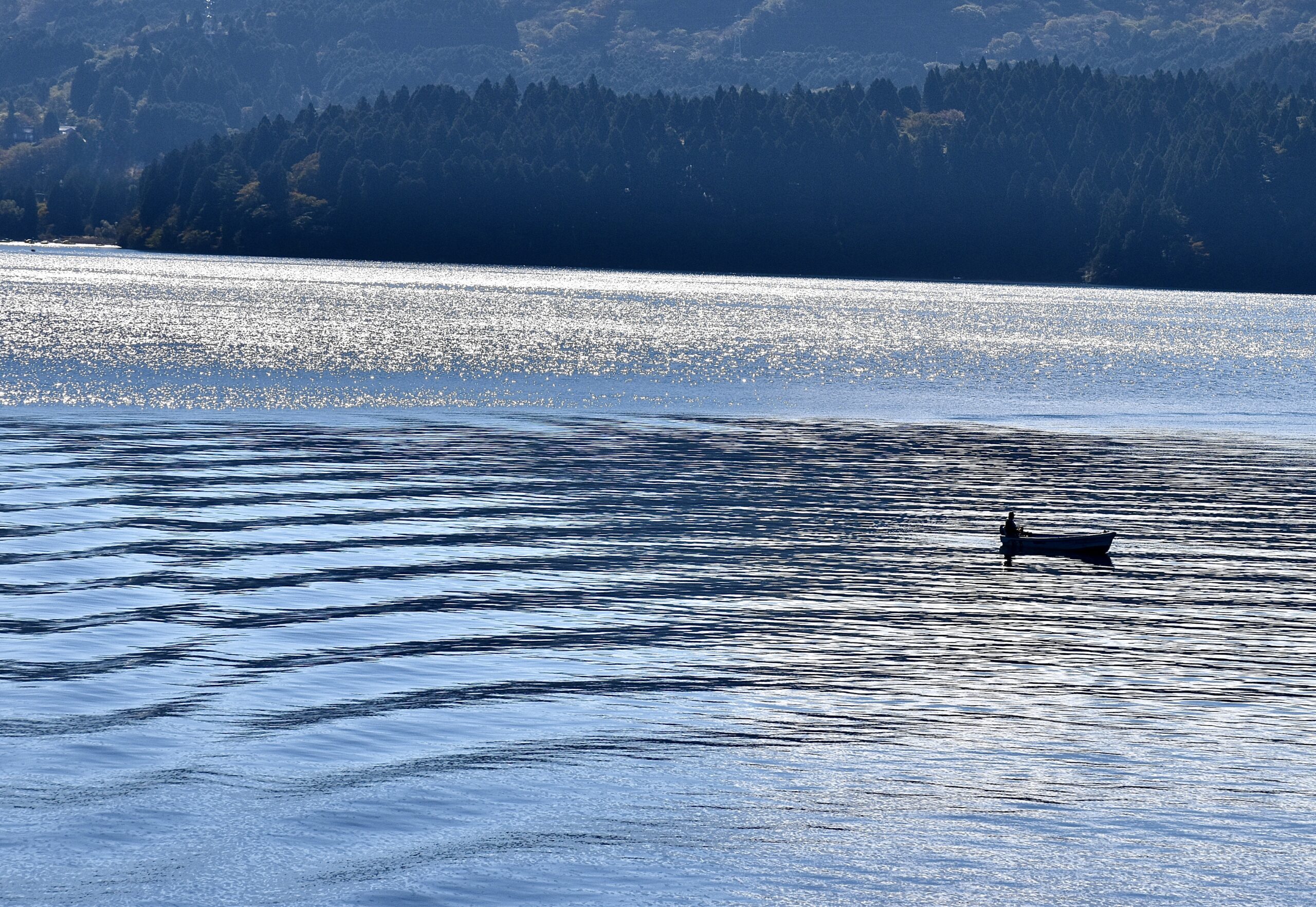
The second adventure of the day was a boat ride on Lake Ashi, the beautiful mountain lake formed in the caldera of the Hakone volcano.
The lake is surrounded by forested mountains, with Mount Fuji sometimes visible in the distance when the weather cooperates. It is one of those places where the scenery seems almost deliberately arranged to look Japanese.
We boarded our boat and headed out across the water, enjoying the mountain scenery and the pleasure of seeing Hakone from an entirely different perspective. Oh – and – the pirate boat.
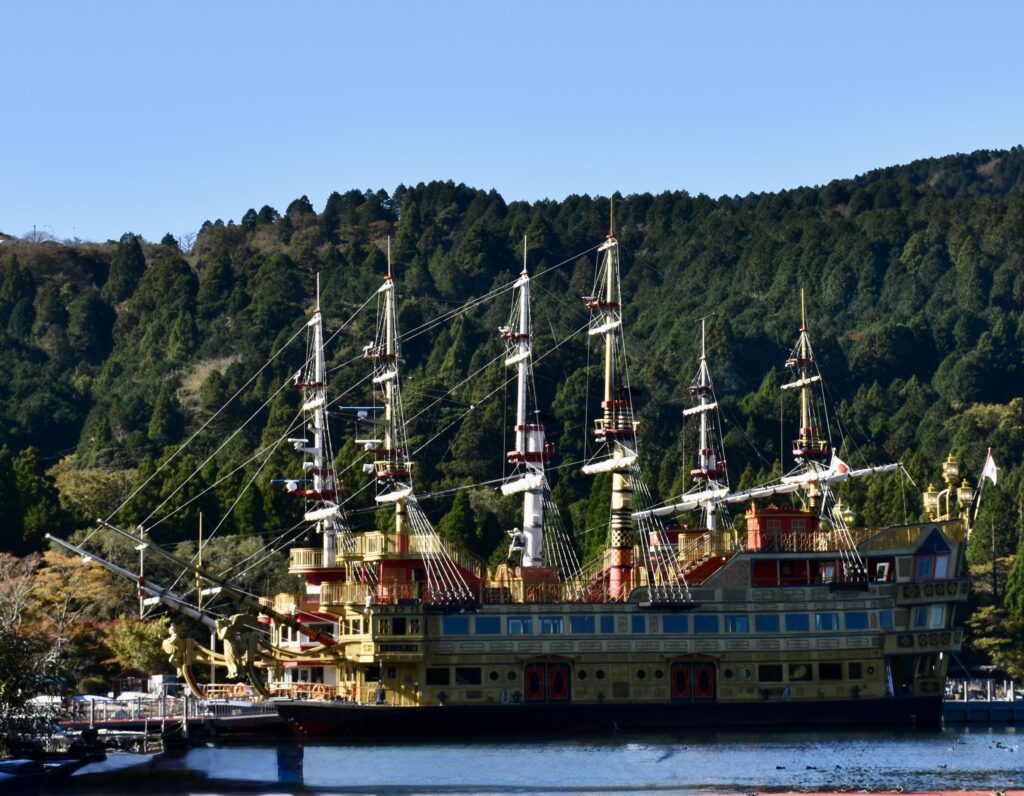


The boat had different levels, each with its own “personality.” One had a spot where you could sit on Japanese-style cushions — shoes off, please. Another had “bucket chairs.” There were swings — yes, swings! — on a higher level. And there was even a little garden off the back deck.


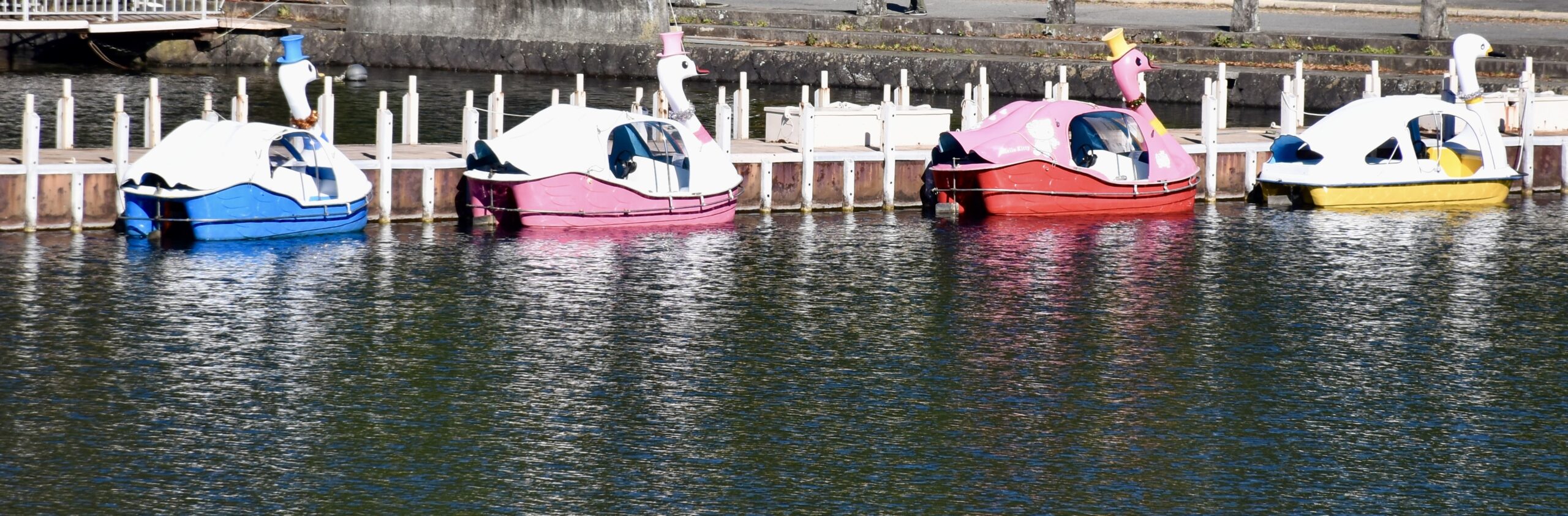
We saw the swan “paddle boats” at their dock, and Utako-san informed us that everyone who goes out in one gets divorced.
Naturally, I had questions.
I asked whether, if her husband ever said, “Honey, shall we go up to Lake Ashi and take one of the swan boats out for a paddle?” she would simply skip the boat ride and call the divorce attorney immediately.
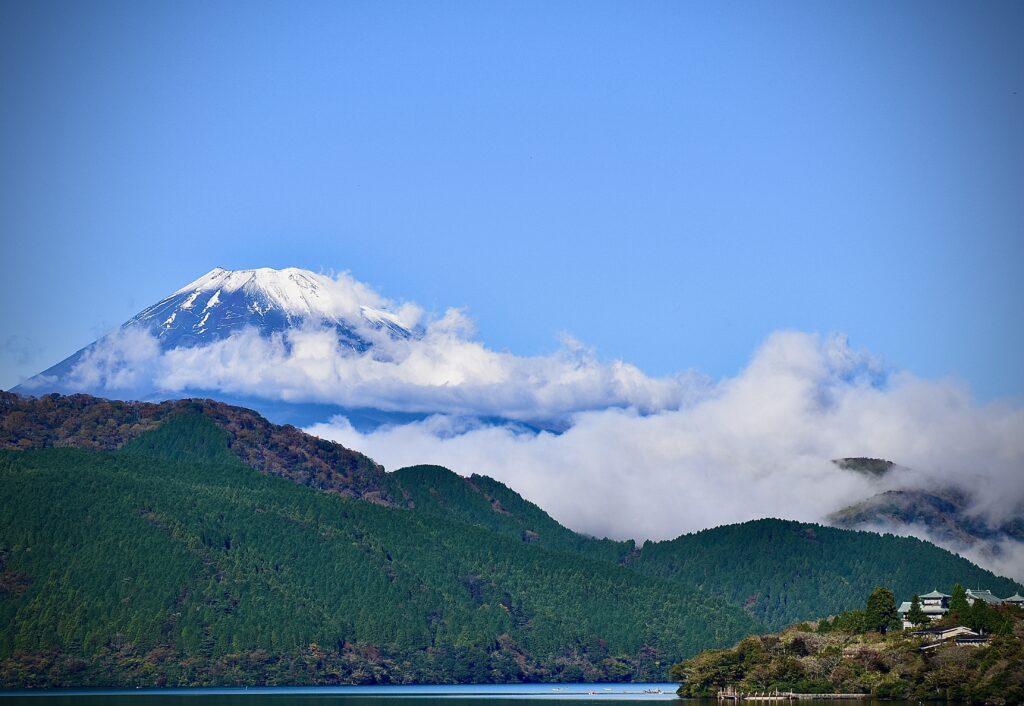
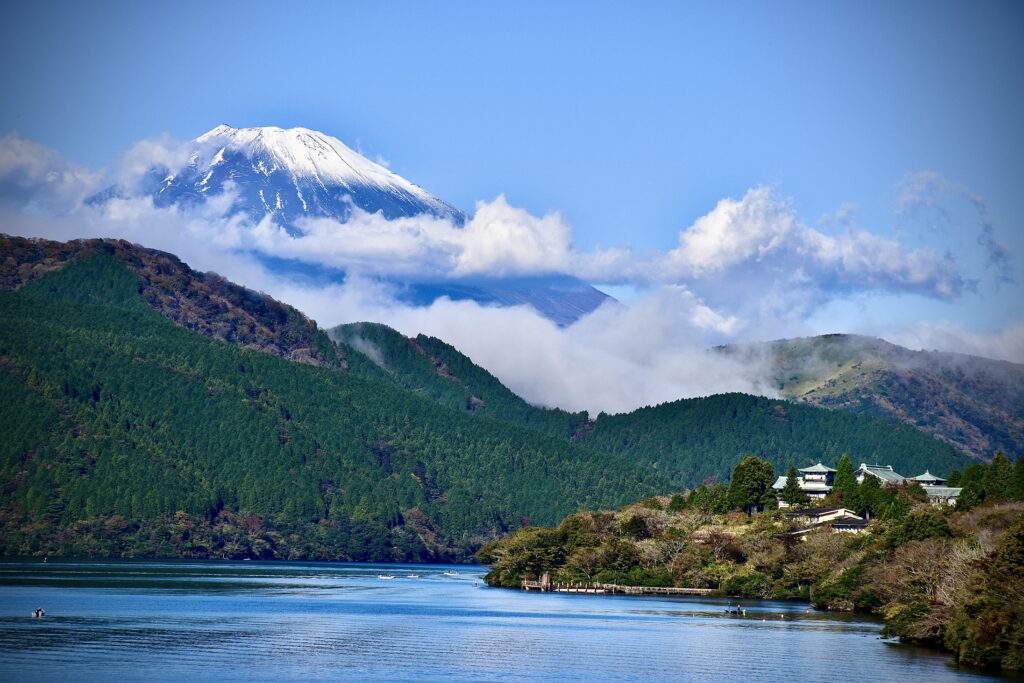
We have been very lucky on this trip. Fuji-sama is apparently hidden by clouds something like 80 percent of the time, but once again, she was out and beautiful for us.
Perhaps Fuji-sama is a morning person?

Hakone Marquetry: Woodworking as an Art Form
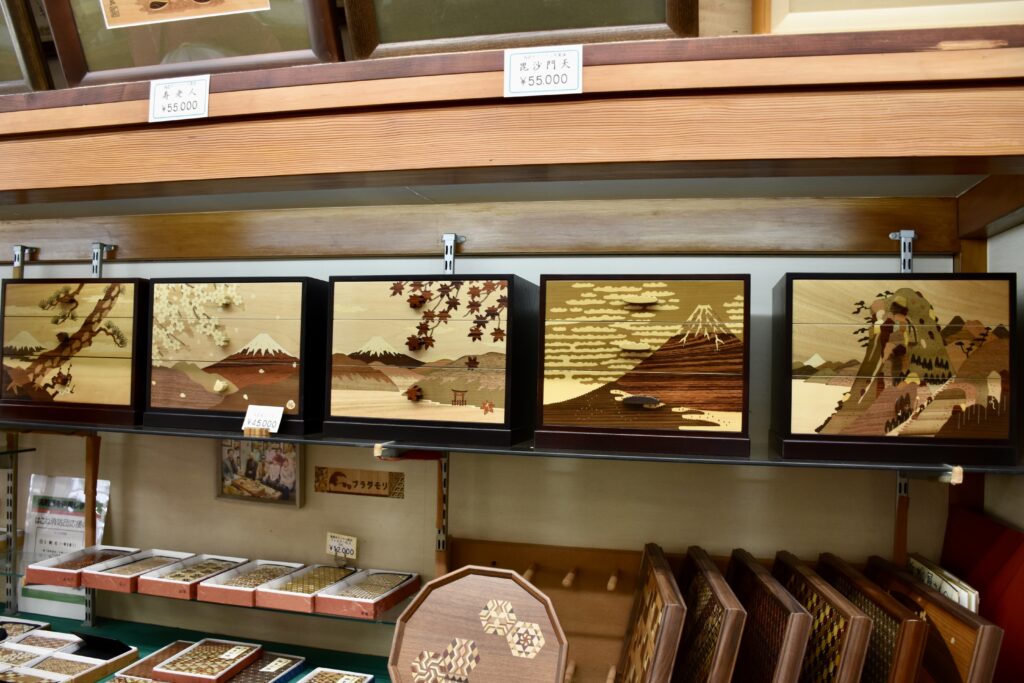
Our next stop introduced us to Hakone yosegi-zaiku, the region’s extraordinary traditional marquetry.
This is the art of combining different natural woods to create intricate geometric patterns. Rather than relying on paint or stain, the artisans use the actual colors of the woods themselves.
The results are astonishing: boxes, trays, jewelry and other objects covered in patterns so precise they almost look printed.
And, of course, there are the famous Japanese puzzle boxes, which require a particular sequence of movements to open.
I love the idea that something can be both beautiful and mischievously difficult to get into.
The craftsman we met is the eighth generation in this particular shop.
He showed us how he first creates a solid block made from the different woods, arranged so that their natural colors form the desired geometric pattern. Then he planes the surface of that block into an extraordinarily thin sheet.
That delicate sheet can then be veneered onto a box, earrings, or any number of other objects.
It was astonishing to watch.
He also showed us how they make rounded pieces — bowls, wine glasses and sake cups — by boring out the inside of a solid block. There really is no other way to create the rounded form, but of course a great deal of beautiful wood is necessarily lost in the process of hollowing out the center.
I found three sake cups: one each for Ron Sensei and Mikhail Sensei, and one for Wilson-san.
I also found sword-bag hangers, each one an individual little piece of art.
Then Utako-san pointed out that they had goshuincho with wood marquetry on both the front and back.
Of course, I already have a goshuincho.
But it will get full someday.
Right?


Shabu-Shabu, a Sore Foot, and the Great Step-Counting Transfer
Next came lunch.
Most of the group walked along the river to the restaurant, which sounded like a lovely way to arrive.
Unfortunately, my foot has been acting up, and I decided that discretion was the better part of valor. So while the others enjoyed their riverside stroll, I accompanied our coach driver.
Sometimes the smartest travel decision is the one that involves sitting down.
There was also a small technological development.
Lynn’s Fitbit had gone kaput.
Now, Lynn is very serious about tracking her steps. And her food. And entering everything into MyFitnessPal.
I, on the other hand, gave up on such things long, long ago. At some point I decided that I didn’t particularly need a computer telling me how many steps I’d taken or what I’d eaten.
I was there.
I knew.
So I gave Lynn my Pixel Watch to use for step counting.
She could continue keeping track of her numbers, and I could continue blissfully ignoring mine.
A most satisfactory arrangement.
Lunch was shabu-shabu, the Japanese hot-pot meal in which very thin slices of meat and vegetables are briefly cooked in a pot of simmering broth.
The name comes from the swishing motion used to cook the meat:
Shabu-shabu!
Of course, given my fish and dashi allergies, anything involving a Japanese broth requires special attention. One cannot simply assume that a perfectly innocent-looking pot of hot water is, in fact, innocent.


Geishas: Grace, Service, Fans, and a Rather Competitive Game
After lunch came an experience that was much more than simply watching a traditional performance.
We met two geisha, and had the opportunity to ask questions about the geisha world and to learn about their lives and training. And it is important to understand that these women are not simply “dancers in beautiful kimonos.” Their training encompasses music, singing, instruments, dance, storytelling, conversation, attentiveness, hospitality — the whole highly cultivated art of entertaining guests.
And this was not simply a matter of “here are two geishas.”
The two women with us were okami — the senior “mothers of geisha” at the top of their respective groups.
A woman may begin working as a geisha part-time. One of the okami explained that when she started, she was juggling three different jobs — but eventually earned enough working as a geisha to quit all three.
We asked all sorts of questions — yes, even the “what if a client wants to have sex?” question — and learned, in particular, how the business side works.
The client company pays the hotel. The hotel pays the geisha association. The association pays the okami, who then selects the geisha — or geishas — appropriate for what the client wants.
Singing? Dancing? Accompanying guests to karaoke?
Different geisha have different skills, and the okami chooses accordingly.
There is a two-hour minimum engagement — although, of course, more hours are better. In general, we were told, a geisha might work about four parties a week.
Then came the participatory portion.


Motivated by our sumo experience, Michael and I once again volunteered.
The geisha served us first.
And then we served them.
There was something wonderfully human about that little reversal: first being carefully served ourselves, and then trying to return the gesture properly.
Only after the questions, conversation and serving did the dancing begin.
One okami wore a magnificent deep-purple kimono embroidered with flowers and gold, while the other wore a pale-blue kimono covered in white blossoms, with a contrasting black obi.
The blue kimono had been handmade by her family, who were dyers. She also told us that she owns more than 300 kimono. When her own okami retired, she purchased that woman’s kimono collection as well.
Against a gold folding screen, the two women were absolutely striking.
The dances were fascinating, particularly because they were so different from one another.
The performer in purple moved with the delicate, controlled gestures I had expected: graceful movements, carefully placed feet, and a beautiful folding fan.


The woman in blue, however, performed what we were told was a male dance.
And what a difference!
There was considerably less softness and delicacy, and much more emphatic movement — including actual stomping.
It was an interesting reminder that Japanese traditional dance can portray very different characters and styles, and that the performers communicate those differences through posture, movement and gesture.


And Then Things Got Competitive
After the dancing came a game.
The geisha sang a little song — almost like a children’s song — while two people faced each other across a table with an overturned cup between them.
The rules sounded simple enough.
Taking turns, each person hit the cup with an open hand in time with the song.
But if the other player grabbed the cup away on that beat, you were supposed to hit the empty table where the cup had been — with your fist.
If you failed to switch from open hand to fist, hit your fist on the cup, missed the beat, or otherwise got it wrong, you lost.
And then, of course, the song got faster.

And faster.
And faster.
Quite a few people tried it.
Michael and I, having apparently regained some common sense after volunteering at both sumo and the serving portion of the geisha experience, wisely stayed out of this one.
Bailey, however, was the undisputed champion.
She was really good.
As the song sped up and the hand movements became quicker and quicker, she somehow kept track of the cup, the beat, the open hand, the fist, and whether the cup had suddenly disappeared from under her.
It became surprisingly competitive — and very funny to watch.
Only after that did we all gather together for a group photo with the geisha.

After the dancing, we all gathered for a group photo with the geisha — a lovely ending to an experience that had turned out to be far more interactive, informative, and just plain fun than I had expected.
Owakudani: 10,000 Rotten Eggs
And then we went to Hell.
Well, not literally.
But Owakudani was once known as Jigokudani — “Hell Valley” — and after about thirty seconds there, I understood why.
Sulfur.
LOTS of sulfur.
The entire valley smelled as though approximately 10,000 eggs had gone very, very wrong at the same time.
Owakudani sits in an active volcanic area of Hakone, and steam still rises from vents in the barren mountainside. It is one of those places where the earth makes it very clear that whatever pleasant landscaping humans may have put around it, underneath everything there is still a volcano doing volcano things.
And, naturally, if you are standing in a place that smells overwhelmingly of rotten eggs, the local specialty is:
Eggs.
Specifically, black eggs.
The eggs are cooked in the volcanic hot-spring water. Minerals from the spring react with the shells and turn them black — genuinely, strikingly black — although inside they are still perfectly ordinary-looking hard-boiled eggs.
There is also a legend that eating one adds seven years to your life.
Well.
This seemed like a fairly inexpensive retirement-planning opportunity.
So, of course, I had to try.
They tasted remarkably like…eggs.
Which was somehow reassuring.
The exterior says, “Mysterious volcanic artifact retrieved from the underworld.”
The inside says, “Would you like some salt?”
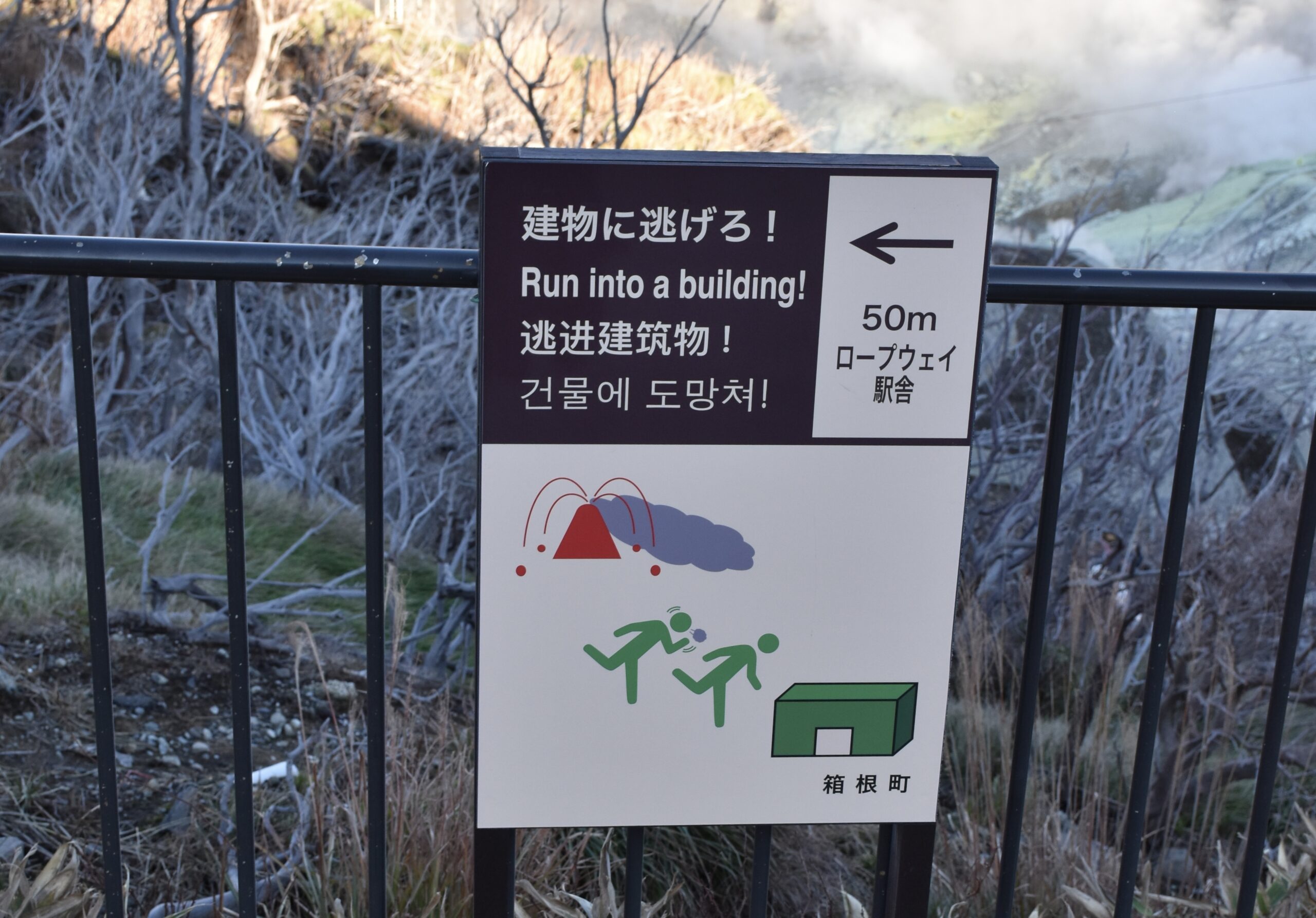
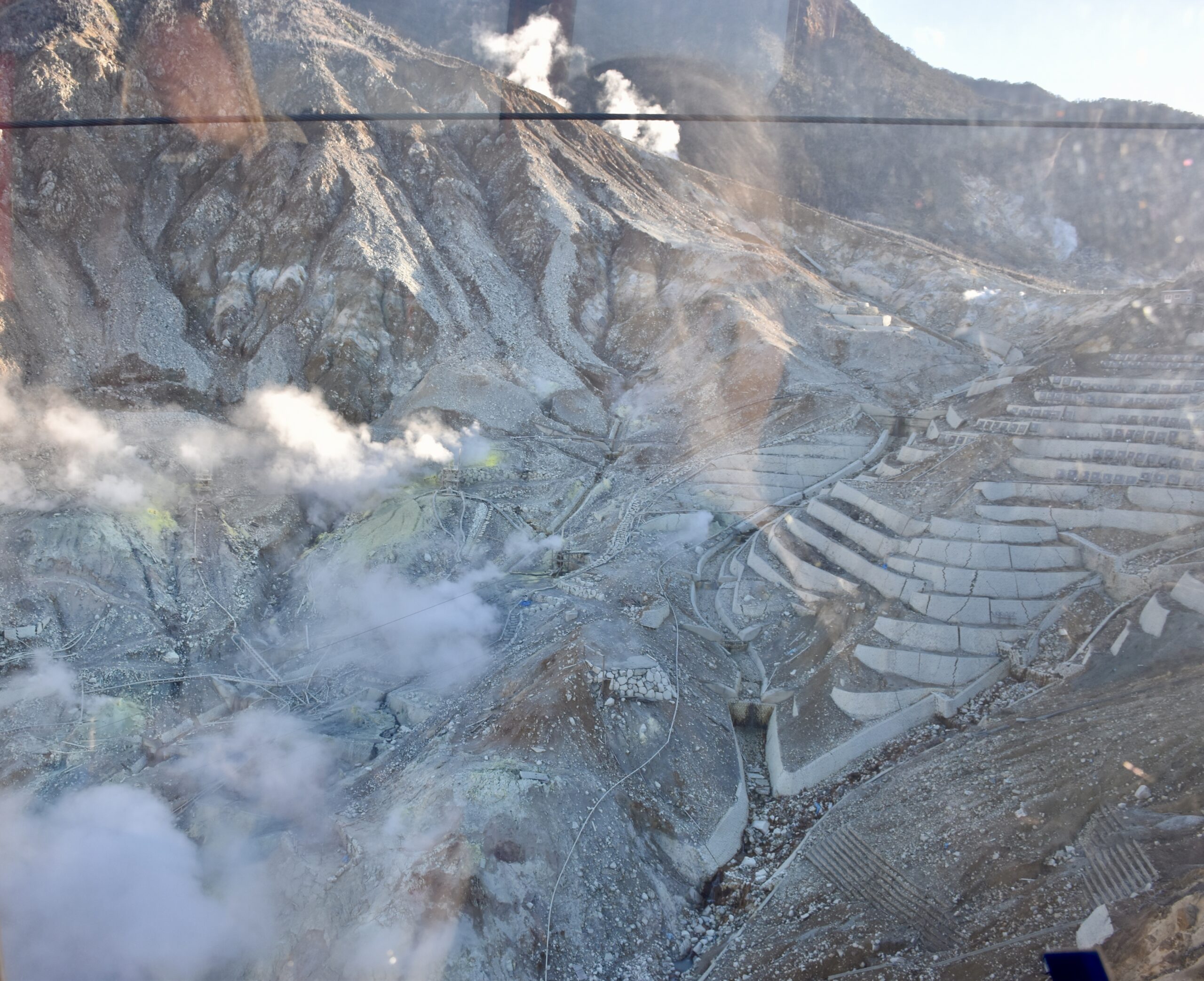
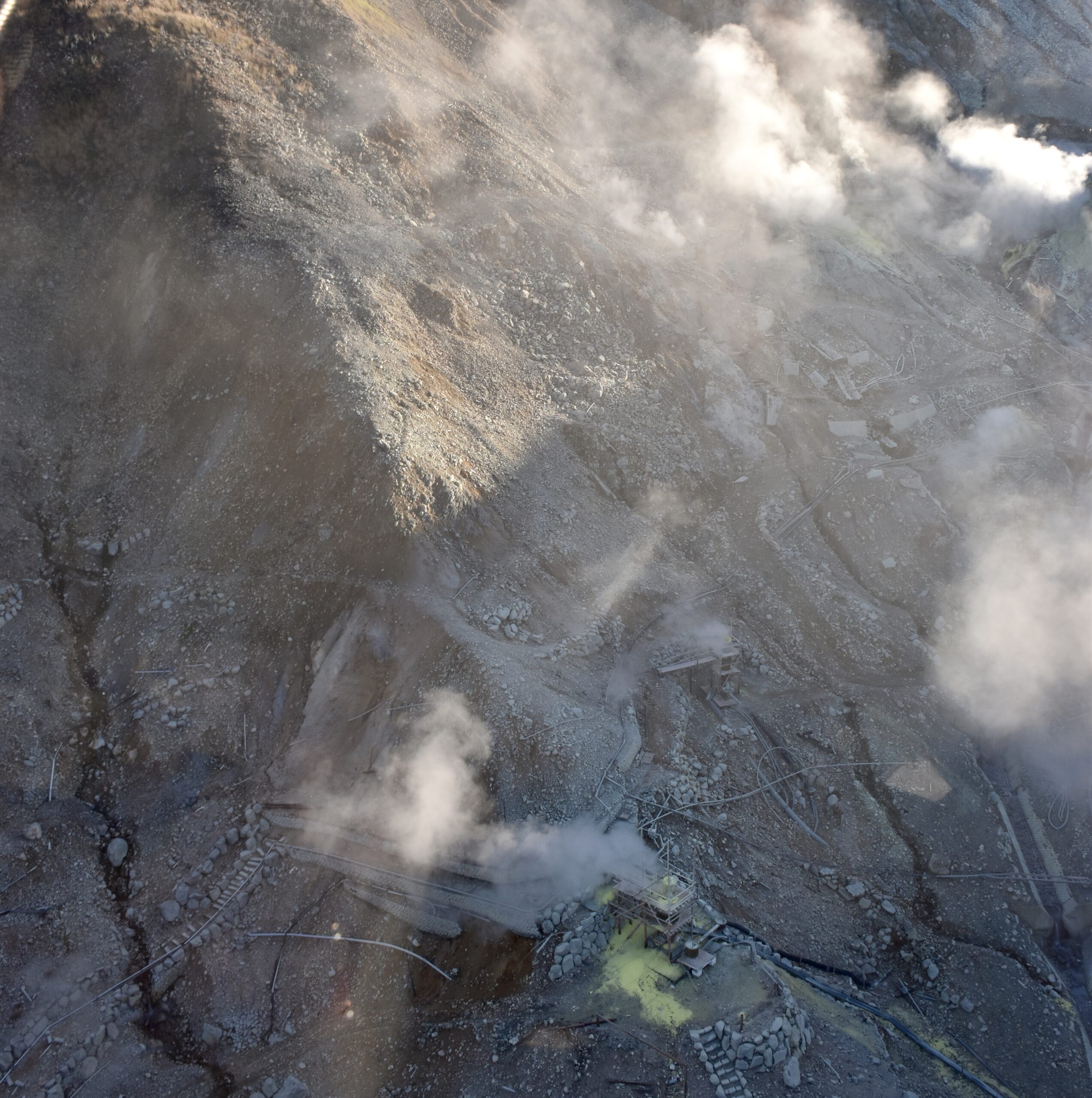
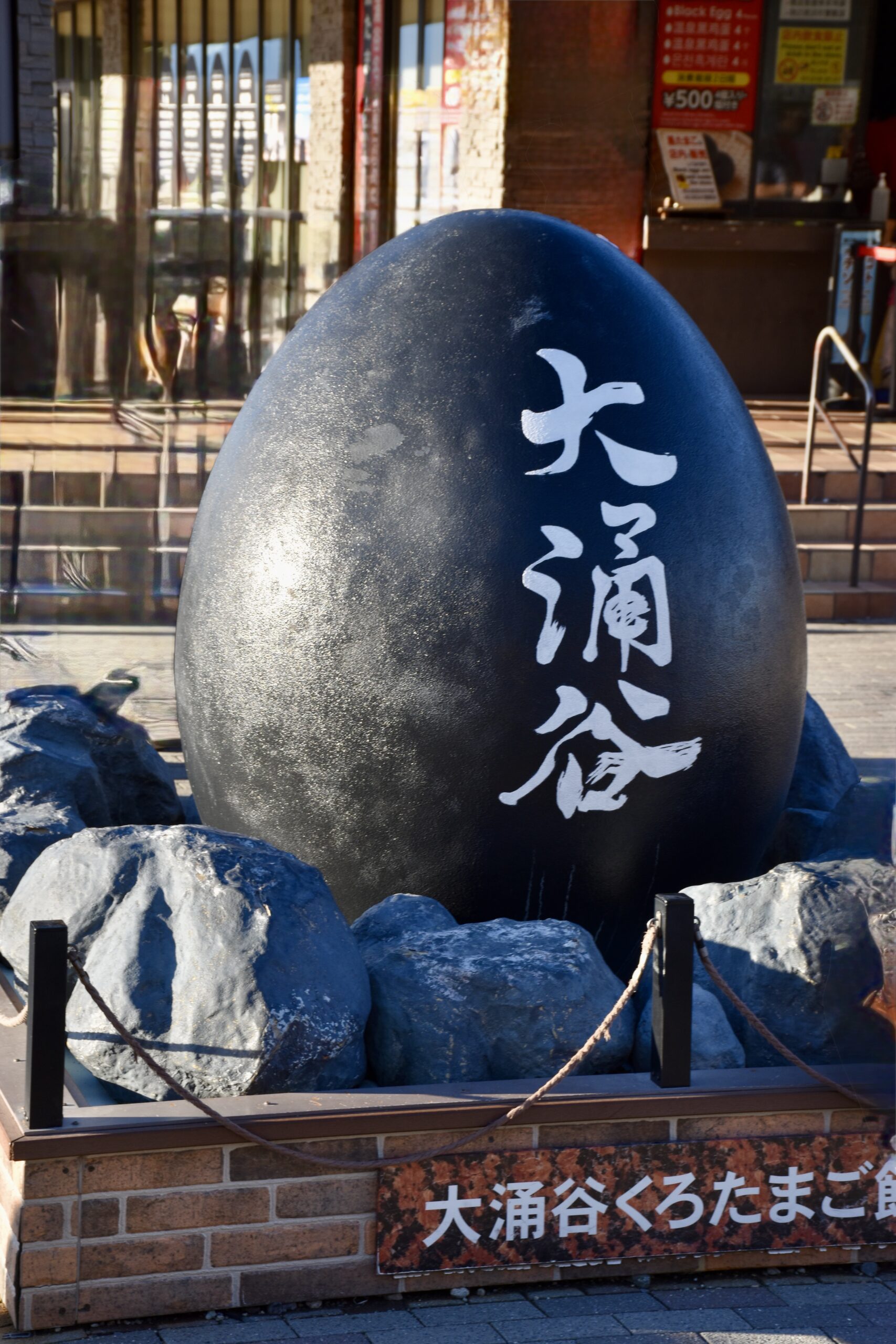
The landscape itself was fascinating — stark, steaming and almost otherworldly, particularly after the green mountains and placid waters of Lake Ashi earlier in the day.
Japan had apparently decided that serene mountain lake, exquisite woodworking, geisha, and active volcanic hellscape all belonged on the same afternoon.
Why not?
Fuji-sama Saves the Best for Last
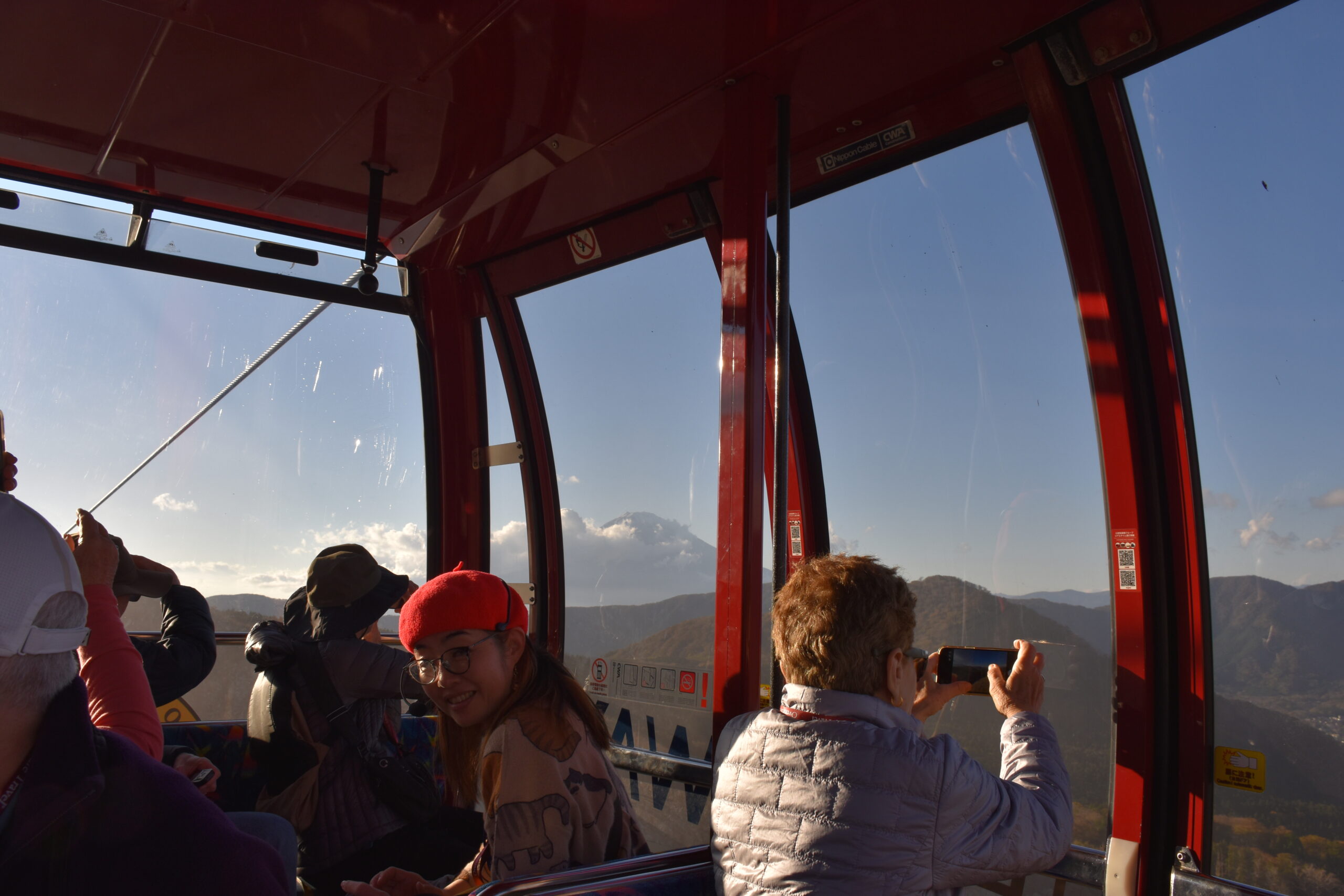
From Owakudani, we continued by gondola — the Hakone Ropeway — back across the mountains toward Lake Ashi.
And the timing could not have been better.
The sun was beginning to set.
Below us was Lake Ashi. Beyond it were the mountains.
And there, once again, was Fuji-sama.
This time in the evening light.
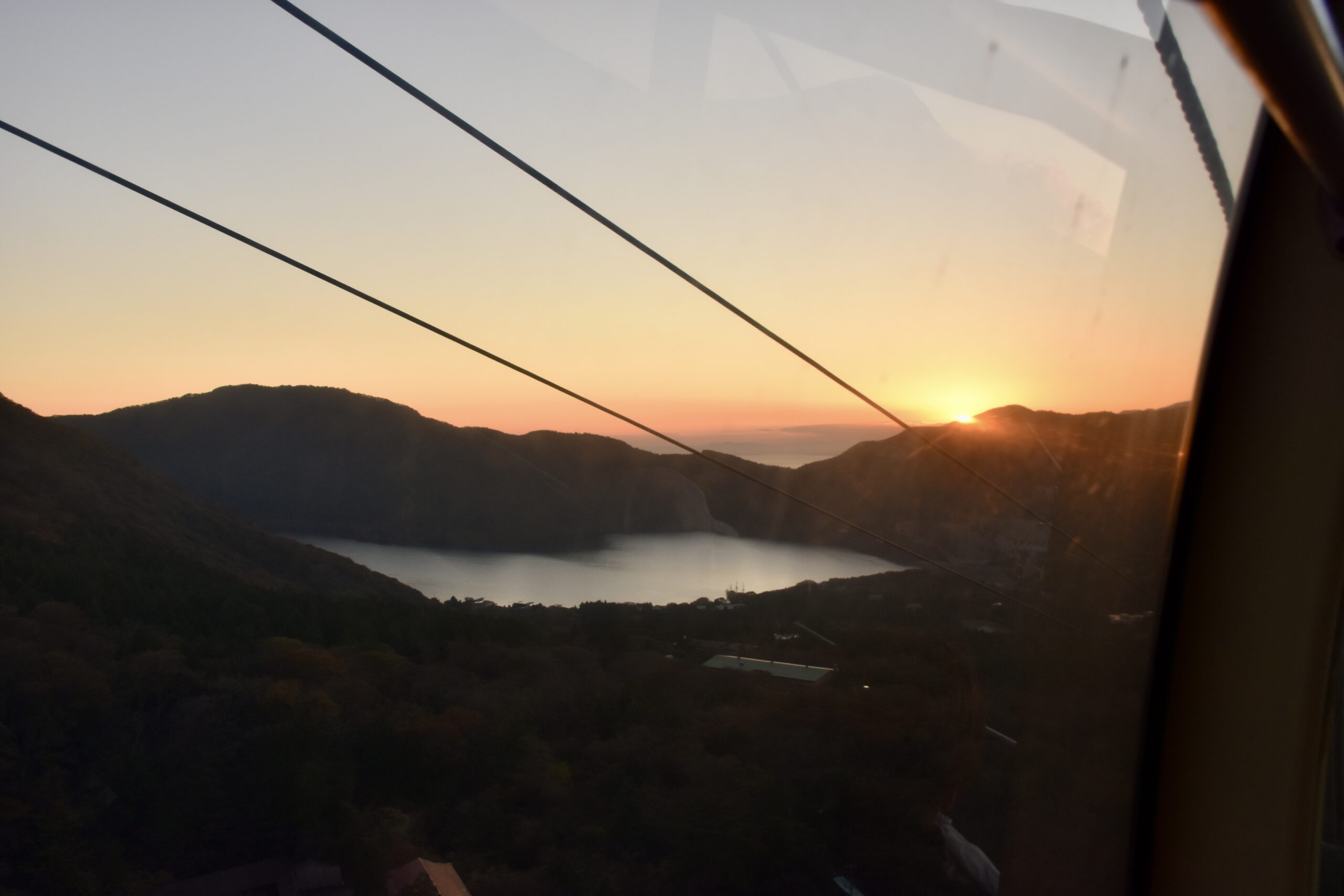
After seeing her in the morning, I certainly had not expected another appearance. Fuji-sama had already been extraordinarily generous with us.
But as the gondola moved above the mountains, the sky began changing around her.
Gold.
Orange.
Pink.
Lake Ashi below us, Fuji-sama in the distance, and the last light of the day spreading across everything.
Apparently Fuji-sama is not merely a morning person.
She will occasionally stay up for sunset.
And Then, Kaiseki
After all that — boat, woodworking, shabu-shabu, geisha, volcanic sulfur, black eggs, gondola, sunset, Fuji-sama — we returned to the hotel for another kaiseki dinner.
Because Japan apparently believed the day still needed several more courses of food.
By that point, however, I was very ready for dinner, a bath, and bed.
Hakone had done enough.
Or so I thought.
The Marble That Jumped
This morning, while I was packing to leave Hakone, one of H’s marbles literally jumped out of my suitcase and rolled toward the window.
Ohhhhhhh.
H was a mountain guy.
And suddenly I knew exactly what that marble was trying to tell me.
I had been really hoping that Fuji-sama would once again be in evidence, so before breakfast I went outside to look.
Whew. Nippy!
But Fuji-sama is, apparently, indeed a morning person.
There she was.
I wanted a photo of H’s marble with Fuji-sama behind it, and I found myself wishing Deborah and Doug — “D&D” — were around to help me take it.
Of course, I had absolutely no idea where their room was, or even whether they were awake.
Well.
As “luck” would have it, I walked outside and found D&D standing exactly at the spot where I wanted to take the photograph.
And they were looking for someone to take a photo of them.
Okay then.
Apparently everyone’s photographic requirements had been efficiently coordinated.
Photos accomplished, I walked down a stone stairway/path that looked as though it might have been laid there in the time of the samurai.
It had a perfect view of Fuji-sama.
And I knew that was where I wanted to leave H’s marble.
At the foot of the stairs, I noticed that the leaves on the bushes looked familiar.
Then I saw that one still had a flower.
I smiled.
Azaleas.
One of H’s favorites.
We have many of them planted right outside our front door at home.
Well.
That settled it.
So one of H’s marbles is now tucked beneath an azalea bush, nestled behind an old stone step, looking out toward Fuji-sama.
A mountain guy.
One of his favorite flowers.
And Japan’s most famous mountain.
I’m glad the marble decided to jump itself out of my suitcase while I was packing.
And now I am writing this on the Shinkansen as we make our way toward Kamakura. Photos from today – later. Using the Shinkansen’s recalcitrant WiFi has been plenty for me. Time for a nap.