
(a.k.a. Yes, I Actually Did That)
Before we dive into South Africa, a small (but actually not small) preface.
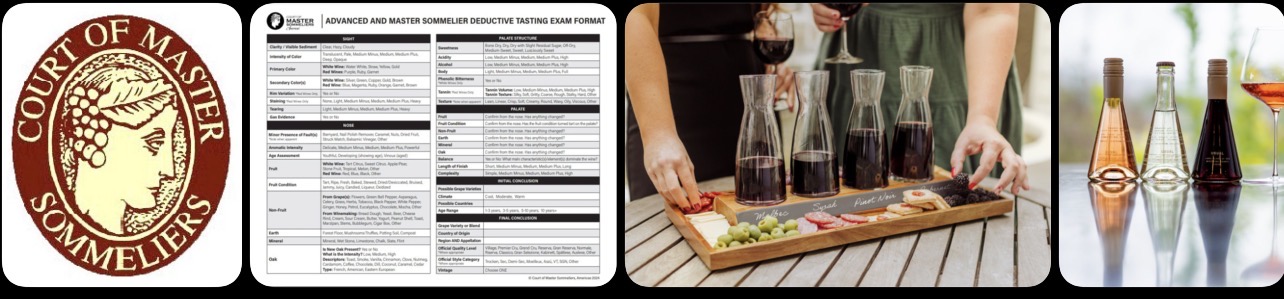
During COVID — when the rest of the planet was perfecting sourdough — I enrolled in the Certified Introductory level with the Court of Master Sommeliers (CMS).
They shipped me little bottles.
Dozens of them.
Tiny, carefully portioned vials of wines from around the world so we could taste blind at home, live on Zoom, while simultaneously being interrogated about soil types in Rioja and labeling laws in Germany.
It was not “wine appreciation.”
It was:
- Every major wine-producing country
- Their history
- Their grape varietals
- Their geology
- Their wine laws
- Their winemaking methodology
- Plus beer, cider, spirits, sake, and all things Proper Serving related (because why not add more pressure?)
The Introductory (Level 1) exam has a pass rate often cited around 60% — but that’s among people who voluntarily sign up for this kind of structured wine nerd-dom. The real attrition happens later. Fewer than 300 people worldwide have ever passed the Master Sommelier Diploma exam.
So yes.
I passed Level 1.
And yes, I earned the lapel pin.
Which brings us to South Africa.
Why This Is Written (Instead of Delivered as a Speech)
I could stand up and present this.
I could gesture.
I could hold forth.
Some people derive visible joy from standing up and doing such things.
I, however, find that if someone is actually interested, they can absorb this far better in writing — at their own pace — perhaps with a glass in hand.
So.
Let’s get on with it.
South Africa: Vast Country, Concentrated Vineyards
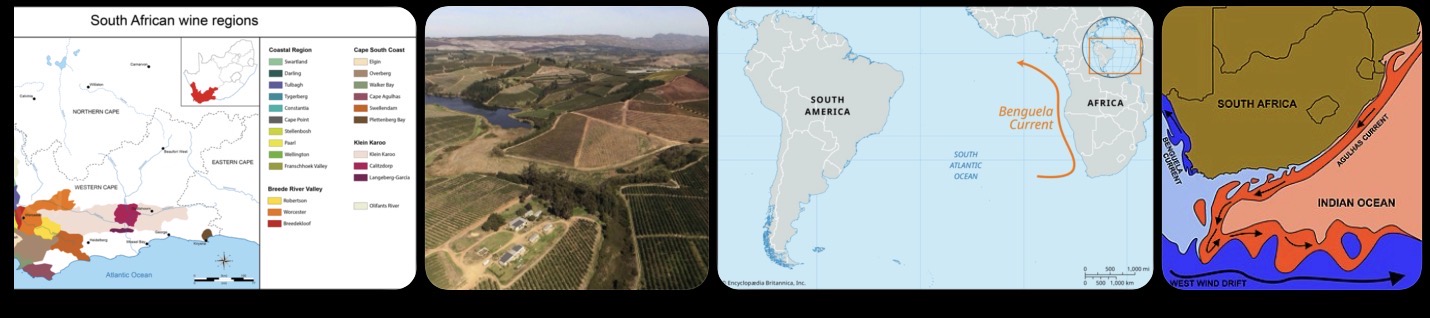
South Africa is enormous.
It’s about a 16-hour drive between Cape Town and Johannesburg.
Yet nearly all viticulture is concentrated in the southwestern corner of the country, near Cape Town.
Why?
Because of major moderating influences:
- The cold Atlantic Ocean (west)
- The warm Indian Ocean (east)
- And most critically: the Benguela Current, a cold current flowing north from Antarctica that cools the western coastline
Without that cooling current, much of the Western Cape would be too hot for quality wine.
History: Wine and Power
1652 – The Dutch Arrive
The Dutch East India Company establishes a refreshment station at the Cape for ships sailing to India.
Wine was not luxury.
It was morale. Medicine. Survival.
1655 – First Vines
The first vines were planted by enslaved people brought from other parts of Africa and Asia.
Slavery is foundational to the early South African wine industry.
Early plantings included:
- Semillon
- Chenin Blanc
- Palomino
1685 – Constantia and Global Fame
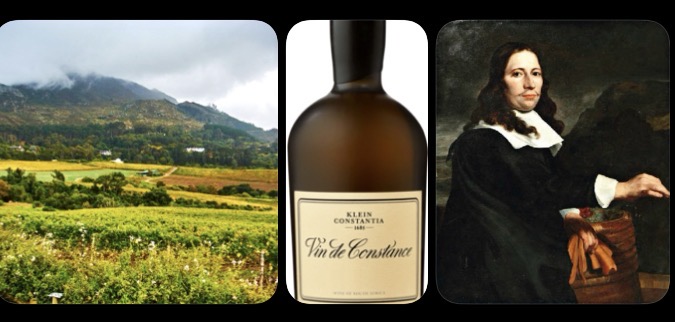
Simon van der Stel (Stellenbosch = [van der] Stel’s Forest) planted vineyards in Constantia.
The sweet wine Vin de Constance became globally famous in the 1700s. It was:
- Served in European courts
- Referenced in literature
- Requested by Napoleon during exile
For nearly a century, it was one of the most sought-after wines in the world.
1688 – The Huguenots
French Huguenots arrived, bringing advanced viticultural knowledge.
Dutch structure.
French technique.
African soil.
That is the foundation.
1800s – War and Phylloxera
The Anglo-Boer Wars destabilized agriculture.
Then phylloxera hit.
Exports collapsed.
1918 – KWV and the Cooperative Era
The KWV (Kooperatiewe Wijnbouwers Vereniging van Zuid-Afrika) was formed to stabilize prices after devastation.
They set minimum prices.
Farmers increased production.
Glut. Bankruptcy. Chaos.
So quotas were imposed.
But farmers had already planted high-yield grapes.
Workaround?
Distill them.
This is how South Africa became known for:
- Brandy production
- Fortified wines
- Oxidative styles
Chenin Blanc (high yielding, relatively neutral) became dominant — especially for distillation.
1948 – Apartheid and Isolation
While the rest of the world was desegregating, South Africa institutionalized Apartheid.
Sanctions followed.
The country produced enormous quantities of wine, fortified wine, and brandy — but had limited legal export routes.
Even more damaging: during the 1970s–1990s, when the rest of the wine world embraced stainless steel, temperature control, clonal research, and modern viticulture science, South Africa was largely cut off.
1994 – Mandela and Modernization
Nelson Mandela becomes president.
Sanctions lifted.
Capital, technology, expertise, and international investment flow in.
Massive replanting begins.
In 1997, KWV becomes a private company.
Today, South Africa ranks among the top 10 wine-producing nations globally.
Terroir: Ancient Soil, Maritime Moderation
- Soils up to 500 million years old
- Nutrient-poor → vines struggle → lower yields → concentrated fruit
- Maritime climate near coast
- Hotter and drier inland
- Elevation plays a major moderating role
The Cape Doctor
A powerful southeast wind.
It:
- Suppresses fungal disease
- Moderates vineyard temperatures
- Can damage flowering and reduce yields
Because fungal pressure is lower, South Africa adopted sustainable and organic practices earlier than many European regions.
The Grapes
Whites
- Sauvignon Blanc
- Chardonnay
- Chenin Blanc (“Steen”)
South Africa produces more Chenin Blanc than the rest of the world combined.
If someone says “Chenin Blanc” and you automatically think Loire Valley…
Think again.
Reds
- Cabernet Sauvignon
- Syrah/Shiraz
- Bordeaux blends
- Pinot Noir
- Pinotage
Pinotage
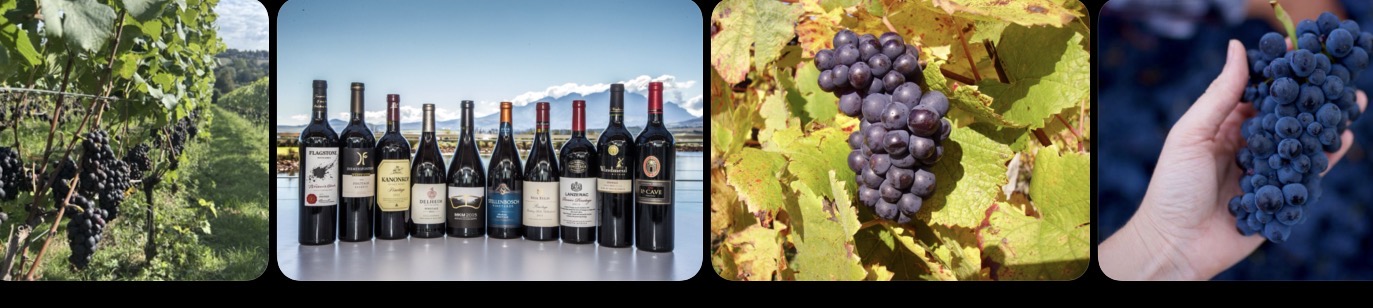
Pinotage = Pinot Noir × Cinsault (formerly called “Hermitage”).
Developed in the 1920s.
Early versions were rustic.
Modern versions are polished, dark-fruited, structured, and distinctly South African.
Méthode Cap Classique (MCC)
MCC = Méthode Cap Classique.
Traditional method sparkling wine (Champagne method).
Bright. High acid. Often extraordinary value.
Vine Virus & The Old Vine Movement
Isolation during Apartheid led to widespread vine virus (leaf roll in particular).
Post-1994, replanting surged.
Today, a remarkable “Old Vine Project” seeks out neglected old vineyards — incredibly low yield, exceptionally high quality.
Wine of Origin (W.O.) — The Hierarchy (With California Comparisons)
South Africa’s W.O. system (1973) guarantees origin.
It does not dictate grape varieties or stylistic rules — unlike many European appellations.
If a wine carries a W.O. seal:
- 85%+ stated vintage
- 85%+ stated varietal
- 100% from the named origin
Now the hierarchy — smallest to largest — with California analogies.
1️⃣ Estate (Smallest)
All grapes must come from one contiguous property.
Wine must be grown and made there.
California comparison:
A true estate-grown Napa property.
No blending from outside sources to “fix” the vintage.
More terroir expression.
Less flexibility.
More vintage variation.
2️⃣ Ward
A small, terroir-defined subdivision within a district.
Defined by soil, elevation, geology, climate.
Example: a ward within Stellenbosch (which has 7)
California comparison:
Rutherford within Napa Valley.
More specific climate signature.
Blending flexibility to reach a desired tasting profile, but only within that ward.
3️⃣ District
Recognizable names:
- Stellenbosch
- Paarl
- Swartland
- Walker Bay
California comparison:
Napa Valley, Sonoma County, Paso Robles.
If it says “Stellenbosch Cabernet Sauvignon”:
- 100% from Stellenbosch
- 85% Cabernet Sauvignon
Producer can blend from multiple vineyards inside Stellenbosch.
4️⃣ Region
Grouping of districts.
Example: Coastal Region.
California comparison:
North Coast or even just “California”.
Greater blending flexibility.
More stylistic consistency year to year. This is why if you can love a “California wine,” the vintner will be able to make that same tasting profile year after year – because they have all of California to source “a little bit of this, a little bit of that.”
5️⃣ Geographical Unit (Largest)
Example: Western Cape.
Broad origin. Maximum blending flexibility.
Concentric Circles
Estate → Ward → District → Region → Geographical Unit
Moving outward:
- Specificity decreases
- Blending flexibility increases
- Consistency becomes easier
Moving inward:
- Terroir expression increases
- Vintage variation increases
- Winemaker flexibility decreases
Unlike France’s AOC system, South Africa’s W.O. does not regulate yield limits, aging rules, or grape approvals.
It is truth-in-labeling of origin.
Very New World in spirit.
Key Regions
Stellenbosch

Historic capital of South African wine.
Produces:
- Cabernet Sauvignon
- Bordeaux blends
- Pinotage
- Chenin
Structured, age-worthy wines.
Swartland
Former bulk wine area.
Now revolutionary.
- Dry farming
- Old vines
- Chenin, Syrah, Grenache
- Revival of Palomino, Cinsault, Semillon
Yield ↓
Character ↑↑
Walker Bay / Elgin / Cape Agulhas
Cool-climate zone.
Chardonnay.
Pinot Noir.
Sauvignon Blanc.
Fresh. Precise. Ocean-influenced.
Constantia
Birthplace of South African wine.
Historic sweet wines; now also fine dry whites.
SOUTH AFRICA QUIZ
- What is Steen?
- How is Pinotage made?
- What cools coastal vineyards?
- Which is a South African district: Mendoza, Maipo, Salta, Stellenbosch?
- Order the W.O. levels smallest → largest.
- Three effects of the Cape Doctor?
- What is KWV?
Answers
- Chenin Blanc
- Pinot Noir × Cinsault
- The Benguela Current
- Stellenbosch
- Estate → Ward → District → Region → Geographical Unit
- Suppresses fungus, moderates temps, can damage flowering
- A cooperative founded in 1918 to stabilize grape prices; privatized in 1997
There you have it.
A not-at-all-small overview of the South African wine industry — history, politics, geology, reinvention.
I would rather write this properly once than make you endure it and zone out.
But if you would like to discuss Chenin over MCC?
I’m available. 🍷 However, I’m sure Abe has forgotten more about South African wines than I ever will know. If you’re curious to see my “wine recording book” (complete with a laminated tasting “cheat sheet”) please just ask.