


We breakfasted watching a bloat of hippos lounging on the far bank of the Crocodile River, directly across from Buckler’s.
Yes, a bloat.
Massive gray bodies half in, half out of the water, occasionally yawning like they were late for something prehistoric. We took photos. Many photos.
Off to Kruger we went. Though we had headed out at 0-dark-30 – because guided cars can get in half hour before self-driven cars – the “computers were down” and we lost our advantage.
The morning soundtrack included one of the local doves. Our driver told us that in the early hours its call sounds like “work harder,” and by late afternoon it shifts into something distinctly resembling “drink lager.”
Honestly? Accurate.
Things were, as they say, “quiet,” so the drive became less about sightings and more about learning.
Elephants eat 18 to 22 hours a day. One stomach. They digest only about 10% of what they consume. Unlike giraffes, they are not ruminants — they do not rechew their cud — so much of what goes in comes out remarkably recognizable.
Which we confirmed.
Because yes, our driver picked up a fresh pile of elephant dung and calmly began breaking it apart in her hands. (I forget if I mentioned that – way back in Entabeni – Abe and our driver Isaac had a contest with who could spit a round of impala poo the farthest. Why yes, yes they did. “Because it’s just grass.” Urk.)
But back to the elephant dung. Up close, you could clearly see green leaves — undigested and, more strikingly, unchewed. She explained that when you see a lot of unchewed plant matter, it often indicates an older elephant whose molars are worn down.
Elephants don’t have one lifelong set of teeth. They have six sets of molars that move forward like a conveyor belt over the course of their lives, roughly one new set every decade. By about 60 years old, they’ve worn through the final set — and without grinding ability, survival becomes difficult.
All of which we discussed while she was holding a turd in her hand.
Because that dung is useful.
Burned, it repels mosquitoes. Used medicinally, it plays a role in traditional healing. Including — yes — for pregnancy.
If a woman near the end of pregnancy is believed to have “caught” a bad spirit in the womb, she may be given tea made from elephant dung, because elephants are revered as devoted mothers.
Pause.
We are, in fact, calmly discussing elephant poo tea.
Safari does expand the mind.
This led to a long conversation about ancestral spirits and rituals. Our driver spoke about her mother, Elizabeth. Her mother must be dead, given the conversation. Since Elizabeth was not married when she became pregnant, certain rituals were required to properly acknowledge and appease ancestral spirits. These things are not folklore to our driver — they are part of the architecture of daily life.
We learned and were walked through a practice of walking around an amarula tree to ease spirits and appeal to them if you are having trouble in your life – involving, I think, first a smoke offering to the East (if your mother was married) or West (if not), then around the tree to the other directions. (She didn’t do this part). Talking all the while. This is followed by violently spitting water in the four cardinal directions and talking to your ancestor (here, Elizabeth) and her dead male relatives, who are responsible for figuring out what ancestor was being a bad actor and giving bad luck. Elizabeth’s male relatives had to be appealed to, since she was not married when the driver was conceived. If the mother had been married, then you start by appealing to the father and his mother, then go down the line. The water spitting, she did.
We learned about the buffalo thorn tree, whose thorns grow alternately forward and backward. If someone dies violently or unexpectedly, a branch is cut, words are spoken inviting the spirit into the sprig, and it is brought to the body so the spirit does not wander. If that wasn’t done at burial and misfortune follows, the ritual can later be performed at the grave.
Some healing practices involve ground wild dog bones. Others involve teas from animal dung. From a modern epidemiological perspective, one might raise an eyebrow. From within the cultural system, it is continuity and protection.
The land holds science and spirit simultaneously.


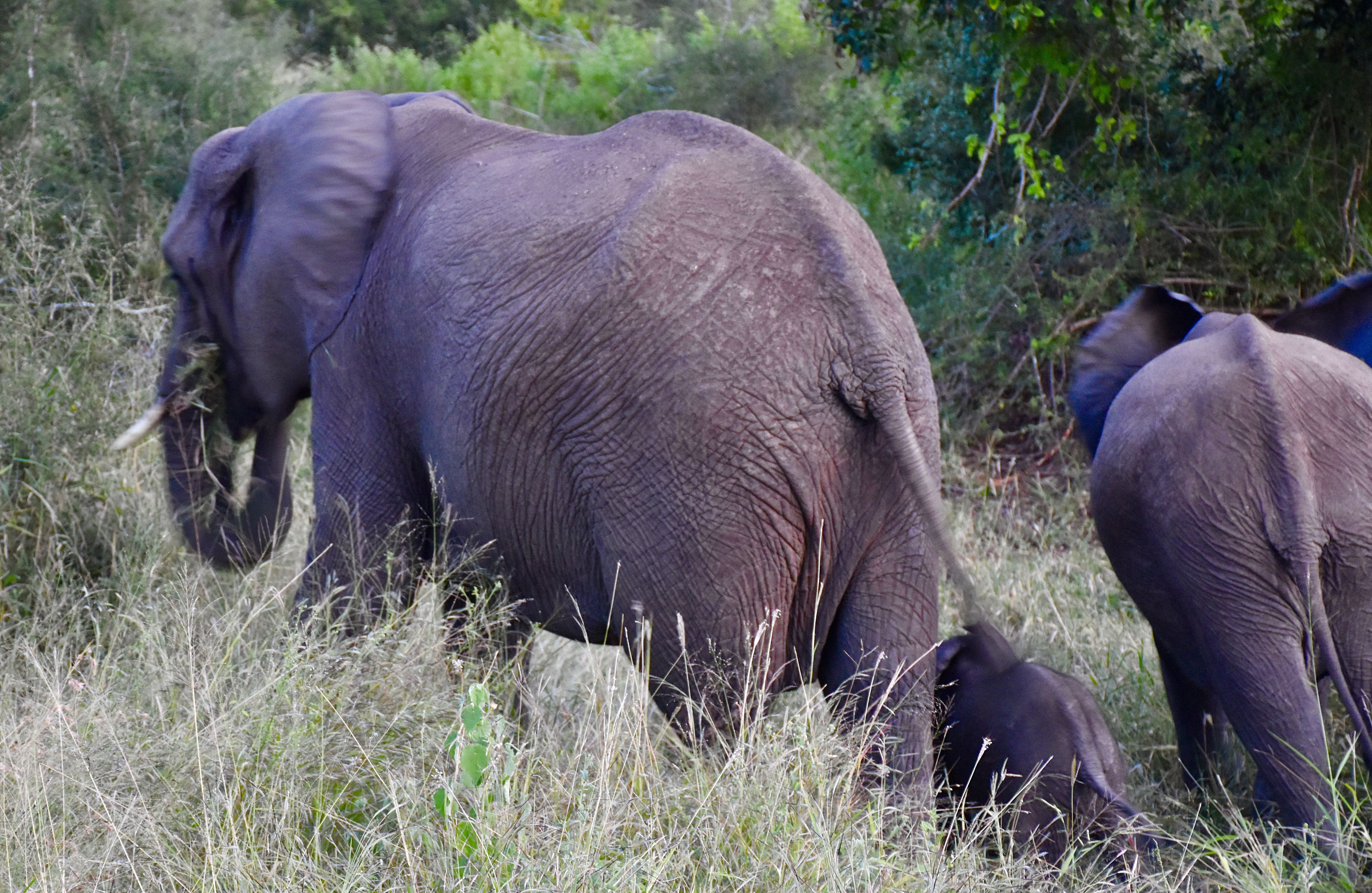
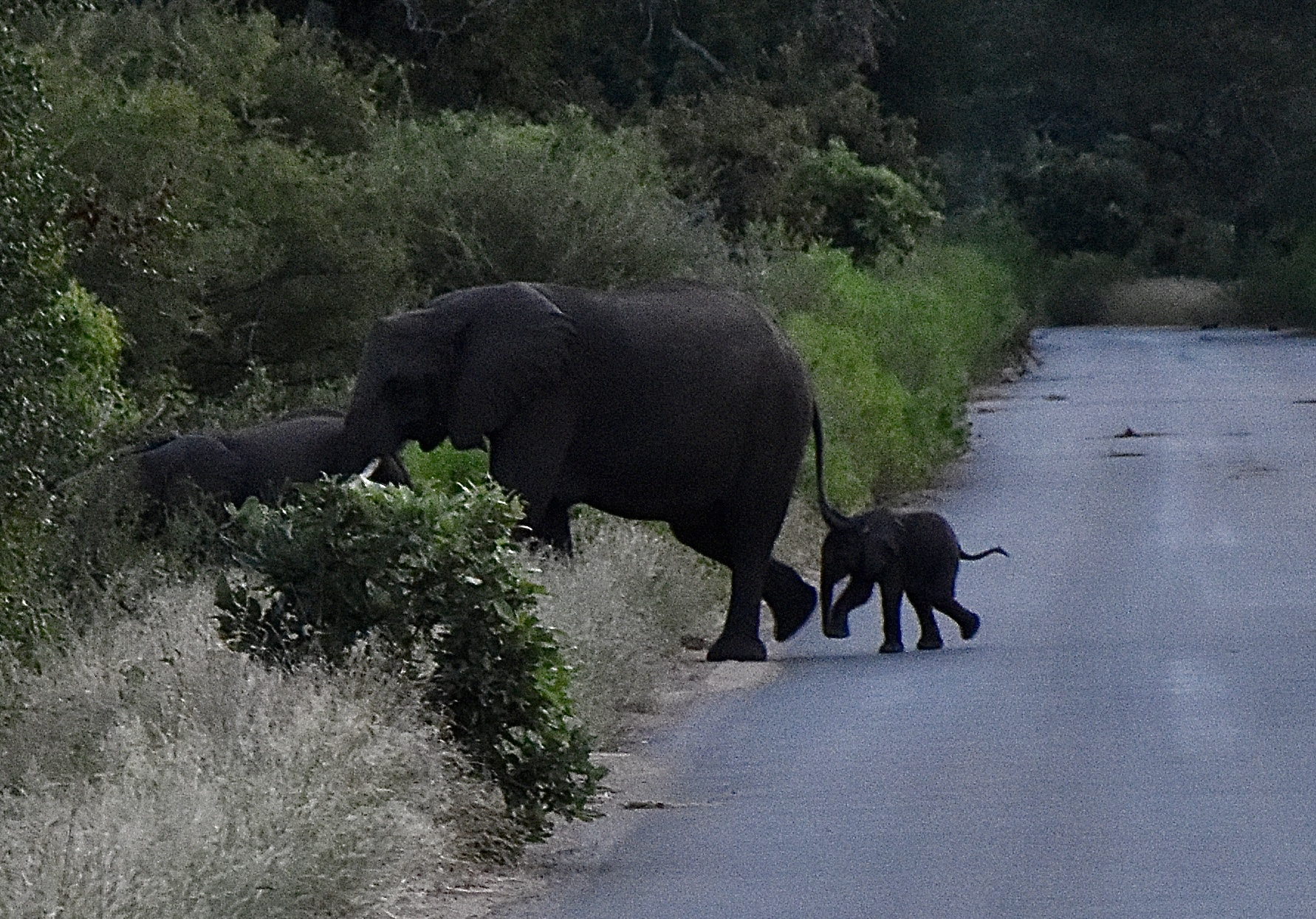
We saw ostrich. A fleeting hyena. Wild/painted dogs running across the road after prey. A baby elephant no more than a day old, wobbling beside its mother.
And then the evening shifted from reflective to cinematic.
Kruger gate closes at 6:30 p.m.
We were going to make it.
Until we weren’t.
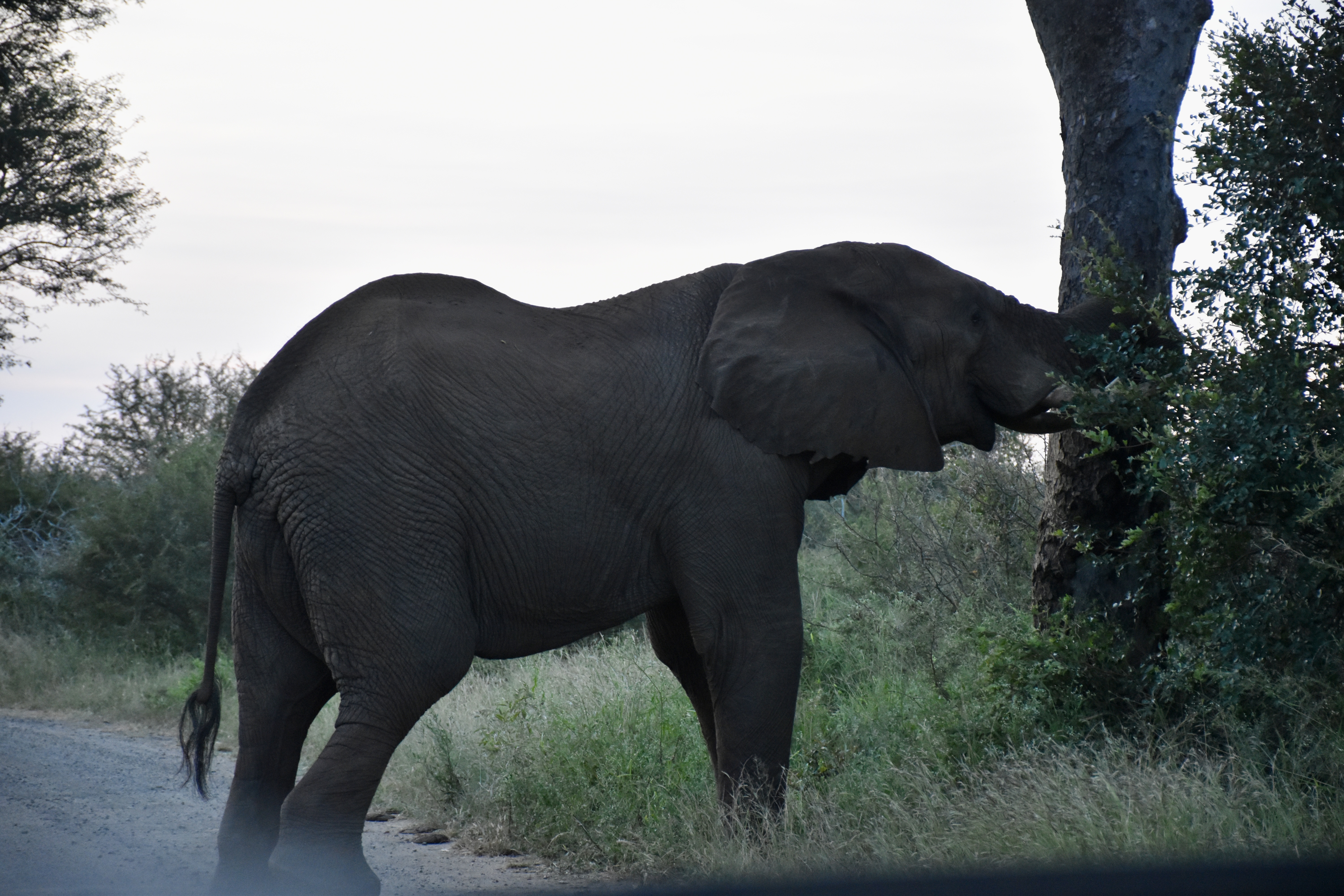
We rounded a bend and found the other half of our group (we’d been split into 2 jeeps) blocked by two male elephants — a younger bull and an older one engaged in some testosterone-laced posturing.
The younger bull stepped toward the older one, who was behind a tree to the side of the road. In that moment, the other jeep seized the opportunity and darted behind him to escape.
Unfortunately, that maneuver spooked the younger elephant.
He backed straight into the road.
Blocking everything.
Turned.
Started toward us.
Our driver began backing up — calmly, smoothly — until we collectively realized she hadn’t seen what was behind us:
An entire herd.
Two babies in the road.
Three adolescents.
And a VERY large mother to the side, trunk slung over her tusk in a stance that clearly translated to:
Try me.
We shouted.
“STOP. STOP. STOP.”
Brigitte – in the other jeep – later said they could hear us yelling from their jeep and couldn’t understand why we were “making so much noise” when you’re supposed to be quiet around elephants.
Yes.
You are.
Unless your driver is calmly reversing you from the frying pan into the fire.
The younger bull turned sideways toward the older male, wrapped his trunk around a small tree, braced his body, and tried — repeatedly — to push it over onto the older bull. (Yes, really. Photos below.)
He was committed.
The older bull stood his ground and performed a series of mock charges.
Tree: undefeated.
So now we were properly stuck.
Forward: agitated bull, now braced with all his might, attempting to clobber his rival with a tree.
Backward: herd with babies and a matriarch radiating consequence.
Meanwhile, another guided jeep approached from behind the large mom (thank heavens it was a guide and not one of the self-driven rental cars that had been making questionable life choices on our drives). They couldn’t see our situation because of the curve in the road.
All we could think was:
Please do not push them closer to us. We have enough going on.
The guides were talking rapidly on their radios in one of the local languages — switching between that and English, sometimes deliberately so we guests are kept a bit in the dark.
Our driver radioed the gate.
“There is no way we are making 6:30.”
The gate did not sound thrilled.
Another flurry of native language explanation from our driver — who, I will note, was normally unflappable but now had a certain . . . edge to her tone. (Perhaps she was reminding the gatekeeper that — Why yes, yes we HAD been forced to wait for them, missing our window of opportunity due to their computer failure that morning). The radio crackled. English this time:
“Mmf. Good luck.”
Which is precisely what you want to hear when you are pinned between two sets of elephants.


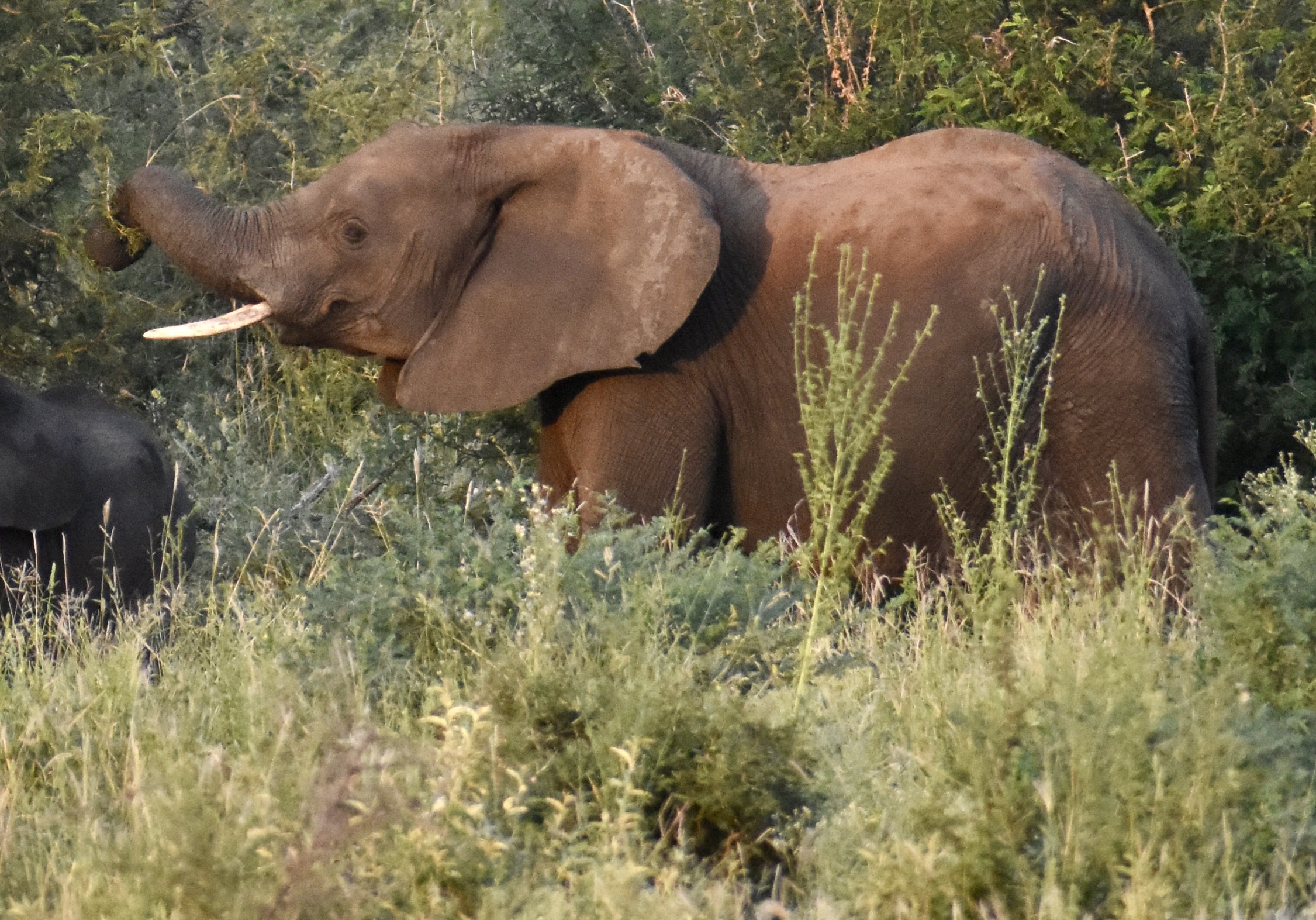


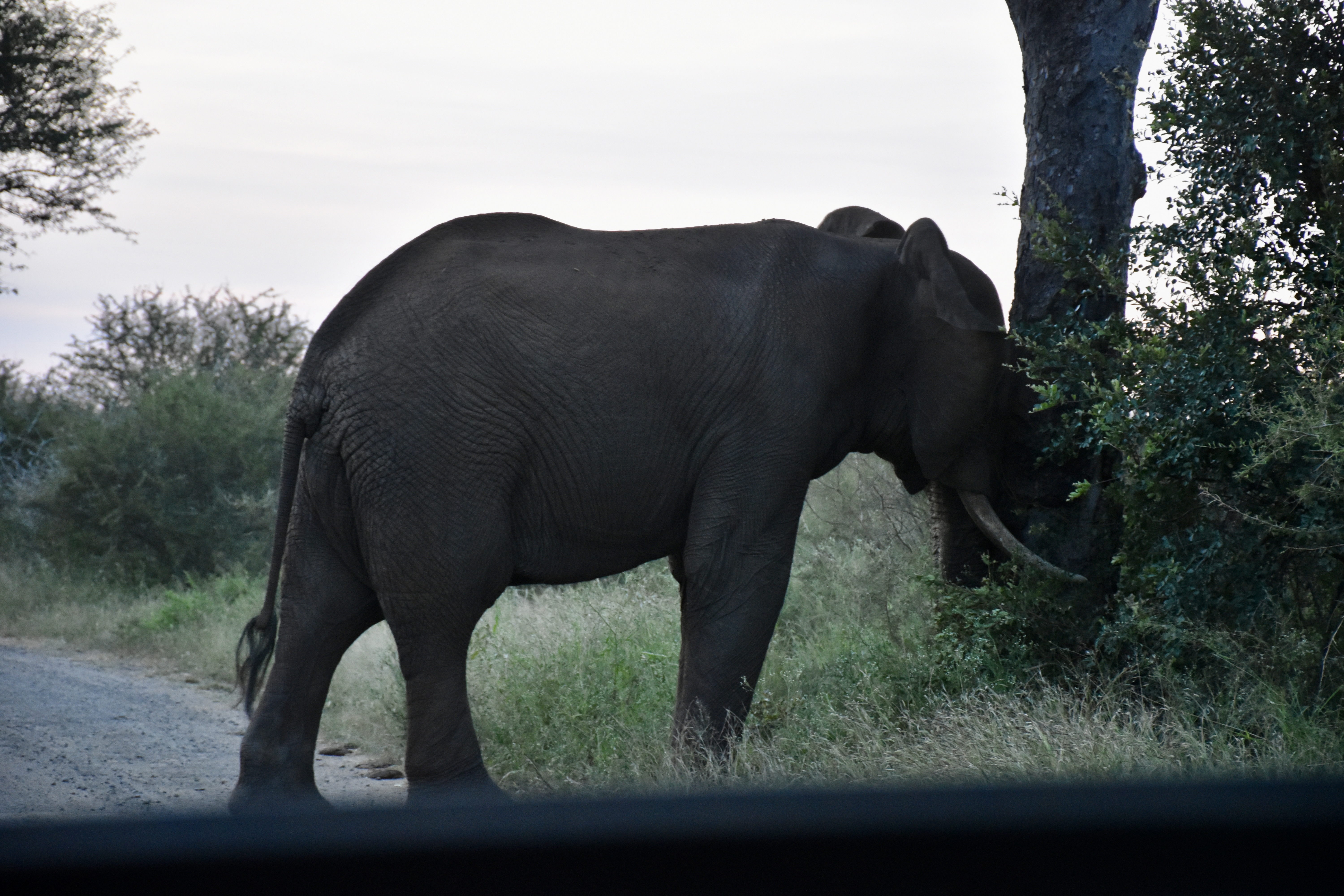

After what felt like a millennium but was probably 15 minutes, the younger bull abandoned his tree-toppling ambitions. The older bull stopped mock charging. The younger one stepped off the road.
We crept forward.
Creep.
Creep.
Creep.
No movement from the Peanut Gallery behind us (ha ha – ouch stop hitting me…)
Rev the engine to bolt AND—
Stall.
Yes.
The engine stalled.
But we restarted.
We escaped.
Nobody was smooshed.


As the last rays of sun were disappearing, we got to the bridge over the Crocodile River that precedes the gate out. Ilana took the photo here of what we were calling our “Bridge To Freedom” 🙂

On the drive back in the now dark, we were pelted by bugs . . . I was hit in the face by a bug so hard I had to wear my hoodie backward as a shield (and actually have a welt on my cheek.)
Boma dinner that night included Zulu children from about four to thirteen performing traditional dancing. They had waited for us because we were late. It wasn’t cold exactly — but watching them all dressed solely in traditional short skirts (standing with their arms folded across their chests waiting) made me feel cold just looking at them.
Dinner was wonderful.
And then I made the potato salad decision.
Potato salad that had been sitting outside. In a muggy African evening. Then waiting some more while we watched the performance. Marinating. Developing character. Quietly biding its time like a sun-warmed culinary assassin.
You know how your mother always said, “Don’t eat the potato salad that’s been sitting out”?
Yes.
That potato salad.
It was there. It was glossy. It looked harmless and delish. It had clearly been gathering strength in the heat, just waiting for an unsuspecting traveler to ignore maternal wisdom and say, “Oh, it’ll be fine.”
It was not fine.
At 3 a.m., vengeance.
Given a 1.5-hour van ride, a 3-hour flight, and another 1.5-hour van ride to Stellenbosch, I deployed Imodium.
It worked. Thank goodness.
At the airport, Janice spotted a bag featuring a hippo lounging on a couch. I bought her a coin purse and picked up some coasters for myself. Clemmie!!!!
I also bought warthog socks — one pair for me, one for Mom.
Mom once told a story about sitting poolside in Africa when a warthog trotted up, slipped, fell into the pool, and had to haul itself out.
Now that I’ve seen warthogs run full tilt, trip over nothing, and glare at the universe as if gravity personally betrayed them, I fully believe that story.
From bloats to buffalo thorn to “Good luck” at the gate, Kruger gave us science, spirit, adrenaline, and dung — sometimes all at once.
And we survived.
Slideshow to ALL the Kruger photos is HERE (Apple version) and HERE (Lightroom version).
Next up: We made it to Stellenbosch. 🍷 I’ll talk a bit about that next. While I did get the slideshow together of ALL the Kruger photos – which took like 45 minutes (linked above), I’ll try to insert more actual photos into the blog. Just . . . Tired. So Tired.
I never get a percentage from any links I include – but! – if you are curious about Overseas Adventure Travel and want $100 off, call them at 1-800-955-1925 and request their amazing catalog, tell them you were referred by Sandy Shepard, customer number 3087257, and get $100 off your first trip! The catalog is what all good dreams are made of!