
The last you saw your fearless traveler, we were being told “Good luck” by the Kruger gate while pinned between elephants.
Since then: vineyards, revolutionaries, perfume chemistry, language monuments, prison guards, penguins-to-be, and one very long stretch of early wake-ups.
Let’s work backward.
Day 16 (Today): Gardens, District Six, and Christo Brand
Up at 6. On the bus by 6:30. Packed breakfast boxes (suboptimal).
First stop: Kirstenbosch Botanical Gardens.
Set against the eastern slopes of Table Mountain, Kirstenbosch Botanical Gardens is widely considered one of the world’s great botanical gardens — focused entirely on indigenous South African flora. King proteas. Fynbos. Sculpted pathways. And the mountain rising behind it like it owns the sky.
It’s often listed among the seven best botanical gardens in the world — alongside places like Kew Gardens in London, Singapore Botanic Gardens, Rio de Janeiro’s Jardim Botânico, the New York Botanical Garden, Montreal Botanical Garden, and Brooklyn Botanic Garden. Lofty company — and honestly, standing there, completely deserved.
Abe guided us from the upper slopes downward, explaining medicinal plants, fynbos ecosystems, and how shockingly resilient some of these species are in fire-prone landscapes. We crossed the “Boomslang” bridge — a sinuous elevated walkway named after the snake — which quite literally snakes above the canopy, giving you that slight vertigo thrill of being suspended between air and leaf.
After that, we were released with simple instructions: “Just head downwards and you’ll get to the gate.”
I was particularly taken with the bonsai garden — serene, disciplined, centuries-old miniature trees calmly existing as if they are not the one plant form I cannot keep alive for love or money.
Bastards.
From there, we went to the District Six Museum.
District Six was once a vibrant, multiracial neighborhood in Cape Town. Under apartheid’s Group Areas Act in the 1960s, it was declared a “whites-only” area. More than 60,000 residents were forcibly removed and relocated to barren townships on the Cape Flats. Homes were bulldozed. Communities erased.
The museum is powerful in a quiet way. Street signs. Personal objects. Stories written directly onto sheets, then the words painstakingly stitched in tiny chain stitches. It is not abstract history — it is lived memory.
We walked through town afterward (“keep your bags in front”), and later heard from Christo Brand, one of Nelson Mandela’s prison guards on Robben Island. Brand was 18 when Mandela arrived and eventually developed a respectful relationship with him. He later wrote a memoir, Doing Life with Mandela. Hearing him speak added nuance — it’s one thing to hear about imprisonment; it’s another to hear from someone who stood on the other side of the bars and changed.
Dinner tonight will be at Marco’s African Place, known for traditional African cuisine and live music — think game meats, bobotie, and rhythms that make you want to move even after 15,000 steps.
Tomorrow: Table Mountain (weather permitting), our OAT “controversial topic” discussion (poaching for subsistence vs. commercial abalone trafficking), Cape Peninsula, Boulders Beach penguins, and the Cape of Good Hope.
Sunday: largely on our own, farewell dinner at The Butcher Shop & Grill.
Monday: Cape Town to Walvis Bay, Namibia.
And yes — back to the 44-lb checked bag and 15-lb carry-on discipline.
Day 15: Franschhoek, Language, and Limo Logistics
Yesterday we drove up to Franschhoek, about 45 minutes from Stellenbosch.
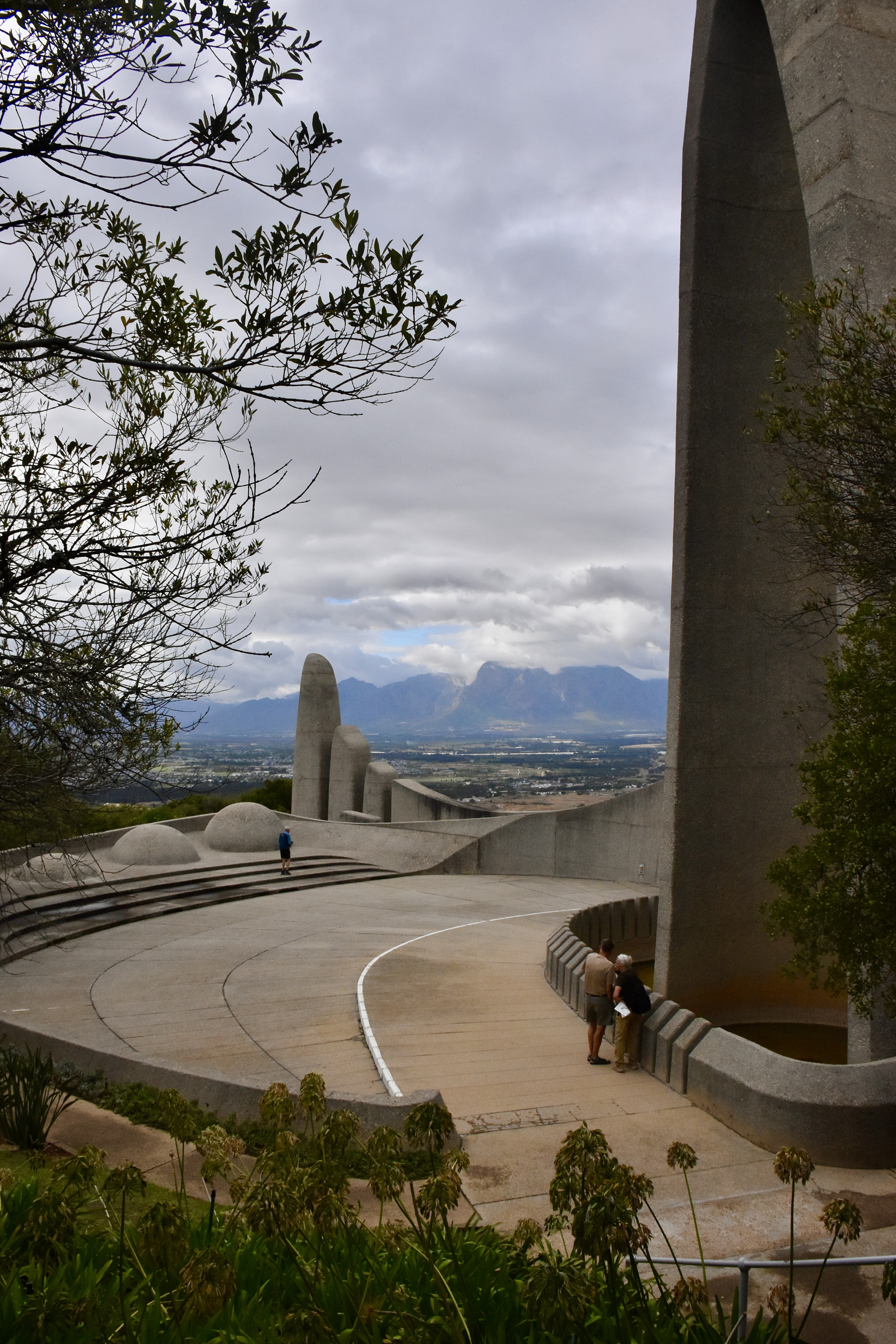
Before heading to Franschhoek, we stopped at the Afrikaans Language Monument (Afrikaanse Taalmonument), dramatically positioned on a hill outside Paarl. From a distance it looks almost futuristic — a cluster of pale concrete forms rising out of the earth like something both sculptural and symbolic. Up close, you realize every curve and angle is deliberate.
The monument was unveiled in 1975 to mark 50 years of Afrikaans being recognized as an official language. The tallest, tapering column — soaring 57 meters into the sky — represents the rapid growth and future aspirations of Afrikaans. A second sweeping arc symbolizes the European roots of the language, primarily Dutch. A lower, rounded form represents African influences, while another element nods to Malay and other linguistic contributions. The structures do not stand isolated; they lean toward one another, intersect, and create negative space between them — visually suggesting that Afrikaans did not emerge from a single source, but from convergence. The open archways and curved walls frame the landscape beyond, reinforcing the idea that language is not static, but expansive.
Architecturally, it feels part monument, part modernist (Brutalist) sculpture garden. The pale concrete shifts color in the light. Pathways lead you upward in stages, so that as you climb, the shapes seem to rearrange themselves. In photos, the lines are bold and clean against the sky; in person, they feel almost kinetic, like frozen movement.
And yet, the monument carries complicated history. Afrikaans evolved from 17th-century Dutch but was shaped over time by Malay, Portuguese, Khoisan languages, and the voices of enslaved and indigenous communities. During apartheid, however, Afrikaans became associated with state power and was imposed as a language of instruction in Black schools — sparking the 1976 Soweto uprising when students protested being forced to learn in it. Standing at the monument today, you feel both pride and tension: celebration of a language’s evolution alongside awareness of the era in which it was politically weaponized.
It is a monument that reaches upward — literally and metaphorically — toward a more inclusive future, while standing firmly in a complicated past.
Franschhoek means “French Corner.” It was settled in the late 1600s by French Huguenots fleeing religious persecution in France after the revocation of the Edict of Nantes. They brought viticulture knowledge that helped shape South Africa’s wine industry.
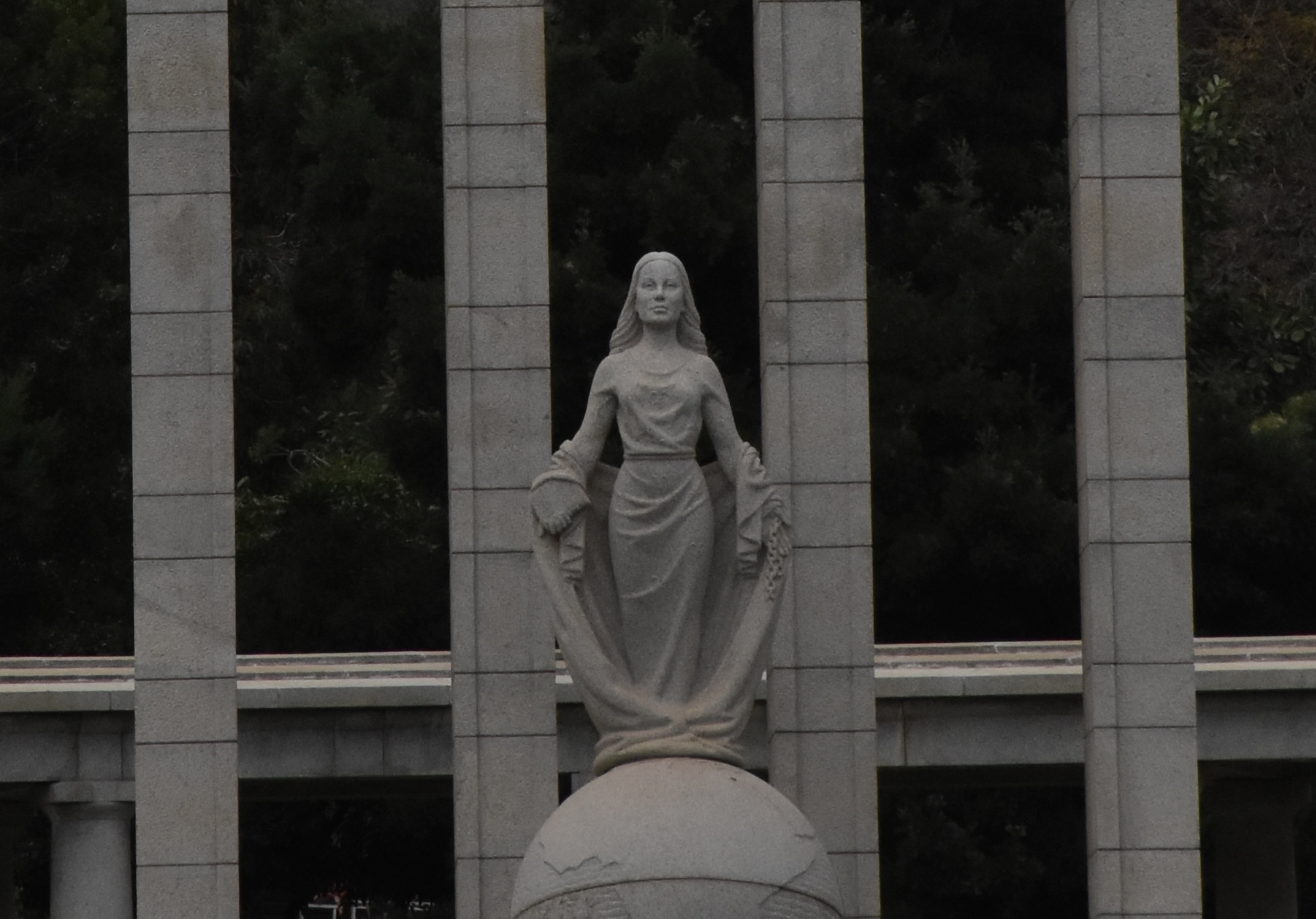
We visited the Huguenot Memorial Museum, which traces that migration and the cultural imprint left on the valley. The memorial itself features a central female figure symbolizing religious freedom, with architectural elements referencing the Holy Trinity and spiritual refuge. The gate was locked, so our photos are from afar — liberty viewed respectfully at a distance.
Inside the same grounds is the First South African Perfume Museum — and I went back three times.
Perfume history is wild. The Romans used scent not just for the body but for clothing, fountains, even walls. They flew perfumed birds through dinner parties. “Cologne” comes from Köln (Cologne, Germany), where Eau de Cologne was first created in the 18th century. Napoleon was famously obsessed with fragrance — reportedly consuming dozens of bottles of cologne a month (jasmine). Xx Scent has always been power, ritual, seduction, medicine.
We had lunch at Wiesenhof, a coffee roastery and eatery. Our places were set with baseball caps reading “Coffee Snob.” The meal ended with a layered mint-and-Amarula drink (called a Springbok) that required one to perform a small dance emulating a Springbok at a watering hole, and then attempting to grab the glass with one’s teeth and down it in one gulp.
The diameter of the glass opening was… ambitious.
Tom tried valiantly.
From there, a splinter group of us hired a limo to visit wineries my manager had suggested. Due to delays, we had to drop one and settled on two: the first, Delair Graaf, a showpiece estate purchased and transformed by a diamond magnate who ripped out the old plantings and redesigned everything into an art-filled statement property; the other Tokara, a more traditional estate.
I was able to convince Ari to hold up one of Jim’s marbles against the mountains – then as he threw it into the bushes surrounding the vineyards, I caught the marble in midair. I wanted to leave one of H’s marbles by a sculpture I know he would have liked – but the security was watching me like a hawk.
We had fun! We tasted. We debated. We actually identified flavor notes. Tracey and Mary were especially taken with the hand soap and lotion at the first estate.
It was glorious.
Day 14: From Kruger to Stellenbosch
We flew from Kruger to Cape Town — arriving to news that the international terminal had experienced a fire, knocking out power. Luckily we were domestic; baggage claim was a guessing game, but manageable.
On the drive to Stellenbosch, we passed a building known locally as “The White House,” where Robert F. Kennedy gave his 1966 “Ripple of Hope” speech at the University of Cape Town during apartheid — speaking about freedom and moral courage in a time of repression.
We also stopped near Drakenstein Prison, where Nelson Mandela was released in 1990 — the famous image of him walking hand-in-hand with Winnie, fist raised. Ironically, just across the road is the former estate of F.W. de Klerk, the apartheid-era president who negotiated Mandela’s release.
In Stellenbosch we stayed at the historic Stellenbosch Hotel — charming, but with several flights of stairs that reminded everyone exactly how much luggage they had brought.
We visited L’Avenir Estate, where Ryan Bredenkamp guided us through the vines and cellar. We tasted MCC (Méthode Cap Classique), rosé, Chenin Blanc, and two expressions of Pinotage. One bottle bore the Old Vine Project seal — awarded to vineyards older than 35 years, with the planting year listed. Another vineyard there will qualify this year.
The rosé was a “Pink Pinotage,” pale and elegant, reflecting the shale soils. Their premium Pinotage used a glass stopper rather than cork — a nod to French style but avoiding cork taint. The punt of the bottle was striated, and when placed over a King Protea bloom, it fit perfectly — art meeting geometry. The single vineyard Pinotage was so strikingly good, Mike and I schemed on how to get it back to the States…until Ryan told us that they had a distributor in San Francisco! Of course Mike is in Florida, but shipping of any number of bottles is ~$25. Score!
That evening we had our home-hosted dinner with Faith and her husband Reggie. “Home hosted meals” are one of the 4 pillars of an Overseas Adventure Trip (controversial subject; home hosted meal; day in the life; charity/school visit). Faith had risen from entry-level work in the wine industry (“when I couldn’t even use a corkscrew”) to leading tours and managing operations. I had watched a YouTube oral history of her beforehand, which startled her delightfully when I referenced it at her driveway.
It was warm, generous, human.
So yes.
We have moved from elephants pushing trees to perfume empires to apartheid history to rosé on shale.
And tomorrow: penguins.
Africa does not do one-note days.
And neither, apparently, do we.