
Monday, November 2, 2026 — Kamakura
There is something particularly Japanese about a day that begins with the crush of the subway, contains a gigantic Buddha and a Shinto wedding, and ends with rain.
Of course, there is also something particularly Sandy about a day involving ancient shrines, a rather enthusiastic international game of charades, thousands of small stone figures, fierce Buddhist guardians, and a warning about predatory birds.
But I’m getting ahead of myself.
Kamakura: Samurai History, with a Chance of Rain
Today’s excursion was optional, and the weather forecast was decidedly unenthusiastic.
Rain. More rain. Possibly rain accompanied by additional rain.
So the elegant haori stayed behind, and my trusty REI rain jacket came out to play.
Our destination was Kamakura, the seaside town south of Tokyo that became the center of Japan’s first warrior government in the late twelfth century.
For someone studying iaido, this is rather like visiting a place where the history you’ve been reading about suddenly stops being theoretical.
The Kamakura period saw the rise of samurai political power, the spread of Zen Buddhism among the warrior class, and the creation of some of Japan’s most extraordinary swords.
I was already interested.
The weather, meanwhile, remained determined to provide atmosphere.
Children, Weddings, and My Very First Goshuin
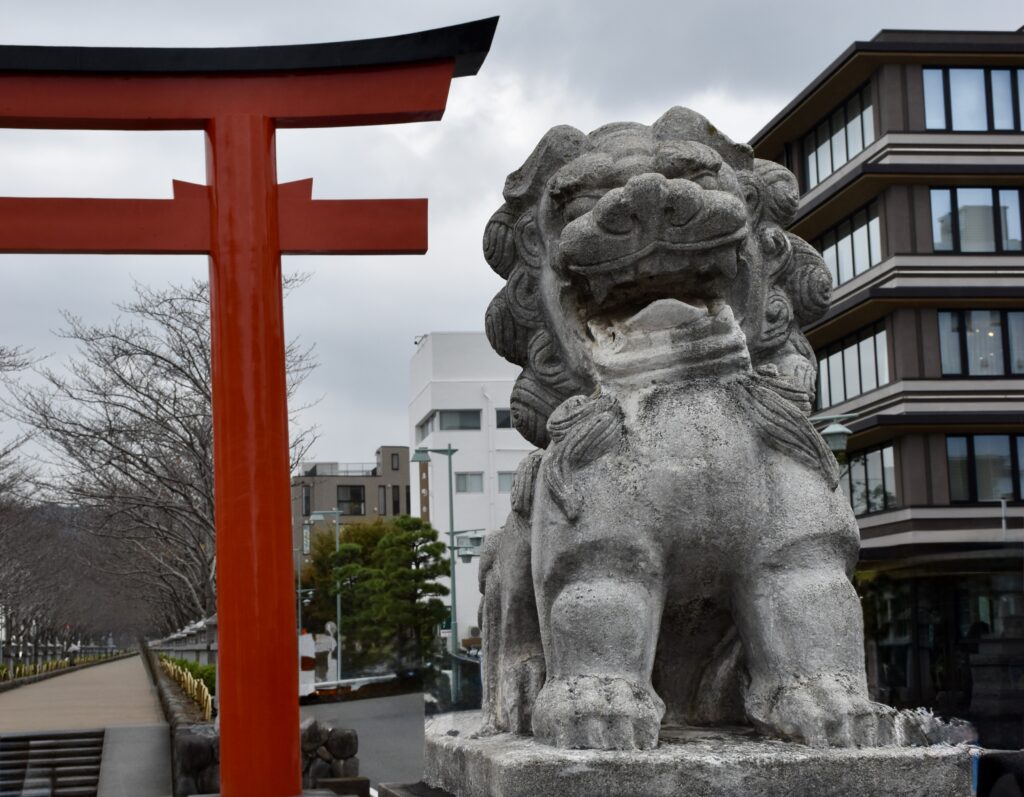
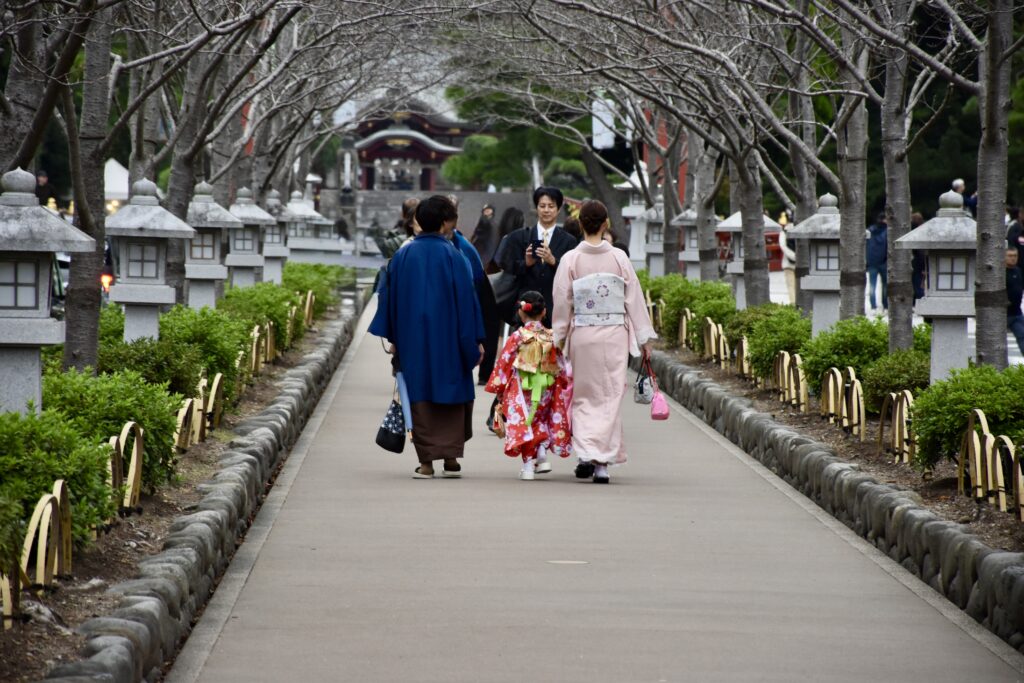
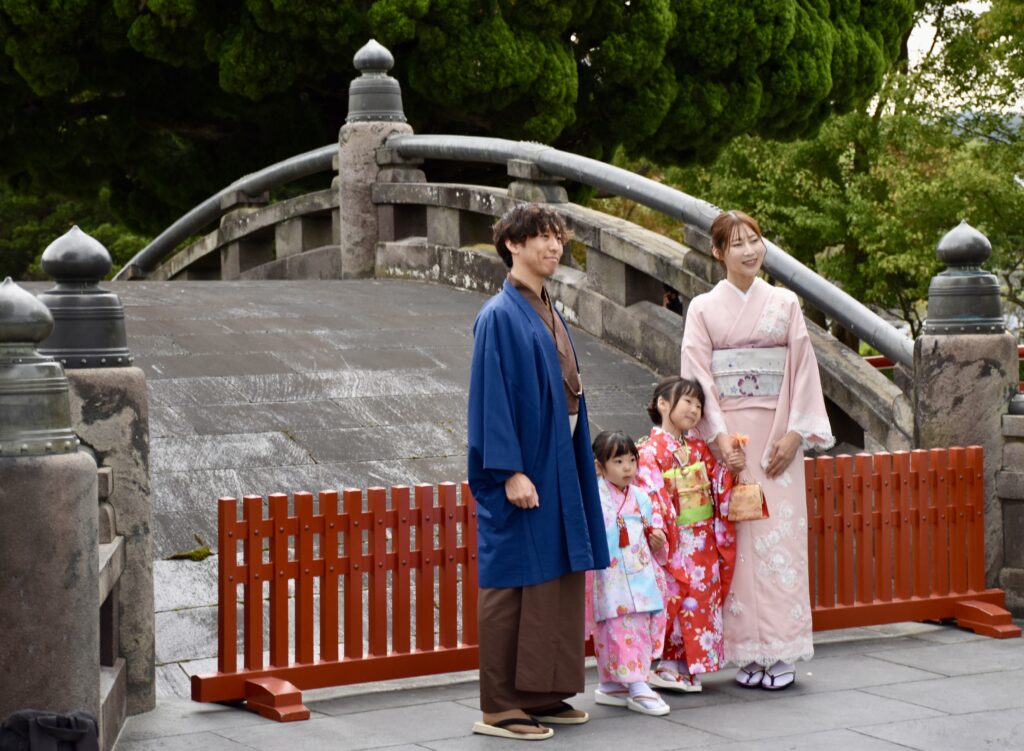
Our first stop was Tsurugaoka Hachimangū, Kamakura’s magnificent Shinto shrine, founded in the eleventh century and closely associated with the Minamoto clan and the Kamakura shogunate.
The buildings were glorious: brilliant vermilion pillars, elaborate painted eaves, broad stone stairways, and a wonderful sense of ceremony.
And ceremony, as it happened, was very much on the day’s agenda.
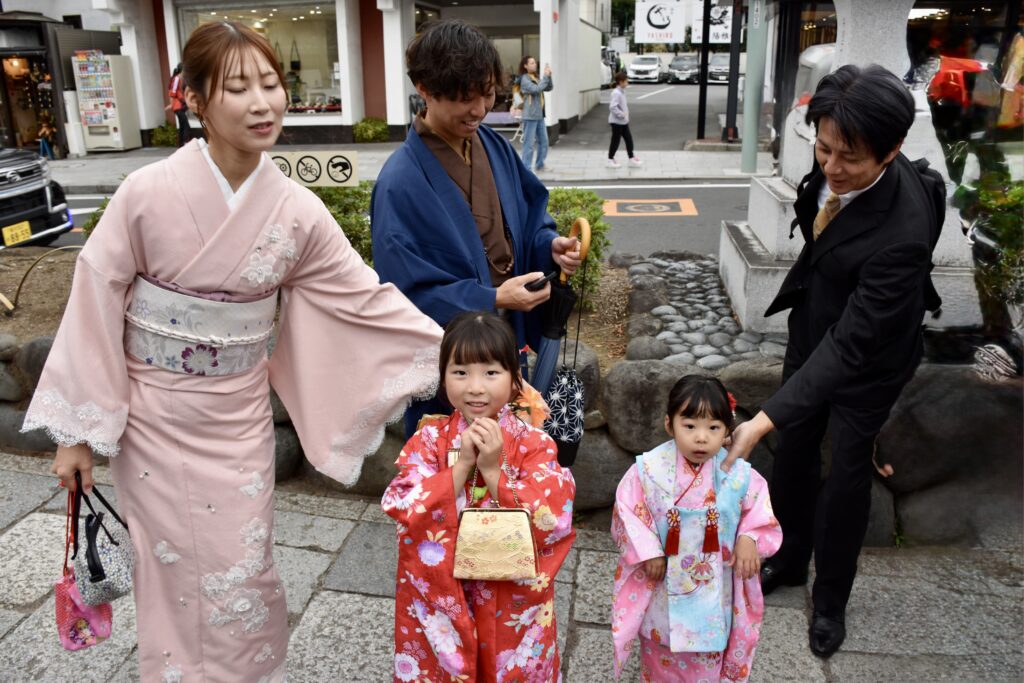
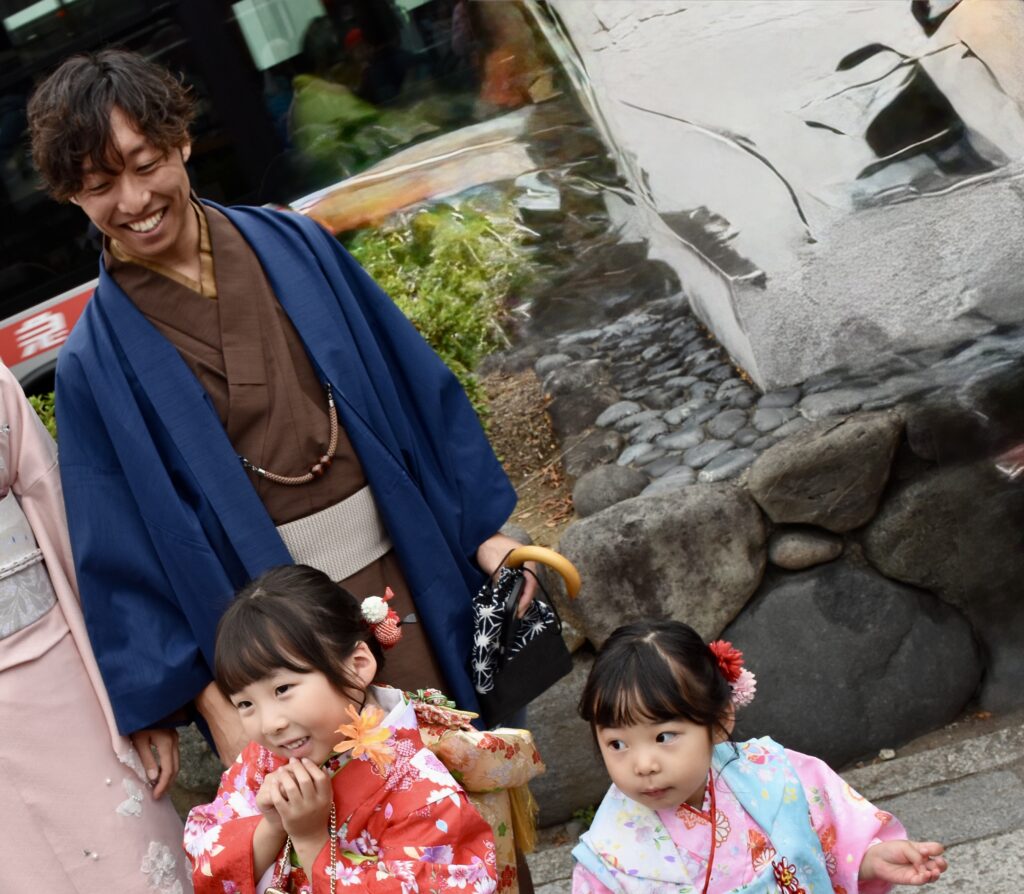
We encountered children dressed in beautiful traditional clothing for Shichi-Go-San, the Japanese celebration marking important milestones for children at ages three, five, and seven.
Little girls in gorgeous kimono, looking both splendid and occasionally rather overwhelmed by the attention. Parents and grandparents arranging photographs. Everyone celebrating the fact that these children were growing up.
Then we encountered an actual Shinto wedding.
The bride wore traditional white wedding attire, the groom formal black clothing, and the ceremony included attendants in elaborate robes, musicians, ritual objects, and offerings.

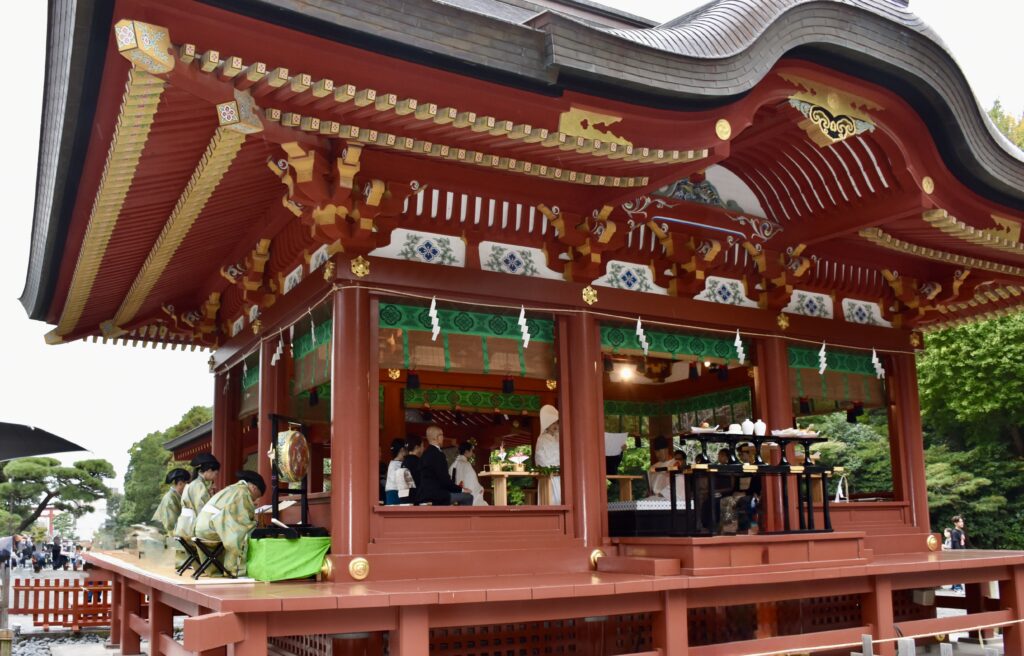
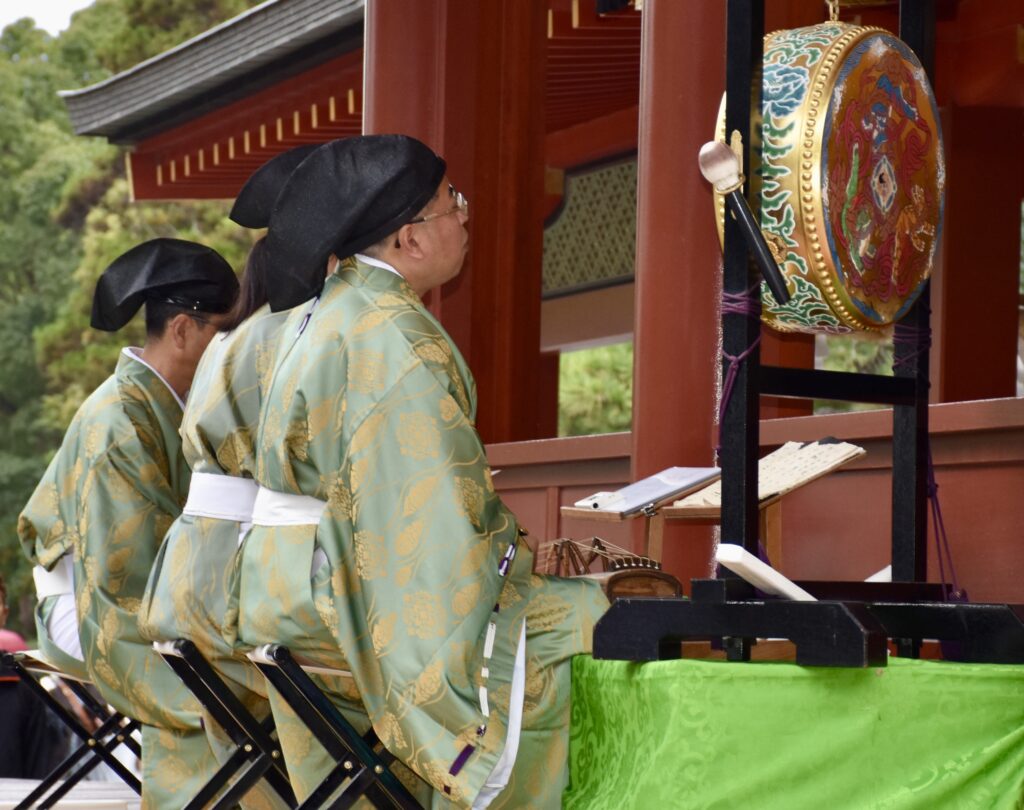
It was a privilege to see something so personal unfolding in such a public, historic place.
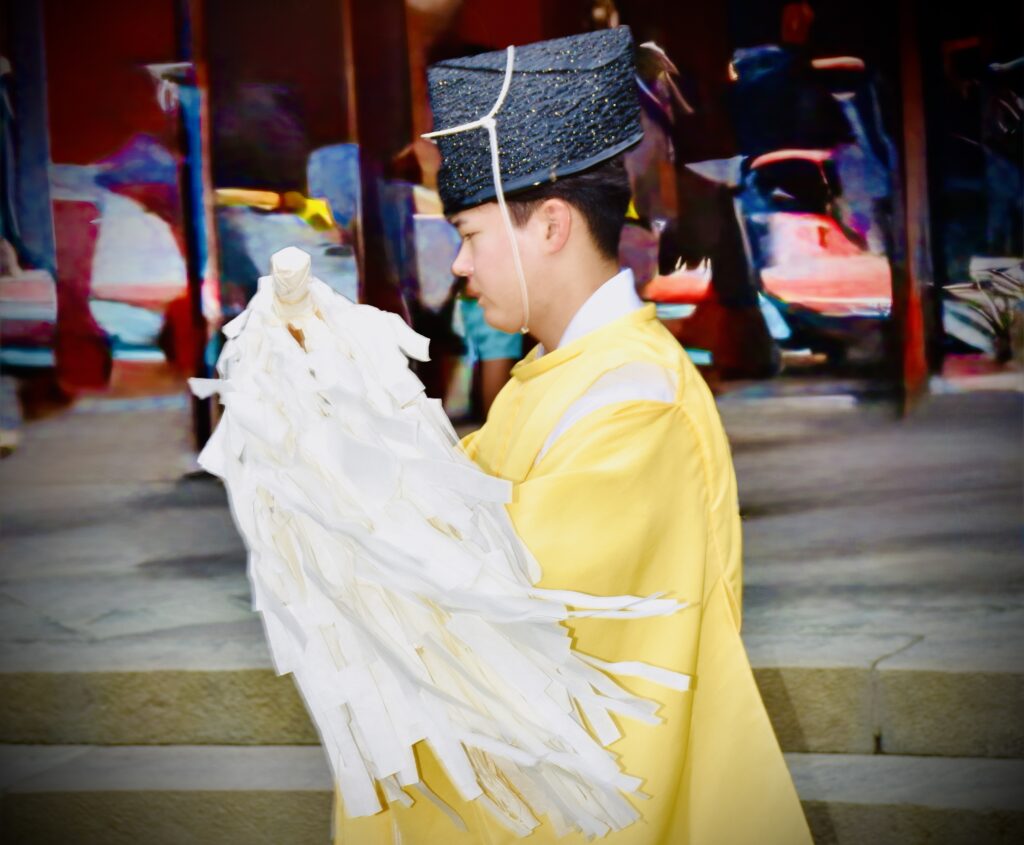
Nearby, a young Shinto priest in vivid yellow robes carried a purification wand adorned with white paper streamers. I photographed him repeatedly, fascinated by the formality of the clothing and the deliberate precision of the ritual.
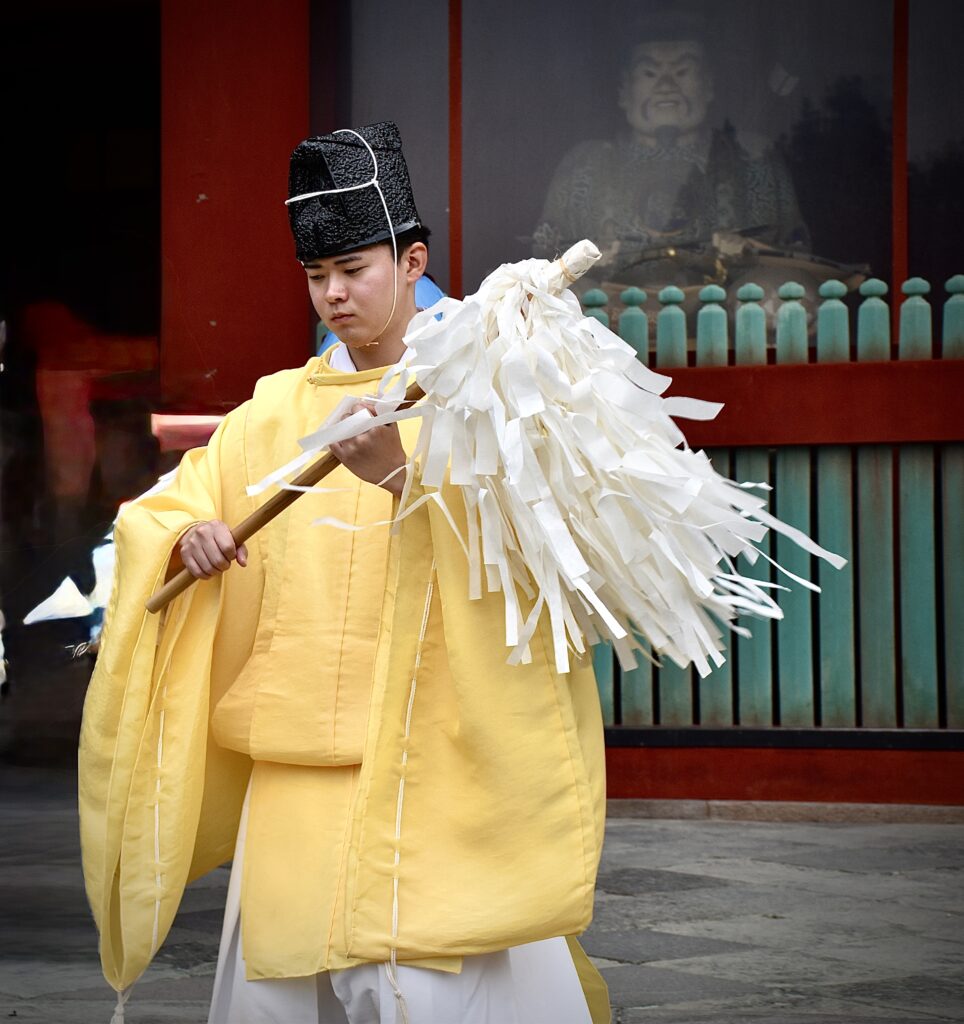

And then came my own tiny ceremonial milestone.
I’d brought along a brand-new goshuinchō, the special book used to collect goshuin—calligraphic inscriptions and stamps received at Japanese shrines and temples.
I presented it to the woman preparing the inscriptions.
She opened it.
She looked at the completely blank pages.
And then she looked at me.
Through a combination of enthusiastic pointing, elaborate gestures, and what I can only describe as heavy international miming, I managed to communicate:
THIS IS MY FIRST GOSHUIN.
Not merely the first one in this particular book.
MY FIRST GOSHUIN EVER.
Her face lit up.
She seemed genuinely delighted that she was going to be the person to inaugurate my collection, and apparently added something special to commemorate the occasion.
I don’t yet know precisely what she wrote, but the pleasure she took in doing it needed no translation whatsoever.
There is something lovely about that.
A little girl celebrating a milestone. A couple beginning a marriage. And a foreign visitor, through the universal language of pointing and exaggerated facial expressions, beginning a collection of sacred calligraphy.
All in the same shrine.
Sake, Sacred Ropes, and Divine Customer Service
There were other things to learn at Tsurugaoka Hachimangū.
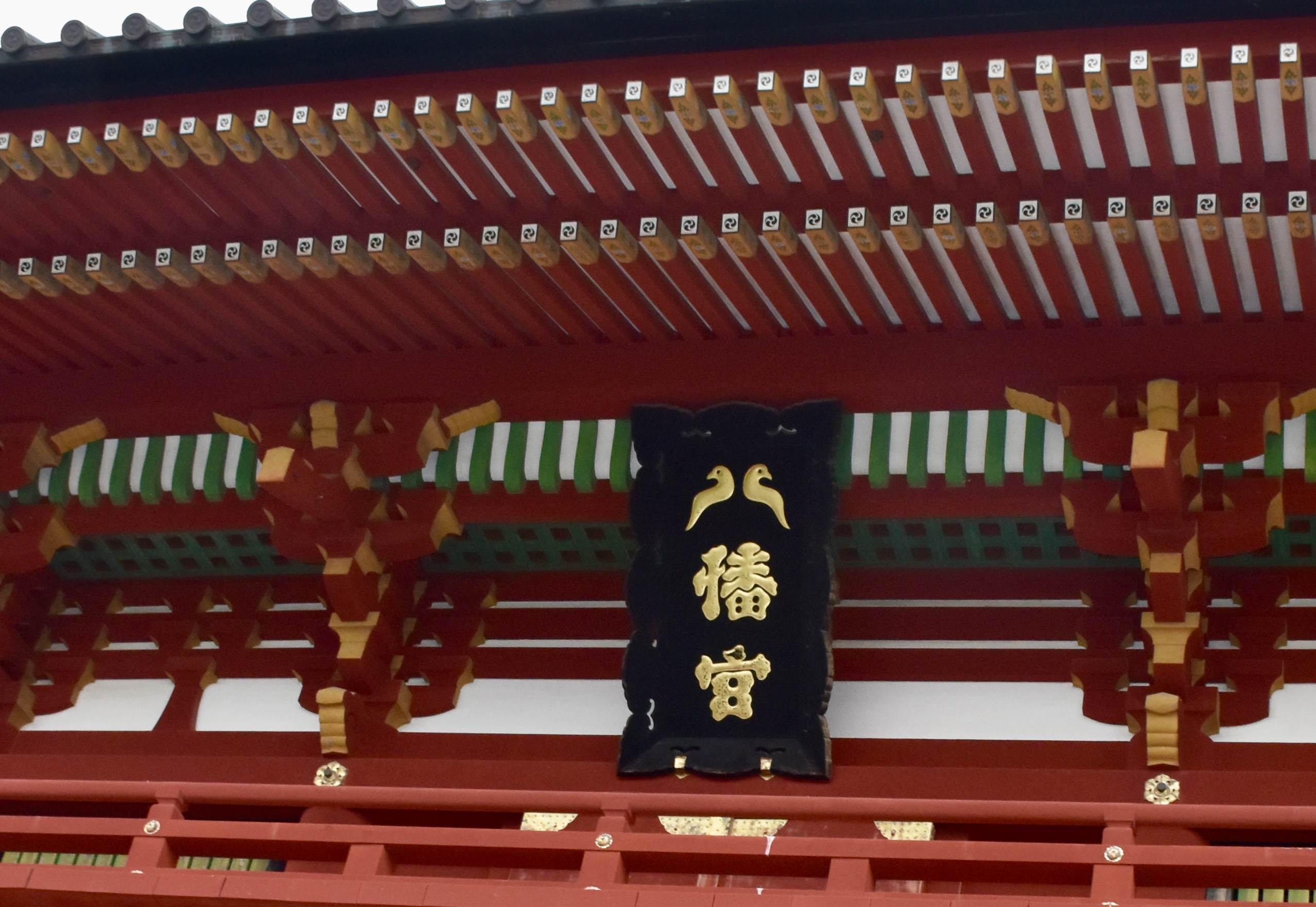
For one – pigeons! At the main entrance, they appeared in the decoration above us, and Utako-san explained their significance. They are considered sacred messengers of Hachiman, the Shinto deity closely associated with warriors and the Minamoto clan, which established the Kamakura shogunate.
In fact, the characters for Hachiman on the shrine’s magnificent name plaque incorporate stylized ones at the top.
So here I was, an aspiring samurai (well, an aspiring iaidoka, anyway), standing beneath the symbolic messengers of the samurai’s protective deity.
Rather a nice welcome.
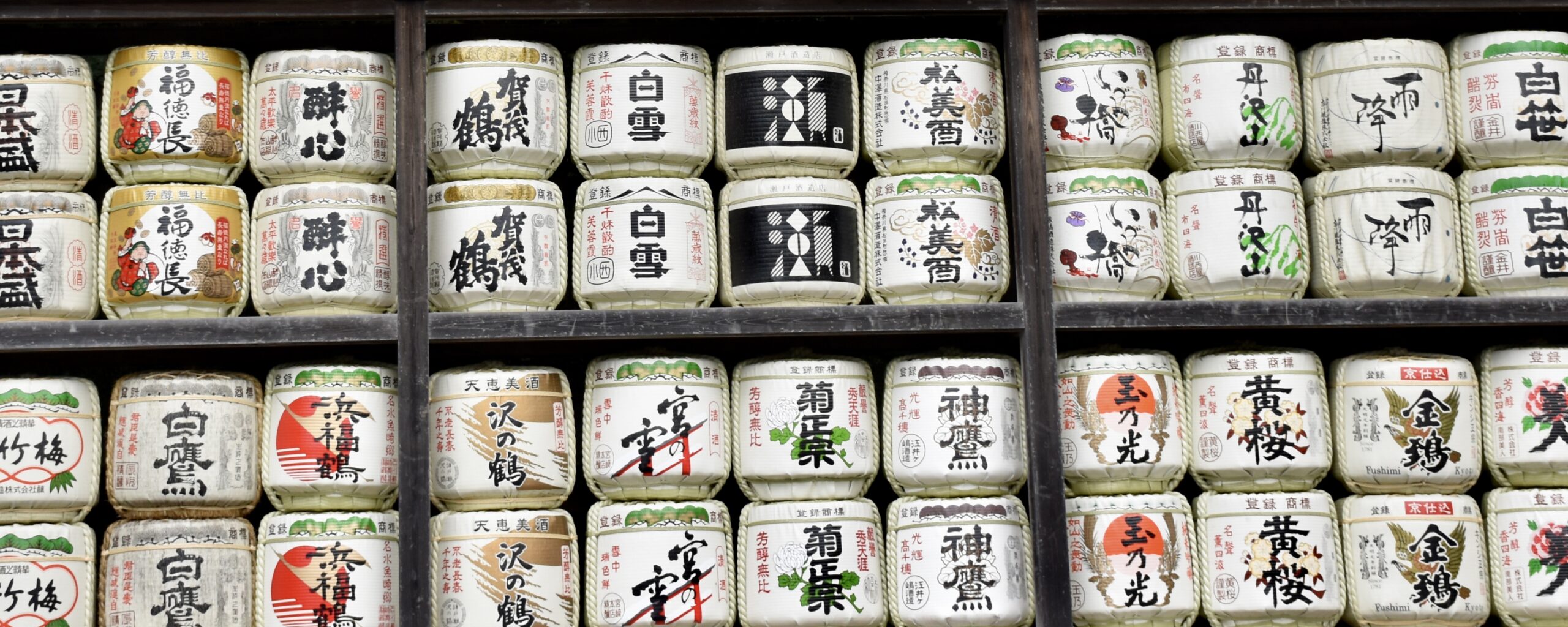
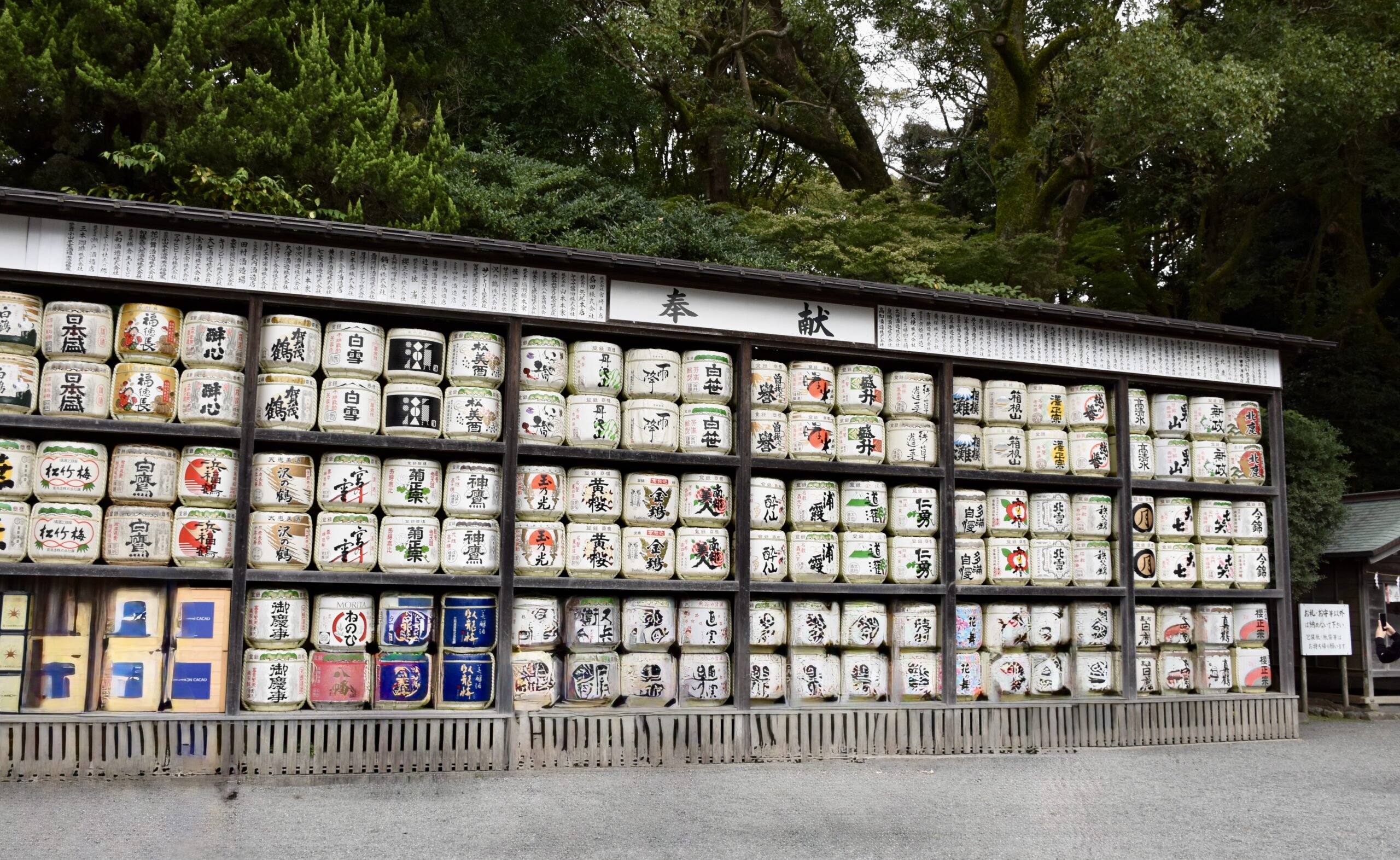
For another, an impressive display of enormous sake barrels, stacked in neat rows and decorated with beautiful Japanese labels.
These are kazaridaru, ceremonial barrels representing sake offerings made to the Shinto gods (kami) by breweries and other donors. Sake isn’t merely something to drink here; it also has an important ceremonial role.
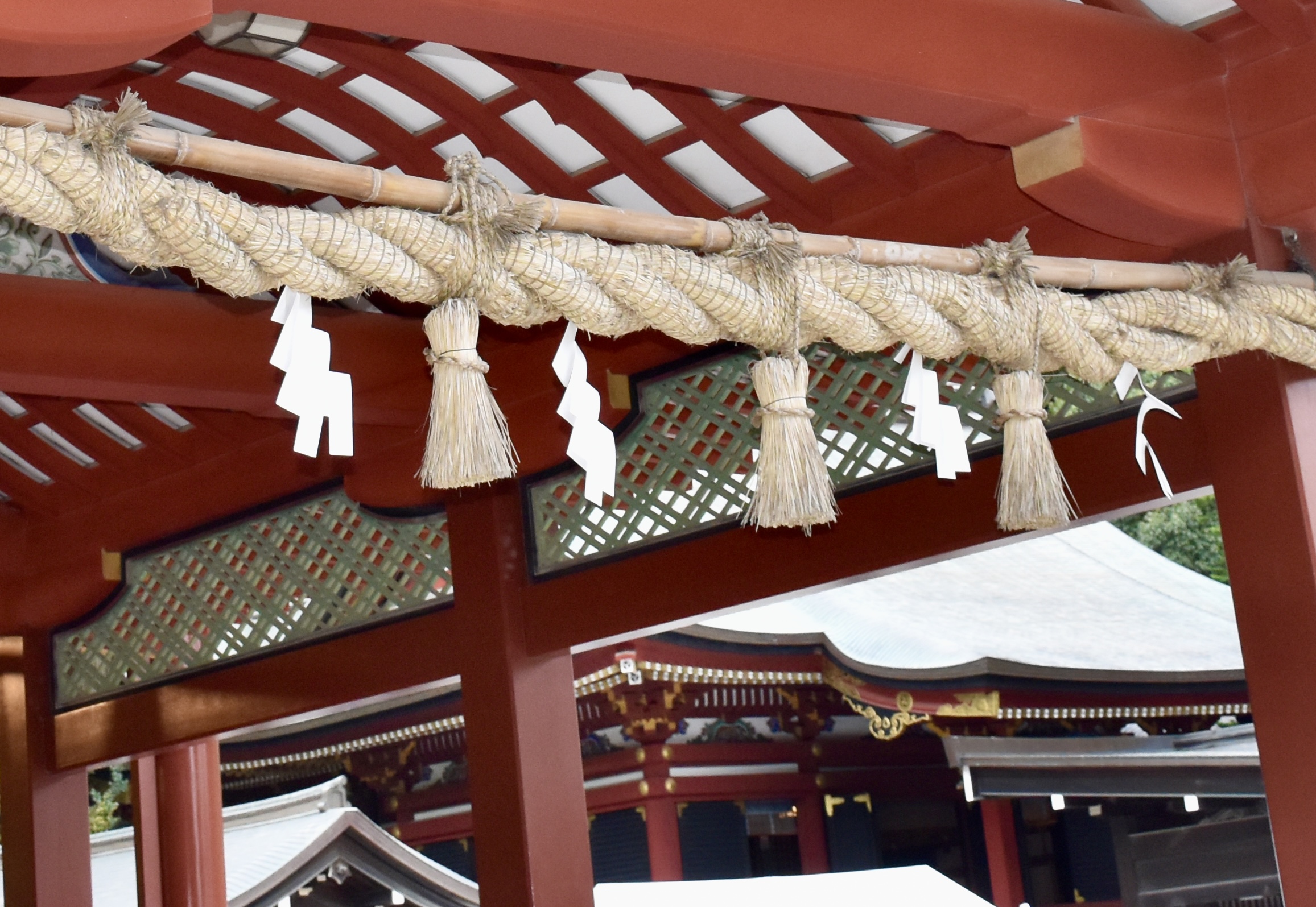
Then there were the sacred ropes, called shimenawa, with their dangling zigzag paper strips, or shide.
Utako-san explained the imagery: the rope represents clouds, while the white zigzags represent lightning. The rope marks the boundary of a sacred space, separating the ordinary world from the realm of the gods.
Which made the fact that we were standing beneath actual rain clouds rather appropriate.
Utako-san also gave us a practical lesson in how to behave at a Shinto shrine.
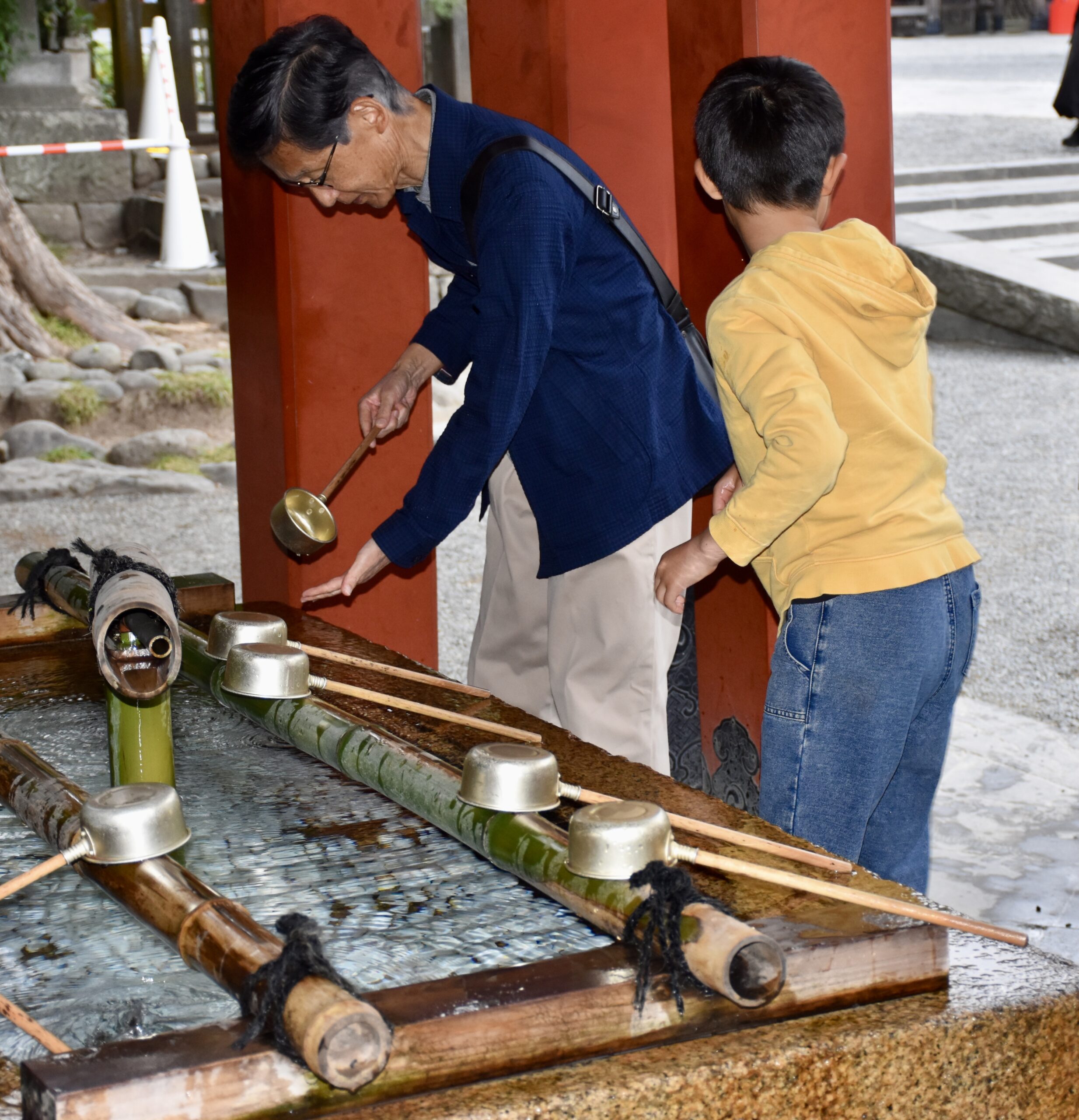
First, purification at the temizuya, the stone water basin.
There is a definite procedure, and it is considerably more complicated than simply washing your hands.
Take the ladle in your right hand and rinse your left. Switch hands and rinse your right. Pour a little water into your left palm, bring it to your mouth, rinse, and discreetly spit the water out. Rinse your left hand again, then tip the ladle upright so the remaining water runs down its handle, cleaning it for the next person.
And, importantly, all the used water goes onto the pebbles outside the basin. NOT back into the clean water!
Having mastered this elaborate aquatic choreography, we were ready to pray.
That, too, has a procedure.
Toss a coin into the offering box. Bow twice. Clap twice. Make your prayer. Then bow once more.
Utako-san explained that it was perfectly acceptable to tell the gods your name and where you lived, so they would know who was making the request.
Or, she added helpfully, perhaps leave your phone number so they could find you.
I rather liked the idea of divine customer service.
Although I wasn’t entirely sure whether the gods accepted text messages.
The Great Buddha: Immovable Serenity


Next came Kōtoku-in, home of the Great Buddha of Kamakura.
The Daibutsu is an enormous bronze representation of Amida Buddha, dating from the thirteenth century. At approximately 11.3 meters tall, excluding its pedestal, it is one of Japan’s most famous Buddhist images.
And photographs really cannot prepare you for the scale.
He sits outdoors, surrounded by wooded hills, his enormous hands resting in meditation and his expression utterly composed.
Visitors come and go. Umbrellas bob. Cameras click. Groups arrange themselves on the steps for photographs.
And the Buddha simply sits.
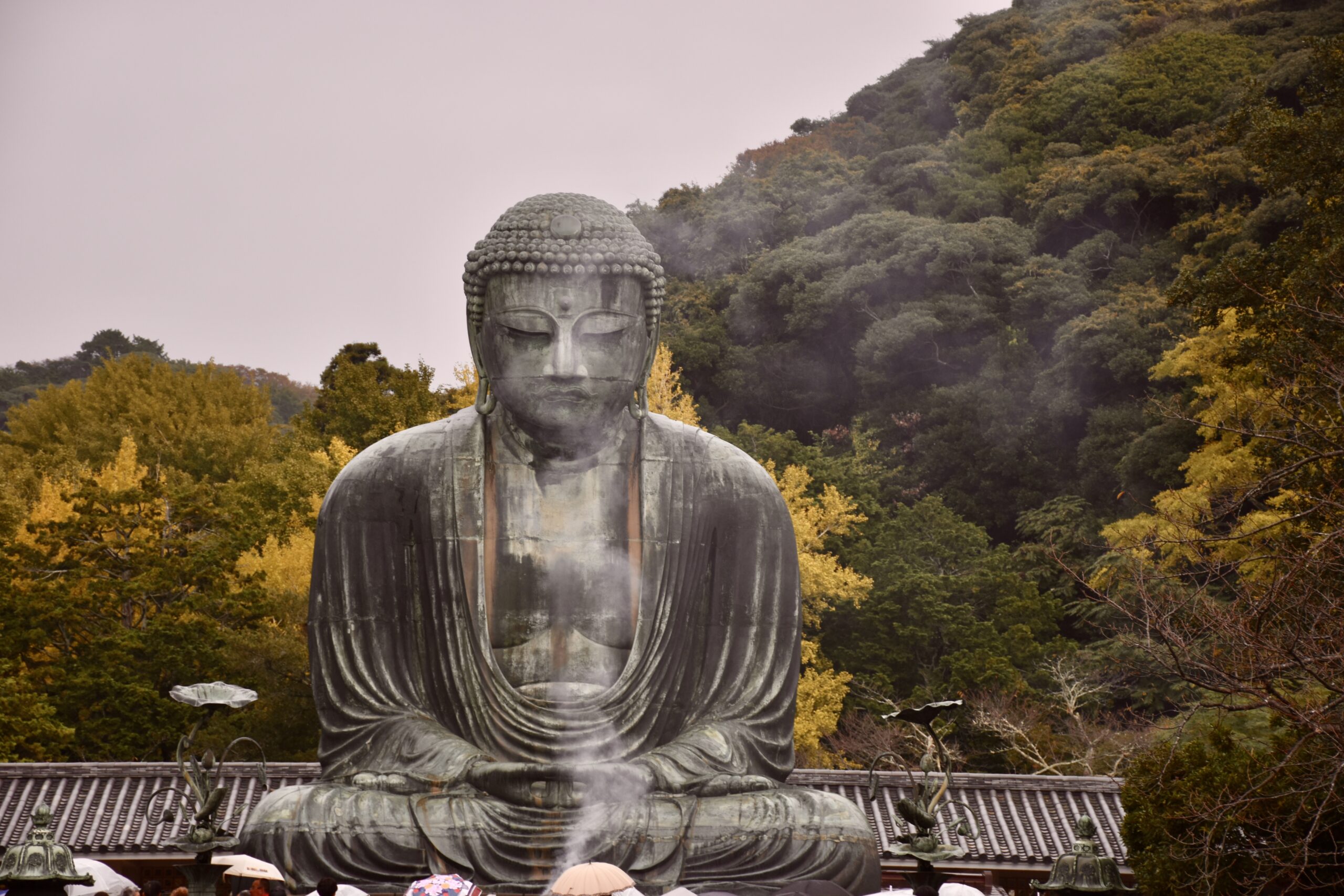
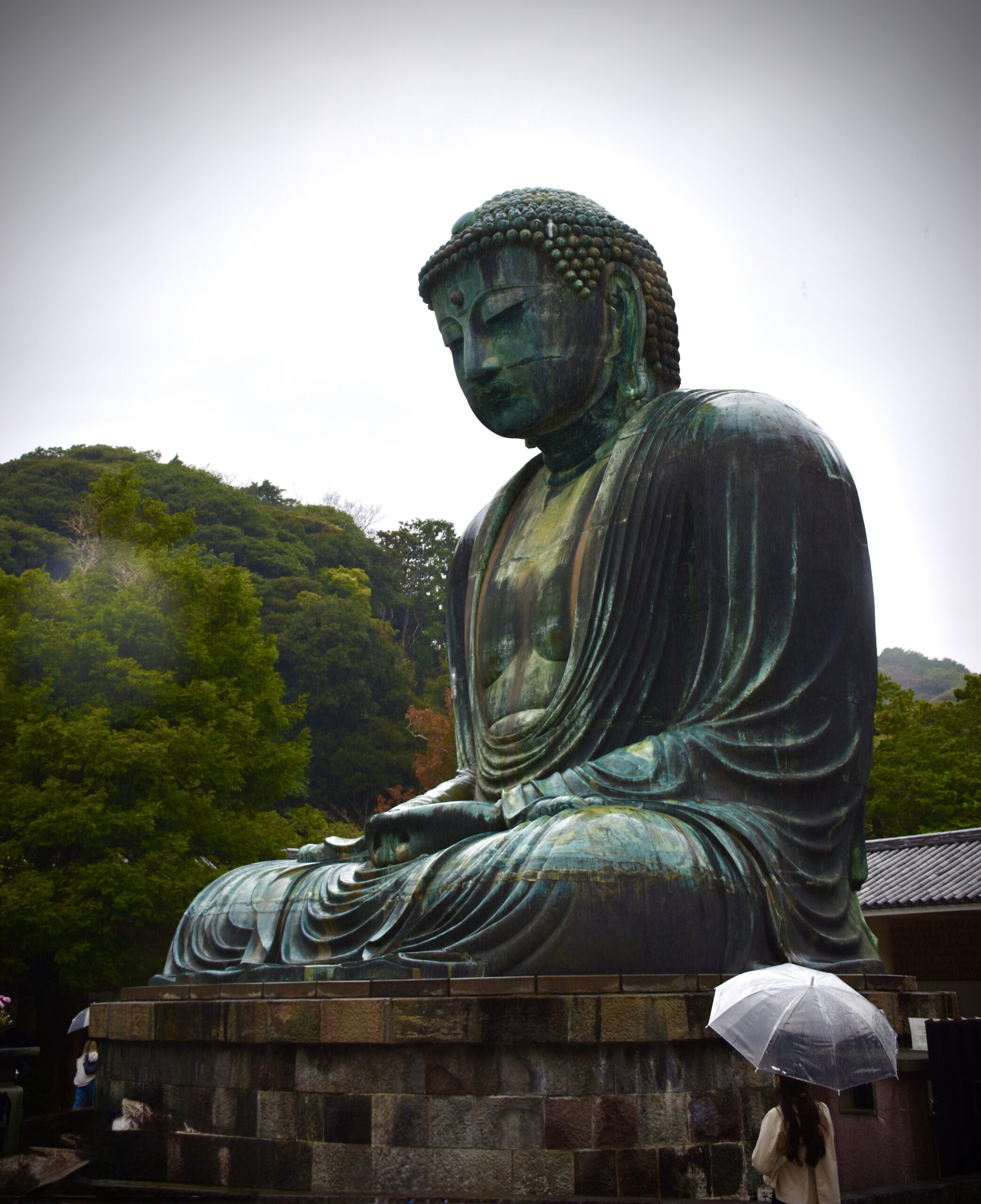

The statue originally stood inside a great hall, but the building was destroyed centuries ago. The Buddha survived, and now sits beneath the open sky.
I particularly loved seeing him from the side, where the immense folds of his bronze robe and the proportions of the sculpture become even more remarkable.
Naturally, we took the obligatory group photographs.
Because no matter how spiritually significant a monument may be, someone must eventually say, “Everybody squeeze together!”
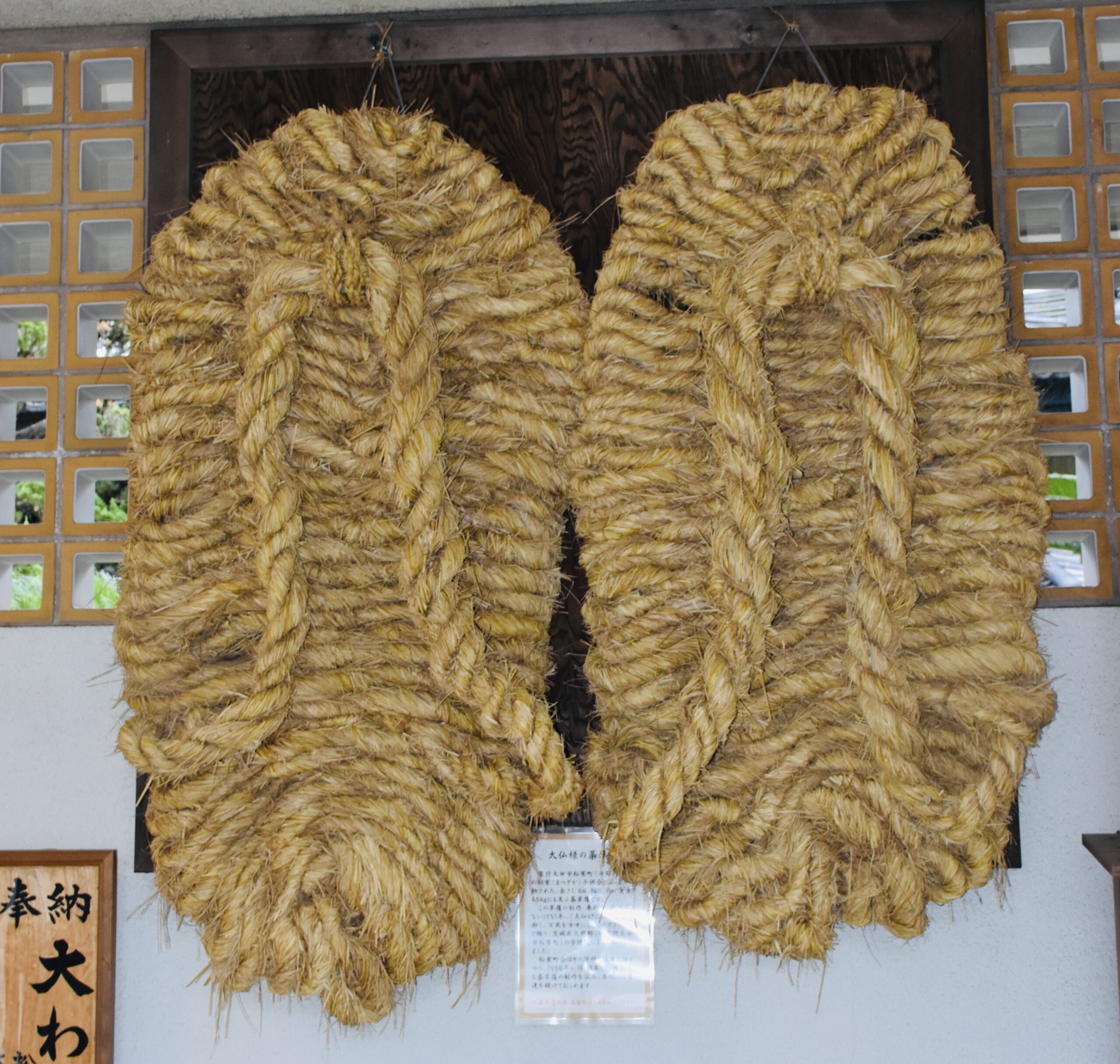
I loved the sandals that local schoolchildren had made for “their” Buddha. (It’s hard to tell from this photo, but they are definitely big enough for this Buddha’s feet – yards and yards and yards of hemp!)
Our final stop, Hasedera Temple, brought us into an entirely different emotional landscape.
Hasedera is a beautiful Buddhist temple set into a hillside, with gardens, stone stairways, bamboo, and views toward the sea.
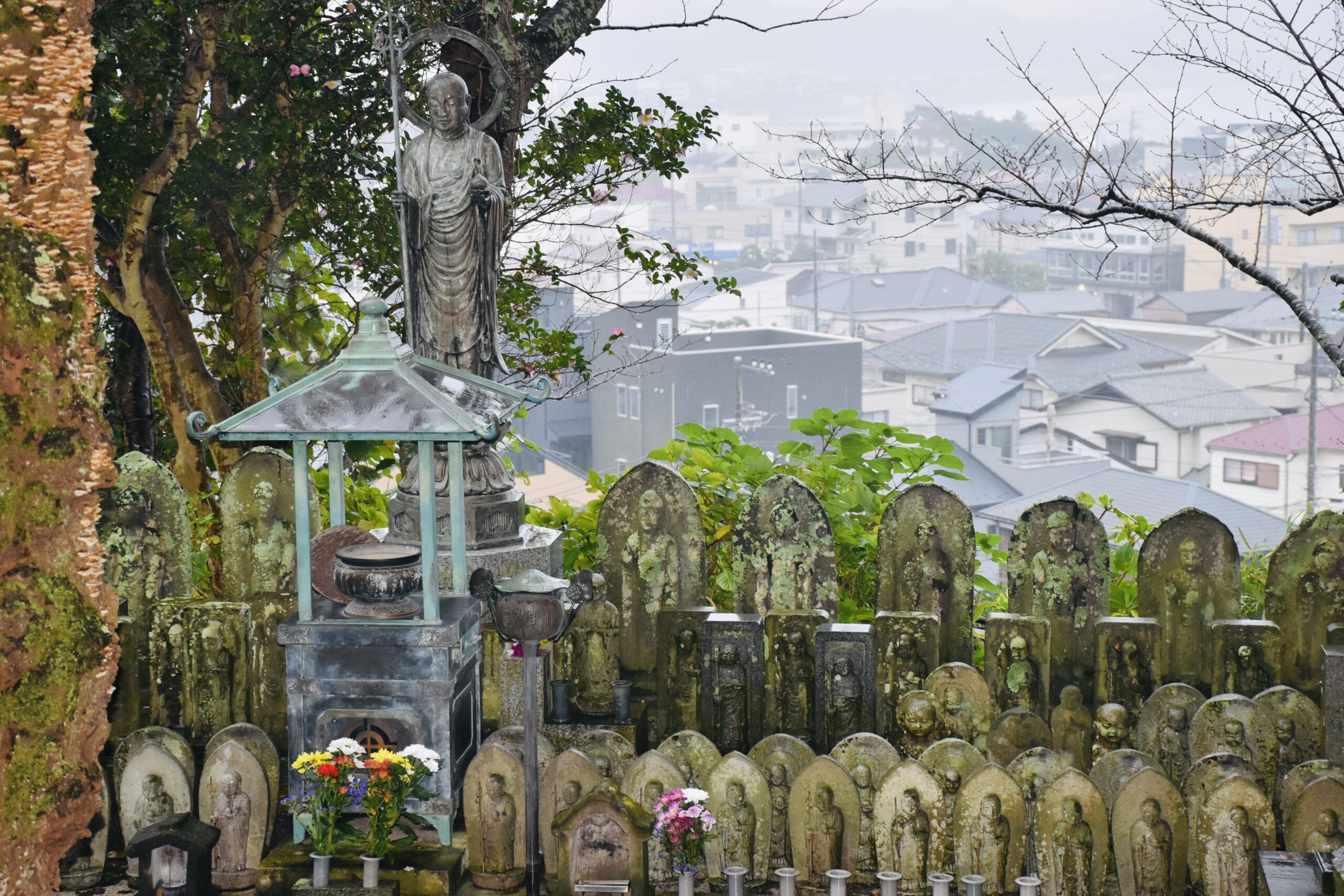
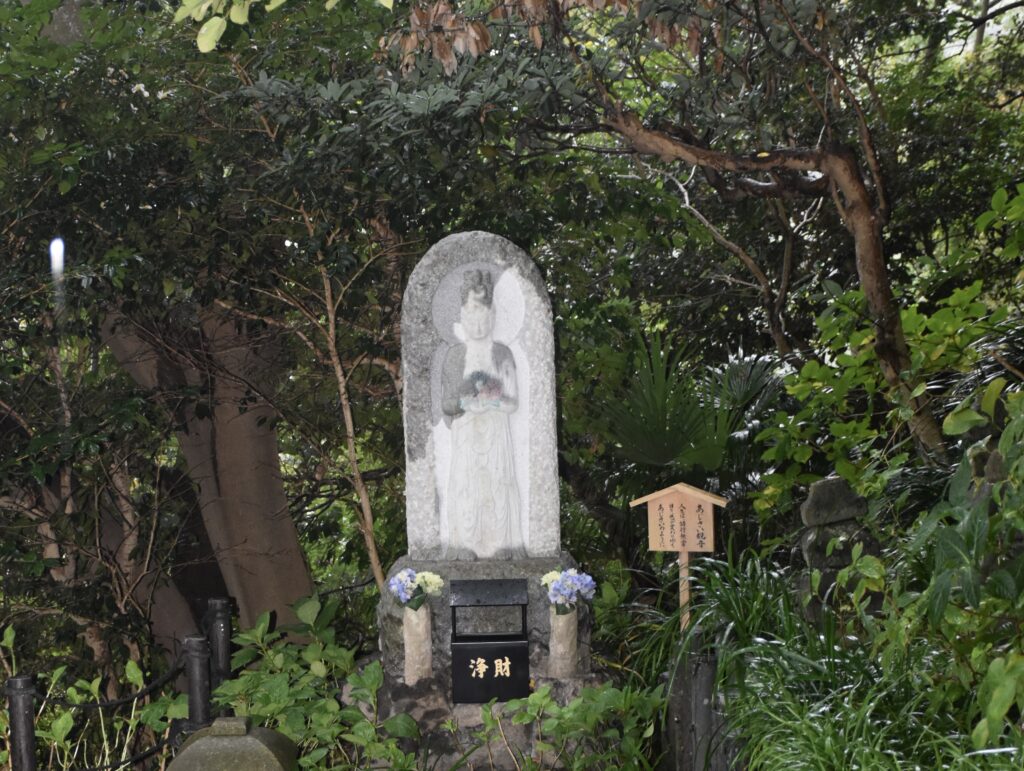
But one of the most affecting sights was a collection of hundreds upon hundreds of small stone Jizō figures, standing in tightly packed rows.
Some were almost entirely covered with moss and lichen. Others still had clearly defined faces. Some seemed to be smiling; others looked solemn.
At first glance, they were simply beautiful in the rain.
Then Utako-san explained what they represented.
They were memorials for children who had died.
These are connected with mizuko kuyō, a Japanese Buddhist memorial practice for children lost through miscarriage, stillbirth, abortion, or death in infancy.


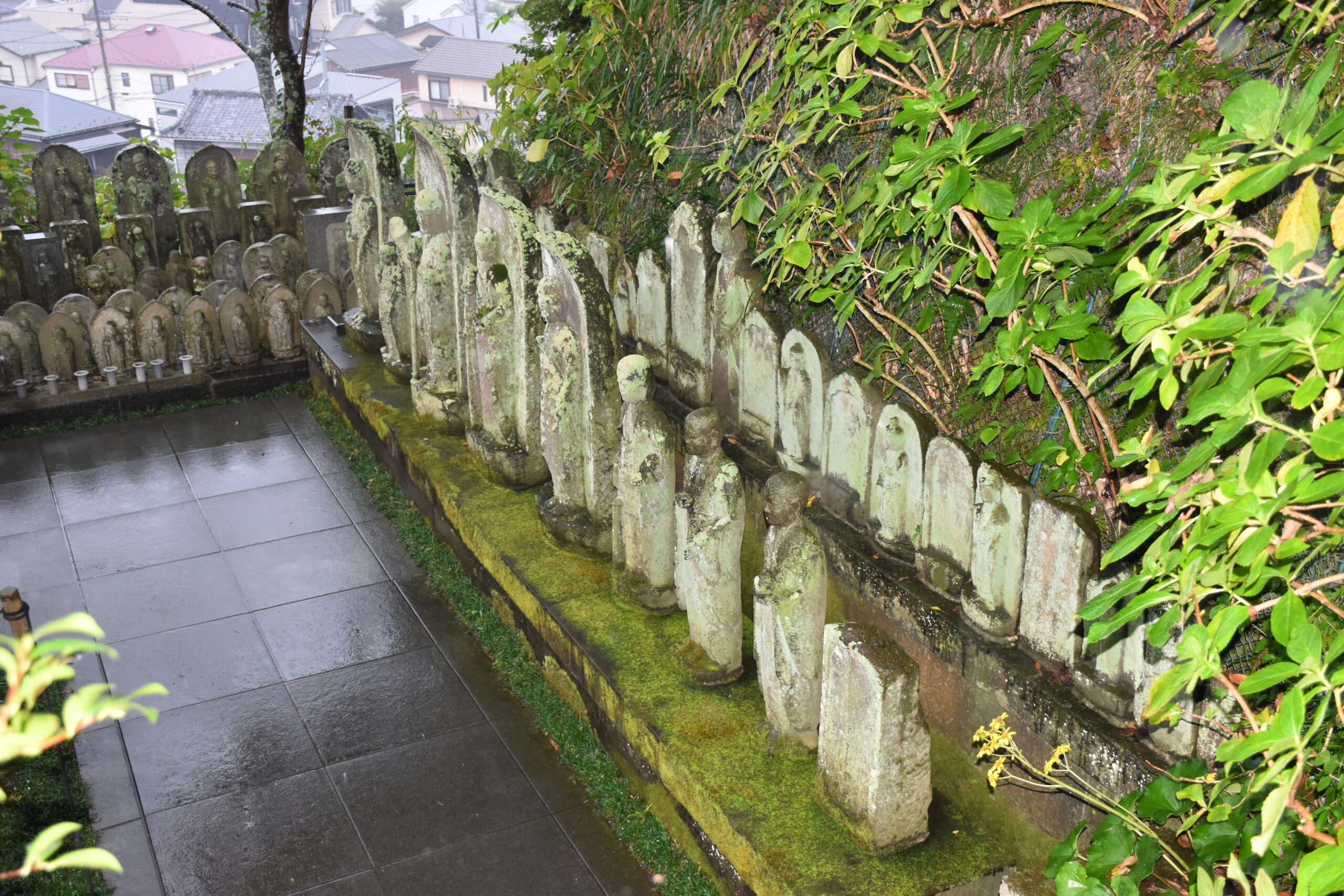

Jizō Bosatsu is a compassionate Buddhist figure particularly associated with protecting children and guiding vulnerable souls.
And the memorials at Hasedera are not simply a collection of ancient statues.
More than 50,000 Jizō figures have reportedly been dedicated there since World War II.
Think about that for a moment.
The little figures we were looking at were not necessarily centuries old. Families have continued to dedicate them in living memory, and the temple periodically replaces older memorial figures as new ones are offered.
Each may represent a child, a family’s grief, a prayer, or an act of remembrance.
The rows are not just an accumulation of stone.
They are an ongoing expression of love and loss.
I looked at my photographs afterward and found them much more poignant than I had realized at the time.
The rain had darkened the stone, and the moss made some of the little figures seem almost to be disappearing into the hillside.
Yet there they stood, shoulder to shoulder.
Remembered.

Nearby was a round-faced, smiling Jizō figure, hands pressed together in greeting.
This is Nagomi Jizō, a comparatively recent addition to the temple, intended to offer visitors a sense of peace and reassurance.
I couldn’t help smiling back.
Perhaps that was precisely the point.
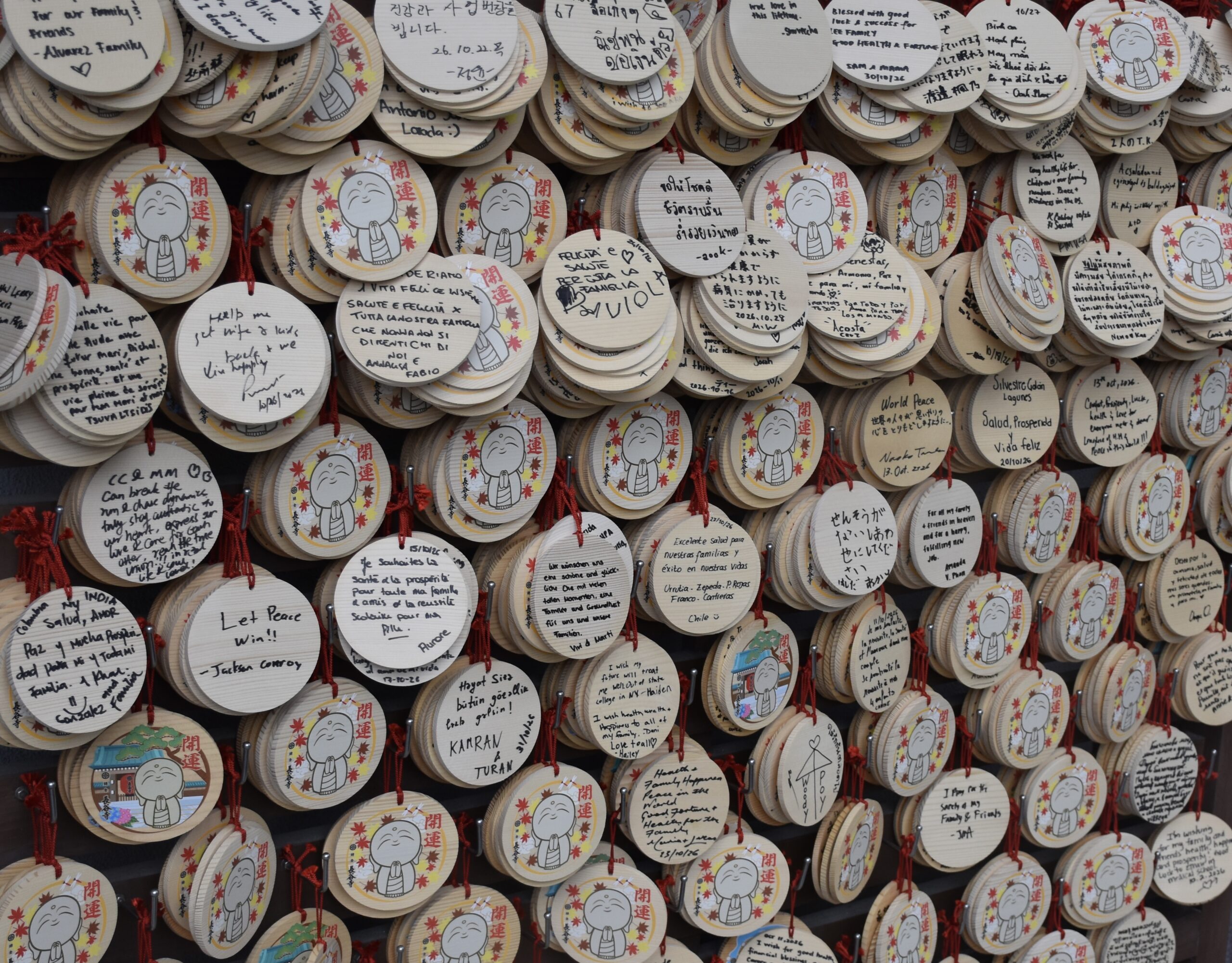
Elsewhere in the temple grounds, hundreds of small wooden prayer plaques hung together, each bearing someone’s handwritten wish.
These are ema, votive tablets on which visitors write prayers, hopes, or thanks before leaving them at the temple.
Some were written in Japanese, others in languages from around the world. Some asked for health, happiness, or love. Others offered prayers for peace.
I found myself thinking how extraordinarily alike we all are in what we hope for, regardless of where we come from or what language we use.
And there was something touching about seeing all those individual wishes hanging together, waiting to be heard.
Bamboo, Stone Steps, and Surfers
Hasedera also has some of those wonderful little passages that seem to lead somewhere important without bothering to announce where.
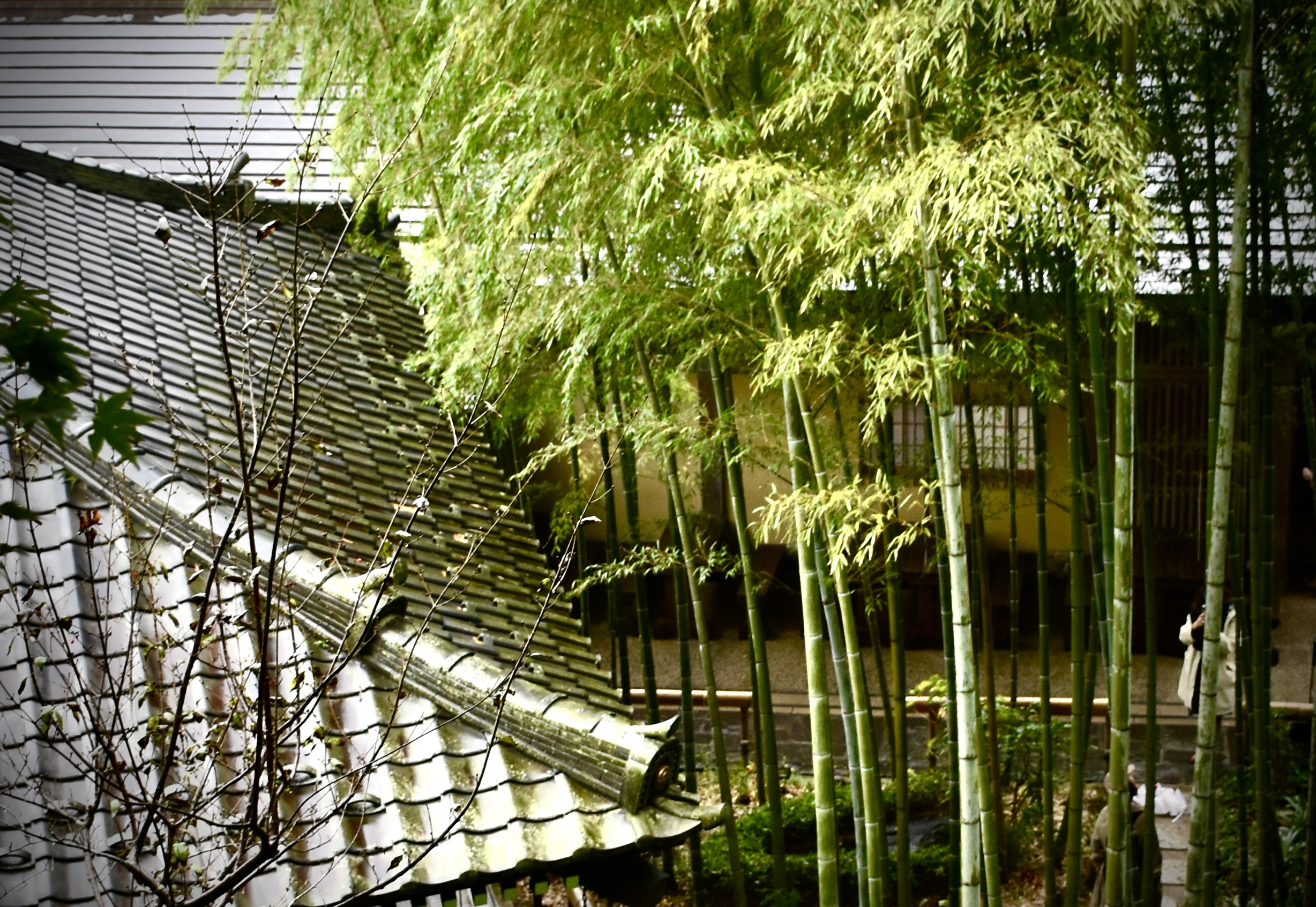
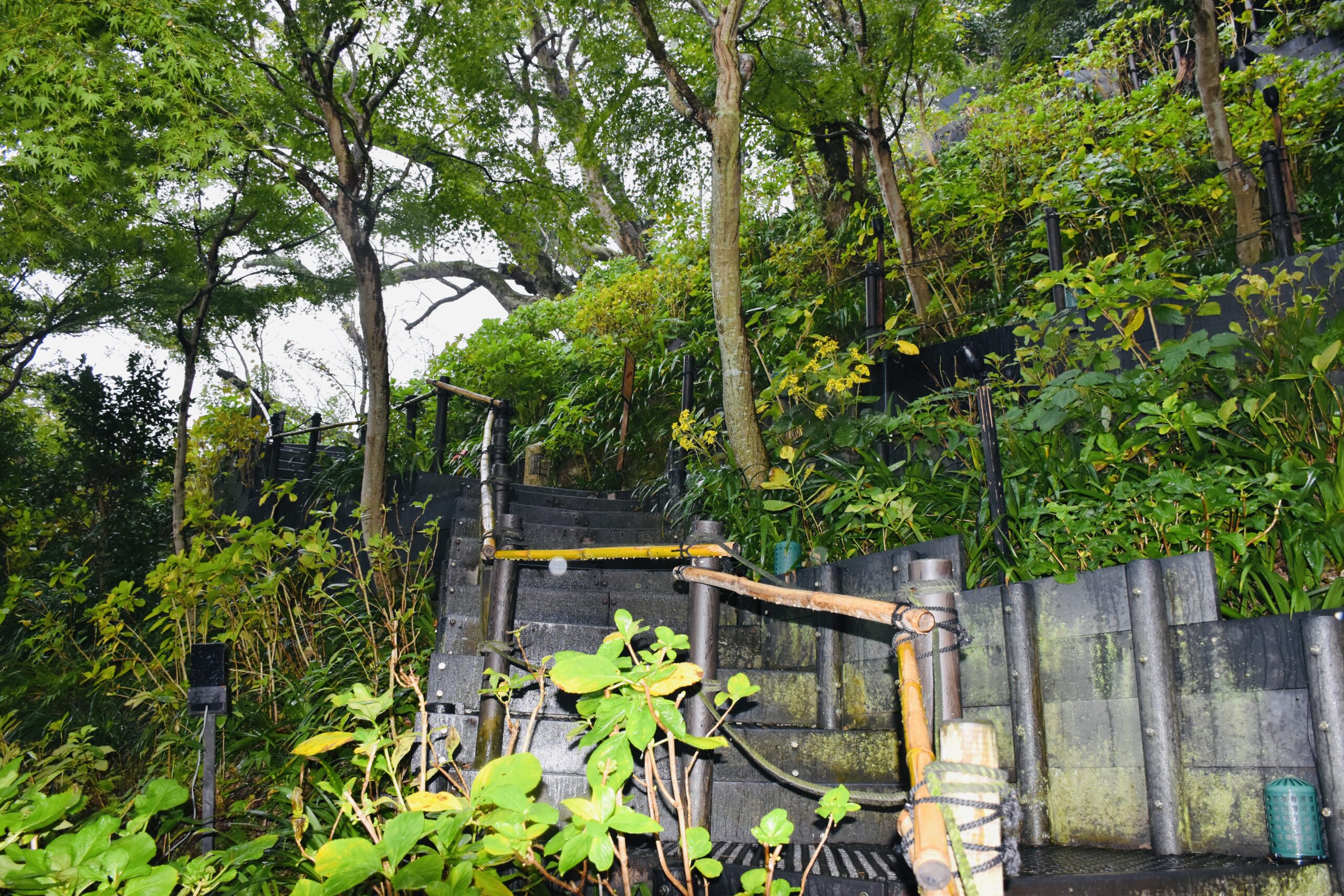
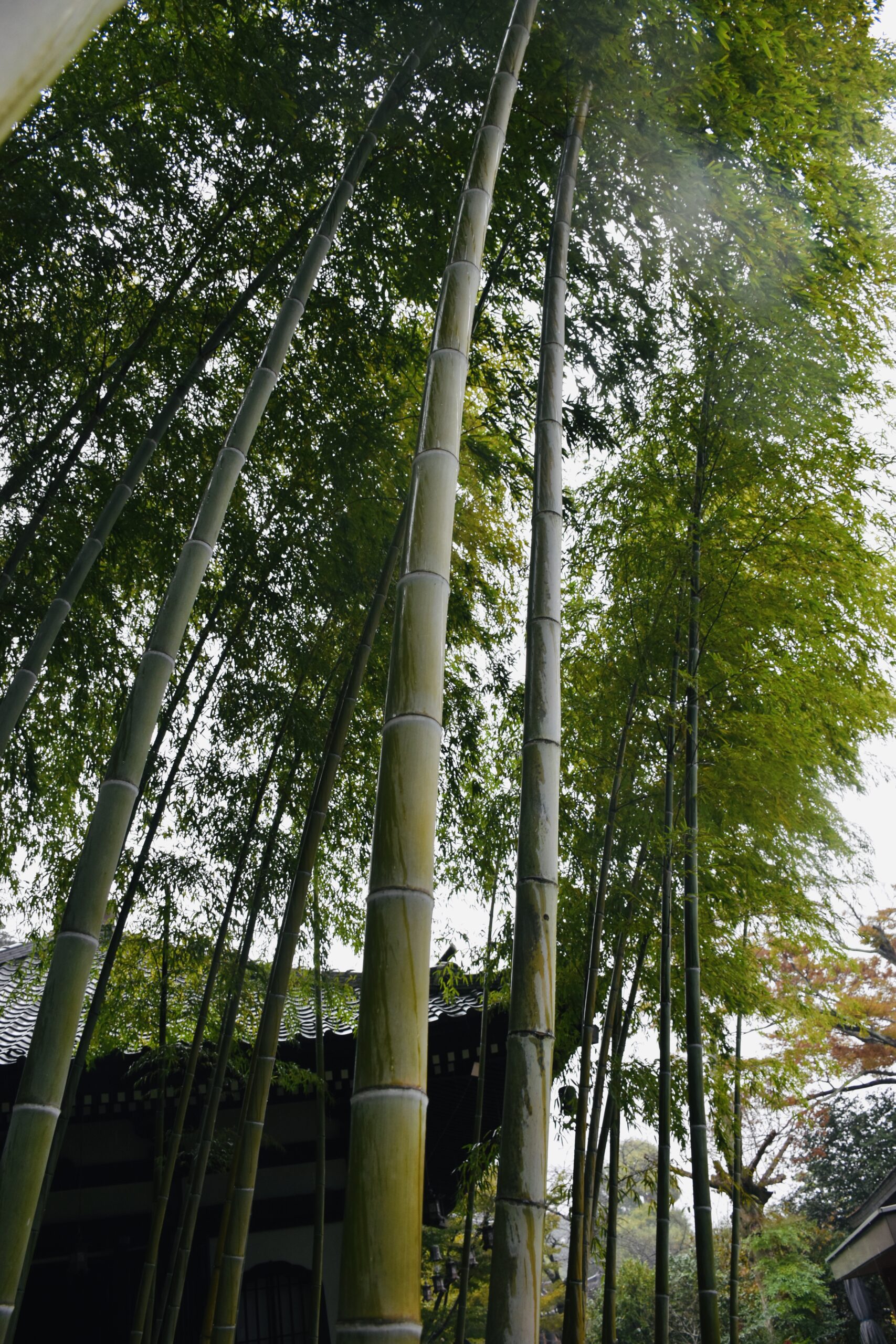
Stone steps climbed through dense greenery. Bamboo rose in elegant columns. Everything smelled wonderfully alive in the damp air.
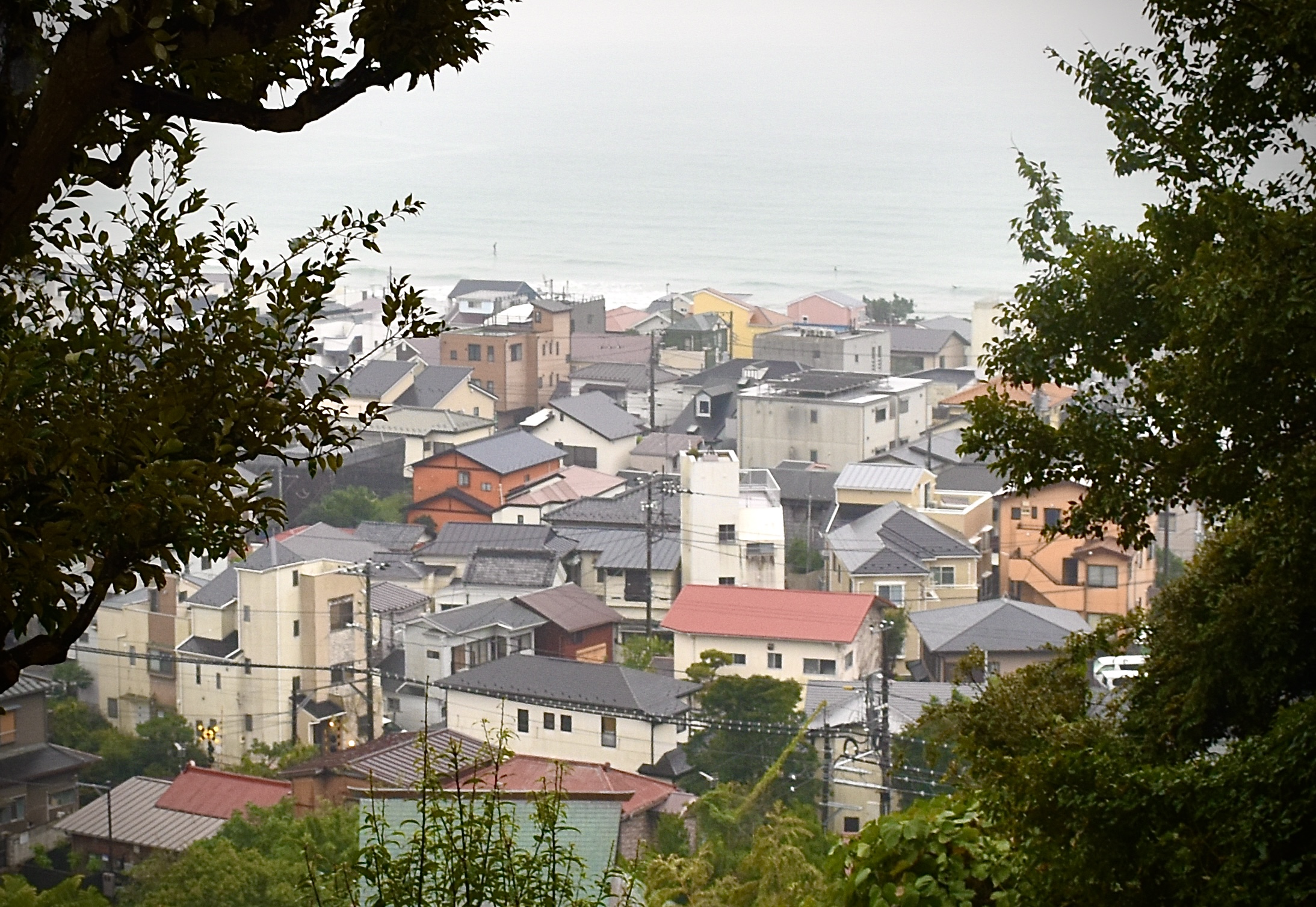
And then, from an overlook far atop many, many slippery, uneven sets of stairs, I could see the sea.
With surfers!
Somehow, with all the temples, ancient warriors, and Buddhist imagery, I had temporarily forgotten that Kamakura is also a beach town.
There they were, bobbing patiently in the gray water, waiting for waves, apparently unconcerned that the rest of us were dressed for a minor monsoon.
I rather admired their optimism.


The Fierce Ones—and Acala


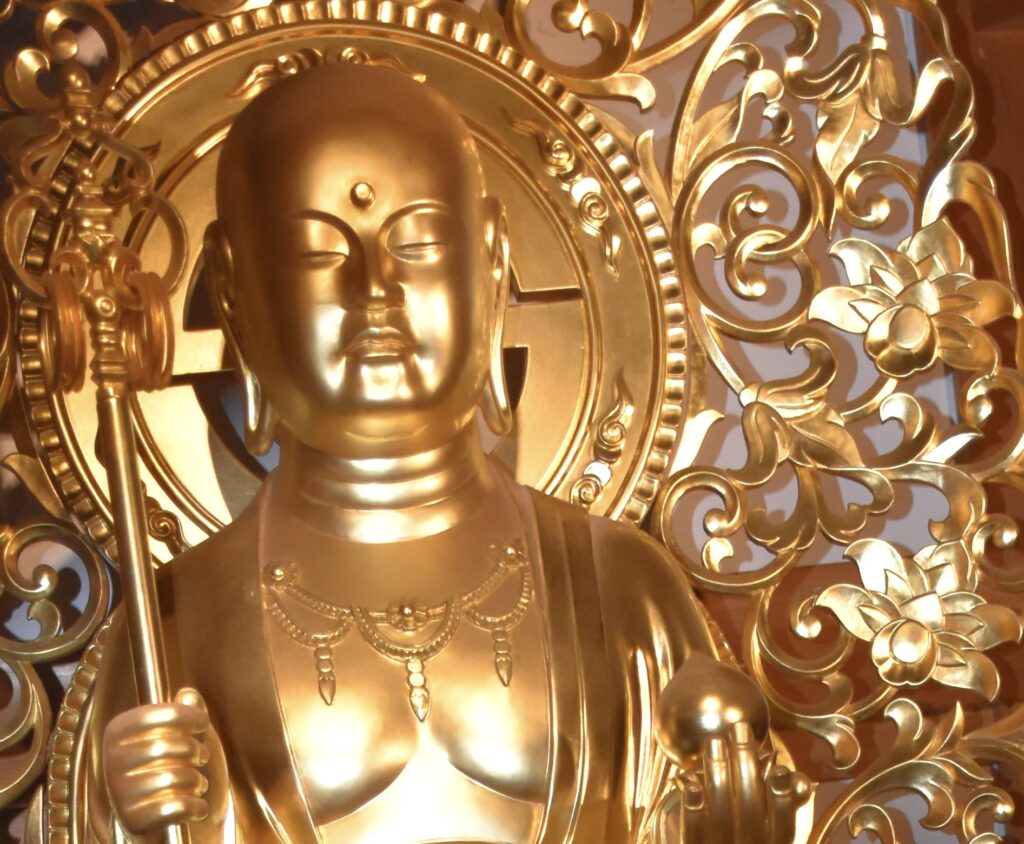
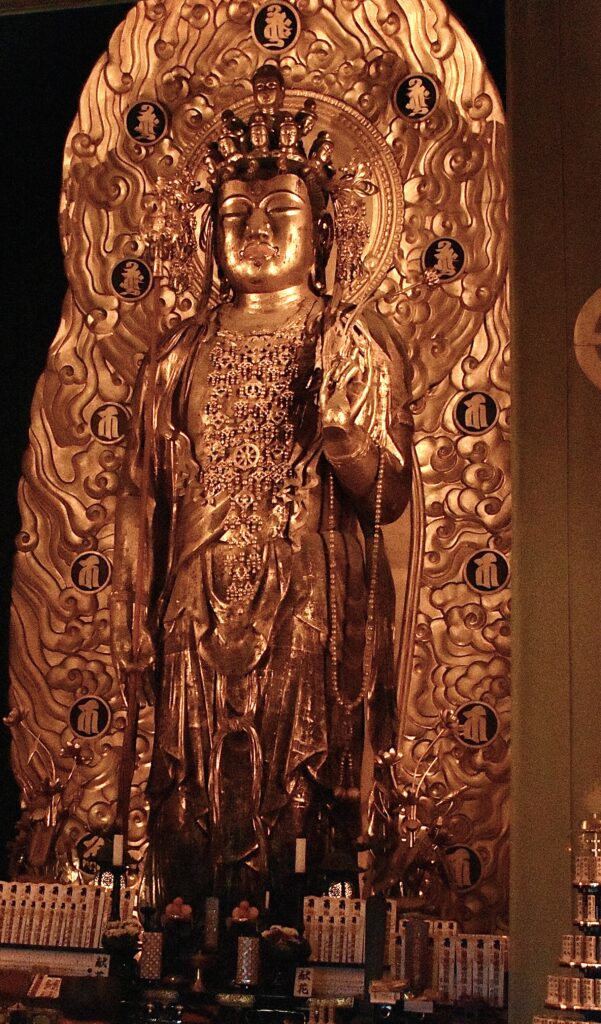

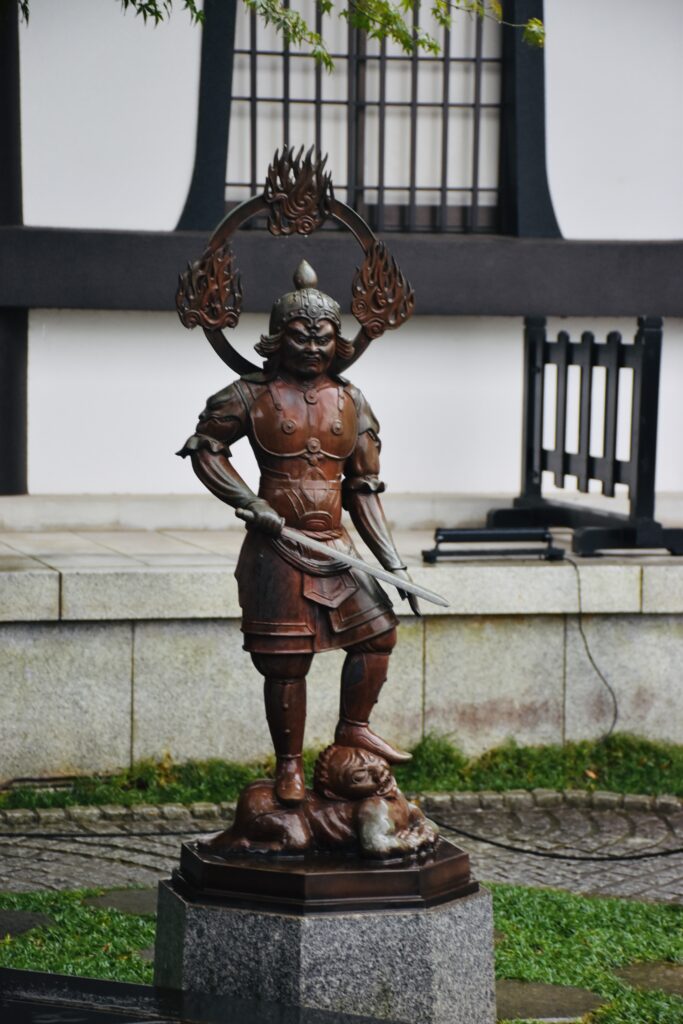

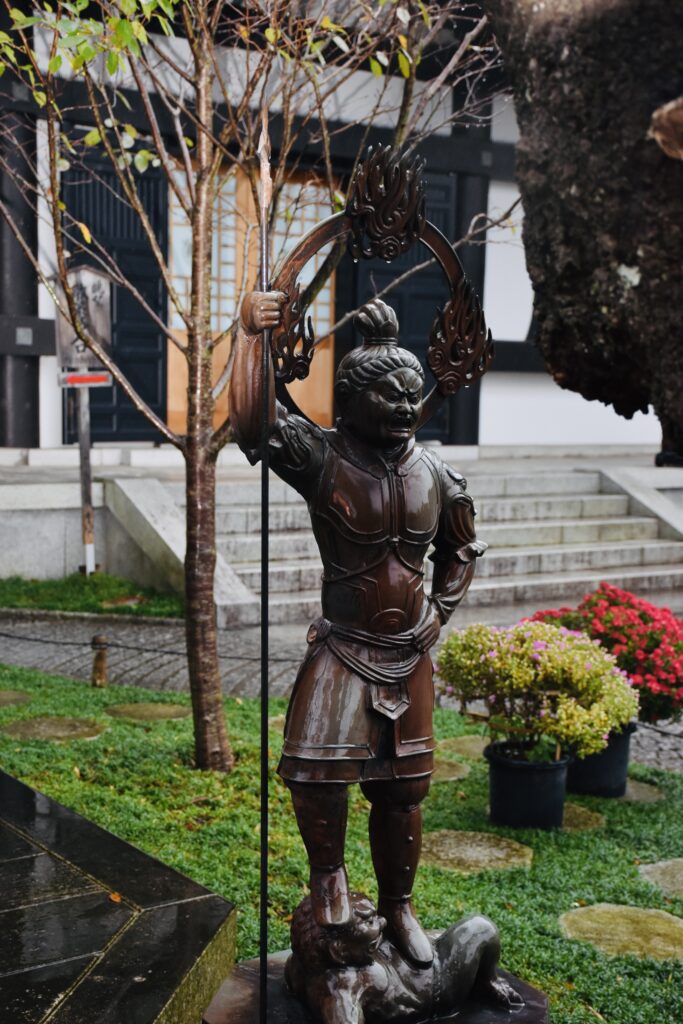
In the temple and on the grounds were many amazing statues, including a huge Kannon, and bronze figures of fierce Buddhist guardians.
Armored bodies. Weapons. Terrifying expressions. Elaborate halos of flames.
They were magnificent.
Some stood over subdued figures representing forces they had conquered. Nothing about them suggested that enlightenment was necessarily a gentle process.
And here’s where the day took an unexpectedly personal turn.
I’ve been designing my second custom iaito, the companion to Lady Nene, and have named it Acala.
Acala is the Sanskrit name for Fudō Myōō, the Immovable Wisdom King of Japanese esoteric Buddhism.
Fudō is typically depicted holding a sword to cut through ignorance and a rope to bind destructive forces.
The guardians we saw weren’t necessarily Fudō himself, but they belong to the broader Buddhist tradition of fierce protectors.
Their frightening appearances are not meant to represent cruelty.
Rather, they express the determination to overcome obstacles, protect the vulnerable, and defend the path toward enlightenment.
There is something deeply appealing about the idea that compassion need not always look gentle.
Sometimes it wears armor.
Sometimes it carries a sword.
I must interrupt the spiritual contemplation for an important public-service announcement.
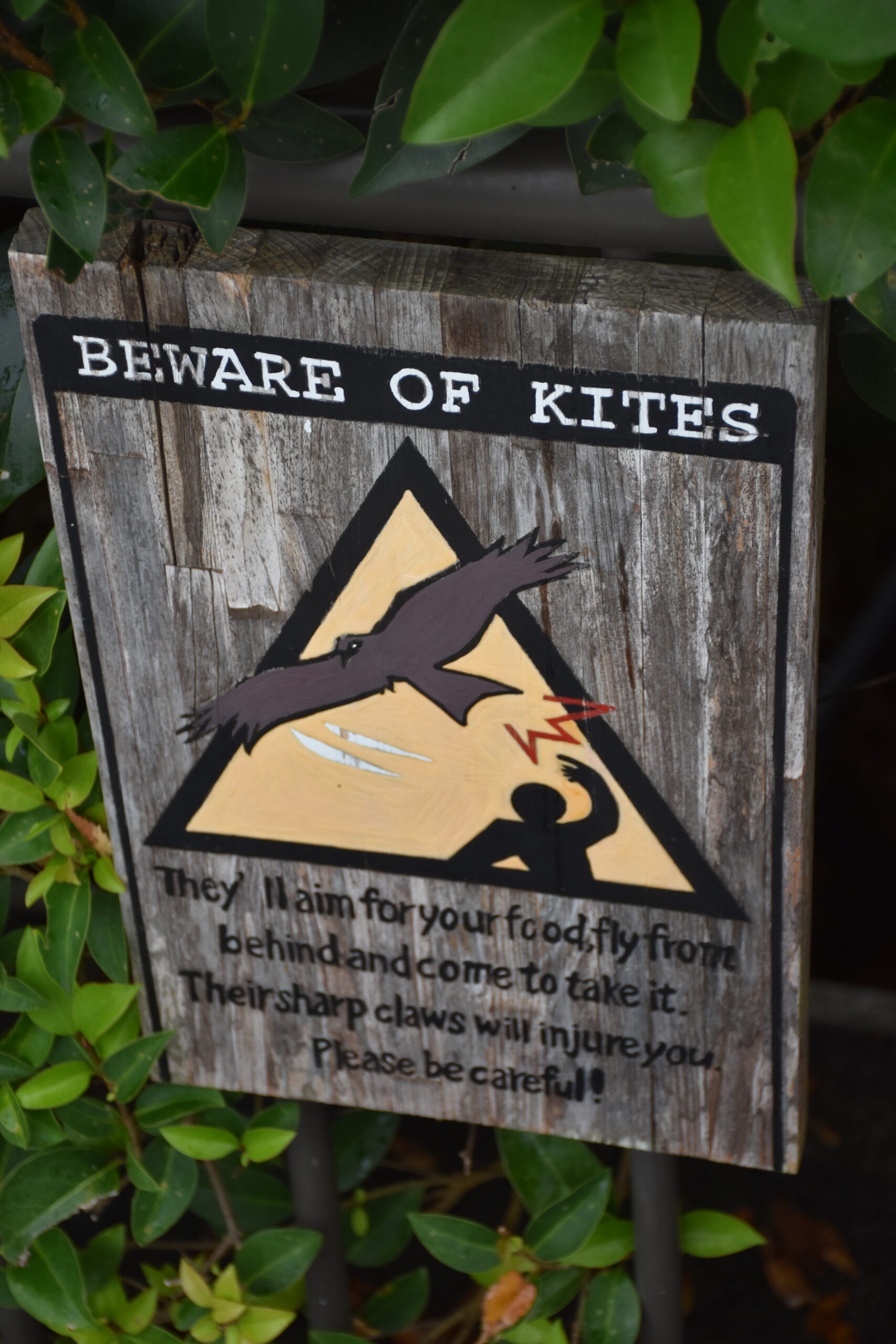
BEWARE OF KITES.
That was the actual wording on a wooden sign.
Kites. Large birds of prey.
Apparently, they have developed a successful business model involving swooping down from behind unsuspecting tourists and stealing their lunches.
The sign explained, rather soberly, that their sharp claws might injure you.
There was even a wonderfully dramatic illustration of a bird descending upon its victim.
Japan: where even the wildlife comes with carefully worded instructions.
This brought on a smile, although I suspect anyone who has lost a sandwich to an airborne bandit might disagree.
The Temples in the Rain — and the Demons on the Roof
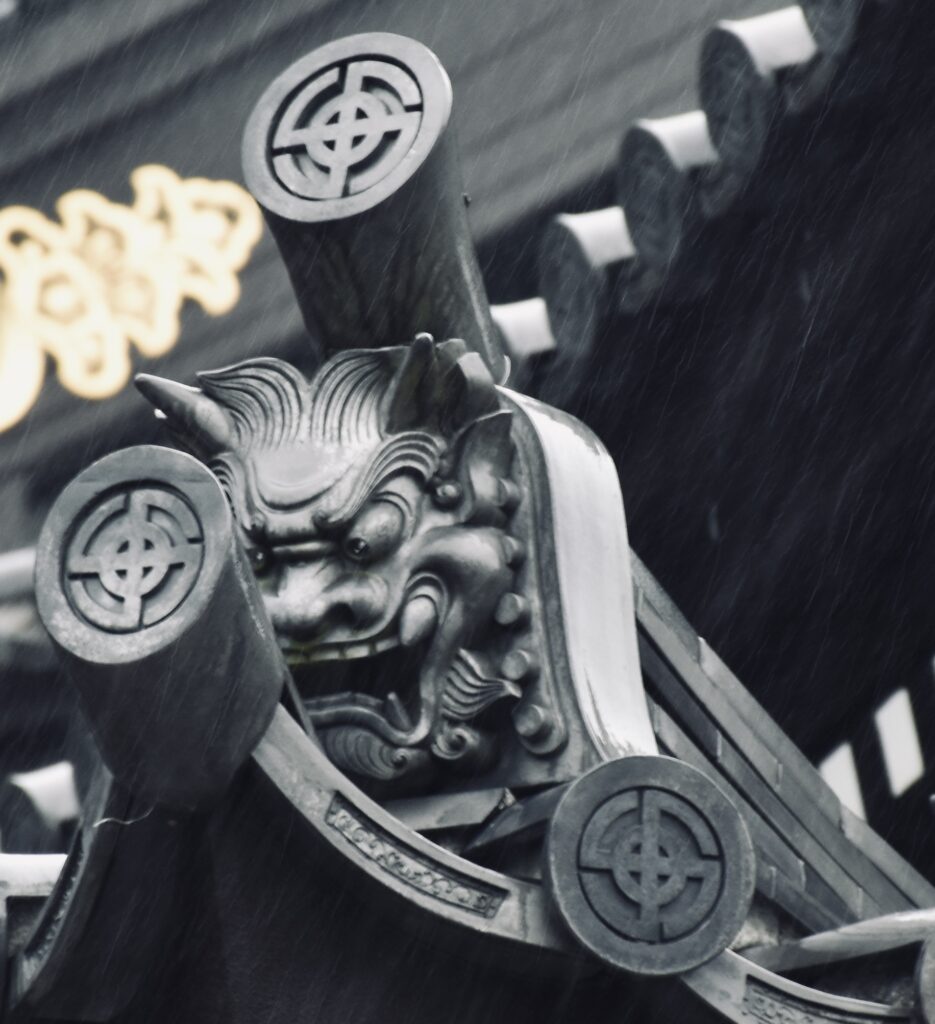
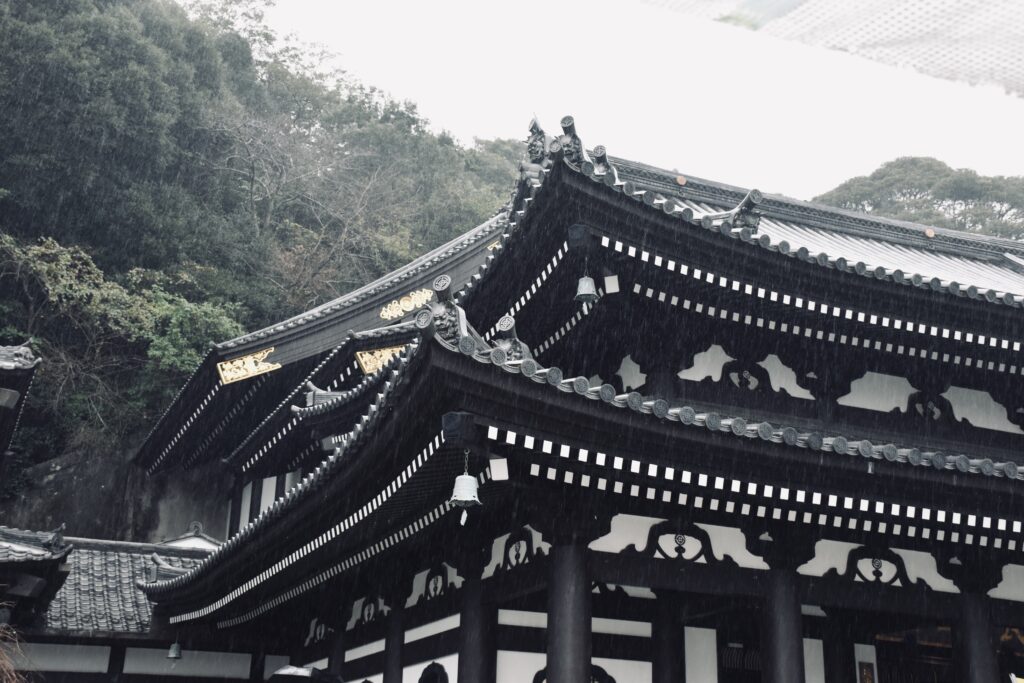
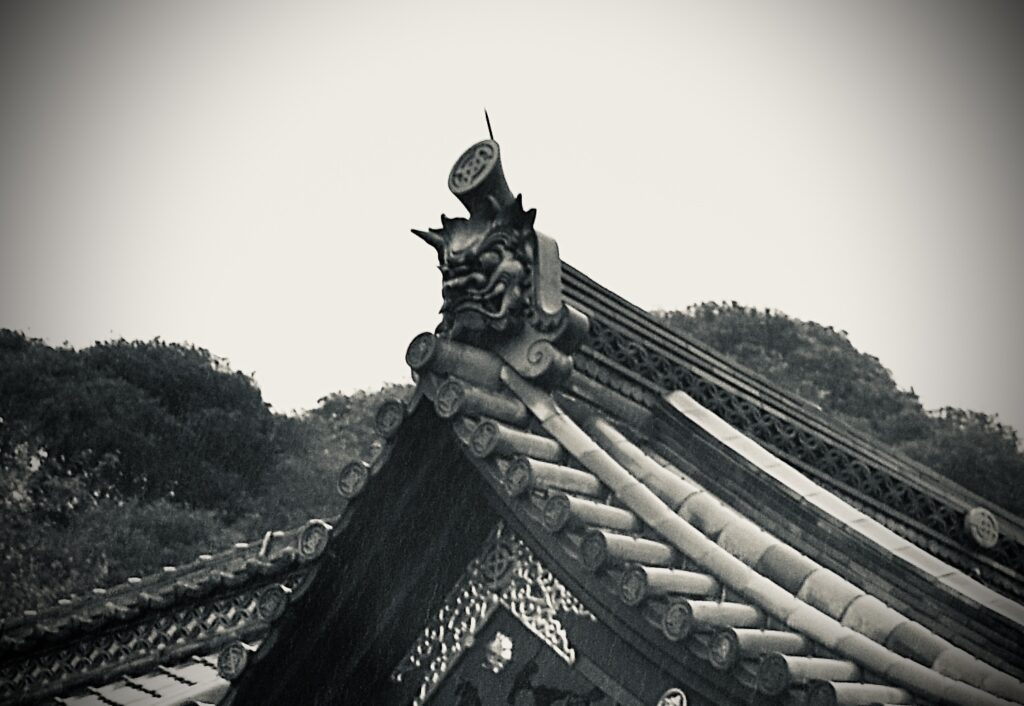
By the time we reached Hasedera, the rain was not merely a gentle Japanese drizzle. Water ran from the enormous upturned tile roofs.
The roofs.
Guarded by the fierce, almost comical faces staring down from their eaves. These are onigawara, traditional Japanese ornamental roof tiles, often depicting demons or fearsome protective spirits intended to ward off evil.
And I actually knew something about them!
At home, I’ve been watching a wonderful Japanese documentary series, I believe from NHK, about traditional craftspeople and the extraordinary skills being preserved across generations. Episodes have explored everything from thatching roofs to textiles and other endangered crafts.
One particularly memorable episode followed a man, perhaps in his fifties, who had inherited his family’s traditional roof-tile-making craft.
The program showed him making these very sorts of demon faces by hand, working the clay into extraordinary expressions before firing the tiles.
So there I was, looking up at the finished work of a craft I’d watched being practiced thousands of miles away.
And suddenly those funny, fierce faces weren’t simply architectural decorations.
They represented someone’s hands, someone’s training, and generations of accumulated knowledge.
There’s a Japanese term for the artisans who specialize in making these tiles: onishi, or “demon masters.”
Which is a rather magnificent job title.
I photographed the faces while trying to shield H’s poor camera from the rain.
And it occurred to me that Japan seems to have an extraordinary number of protectors.
Fierce Buddhist guardians carrying swords. Demon faces watching from rooftops. Jizō figures watching over lost children.
Different traditions, different meanings, but all expressing, in their own ways, the very human desire to keep something precious safe.
Even if, in this particular instance, what I most needed protecting from was the weather.
Beginnings and Remembrances
Looking back on the day, I keep thinking about the contrast between our first shrine and the later temple.
At Tsurugaoka Hachimangū, we saw children celebrating the fact that they were growing older, a couple beginning married life, and a delighted shrine attendant commemorating the very first page of my goshuin book.
At Hasedera, we saw thousands of small figures dedicated to children who never had the chance to grow older.
And at Kōtoku-in, the Great Buddha sat quietly, seemingly beyond all these human beginnings and endings.
Perhaps it’s tempting to make too much of that sequence.
But sometimes travel gives you a theme without asking your permission.
We celebrate beginnings.
We remember those we’ve lost.
And somewhere between the two, we try to understand what it means to live well.
The rain made the bronze shine, the moss glow, and the temple roofs look almost alive.
And I came away with a stronger connection to the name I’d chosen for Acala.
Not because a sword should be fierce.
But because there is something deeply appealing about being immovable in one’s purpose while remembering that strength and compassion need not be opposites.
And perhaps the whole day can be captured in the seventeen syllables of a haiku:
Fierce guardians watch
The Buddha sits in stillness
A kite steals my lunch