
The map and the town
Actually now agree
As I drive away
By Thursday morning, something unexpected had happened.
The map and the town had finally agreed.
This may not sound remarkable.
But after several days of wandering Vancouver—sometimes intentionally, sometimes not—the city had begun to make sense.
The streets looked familiar.
The harbor felt familiar.
Even the ping-pong tables I spied as I drove past—metal tables in the middle of downtown, thoughtfully containing a net with paddles and ball tucked underneath—made me laugh in recognition.
(We are so in Canada. They expect people to act their best. We expect people to act their worst.)
Nothing had changed.
Except me.
Or perhaps I had simply been there long enough for Vancouver and my understanding of Vancouver to finally agree.
Naturally, this happened on the morning I was leaving.
The day began again with breakfast at the Pan Pacific Club, 23rd floor.
Floor-to-ceiling windows.
Grey mountains.
Float planes.
The harbor below.
I dawdled a bit over coffee, but it was time to hit the road.
After checking out, I asked a security guard—who was coordinating the loading of approximately six hundred suitcases into what was almost certainly a cruise ship transfer van—how to get to the train station.
She looked at me quizzically.
“Go left. Turn the corner.”
Three days earlier, I had arrived from the right.
I pointed left.
She nodded.
Okay then.
This seemed completely wrong, but I decided to trust an expert.
Upon turning the corner, the train station that had somehow seemed mysterious and elusive upon arrival (Chad: “No, the other direction – find the water!”) stood about 20 paces ahead.
The city that had required maps, consultations, and occasional negotiations with Chad had apparently decided to cooperate.
Or perhaps I finally had.

Heading off, I had received a side smile and a discreet once-over from the security guard.
My luggage situation had become . . . ambitious.
There was Lady Nene in her hard travel tube.
There was the carry-on.
There was the puffer tote.
And there was a spectacular bouquet of flowers.
The whole arrangement looked less like luggage and more like a traveling production company.
The train ride to the airport was uneventful.
Which, after the previous few days, felt almost suspicious.
The rental car pickup was equally straightforward.
Again, suspicious.
At this point I began to wonder whether Vancouver had simply decided to stop fighting me because I was leaving.
Driving back through the city, I passed familiar landmarks.
The harbor.
(“Head for the water!”)
The streets I’d wandered.
(And wandered. And wandered.)
The ping-pong tables.
Those tables still made me smile.
For reasons I cannot adequately explain, they had become one of my favorite discoveries.
Not attractions.
Not landmarks.
Just ping-pong tables quietly existing in downtown Vancouver, ready for a game.
By then, however, Nanaimo and the iaido seminar were waiting.
But one more stop first.
The Nitobe Memorial Garden at UBC.


The first thing that struck me was the light.
The previous day had been all dove-grey harbor and wandering city streets.
Nitobe seemed illuminated from within.
Sunlight filtered through maples.
Stone lanterns appeared around corners.
Bridges reflected perfectly in still water.
Every path was designed not to reveal everything at once.
The garden invited you to slow down.
So I did.


Then there was the moss.
Now, I realize this is not a sentence most people begin with enthusiasm.
Nevertheless.
The moss.


The moss looked less like ground cover and more like a tiny landscape viewed from an airplane.
Little hills.
Little valleys.
Little forests.
The sort of terrain through which one imagines marble-sized expeditions setting out with backpacks and supplies.
Speaking of marbles.
Naturally, H’s cremarbles came with me.
Several of them found temporary homes among the moss and stones.
Tucked into little pockets of sunlight.
Nestled beside roots.
Hidden in plain sight.
Unless you knew where to look, you would miss them entirely.
Which somehow felt exactly right.
The garden itself was beautiful.
But what struck me most was the feeling of familiarity.
The paths.
The lanterns.
The water.
The tea house.
The careful way every view revealed itself slowly.
Not dramatically.
Patiently.


At one point I found myself standing outside the tea house, looking at the veranda and the rooms beyond.
And then I realized why the space felt so familiar.
The garden’s tea tradition is Urasenke.
The same tradition I studied this winter at Green Gulch Farm.
Suddenly what had felt merely beautiful became something else.
Recognizable.
Not because I had been there before.
Because part of me already knew how to be there.
The veranda.
The waiting bench hewn from a massive log.
The threshold between indoors and outdoors.
The careful attention to proportion.
The way the building encouraged looking rather than doing.
The way it invited stillness.
I found myself thinking that much of what I love about ryokan, Japanese gardens, tea rooms, and certain temples comes from exactly the same place.
None of them demand attention.
They reward attention.
There is a difference.
And perhaps that was another reason the garden felt so familiar.
It wasn’t introducing me to something new.
It was quietly reminding me of something I already loved.


Near the tea house stands a commemoration to both garden founder Dr. Inazo Nitobe (who wrote many, many books on the way of the samurai, bushido, etc.) and Professor Kannosuke Mori, the distinguished landscape architect who designed the garden as the final major work of his career.
Standing there, looking at the inscription, I found myself thinking about legacy.
Not the grand kind.
The quieter kind.
Creating something beautiful enough that decades later complete strangers wander through it on a sunny afternoon and leave calmer than they arrived.

Eventually I wandered over to the adjacent Asian Centre.
Partly because there was a washroom.
(Long drives reward a certain amount of planning.)
And there I encountered what may have been the most human thing I saw all day.
The path turns outward
Not every lesson is deep
Some just hold things up
The building contained beautiful artwork.
Elegant calligraphy. (Excuse the reflections on the glass)

Thoughtful displays.
Evidence of scholarship, tradition, and culture.
I admired all of them.
A peaceful place.
Hushed.
Students bent over studies.

Then I noticed the couch.
More specifically, I noticed one corner of the couch.
The corner being unobtrusively supported by books.
Large books.
Japanese books.
Two of them.
Holding up a couch leg.


I performed an actual double-take.
The entire building had spent considerable effort communicating wisdom, culture, beauty, and learning.
Meanwhile somebody had solved a wobbly couch with literature.
I never identified the books.
For all I know they were profound works of philosophy.
Or economics.
Or diplomacy.
Equally possible: carpentry.
Stability.
Furniture maintenance.
It was wonderfully human.
A reminder that even in places devoted to contemplation and beauty, somebody eventually has to solve practical problems.
“Does the couch wobble?”
“Yes.”
“Do we have anything heavy?”
“Books.”
”Done.”
Eventually it was time to continue north.
The ferry crossing came and went.
Lady Nene survived.
The luggage survived.
I survived.
And by evening I arrived at the Inn on Long Lake.
Where the bouquet found a new home.

The receptionist seemed delighted when I explained where the bouquet had come from and why I was passing it along.
After accompanying me through Michelin dinners, harbor sunsets, train rides, and ferry crossings, the flowers deserved a second act.
And then, there was nowhere I needed to be.
The luggage had exploded across every available surface.
The sword was finally out of the hard case.
(This is when I discovered that, in their zeal to examine Lady Nene, TSA had managed to rip her silk sleeve. Yes, take that exactly as intended. Given Lady Nene’s temperament, I suspect she may arrive at this evening’s practice harboring thoughts of vengeance. I will take appropriate precautions.)
And for the first time all day, I sat down and looked out over the lake.
That’s when I noticed the couple.

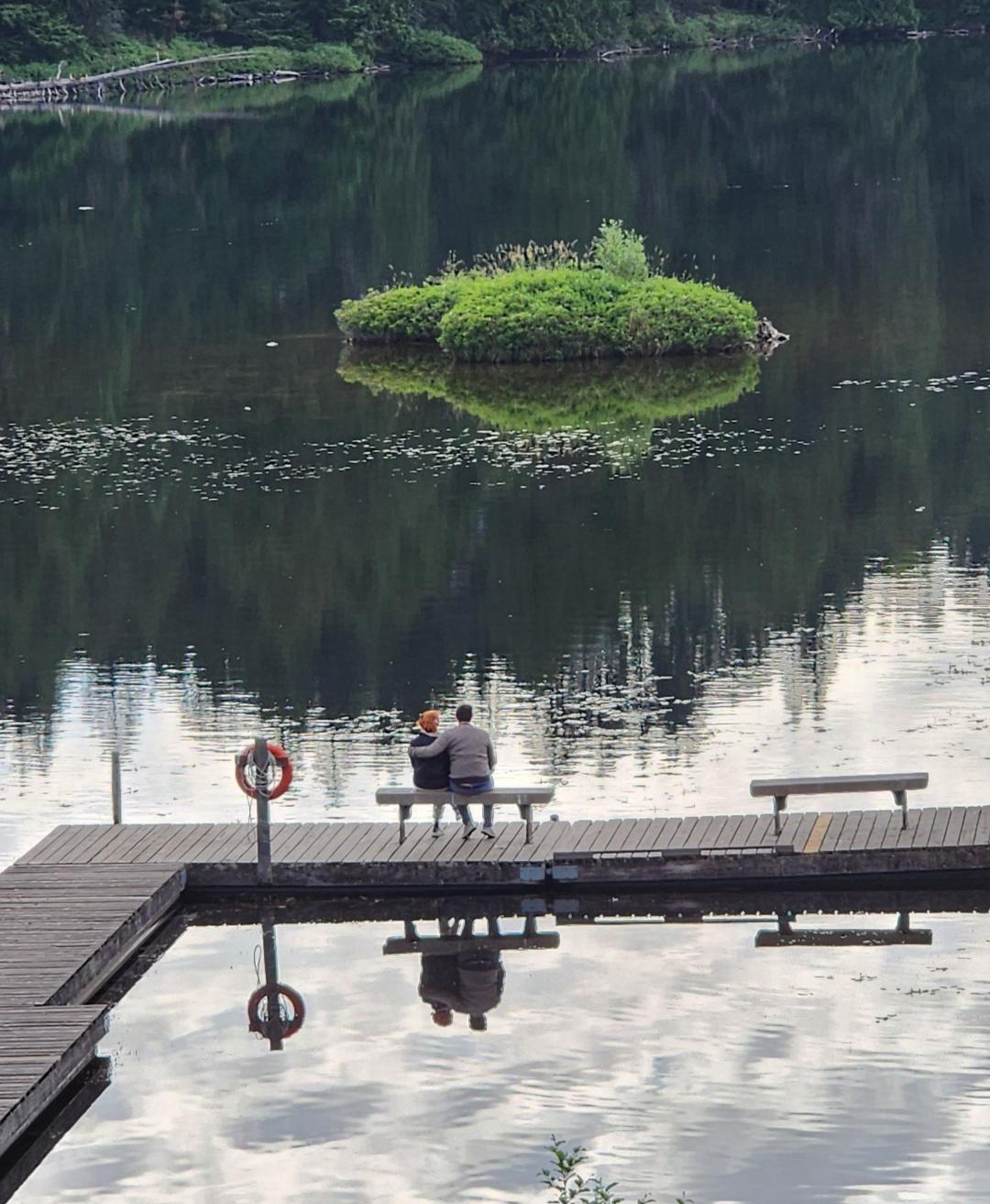
Farther out sat a tiny island.
Not much bigger than a shrub.
The lake reflected everything.
The island.
The trees.
The sky.
Even the couple.
The whole scene felt strangely familiar.
And then I realized why.
Suddenly, I was at the Ripplecove.
Let me explain.
Years ago, on our honeymoon, H and I found ourselves at the Ripplecove Inn.
Actually, that’s not quite true.
We found ourselves on the road to somewhere else.
In fact, Ripplecove was never supposed to happen at all.
Like many newlyweds traveling on a budget, H and I had become unexpectedly wealthy through airline incompetence. We had been bumped from a flight and received travel vouchers, which we promptly converted into a honeymoon in eastern Canada.
The furthest the vouchers would take us was Halifax.
So Halifax it was.
People would ask where we were honeymooning.
“Nova Scotia.”
One memorable person asked which island near Bali that was.
We spent time in Halifax, Nova Scotia, PEI, rode an Art Deco train across portions of eastern Canada, visited Montreal and Toronto, took a slow paddle wheeler river cruise through the Thousand Islands during prime autumn color season, and generally had a wonderful time.
H planned almost the entire trip.
I planned exactly one section.
The wine country section.
I researched it.
I organized it.
I had routes.
I had a plan.
The map and I were in complete agreement.
Then, on the morning we were supposed to begin that carefully planned section, H looked at the map and said:
“What if, here, we head left instead of right?”
Then, because he was both wise and interested in remaining married (this time), he immediately added:
“But if that’s even a tiny problem, we won’t.”
I thought about it for approximately three seconds.
“Okay.”
So we went.
No destination.
No reservation.
No idea where we were going.
We ended up at the Ripplecove Inn.
The view.
The lake.
The room.
The white-gloved waiter.
It became one of the great memories of our honeymoon.
For years afterward, H would occasionally catch me staring off into space.
“What are you thinking about?”
“Oh. I was just at the Ripplecove.”
Every single time, he would smile.
Looking out over Long Lake, I realized I had misunderstood that memory for years.
I thought I was remembering a place.
I wasn’t.
I was remembering trust.
The moment before the place.
The moment when we abandoned the plan.
The moment when H followed a hunch.
The moment when we trusted each other enough to see where the road went.
The moment when the road and the map finally agreed.
And perhaps that is why Vancouver suddenly made sense as I was leaving.
Why Nitobe felt familiar before I understood why.
Why the passport covers seemed to belong to the same story.
Why the flowers felt right at the reception desk instead of in my room.
Why two people sitting quietly on a dock could stop me in my tracks.
The old passport cover and the new one.
The planner and the wanderer.
The route and the detour.
The place I thought I was going and the place I actually needed to be.
Sometimes it takes a few days.
Sometimes it takes twenty years.
But every now and then, things that appear to be arguing with one another quietly reveal that they were never in conflict at all.
They simply needed enough time to discover that they already agreed.
