
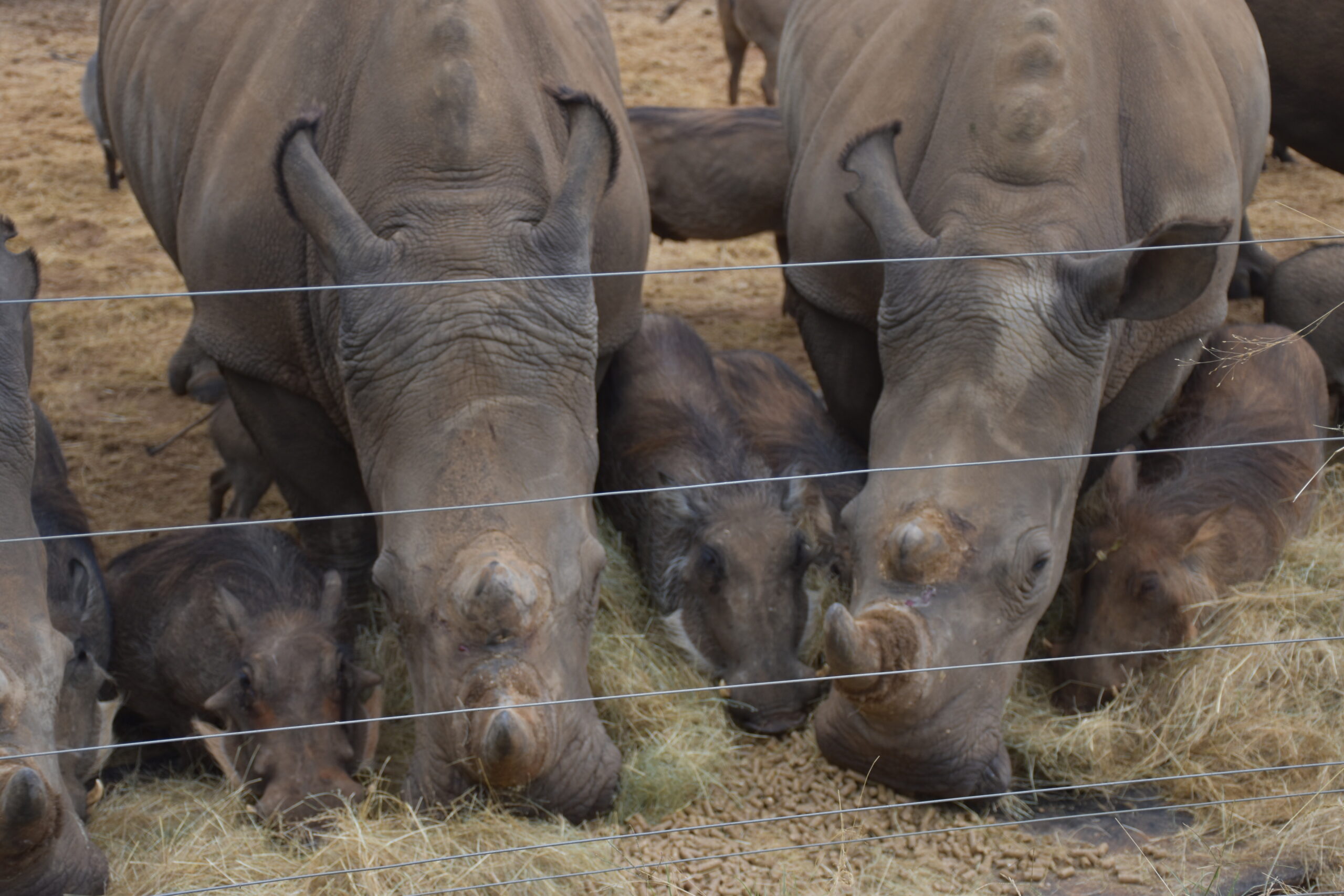
This afternoon we drove to the Rhino Orphanage, where we learned a great deal about South Africa’s long and heartbreaking history with poaching.
Through the 1960s, the numbers were going down, down, down — to roughly 370 rhinos killed in a year. But then, decades later, the crisis surged again after a very specific spark: in the late 2000s, a high-profile Vietnamese politician publicly claimed — on television and in the press — that rhinoceros horn had cured his cancer. The story spread far and wide, and the demand exploded.
It cannot.
Rhino horn is keratin — the same substance as human fingernails — but the belief, and the money behind it, has driven an absolutely devastating trade. We heard some disheartening and sickening stories that I won’t repeat here.
What I will say is that the orphanage is doing extraordinary work.
We were able to see several rhinos that cannot be released, including one that showed up with a “10% chance” because his skull was hacked through and he had 30 machete cuts. Another, as a tiny baby, had survived a shotgun attack that killed her mother while shooting out both her eyes in the process. As an adult, she has taken on the role of “mothering” the newly rescued, traumatized babies — a quiet kind of resilience that was almost impossible to witness without feeling undone.
They feed the rhinos hay and pellets… and of course the warthogs horn in (yes, I did that on purpose) and try their best to pretend they are also rhinos and deserve pellets too.
We were allowed only limited photos, because nothing can be shared that would give away the location. There is a large crash of rhinos there — and the poachers would absolutely come.
The economics are part of the horror: once rhino horn is trafficked out of South Africa and reaches the end consumer market, it has been reported to sell for tens of thousands of dollars per kilogram — sometimes quoted as rivaling the price of gold. And it isn’t simply a matter of “cutting off a horn”: poachers often take both horns and even hack away the tissue and bone between them — essentially scalping the rhino’s face.
And the corruption runs deep: this is not just greedy individuals on the ground, but organized networks, bribery, and graft at very high levels.
Abe even told us a story from years ago, when he was asked (while working with a different tour company) to guide a group of “Vietnamese businessmen.” Only later did he realize he had unwittingly been adjacent to this vile trade — the court visits, the politician meetings… the wheels being greased.
It was sobering, in the truest sense of the word.
Our guide told us that a documentary had been made about the whole rhino horn trade/etc. Called “Stroop” – two women documentarians had spent more time than they’d expected (isn’t that the way) and wound up basically doing an “expose.” She said that it’s winning all sorts of film awards.
After the orphanage, we headed out for our final jeep safari at Entabeni.
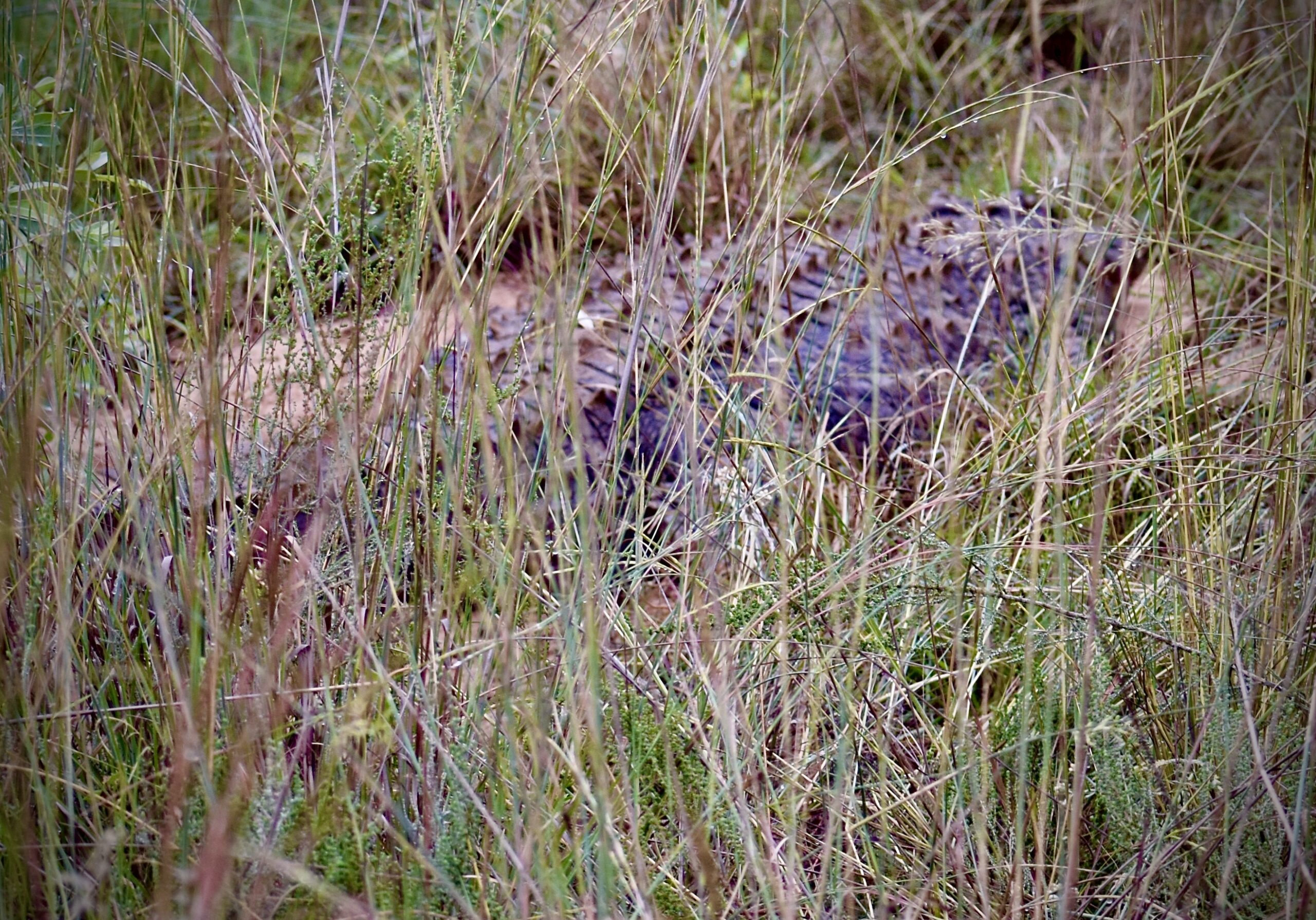
Isaac somehow spotted a crocodile lying perfectly still in long grass near a stream full of sugar-cane-looking reeds — I have a photo, but it doesn’t quite capture how enormous this creature was. (Also, I’ll never quite look at the “innocent” sugar-cane-looking reeds again.)
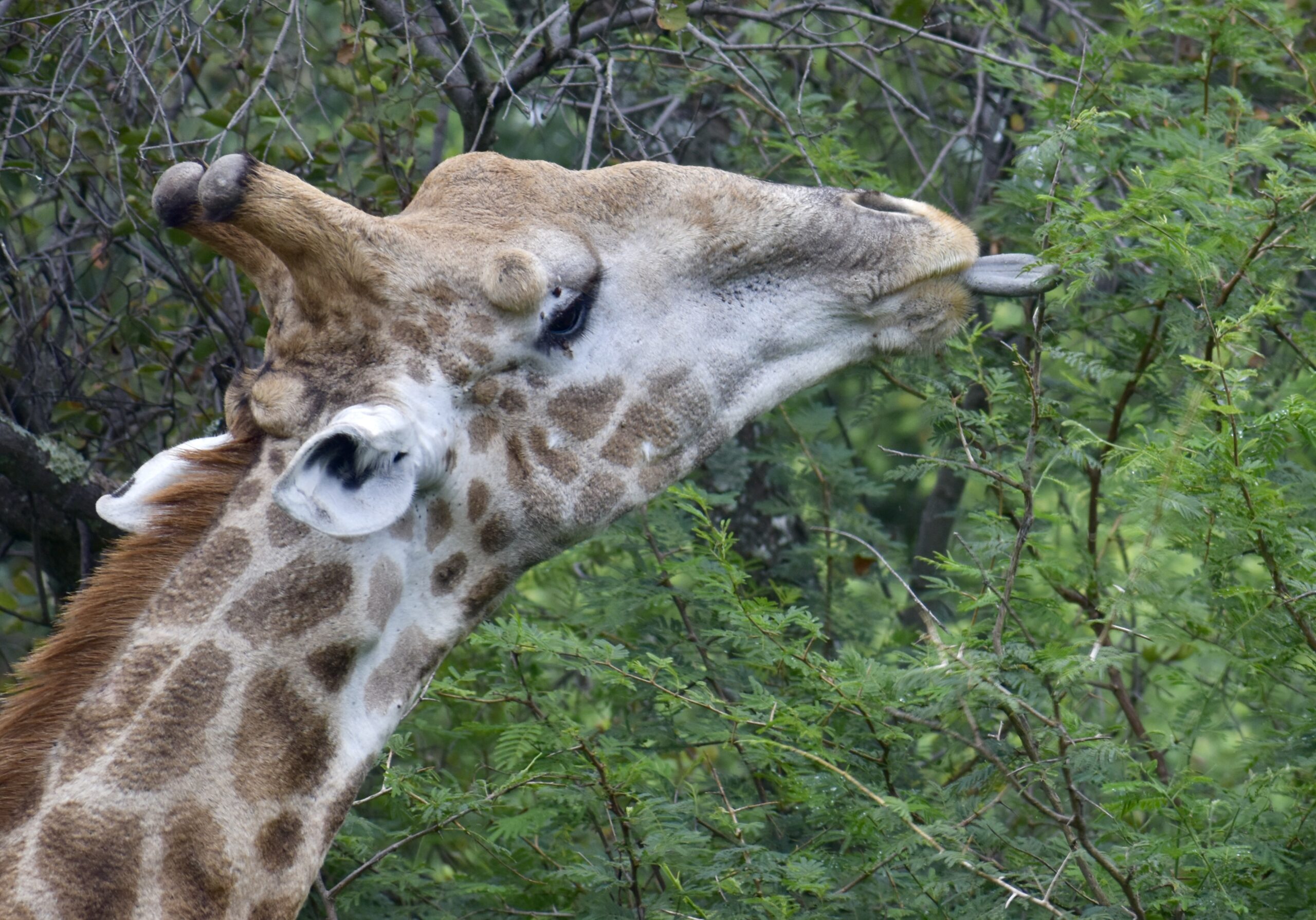
We saw a lone male giraffe eating the tops of a tree, and, because I was on the other side of the vehicle, handed Janice H’s camera to try to capture that incredible tongue.
We also found the pride of lions — the mother and her four boys — all absolutely stuffed and sleeping in the satisfied way that suggested Mom definitely caught something the night before.
And then, last but certainly not least…
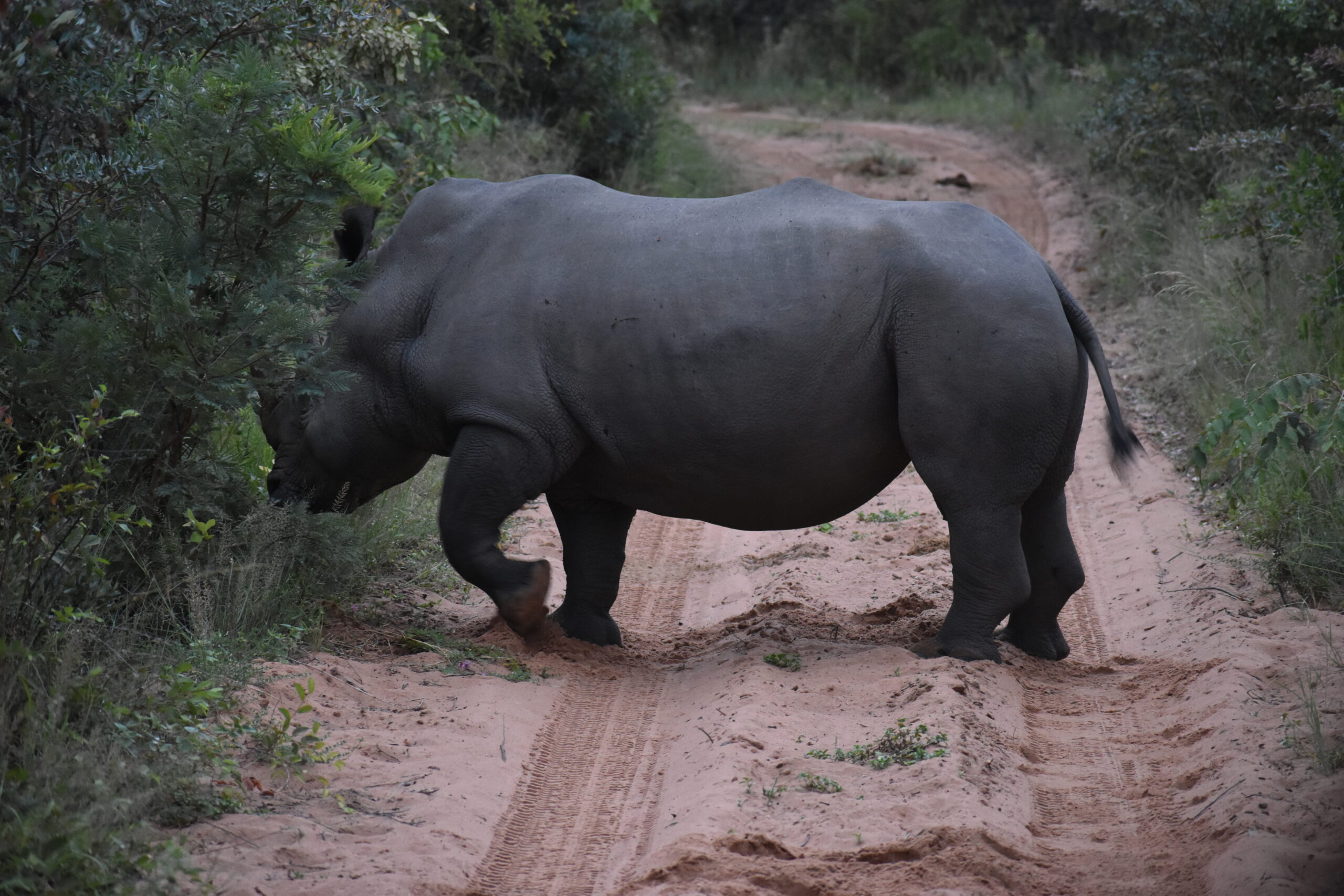
As we were about 2/3 of the way home, a very large male rhino decided to mosey down the “alley” of the road, away from us, and directly toward two other safari vehicles full of tourists. (Cue Sir Mixalot “Baby Got Back”)
A group of rhinos is called a crash. . .This one nearly caused the crash all by himself.
For a few minutes, all of us were politely inching forward (us) or inching backward (them), as if we were commuters dealing with a slow-moving tank who had the unquestioned right of way. The rhino, meanwhile, spent his time spreading “Pmail” about every yard in firehose-like fashion.
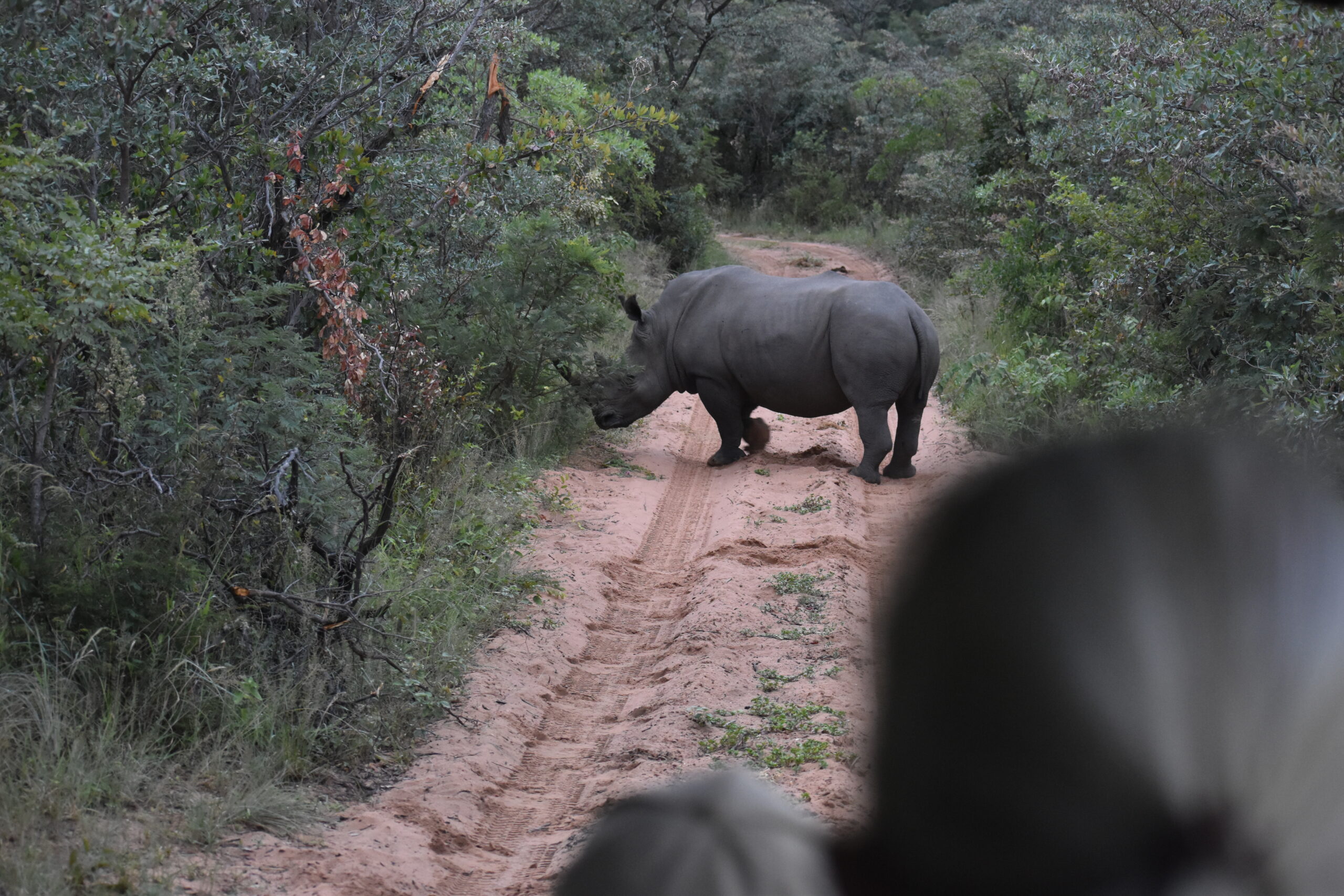
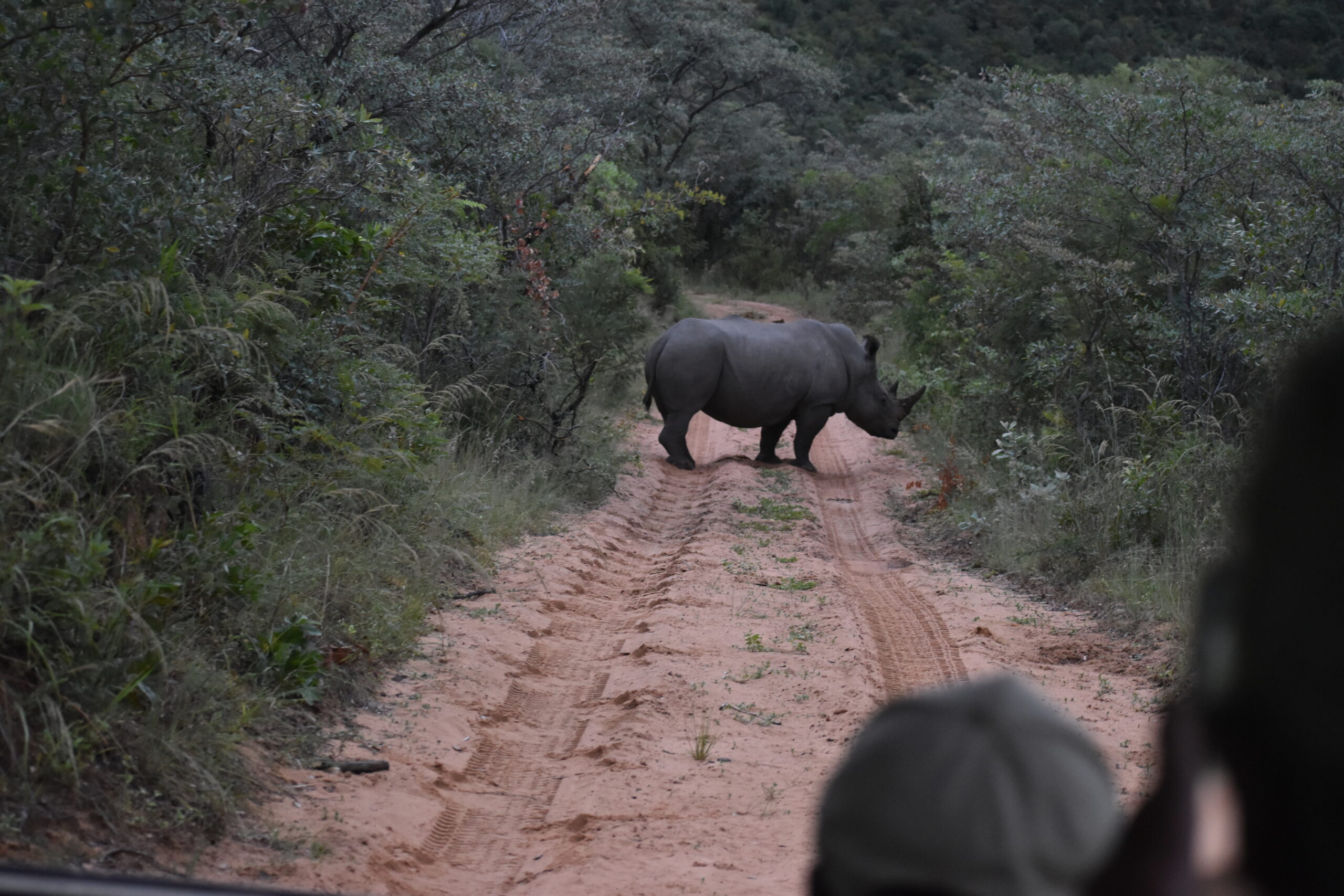
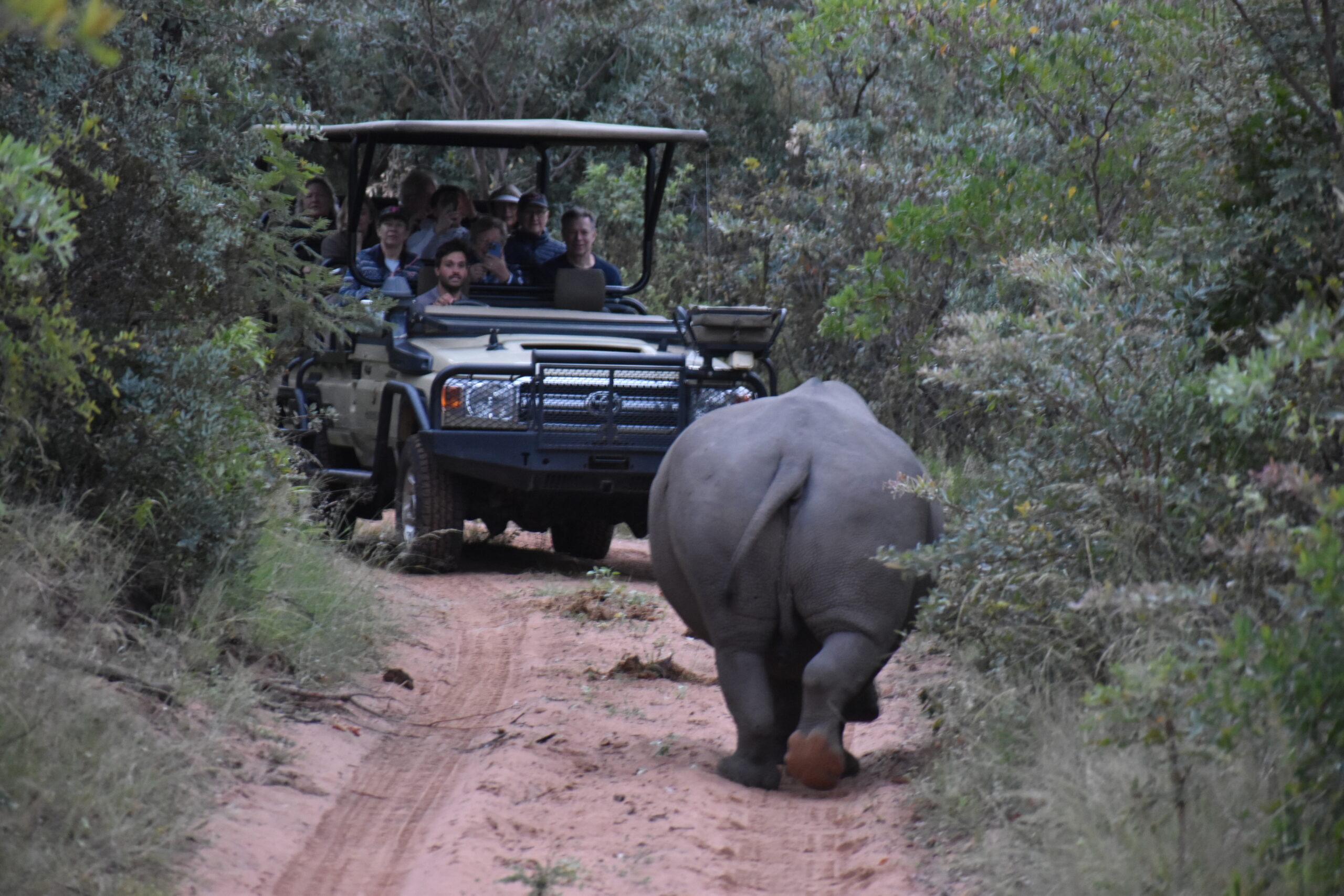
In an attempt to let the rhino pass, then let us pass, and ultimately to get around us (it was not a wide path!), one of the vehicles heading towards us backed cautiously into a field surrounded by trees.
The rhino started looking like he would “mosey right past” the vehicle that was basically in a cul-de-sac – changed its mind, wheeled, and headed into the cul-de-sac.
We couldn’t see the rhino (or the look on the guide’s face – obviously one of “Oh THIS was a mistake of epic proportions….”), so the other vehicle facing us, and our vehicle, just had to sit there. We didn’t want to disturb any thoughts that were going through that rhino’s oh-so-thick pate.
Finally, the rhino snorted, backed back out, and started to mosey back down the road. As we crawled along behind it, we ultimately could see into the cul-de-sac. The visitors still looked a little shell shocked. The young guide still had a bit of a ghostly pallor. We suck – we burst out laughing at what had happened. Once we passed the cul-de-sac, they were able to get “around” behind us and down the road.
The other vehicle that was facing us had backed up to a cross road, but we were still a good 40 yards away. The tank (I mean rhino), of course, didn’t mosey on up to the cross road; instead, he walked into a little field to the left of the path. Again – ringed by trees, so we couldn’t see what he was doing.
We could just barely see his eyes and horn through the bush that separated us. He put his head down, then back up, then back down, back up, and ultimately down. Isaac, our driver, waited a tic, driving OH SO SLOWLY up so that he could see the rhino “for sure.” The rhino was in fact grazing (facing us), so he put it into high gear and SPED out to the crossroad.
He said that if the rhino’s head had stayed up, he couldn’t have risked it – but if its head stayed down, the “balancing act” for it to bring that big head up to get a bead on us to charge, then charge, took too long and (as Isaac had surmised), the rhino just decided he’d played the game long enough.
We wondered what the rhino would tell the “boys” that evening. Probably something like:
“You should have seen me today. I held off three giant metal beasts full of squishy tourists. Absolute dominance. Peeing all the way. I win.”
Back at the lodge, it was our last dinner here: a braai — South African barbecue — though we had to eat indoors instead of in the Boma because it had turned chilly and a bit misty.
There was singing from the staff, a warm chat from Abe, and then, finally, bed.
It’s not even 10 p.m. as I type this, which tells you everything you need to know.
The Wi-Fi hotspot isn’t working, and typing in the reception area holds absolutely no appeal.
Tomorrow: a bush walk in the mist, and then back to Pretoria to meet up with the rest of the group.
For now: goodnight from Entabeni.