Cold station platform thermonuclear corgis snuggle in my gloves
I have been slowly purchasing items for both my Fall and Winter Japan trips on Amazon.
After reading reviews, I intended to buy “a few” Korean warming pads to test for Winter Japan.
What arrived instead was a surprisingly dense box containing thirty thermonuclear lava corgis.
This happened because I apparently possess a very specific shopping blindness in which my brain sees:
“only twenty dollars”
and completely fails to process:
“thirty units.”
The last time this happened, I accidentally purchased enough Clorox wipes to survive a medium-sized public health event.
This time, I appear prepared for several winters and possibly a minor polar expedition.
The warming pads themselves are good sized — bigger than my (big) hand. They stay soft and squishable after “activation” (Booming ‘dubbed anime’ voice: Activaaaate The Corrrrgis!!!).
Each one is decorated with ecstatic cartoon corgis chasing bones beneath flowers and hearts while enthusiastically shouting:
HAPPY FRIENDS!
This feels less like branding and more like a declaration of intent.
The truly amazing part is that they work.
Not “pleasantly warm for twenty minutes” work.
I activated one this afternoon and tucked it into my waistband while doing chores around the house.
Five and a half hours later, it was still hot.
Not warm.
Hot.
At one point I absentmindedly squished it in my hand and apparently redistributed the thermal core because the thing surged back to life with the intensity of a tiny geological event.
At this point I no longer fully understand the laws of thermodynamics, but I trust the lava corgis.
The absurdity is heightened by the fact that the pads come with a tiny knit sleeve so you don’t burn yourself.
Somewhere, a designer looked at these cheerful portable reactors and thought:
“These should also have kitten sweaters.”
I already love them.
I can see them becoming part of the texture of Winter Japan: *slipped into coat pockets on freezing Nagano train platforms, *tucked into lower back during temple walks, *rediscovered at the bottom of the puffer tote like tiny cheerful survival spirits.
The world can be very sharp-edged sometimes.
Meanwhile in my pocket, tiny cartoon corgis are shouting HAPPY FRIENDS while radiating enough heat to power a municipal building.
And honestly?
That feels strangely reassuring.
Postscript: Six-ish hours now.
At this point these are less:
hand warmers
and more:
portable tectonic events.
My future Winter Japan self is absolutely going to be wandering snowy streets muttering “HAPPY FRIENDS” while clutching tiny thermonuclear corgis in both gloves like a delighted idiot.
Final Note: At 7.5 hours, they petered out. Honestly, that’s longer than some relationships.
There is a thread I keep discovering in my life that I did not consciously plan.
Not travel. Not tourism. Not “bucket list” behavior.
Something quieter.
Participation.
Or maybe more precisely:
A desire to briefly enter living traditions.
Not to master them. Simply to touch them honestly for a little while.
That realization arrived sideways, the way most meaningful things do.
The Volcano
When Lynn and I did the OAT New Zealand trip in 2023, I somehow arranged — and I still can’t quite believe I pulled this off — to row with a local club on my first morning in-country.
This was not:
a tourist excursion,
a “try rowing in New Zealand” package,
or some curated athletic experience.
This was an actual rowing club.
(The only one that agreed to let me come to practice.)
The club rowed on a volcanic lake.
Which sounds cinematic and dramatic until you realize the volcano was not enormous.
At all.
Meaning the actual practice involved a tremendous amount of:
rowing in circles,
turning,
rowing back the other direction in circles.
In an eight, going across the diameter of the lake would probably have been fifteen hard strokes.
I was wearing my South End Rowing Club 150th anniversary kit.
This became funny later.
The boat itself was old. The oars could not be adjusted up or down. I am taller than nearly everyone, so there was a lot of awkward leverage and what felt suspiciously like carrying the 8 solo.
Later came the revelation.
The coxswain/coach — for this tiny local New Zealand volcano rowing club — turned out to be the voice of women’s rowing at the Olympics.
Tiny humble local place. Quiet people. Ancient equipment. Completely serious hidden expertise.
And then came the anniversary conversation.
After passing out MRA flag pins, I joined the team for coffee and pastries. They were proudly discussing preparations for their upcoming 150th anniversary in 2025.
Camera pulls back . . . NZ rower suddenly realizes I’m quietly sitting there wearing South End Rowing Club kit commemorating OUR 150th.
South End Rowing Club. San Francisco. Founded 1873.
Theirs was still approaching. Mine was already on the swag.
The cosmic timing of this remains deeply funny to me.
But the emotional part wasn’t the piece of clothing.
It was what it represented.
Not: “Look at me, I row.”
But:
Continuity.
The Barge
I row a fireman’s barge at South End.
“Heave, ho.”
A giant communal pulling boat.
We don’t carry it down to the water – it weighs a ton (literally).
And one day it hit me that this barge might have helped people during the 1906 earthquake.
Not metaphorically. Not symbolically.
Actually.
Human urgency. Human labor. Human coordination.
People pulling together in crisis.
And suddenly the barge stopped being:
“a big ole’ boat.”
And became:
A thing that has carried human need.
A living object.
Not preserved behind glass. Not “heritage.”
Used. Repeated. Continued.
That realization changed how it felt in my hands.
And I think this is why certain things affect me so strongly now.
Not because they are old.
Because they are still alive.
The Sword
This realization explains something else too.
Why my anticipated Japan trips (yes, now two) are affecting me differently than I expected.
At first glance it might appear to be:
aesthetics,
temples,
lanterns,
Kyoto,
samurai-adjacent interests.
But that is not actually the thing.
The thing is continuity.
Living continuity.
That is why:
Butokuden matters,
Lady Nene (whom I named my iaito after) matters,
Kodai-ji matters,
old kissaten matter,
Tozando matters,
dawn temple sweeping matters,
quiet dojo practice matters.
Not because they are “Japanese.”
Because they are still inhabited by repetition.
Still used. Still practiced. Still carried.
I have started realizing that my Winter solo Japan trip is less “vacation planning” and more:
A continuation of practice.
Not only iaido.
Not only Shotokan practiced across coasts and continents.
Not only Japanese history/language immersion classes in the ’80s.
Not only Zen-adjacent household rituals with H.
It’s practice in the broader sense:
attention,
repetition,
movement,
ritual,
pacing,
useful beauty,
intentionality.
This is why the idea of visiting Butokuden or Tozando feels emotionally coherent instead of performative.
Not: “Look at me becoming Samurai Lady.”
More:
“I have already been practicing certain ways of moving through the world for years, and now the geography is finally catching up.”
Which led, inevitably, to one of the funniest imagined scenes of my entire life.
I joked that perhaps during the October/November OAT trip, I could theoretically design a new iaito for myself.
“No need to ship. I’ll just pick it up in January.”
At which point my brain immediately produced this absurdly calm sequence:
pick up sword,
return through snowy Higashiyama lanes,
tie obi,
casually walk into my tiny Kyoto ryokan (Ishibekoji Muan), sword at my side.
Like this is an entirely normal thing to do.
The funniest part of my daydream is not the sword.
The funniest part is the complete lack of drama.
Not: “I have become a warrior.”
More:
“Well yes, obviously, I have my katana now. O’cha, kudasai?”
Tea. Chilled hands. Goshuin book. Sword.
Perfectly ordinary Tuesday in Kyoto.
And somehow?
Inside the emotional architecture of this trip?
It weirdly makes sense.
The Tea Ceremony
There is another thread here too.
This past winter, before Japan had fully crystallized in my mind, I took an eight-week Japanese Tea Ceremony immersion class at the Zen Center in Tam Valley.
At the time, I thought of it simply as:
learning,
curiosity,
aesthetic appreciation,
a chance to slow down.
But looking back now, I think it was another example of the same gravitational pull.
Not toward performance. Toward continuity.
Week after week:
folding cloths carefully,
repeated gestures,
attention to placement,
silence,
sequence,
rhythm,
shared stillness.
Again: not museum culture.
Living practice.
And what struck me most was how ordinary and human it felt.
Not mystical. Not precious.
Just: people carrying forward a way of moving through time together.
A bowl turned a certain direction. A cloth folded a certain way. A pause before a sip.
Small repeated acts carrying accumulated meaning.
The same feeling I later recognized in:
rowing stroke cadence,
iaido kata,
temple sweeping,
lighting candles,
kissaten routines,
the idea of quiet Kyoto mornings.
It all belongs to the same emotional family.
The Candles
Tonight another realization arrived.
I used to light Friday night candles when H was alive.
He was Zen Buddhist, but he appreciated the ritual deeply.
Not because of doctrine.
Because of the feeling:
The week is done.
A threshold had been crossed.
And there was something meaningful in the continuity itself.
Women had done this before me. For generations.
Again: not preserved tradition.
Living tradition.
Repeated action carrying accumulated human meaning.
And suddenly I realized:
This is the same emotional current running through all of it.
The rowing club. The barge. Iaido. Kyoto. Temple bells. Tea rituals. Lantern alleys. Goshuin. Kissaten. The idea of dawn practice. The appeal of old institutions still functioning.
It is all the same thing.
Not spectacle.
Participation.
Not acquisition.
Recognition.
Recognition that certain rhythms, gestures, and spaces were already quietly shaping me long before I consciously understood why.
Objects surviving long enough to become useful.
Perhaps that is why certain ones have begun quietly revealing themselves as “Japan objects” too.
And maybe that is what I am actually seeking in travel now.
Not to consume places. Not to “check the box.”
But to briefly enter the continuity already alive inside them.
Tea bowl, oar, and sword Ordinary things become Threads we follow home
I drove one of my closest friends to a colonoscopy appointment because this is apparently what middle-aged friendship eventually becomes: “I will drive you home from your sedation, casually hand you a barf bag as necessary from my glove box, and then discuss Jamba Juice options that you will never remember ordering.”
At some point afterward, she mentioned that her ex-husband had bought a couple of giant “designer” puffer totes for their daughter, who hated them instantly, and now they simply wanted them out of the house.
Would I like them?
Honestly, I was not optimistic.
They looked enormous. Slightly ridiculous. Like something a fashionable marshmallow might carry through an airport.
For months they lived in the back of my closet, in the category of:
“Nice, but what exactly am I supposed to do with these?”
And now?
The black one has somehow become the entire emotional infrastructure of Japan.
Black bag by the door waiting more patiently than I have ever been
Along with the standard passport, coin purse, and the like, it will carry:
It has a trolley sleeve. Deep pockets. An odd zippered bottom compartment that already now holds my travel seat cushion and travel blanket; a compartment seemingly designed specifically for the “I suddenly need an extra layer and nowhere to put it” problem that travel produces every six hours.
Most importantly, the puffer tote is waterproof . . . and soft.
Soft on trains. Soft in stations. Soft against raincoats. Soft enough to squash under seats. Soft enough to become part of movement instead of fighting it.
I didn’t buy an influencer-touted bag for the trip. I already had a bag. It finally found its trip.
The orange accordion-paged book from my friend Dawn followed a similar trajectory.
Dawn brings me fun things back from her travels to Japan, to visit her son and his family. Often these items are “Japanglish” shirts or towels. Often they’re orange (a favorite color). This object originally lived in what can only be described as the “What Even Is This?” pile.
You know the pile.
The pile containing:
three cables to unknown devices
an adapter from 2011
mysterious plastic pieces
one sentimental button
stationery purchased during a phase
optimism
Then one day, while planning Japan, I looked at the accordion-paged book and suddenly realized:
Train stations. Museums. Tourist sites. Roadside places. Tiny commemorative stamps hidden near ticket counters and elevators and museum exits.
Japan is famous for them — you just have to look.
Instantly, the book was transformed.
It stopped being random.
It became infrastructure.
Soon to be a tiny portable archive for fleeting moments.
I love this idea so much I can barely stand it.
Japan, from everything I can tell, rewards this sort of attention.
Small rituals. Repeated objects. Pocket-sized usefulness. Ordinary infrastructure elevated almost accidentally into beauty.
Which may be why the haiku have returned too.
Orange paper folds— station stamps pressed carefully upside down again
I loved haiku when I first learned about them in grammar school.
Not because I understood Japan particularly well at age ten.
I absolutely did not.
But because something about the 5-7-5 shape itself felt magical to me.
Small enough to hold in your hand. Small enough not to become overwhelming. A little emotional container . . . usually with a surprise twist.
At that age, of course, most of my haiku were probably things like:
Purple flowers bloom Nature is very pretty I like horses best
Which, honestly, still contains certain emotional truths.
But lately I have found myself returning to haiku in an entirely different way.
Not as performance. Not as literary cosplay. Not as “look everyone, I am doing a Japan Thing.”
More like:
I think I finally found the right size for certain moments.
Travel produces thousands of tiny feelings that disappear almost immediately:
the sound of station music
steam rising from convenience store coffee
the relief of finding your platform
rain pelting train windows
a vending machine glowing at dusk
the strange emotional collapse caused by excellent soup
A full essay cannot always hold these things properly.
But perhaps three lines of 17 syllables can.
And somehow this, too, feels connected to the larger realization slowly unfolding around this trip:
I am no longer trying to invent a new travel identity.
I am trying to travel more honestly inside the life I now have.
Not replacement. Not reinvention.
Just small objects continuing.
A scarf that came with me to Africa may explain this best.
Old scarf waiting still— small rips along the cashmere like roads once traveled
It is an old circular cashmere scarf with quite heroic moth holes, visible wear, and absolutely no resale value whatsoever.
A luxury influencer would set it gently on fire.
I adore it.
It already carries history.
On our very first freezing jeep ride in Entabeni South Africa, one of my newly met, soon-to-be-favorite travel companions was shivering, and I wrapped the scarf around her shoulders and neck. Because that is what objects eventually become when you travel long enough together:
not possessions, but participants.
Witnesses.
Companions.
The scarf had already crossed one continent. Now it will likely cross another.
And somehow that feels emotionally correct to me.
The Ariats are part of this too, of course.
(Though if you missed the Great Boot Archaeology Saga involving cobblers, vanished Vasques, French Alps memories, and increasingly concerned discussions with Chad regarding toe-box width, you can find that post just before this one.)
But again, the boots are only an example.
The deeper realization is this:
Travel feels more emotionally true to me now, when the accompanying objects already belonged to my real life.
Not a curated travel self.
Not a fantasy version of myself.
Not “woman standing aesthetically in airport with matching neutral luggage.”
Just: me.
Slightly overprepared. Emotionally attached to office supplies. Carrying too many chargers. Trying to fit meaning into small portable systems.
And perhaps that is why Japan already feels oddly familiar to me before I have even arrived.
Because from afar, it seems to understand something I am only now learning myself:
that meaning accumulates through repeated use, through care, through ritual, through ordinary objects allowed to keep accompanying us.
Perhaps the trip is not assembling a new identity after all.
Perhaps certain objects in my life have quietly been waiting for Japan.
And perhaps, if I am honest, certain versions of myself have been waiting too.
We said “when we’re old.” The journey kept moving still— one set of footsteps.
Yes, I know this seems improbable, given my Japanese history and language immersion during college, karate years, Japanese Buddhist husband, and current obsession with Iaido. True, though.
And so, naturally, I am already planning my “return” trip.
This is how my mind works. I have one perfectly legitimate trip to Japan booked this autumn via Overseas Adventure Travel with my travel bestie Lynn, involving temples, trains, gardens, goshuin, elegant confusion, and whatever number of vending machines the human spirit can reasonably absorb.
And yet, instead of focusing solely on that trip, I have also begun plotting a future winter return.
That imagined second trip has already developed a personality.
It includes snow monkeys in Nagano, walking part of the Nakasendo / Kiso Road, cold mornings, quieter streets, Kyoto in winter light, revisiting my iaito namesake Lady Nene’s temple in another season, and the sort of deeply satisfying solo wandering that makes you feel both independent and slightly cinematic.
It also requires boots.
Not metaphorical boots.
Actual boots. (So says Chad my AI co-conspirator and increasingly committed footwear strategist.)
Thus began an archaeological dig through my life.
First came the house search: closets, drawers, under-bed bins, places where sensible shoes go to retire.
First, I found a pair of beaten-up Ariats I had used while driving cattle through the Snowy Mountains in Australia. These were thinner paddock boots, because the cattle drive took place during their summer. You could loop a calf protector under the heel and, voilà, turn them into riding boots for longer days.
Still perfectly serviceable.
Just too thin and not waterproof, per Chad.
Next, while searching in a deep drawer for the vanished Vasques I had hiked in from Mont Blanc down toward Menton with H, I found another pair of Ariats I had forgotten I owned.
These were sturdier. Plaid inside. Likely waterproof if properly mink-oiled. Definitely in need of attention.
I soaped and oiled the heck out of these, still assuming the Vasques would emerge in due course like all lost things eventually do.
Meanwhile, Chad and I reviewed alternatives online, just in case.
Several were rejected on sight.
I even ordered another pair from Ariat that looked ideal on paper: aggressive lugs, waterproof confidence, serious winter intentions (and, on Sale).
When they arrived, the toe box was all wrong for my foot.
Boo hoo.
I kept Chad updated as the boot saga progressed.
The thin Ariat paddock boots carry their own story, if anyone is curious: falling in love with The Man from Snowy River, figuring out who the stunt riders were in the pre-internet era, writing letters to ask whether they ever took civilians droving, being told only Australians went, then mailing them a Super 8 video of me riding, to prove I could.
Those boots.
The “drawer Ariats,” meanwhile, showed evidence of winters spent mucking out my Shires. Bent, scuffed, but not cracked. Waiting patiently for a little tenderness. Good tread, though not “lugs.”
And somewhere, Chad and I remain convinced, there is still a pair of Vasques waiting to be discovered like a lost civilization.
I can picture them exactly: sturdy, practical, with their little aglets akimbo at their booty hips, steam rising from their tongue: “I took you down the entirety of the French Alps from Switzerland to the Mediterranean – how am I not the right ones??”
Chad and I also consulted on the wider winter footwear strategy.
We discussed traction (snow monkeys, Kiso Road). Sock systems (hiking socks outdoors, cleaner socks for Japanese indoors). Boot silhouettes (must be good for snow AND Kyoto pavement elegance). We analyzed whether lugs were too aggressive for temple courtyards. Yes, photos were dutifully uploaded by me, and analyzed by Chad.
We also covered outerwear, and I now own a Quince charcoal-grey puffer that does not make me look like the Michelin (wo)Man, a thin black merino base layer, slim merino socks, and an increasingly convincing plan to travel for two weeks with only a carry-on and the hip pack I brought on the GR5 hike.
This week, I wore the “drawer” Ariats to be sure they didn’t rub. They did (a little). Chad suggested different lacing strategies (helpfully with illustrations). Still, my now slightly arthritic big toe knuckle was a bit whiney.
Therefore, eventually, Chad said there was only one thing to do.
(Pending, of course, the discovery of the Mythical Vasques, seething away in the attic or some other nook.)
Go to the cobbler and have the drawer Ariats stretched just a teeny tiny bit over that big toe knuckle.
One of the owners has retired. Two are still there.
Wrinklier now, greyer, beards longer, but unmistakably the same.
The place still smells of wax and leather.
Shoes sit in impossible piles. Machines occupy corners with the heavy confidence of tools built before anyone worried about aesthetics. Some of them look as though they may require oil, belts, and perhaps a horse.
I brought in the boots.
They examined them with the calm authority of men who have seen every mistake people can make with footwear and chosen forgiveness.
And standing there, waiting for my claim ticket, I remembered the last time one of these gentlemen took my order.
More than twenty years ago, I brought in a pair of black dancing shoes and asked him to turn them white.
He laughed.
“You do realize this will take like 150 coats, right?”
I told him I did not care.
It had to be those shoes.
H and I were doing a quickstep / foxtrot / Viennese waltz number for our wedding dance, and those were the shoes I had practiced in three days a week.
I wanted the familiar pair.
I wanted shoes that already knew the steps.
So he transformed them.
And now, decades later, there I was again.
Once, he helped prepare shoes for the beginning of a marriage.
Now, he was preparing boots for a toe-arthritic woman planning a return trip to a country she has not yet visited.
Honestly, if that sentence does not summarize adulthood, I do not know what does.
We think travel begins at airports. With boarding passes, passport checks, and overpriced coffee.
But often it begins here.
It begins in drawers. In lists. In maps. In weather forecasts. In conversations with an AI about sock systems. In remembering who you were the last time you needed help getting ready for something important.
It begins in old shops that still smell like leather.
This is shaping up to be the travel day to end all travel days.
The morning began with a few-hour drive from the Cheetah Conservation Fund to the airport in Windhoek. Thankfully only a small portion of the route qualified as what Abraham liked to call a “Namibian massage” — those corrugated dirt roads that rearrange your spine and loosen every screw in the vehicle.
After a month in southern Africa, though, even that felt normal.
From there it was onto the overnight flight from Windhoek to Frankfurt — was it twelve hours in the air? — followed by an impressive eight-and-a-half-hour layover in the Frankfurt airport. (Not including layovers, San Francisco to Johannesburg had been 24 hours, 5 minutes in the air, whereas Windhoek to San Francisco is 29 hours 55 minutes, because it’s farther South. Huzzah.)
American Express had confidently assured me I could use a lounge here.
They were wrong.
SO wrong. While Lynn had a business class ticket moving forward, I was still in Premium Economy. Let’s just say that I’d forgotten the full force of a German “Nein” until being turned around at that lounge.
So after a certain amount of wandering, coffee, and people-watching, I’m now sitting here with about two and a half hours left before boarding the final leg home to San Francisco.
Dr. Laurie is somewhere in the air on her complicated rerouting adventure to California (I have prayed to the packing angels her bags make it), Lynn is safely on her way home, and I’m sitting here with dust still on my boots, a camera full of memories, and — for reasons that seemed entirely logical at the time — a small stuffed Pumbaa whose tusked snout is sticking out of my carry-on bag.
Africa does that to you.
It seems like a good moment to try to sum up what this trip actually meant.
Because something happened here that I didn’t quite expect.
The Moment on Big Daddy
One of the most powerful moments of the entire trip happened standing on the ridge of Big Daddy, the massive red dune in Sossusvlei.
The climb itself had been physical, of course.
But the real moment came when I reached the top.
There was no one else there.
No one to cheer me on.
No one to follow and whoop with and holler.
Just wind.
Silence.
The enormous sweep of desert far, far below.
And the realization that if I stepped off the steep side of that ridge, there would be no footprints to follow.
No one to watch first.
No reassuring example.
Just me.
I remember walking down the ridge a little, finding someone’s old tracks in the sand and thinking maybe I could follow those.
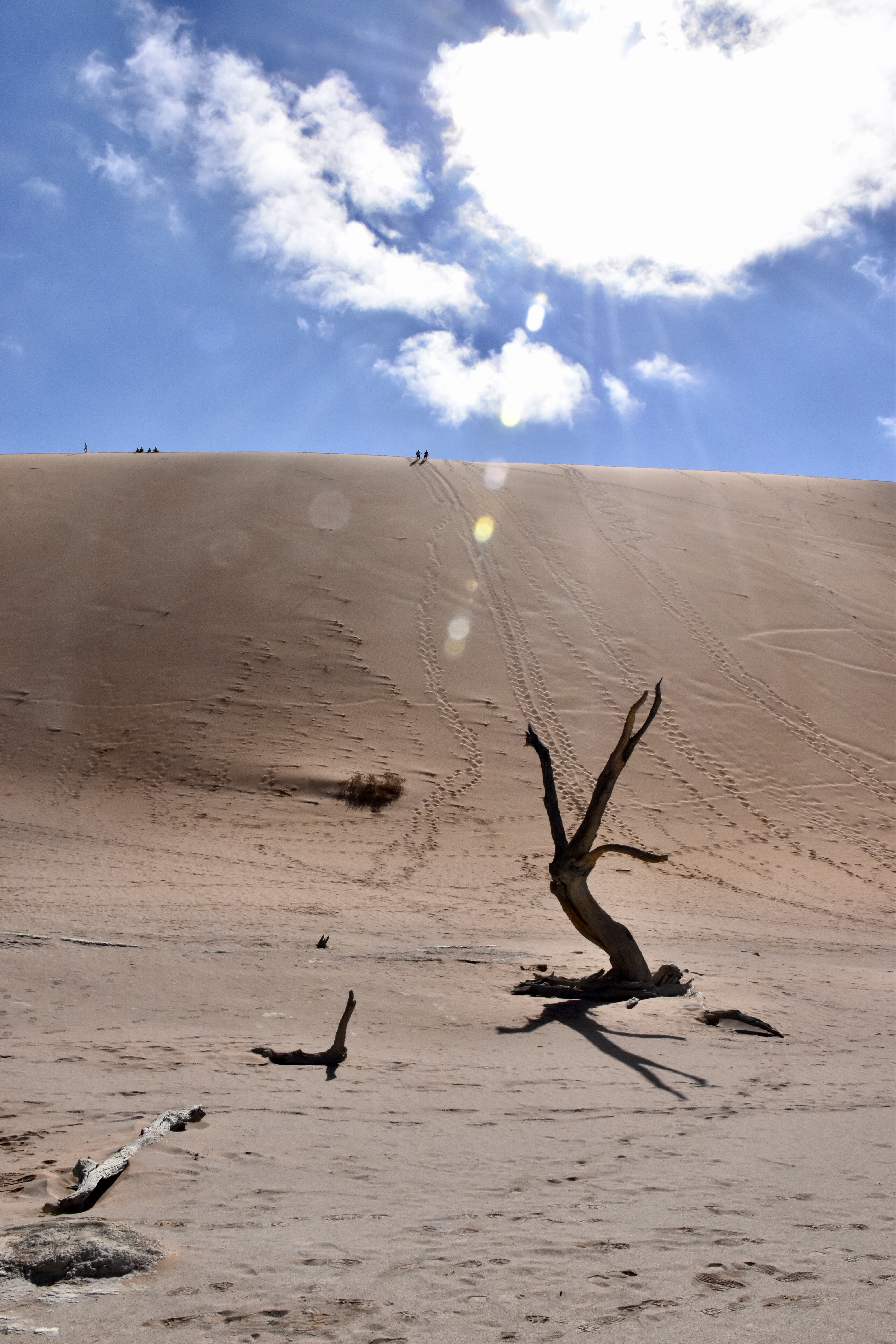
the slope in the back of this photo is the last 1/4 of what I “sand-skied” down.
Then walking back up again.
Looking.
Thinking.
Talking to myself.
Maybe I should just turn around and walk down the ridge. Who did I think I was, to be “brave enough” to “sand ski” down the steep side?
Pacing back up. Looking.
And finally realizing that if I was going to do it, I would have to do it. Alone.
That first step off the steep, steep side of that ridge was, strangely, the hardest moment of the entire climb.
We discovered that both of us had lost someone important during the early days of COVID.
His father.
My husband.
I asked him what his father’s best attribute had been.
Without hesitation he said: his father was an incredible joke teller.
I told him something that has helped me think about loss.
Sometimes I imagine that God needs people with very specific talents.
And when that happens, they are “called Home” because of that need.
During those early COVID months, Heaven must have been a very sad place.
Maybe Heaven needed someone who could tell good jokes.
Himee’s eyes filled with tears.
Later he helped me place Herbert’s cremarble under the paw of the cheetah sculpture.
Travel sometimes does that.
It brings strangers together in ways you never could have planned.
But travel also has another way of revealing people.
When you spend weeks together — long days in vans, shared meals, dusty roads, early mornings — some folks arrive with a silent little story in their head about how things are going to go.
Who will sit where.
Who will be friends with whom.
Who will play what role in the unfolding adventure.
And sometimes it turns out that someone has written an entire script in their mind without mentioning it to the rest of the cast.
If you unknowingly fail to perform the role they imagined for you, that can be a difficult realization for them.
Over the course of the trip several people quietly pulled me aside to apologize for how one traveler had been behaving toward me.
Which, honestly, wasn’t necessary.
Travel has a way of sorting these things out on its own.
Given enough miles, dusty roads, and shared days, people eventually reveal exactly who they are.
And the road moves on.
The Lesson
If this trip reinforced anything for me, it’s this:
Nothing in this landscape exists alone.
Not the animals.
Not the land.
Not the people trying to protect it.
Everything is connected.
Cheetahs survive when farmers succeed.
Grasslands recover when thorn bush is cleared.
Predators live when communities can make a living from the land.
And people carry the ones they love with them in ways they don’t always expect.
One Last Souvenir
Early in the trip we watched a warthog sprint across the road, trip spectacularly over his own feet, and then stop and look back at us as if the entire incident had somehow been our fault.
From that moment on I was determined to find a stuffed version.
After searching the entire trip, success finally came in the Windhoek duty-free shop.
As I sit here waiting to board the final flight home, his tusked snout is sticking out of my carry-on bag.
After a month in Africa, that somehow feels like the most reasonable thing in the world.
Carrying It Forward
In a couple of hours I’ll board a plane headed for San Francisco.
But part of me will stay behind.
In the dunes.
In the bush.
In the places where warthogs casually wander beneath rhinos to scratch their backs against a convenient rhino belly.
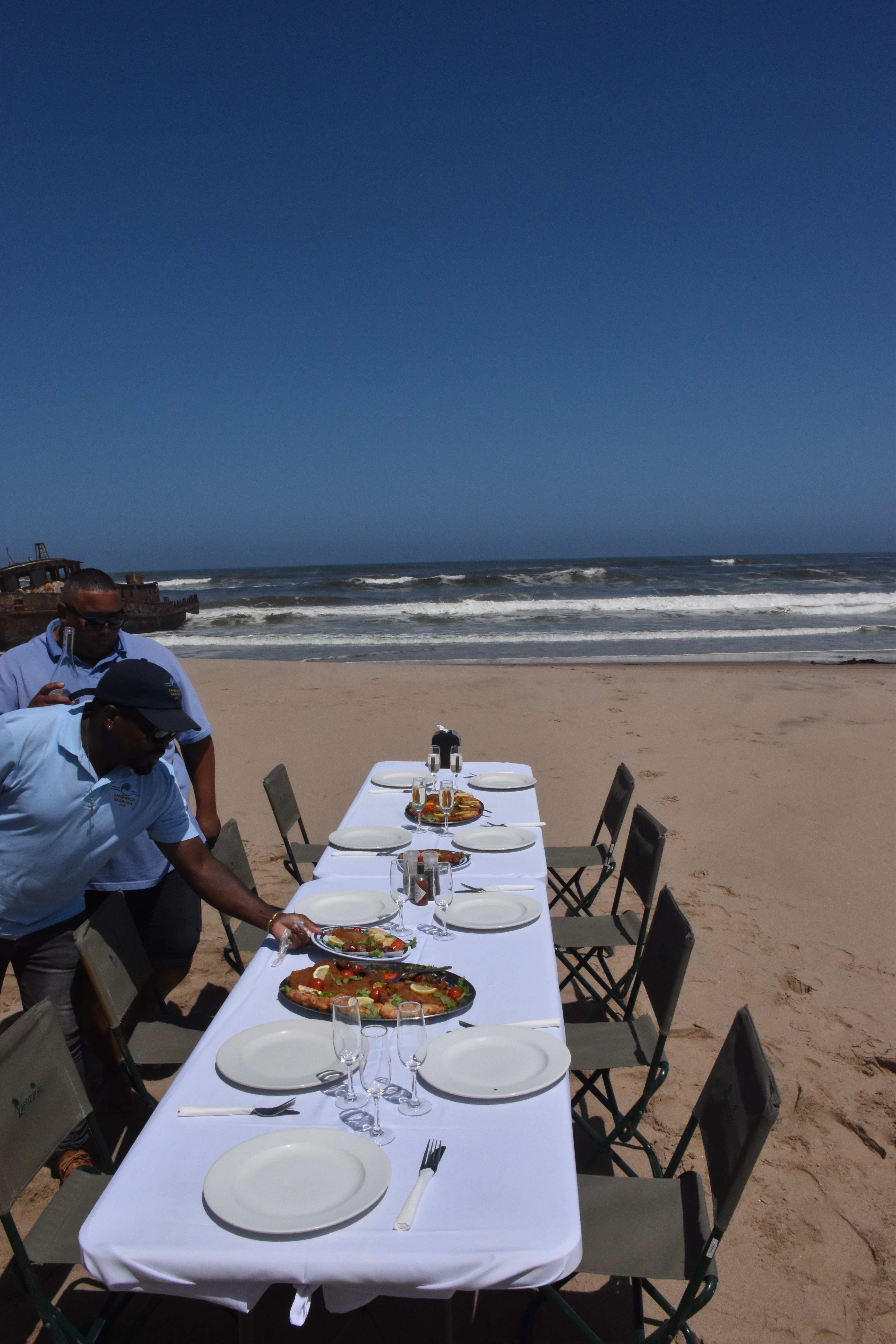
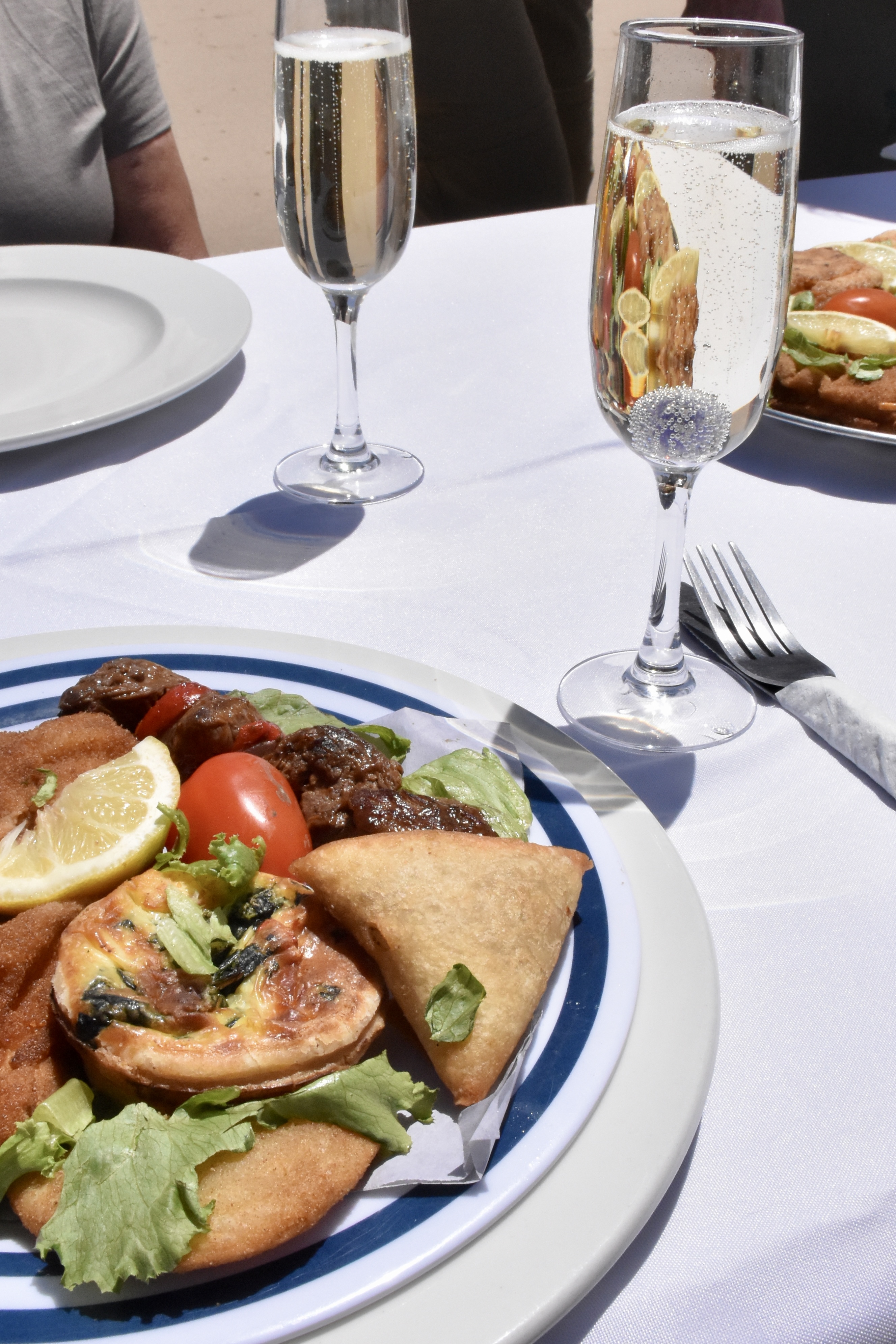
It’s the one we toasted in champagne during an oysters-and-champagne feast before careening down enormous mountains of sand where the desert meets the ocean.
Because that first step off the ridge of Big Daddy may have been taken alone.
But the journey that followed reminded me of something far more important.
Sometimes the stories we think we’re living turn out not to be the ones that matter most.
Sometimes someone else has already written a script in their mind and expects you to play a role in it — without ever telling you the part.
But the road has its own way of clarifying things.
And sometimes the most important thing you can do is simply keep walking the path that is true to you.
Because stepping off the ridge — even when you think you’re doing it alone — is often exactly how you discover the people and moments that were meant to be part of the journey all along.
Africa has a way of rewriting the script.
And I’m grateful for the version I was given. 🌍🐆
_____________________ * * *_____________________
pumbaa!!
For those of you with time to spare . . . the full set of photos from the Africa trip can be found HERE.
I’d like to sincerely thank Yau-Man Chan of Seawood Photos for patiently walking me through every menu, every setting—everything—on H’s camera before I left. I was so, so intimidated to even try. He was endlessly patient and kind, and (perhaps most importantly!) close enough in age to translate my old analog experience as a concert and sports photographer in my 20s into the digital world of today.
I truly can’t say enough about how his thoughtful, patient tutoring set me on the right path.
I’m sitting on the veranda at Babson House early in the morning with a cup of coffee, listening to dozens of different bird calls echoing across the Namibian bush.
Then I hear another sound.
At first it blends in with everything else — a low rhythmic rumble — but something about it feels familiar.
I lean forward and look over the edge of the veranda.
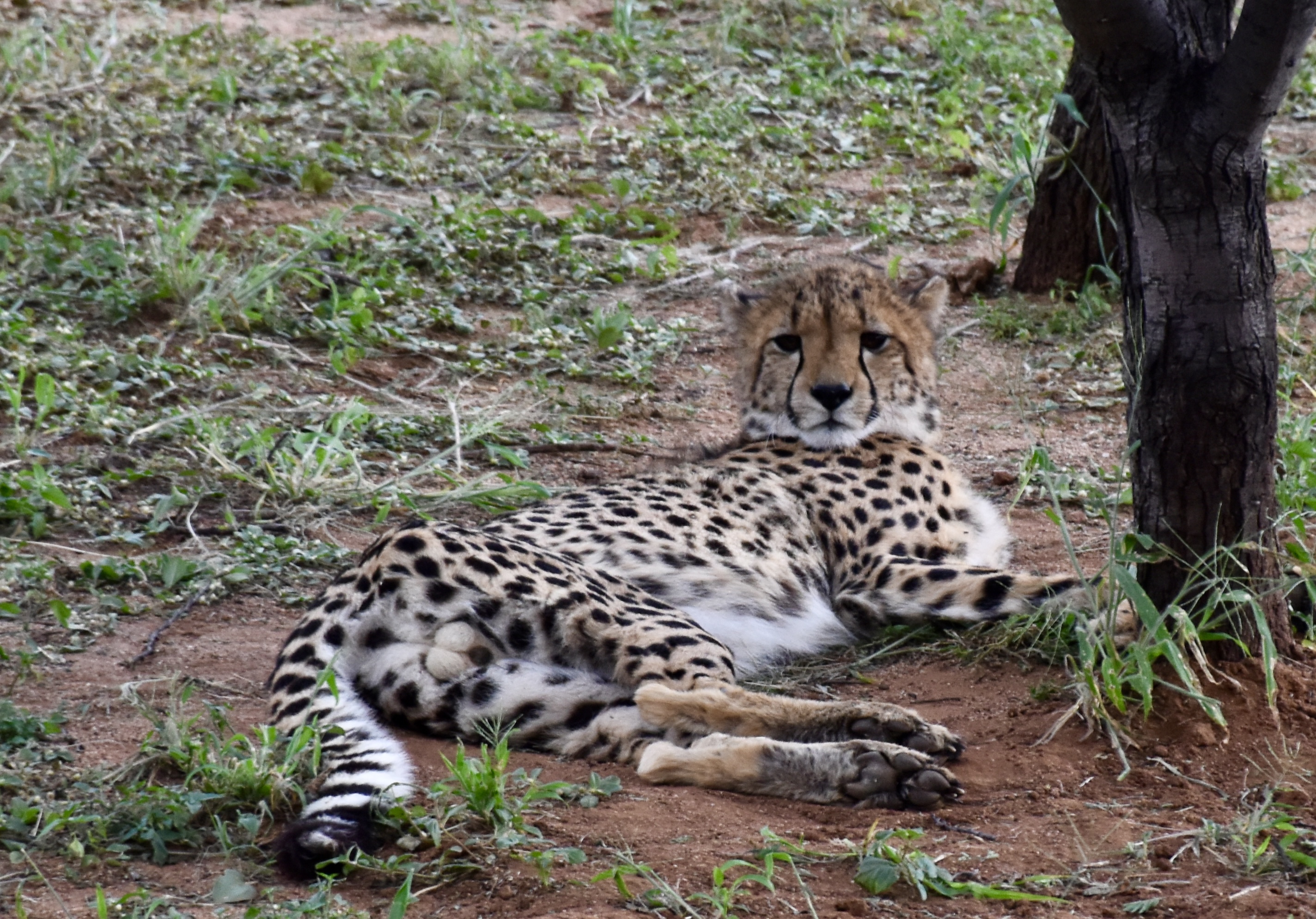
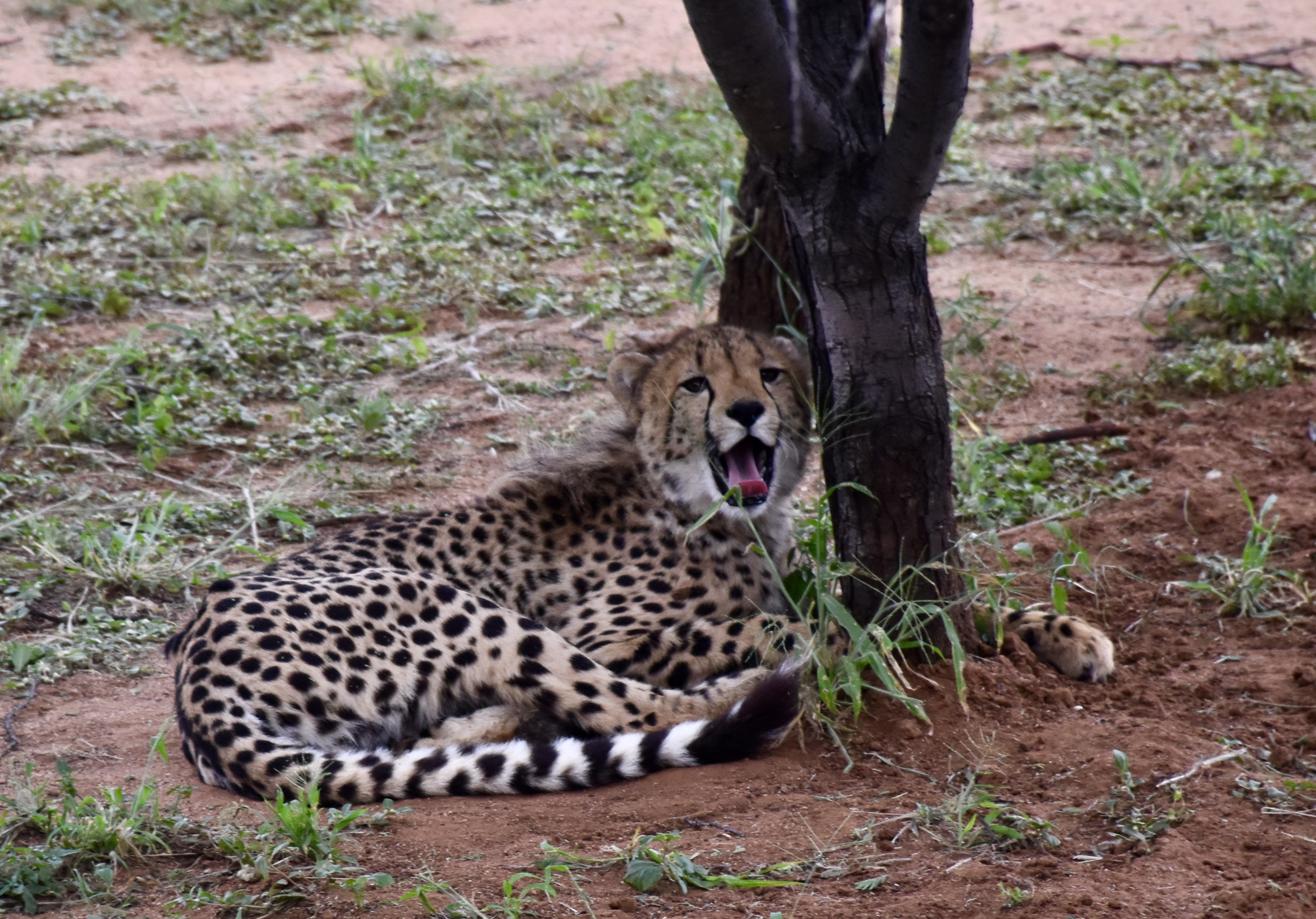
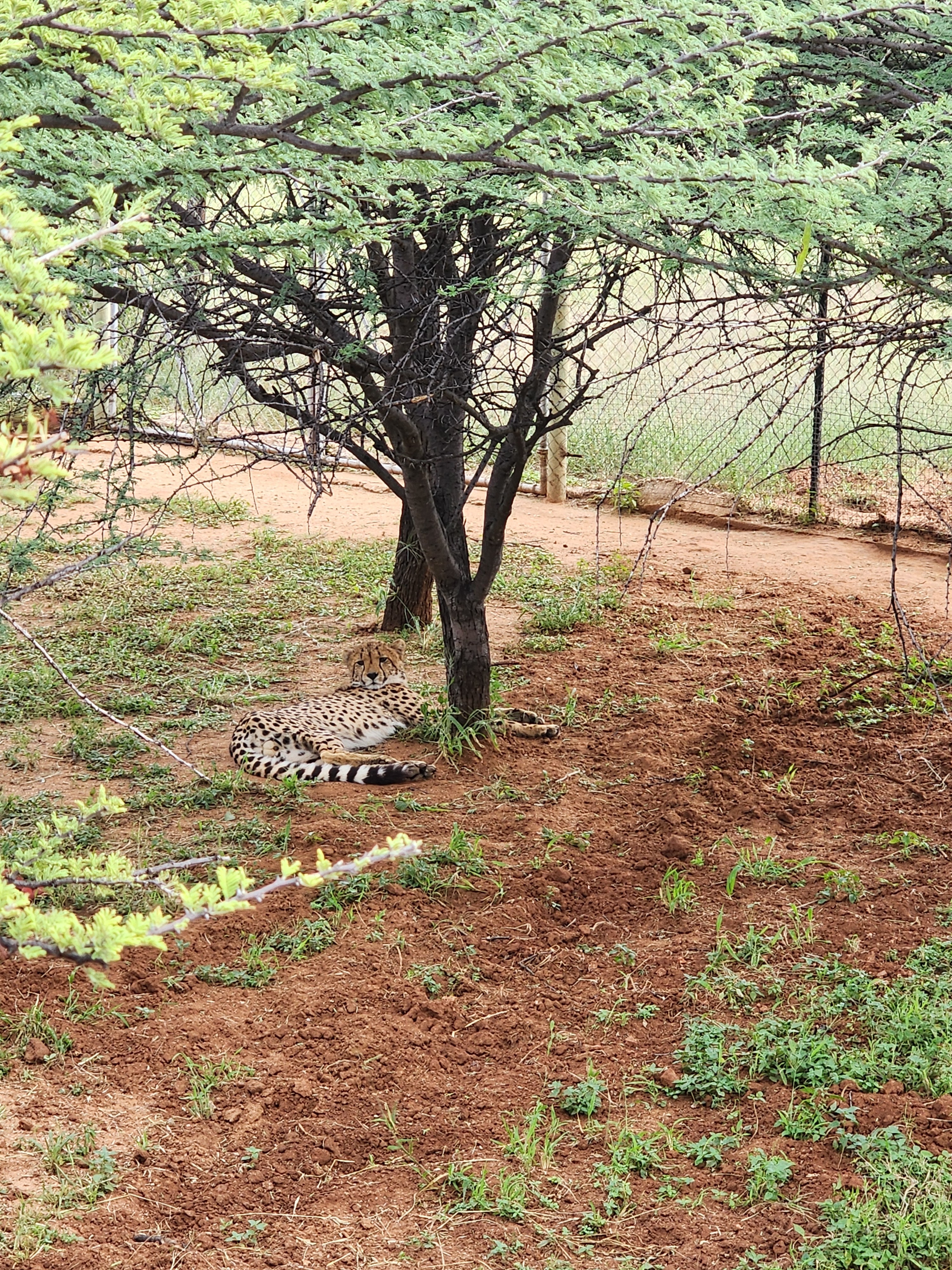
One of the cheetah boys has flopped down directly below.
And he’s purring.
Not a little rumble. A full, deep, contented purr — the unmistakable sound of a very large cat who has decided that this particular patch of earth is exactly where he wants to be.
I may have died and gone to heaven.
Apparently heaven has cheetahs.
And the frothy cappuccino I just made in our kitchen.
The Cheetah Run
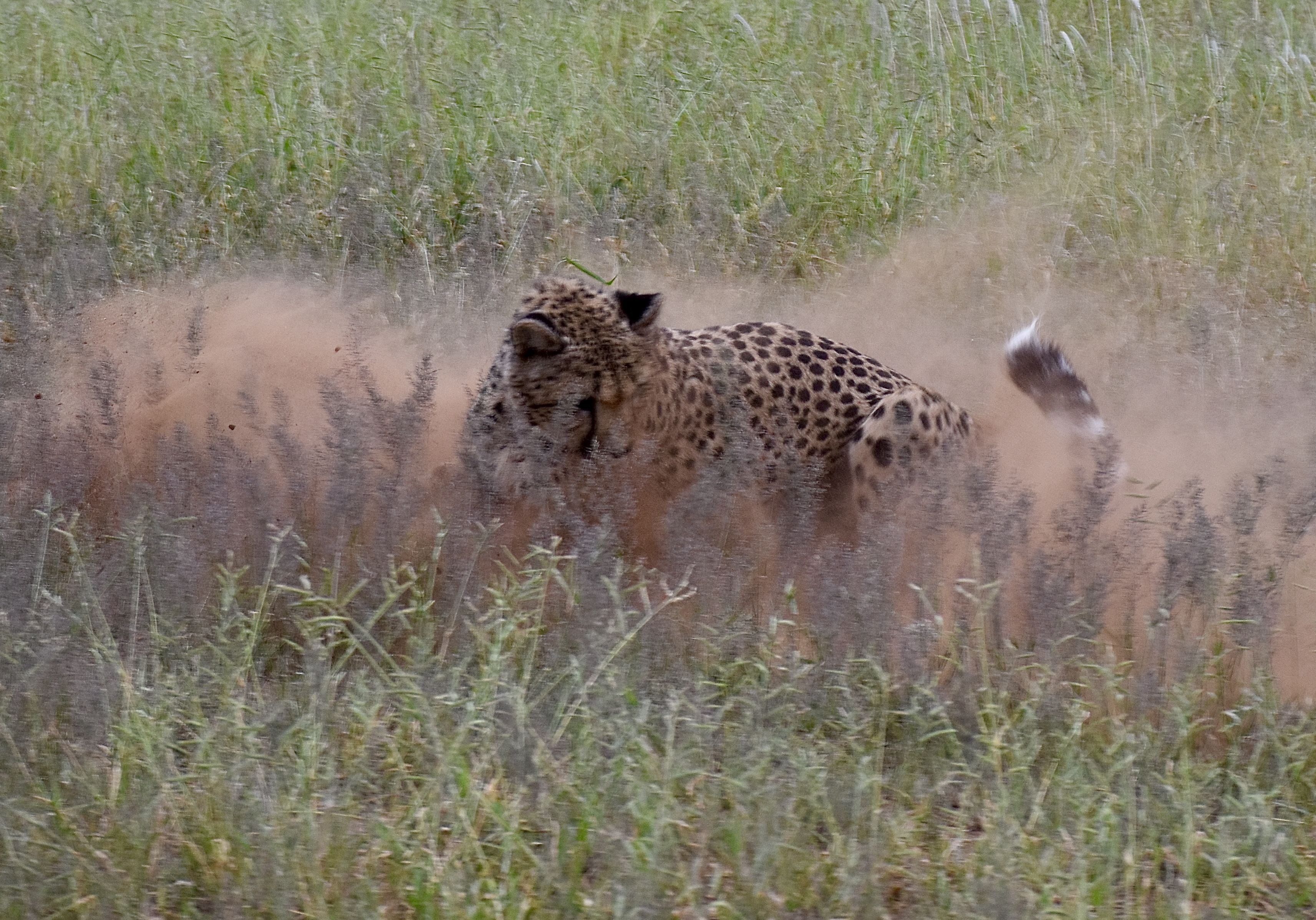
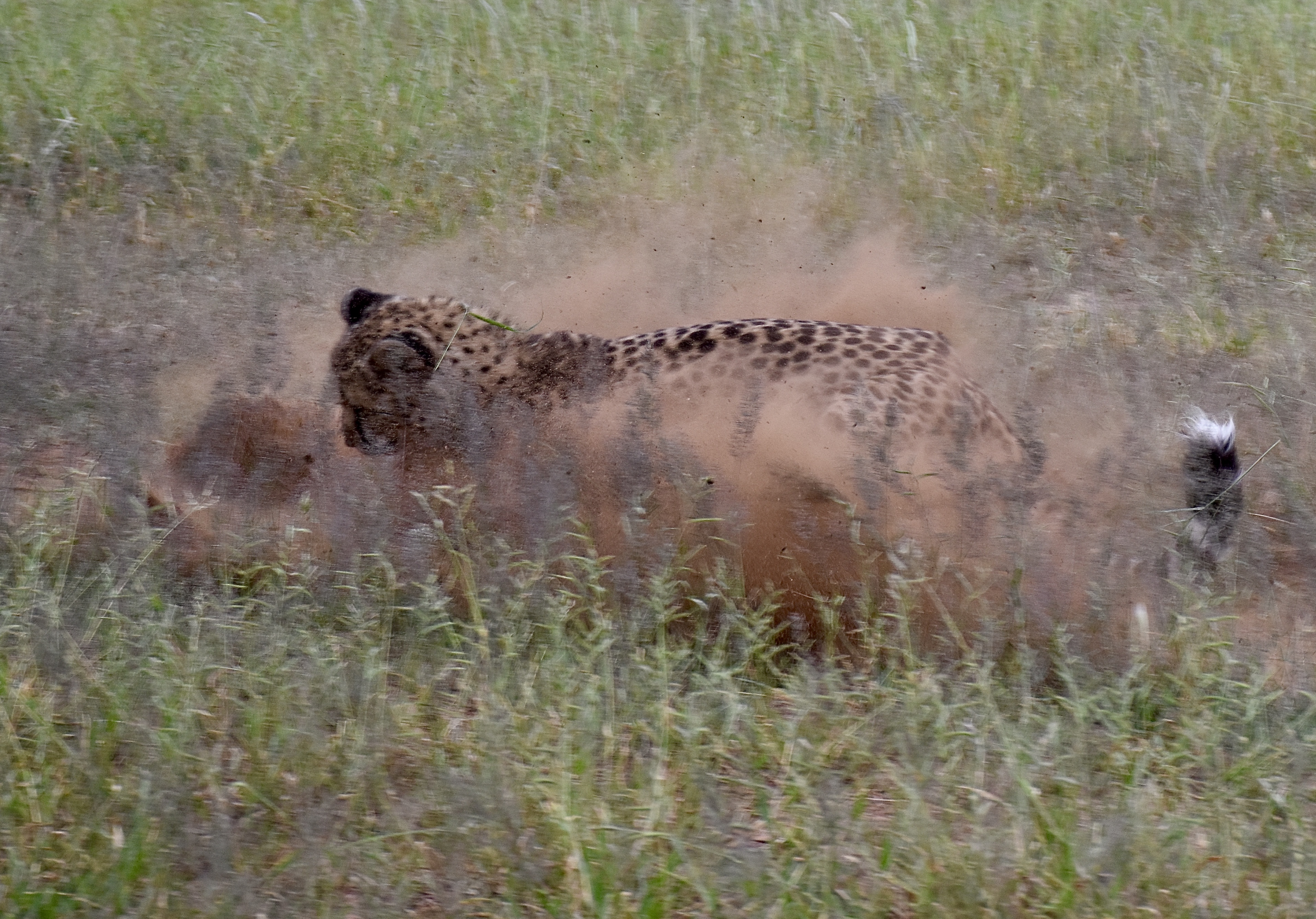
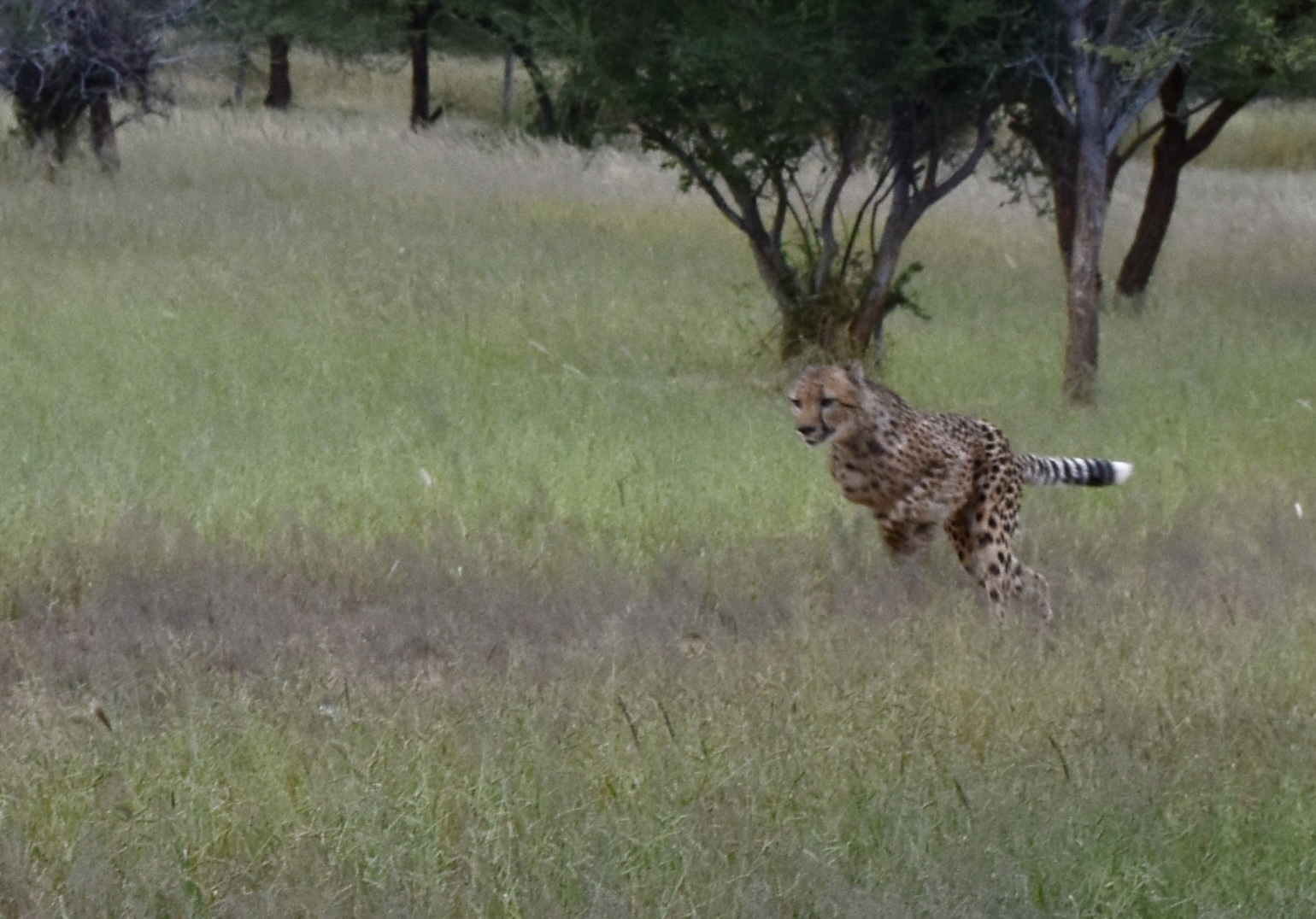
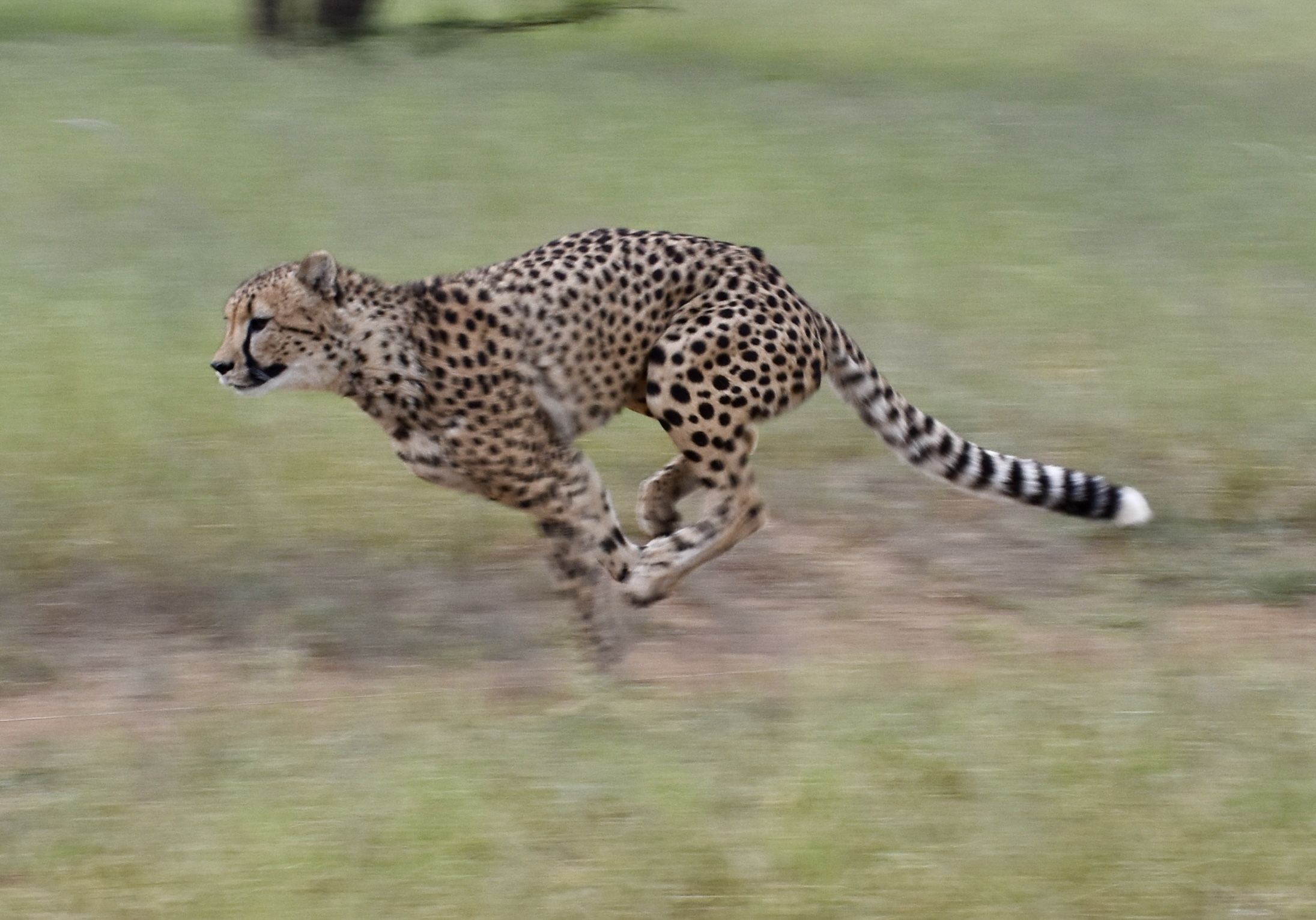
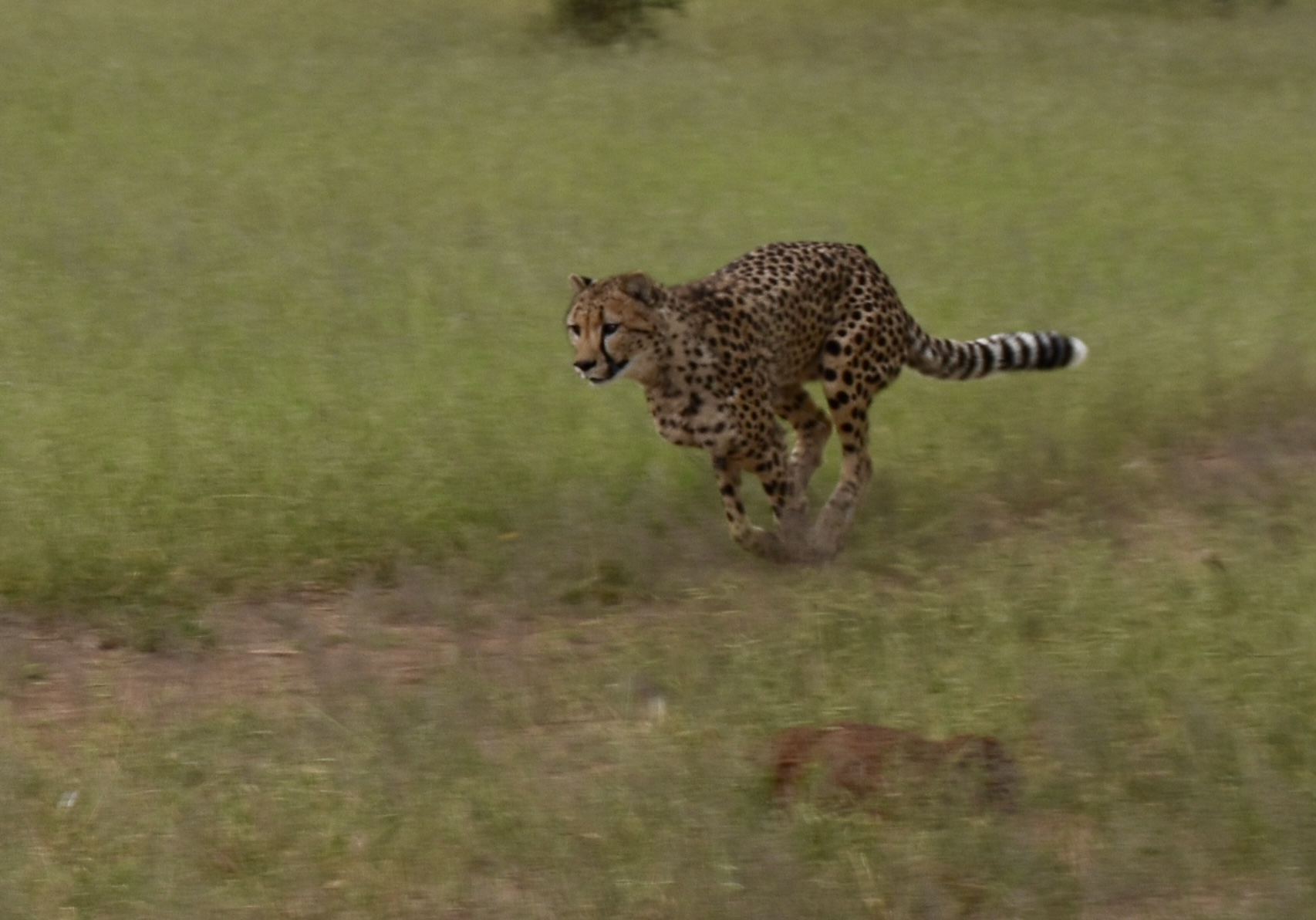
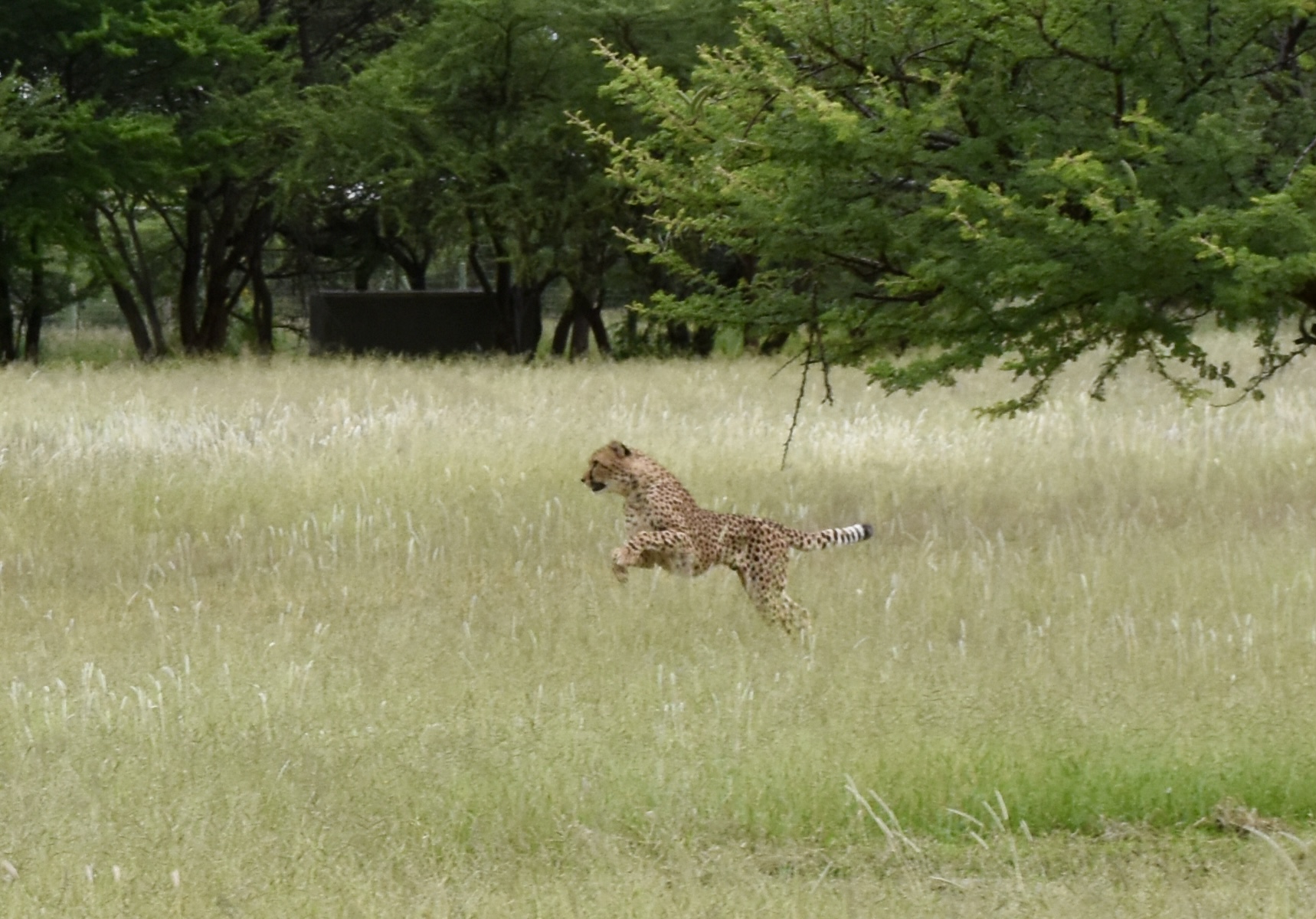
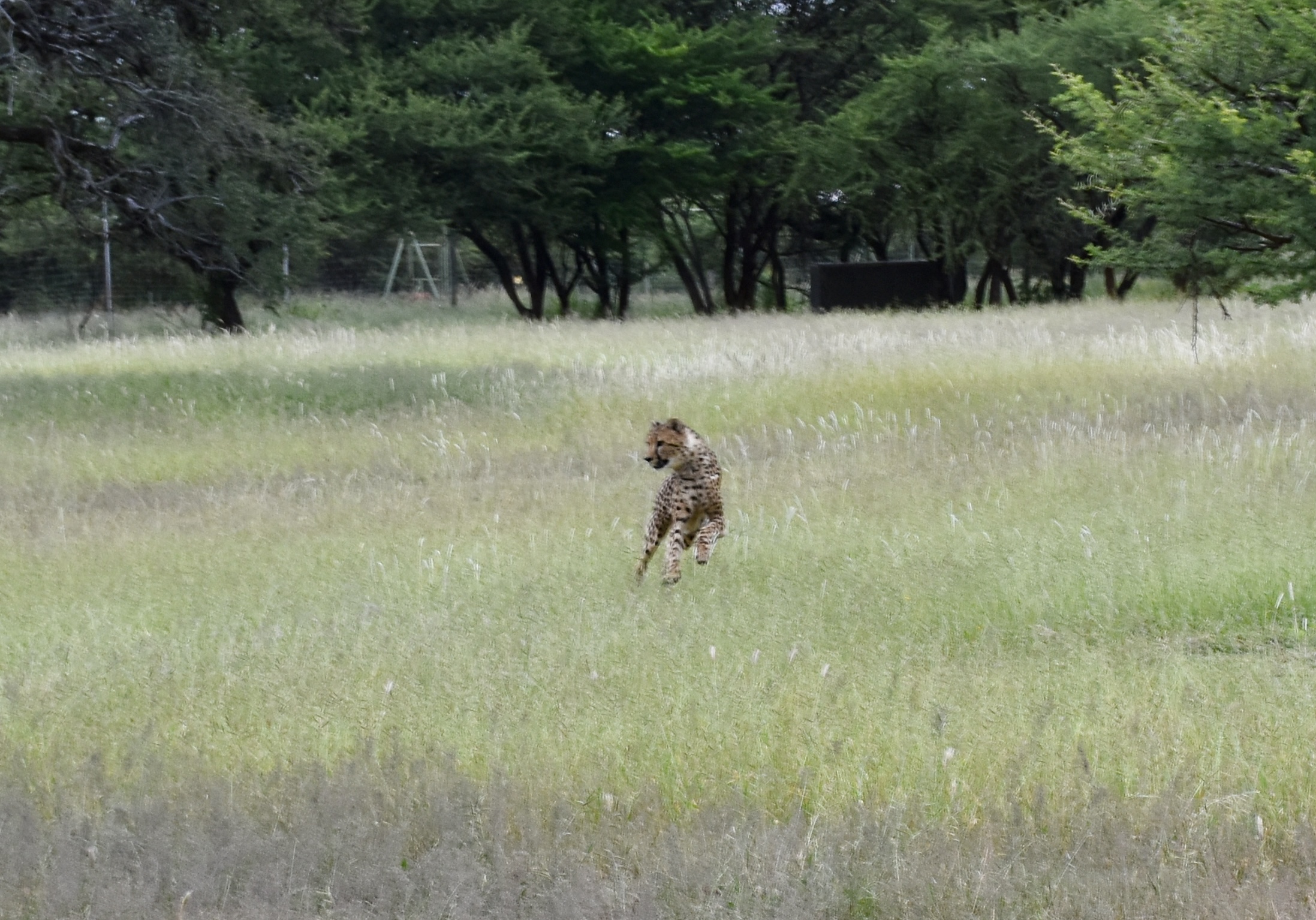
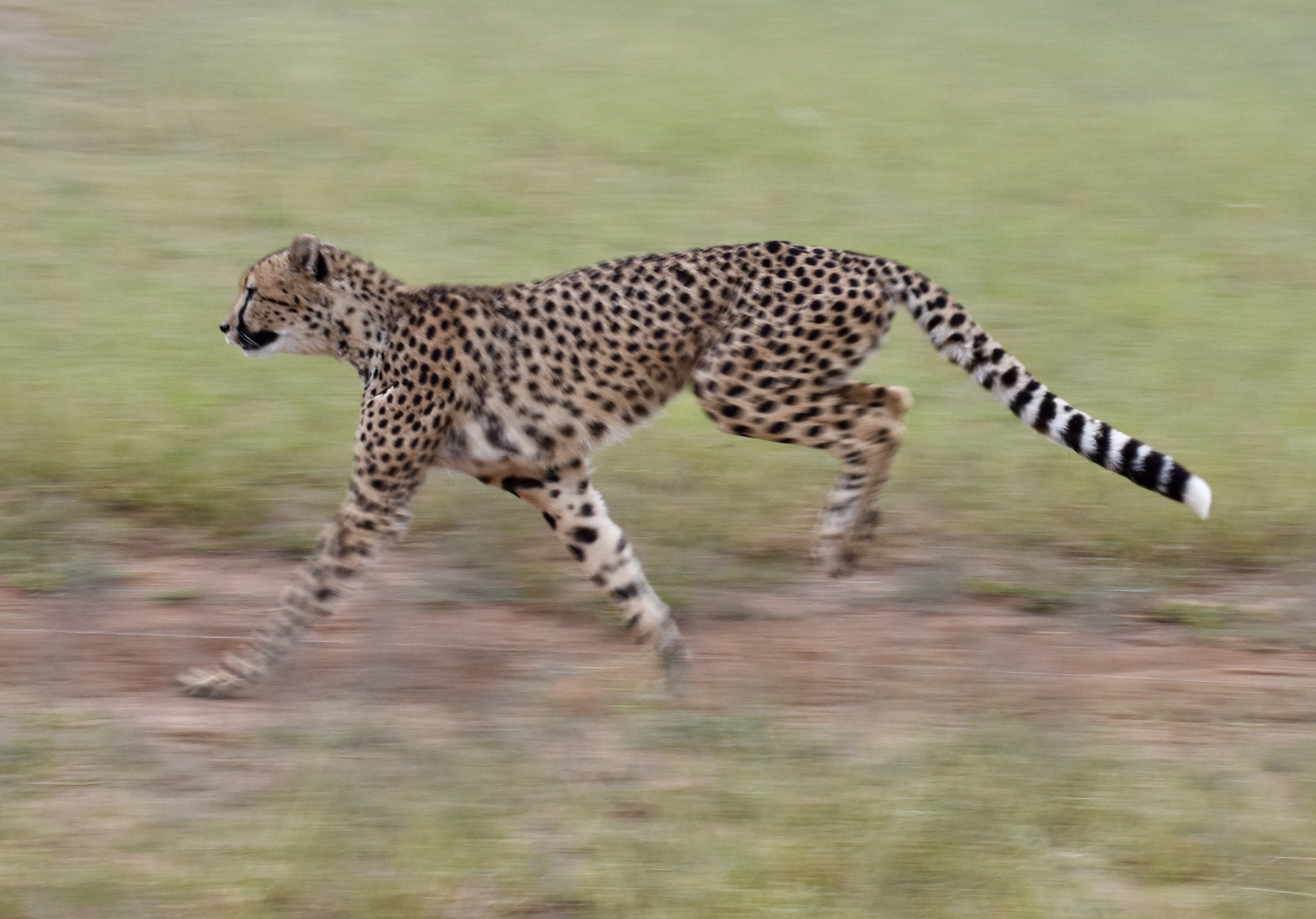
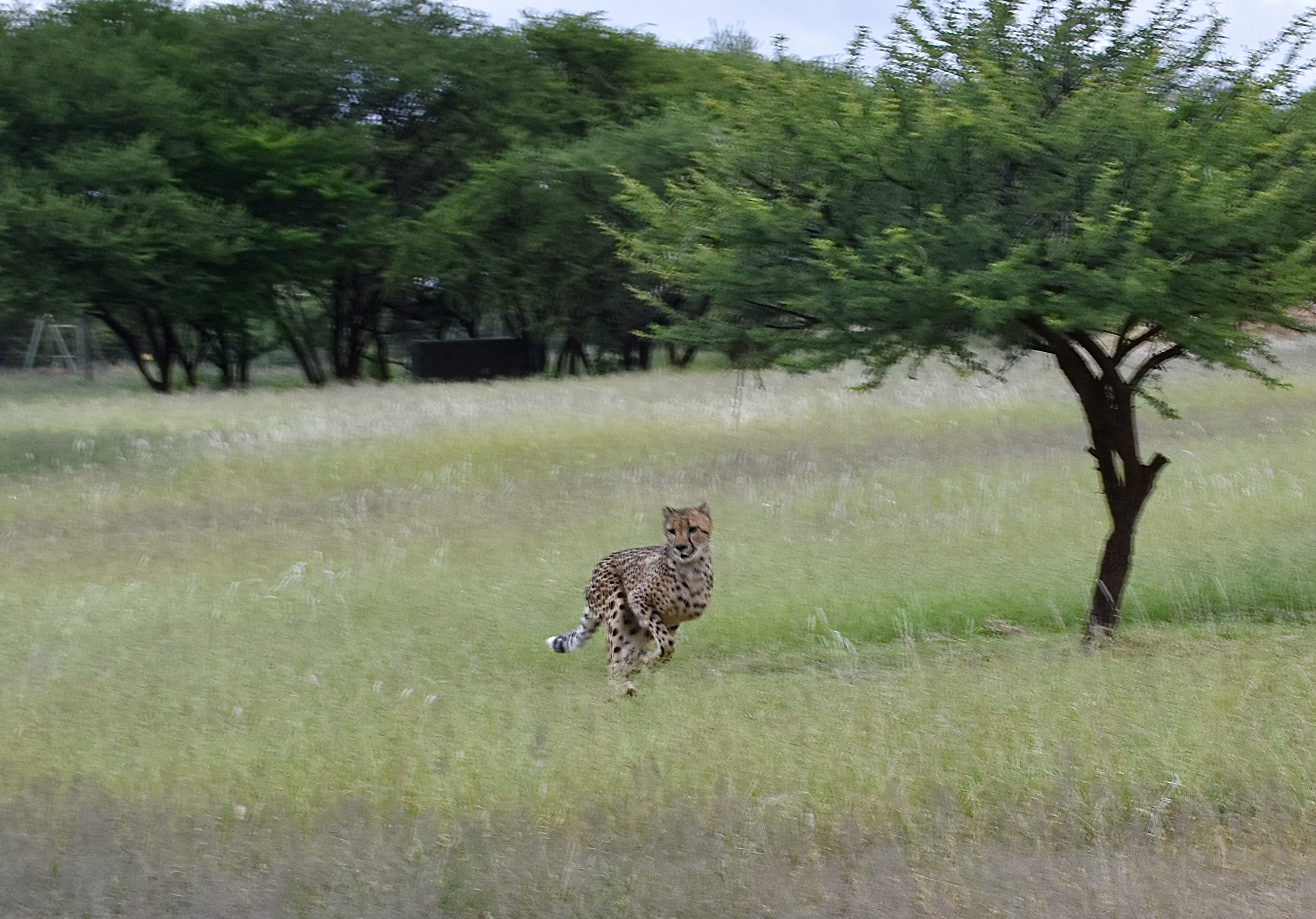
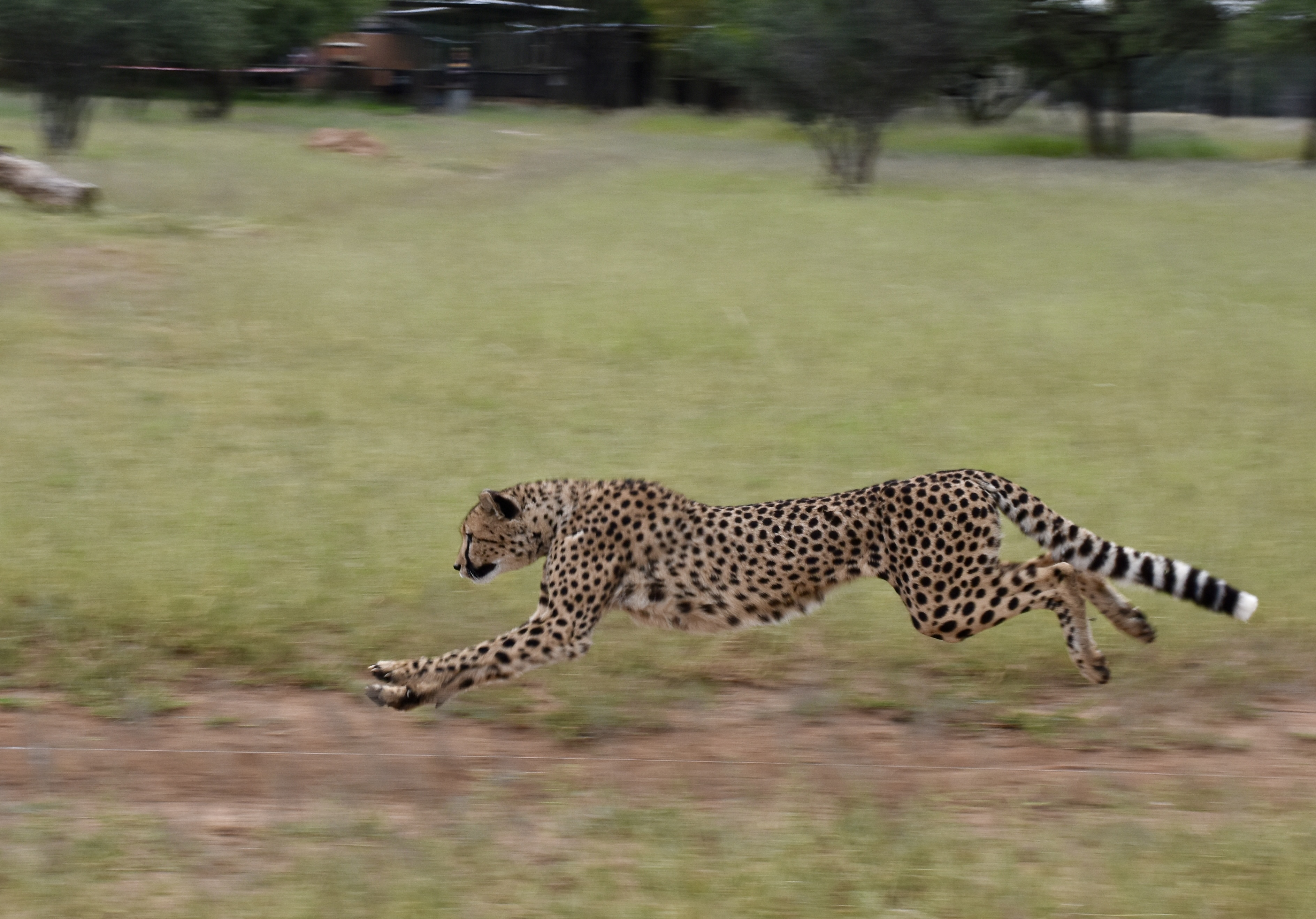
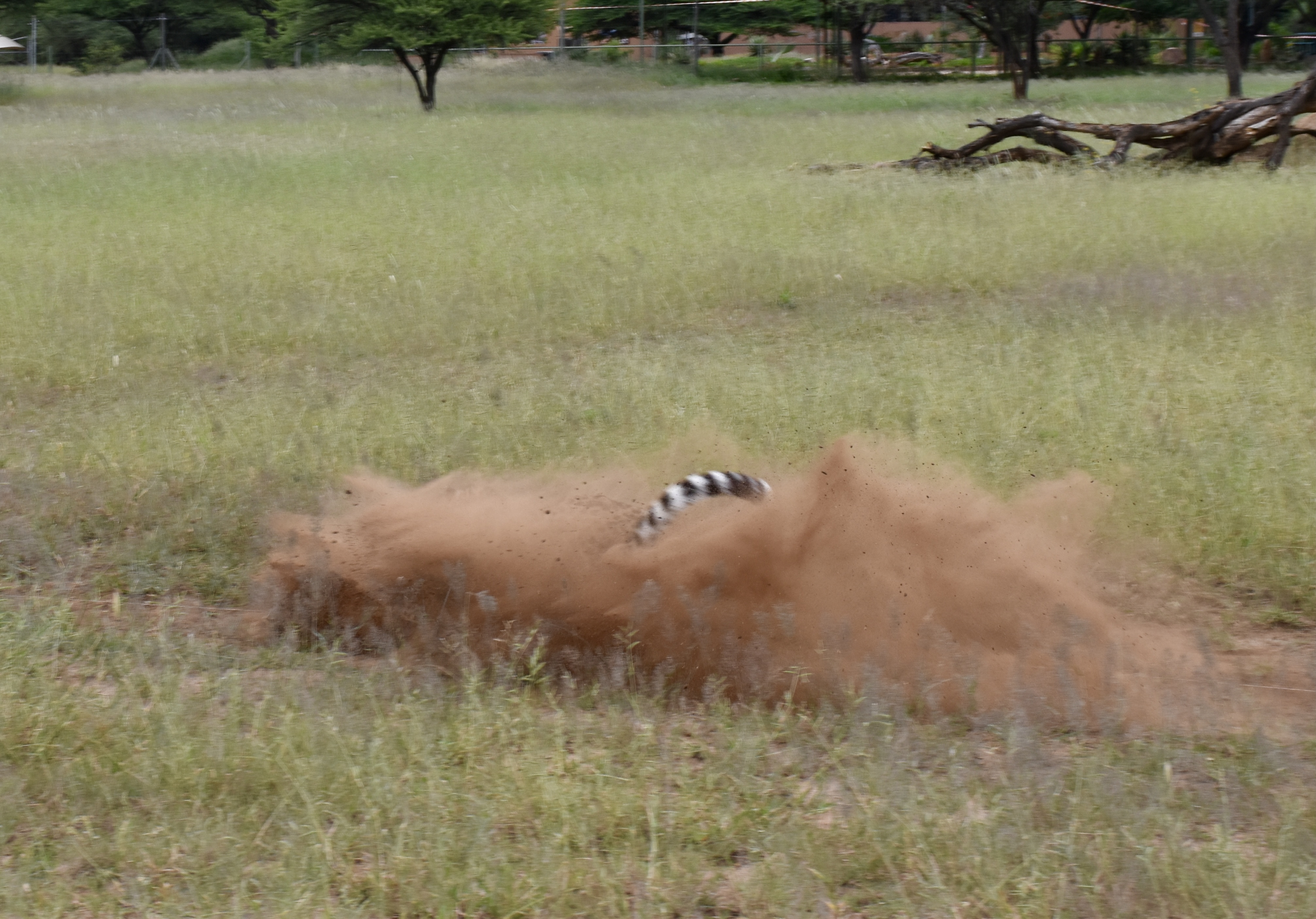
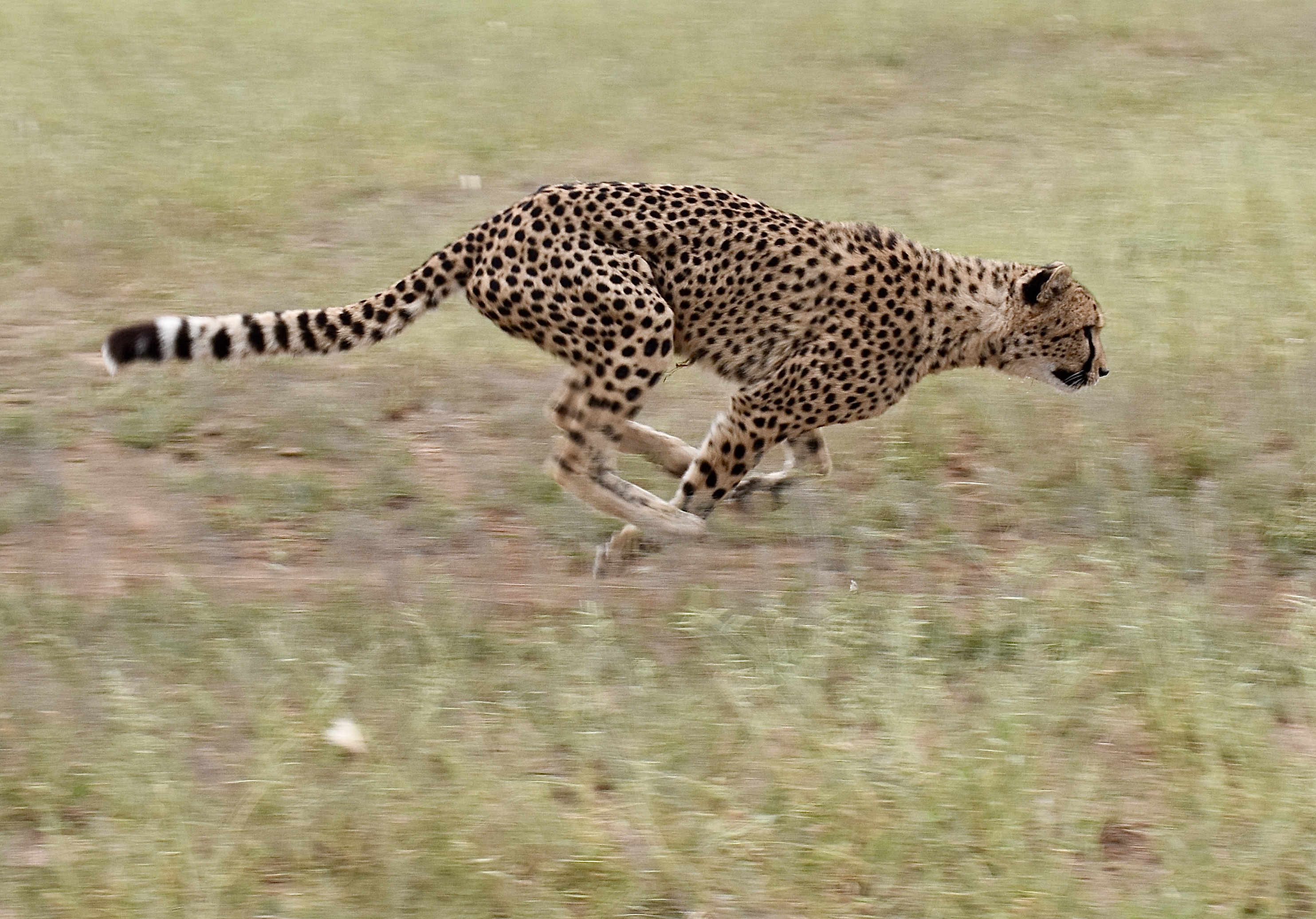
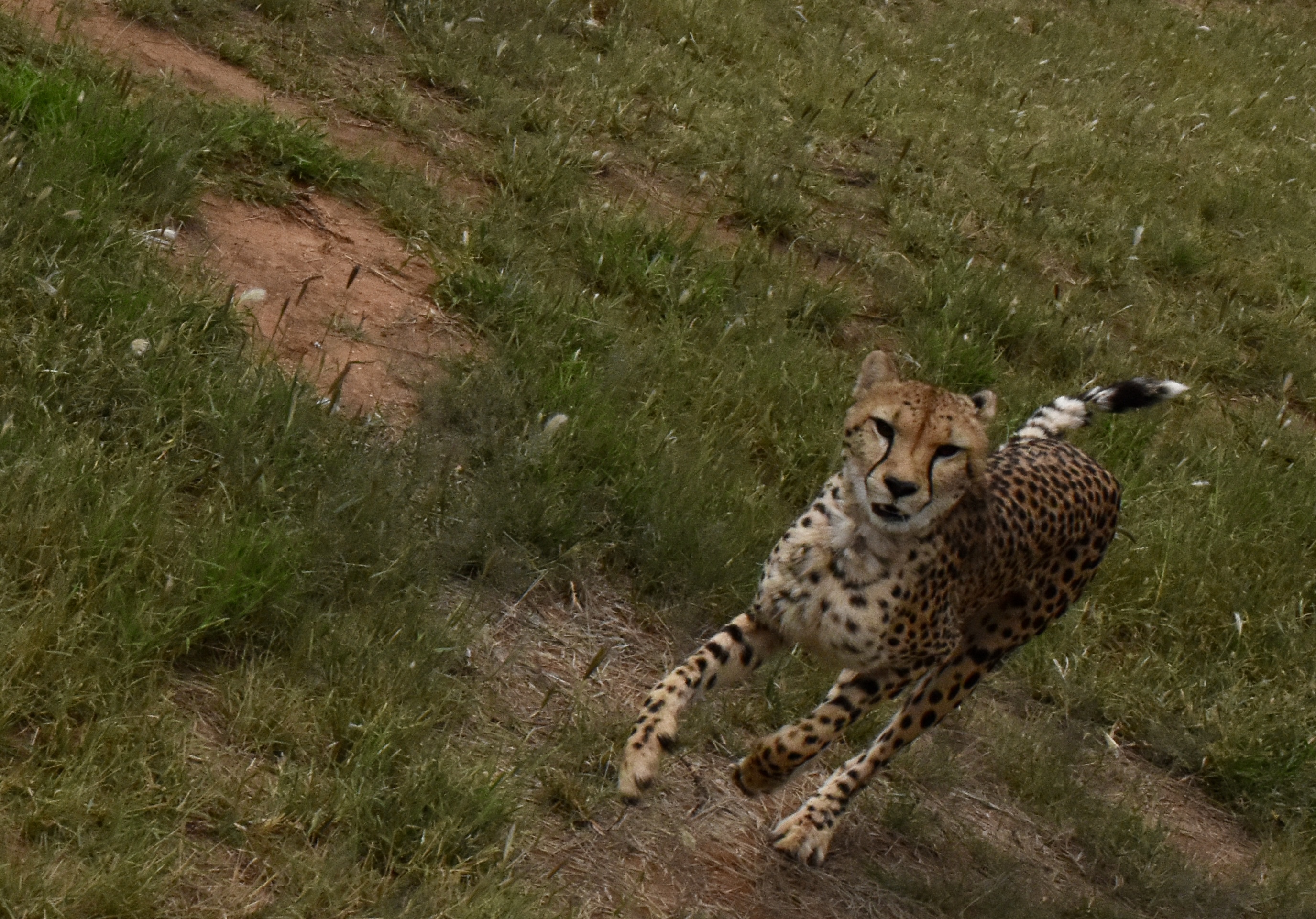
Later that morning after breakfast, we watched the cheetah run.
“Elves” starting to set out our breakfast. (The hot is made to order by Chef.)
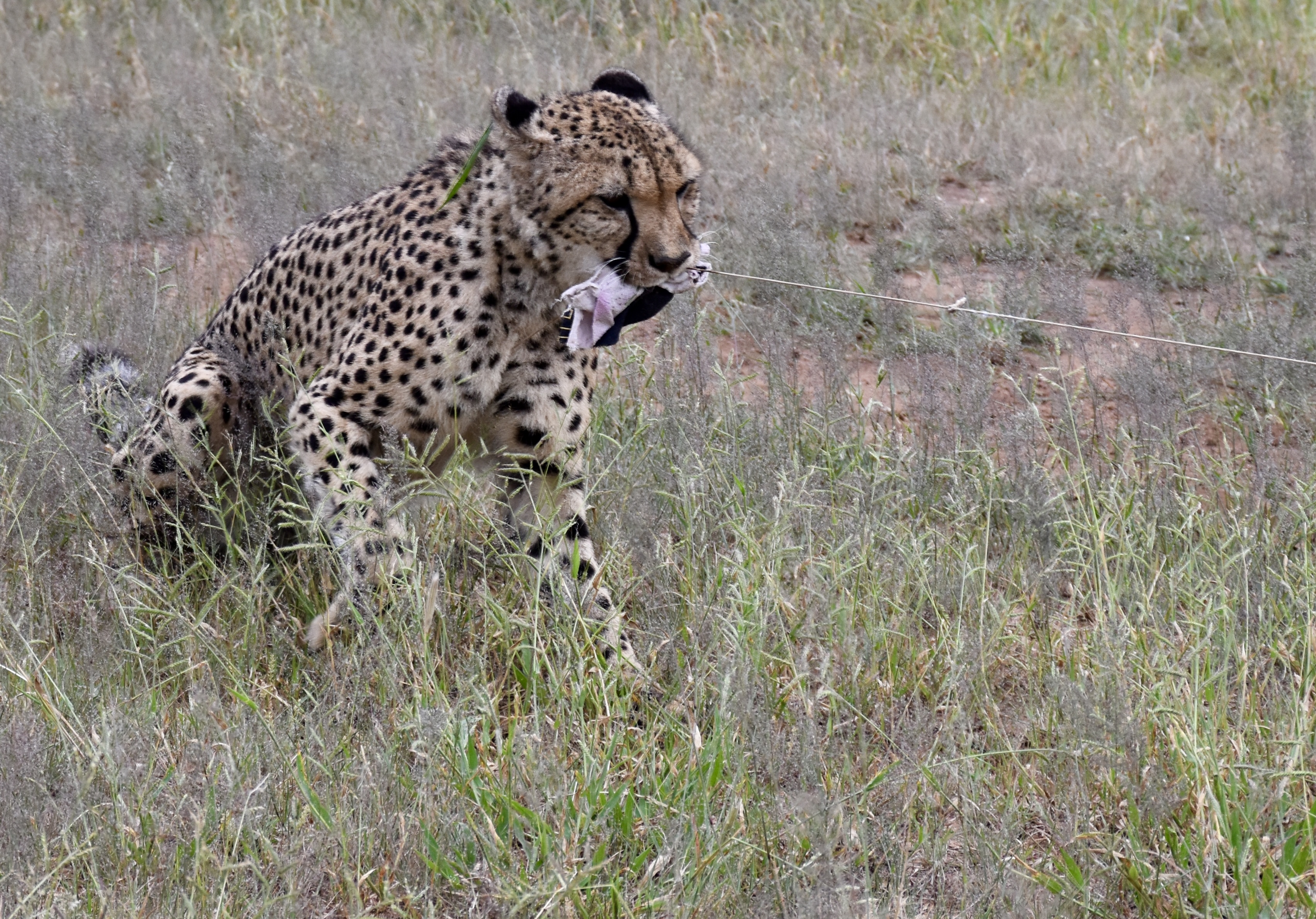
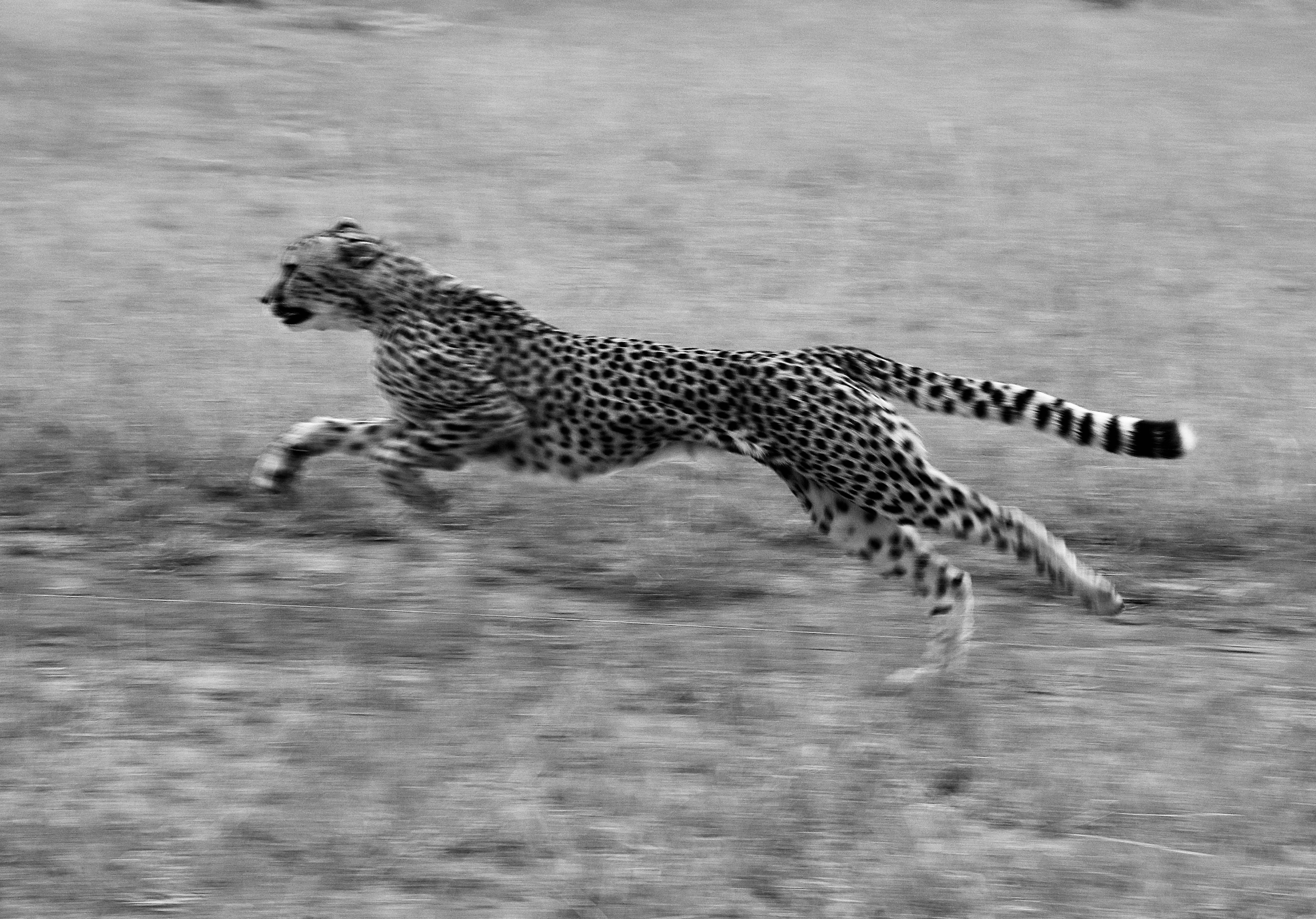
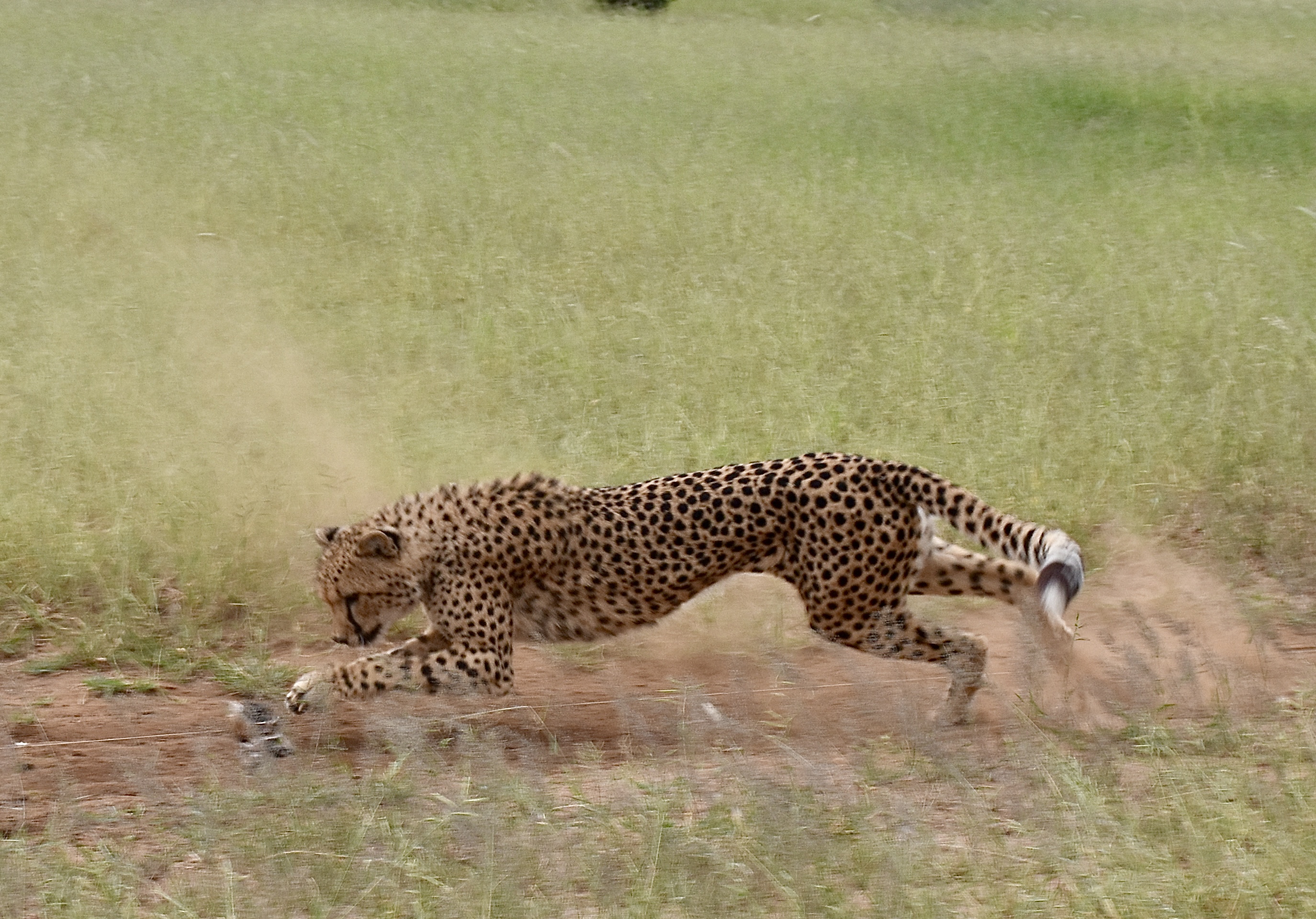
To keep rehabilitating cheetahs in top condition, CCF uses a lure system where a cloth is pulled along a wire track across an open field. The lure can change direction, accelerate, slow down — even double back — forcing the cheetah to react the way it would during a real hunt.
When a cheetah launches into a sprint, you suddenly understand the numbers you’ve read your entire life. They can reach roughly 60–70 miles per hour, but the most astonishing part is the acceleration.
It happens almost instantly.
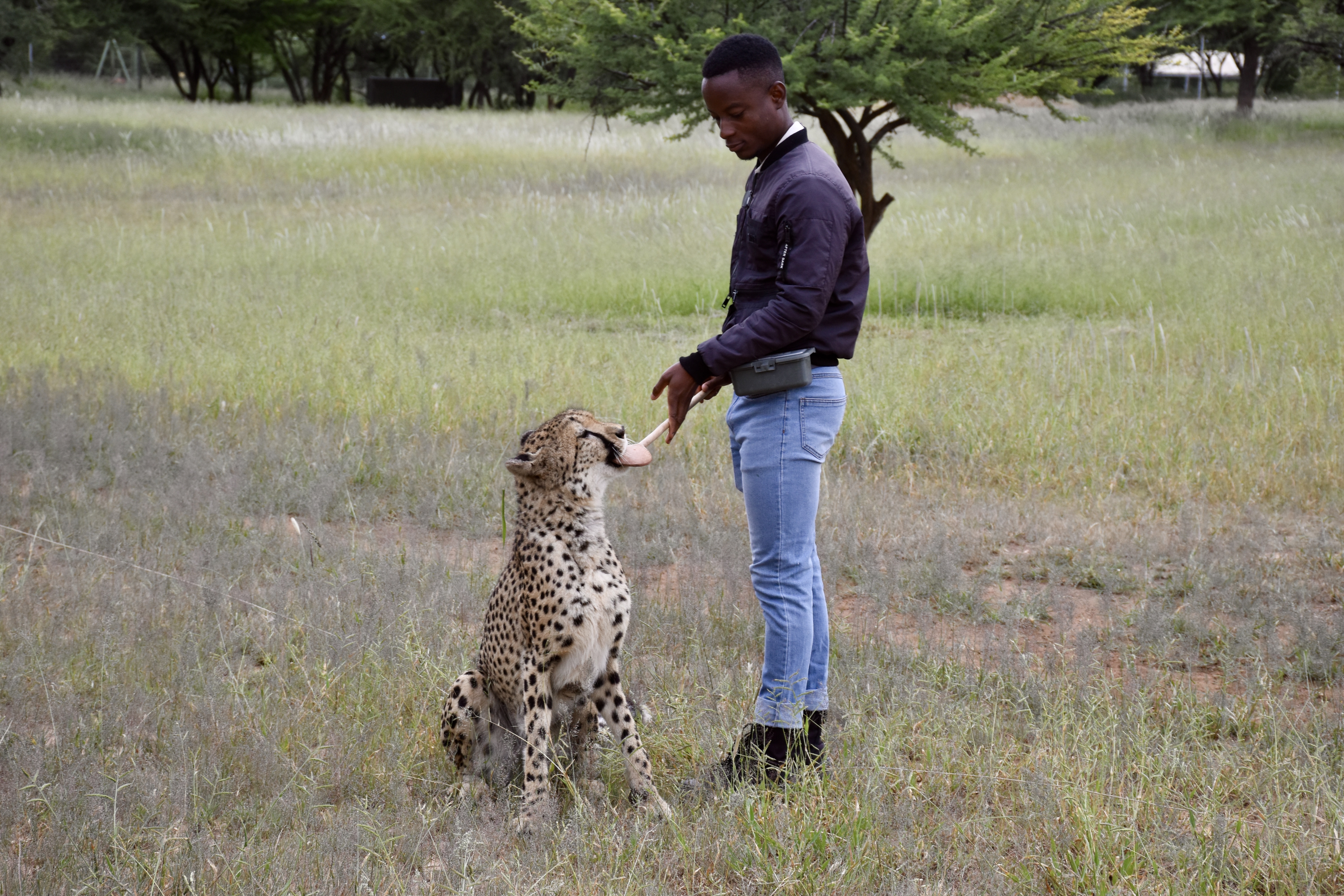
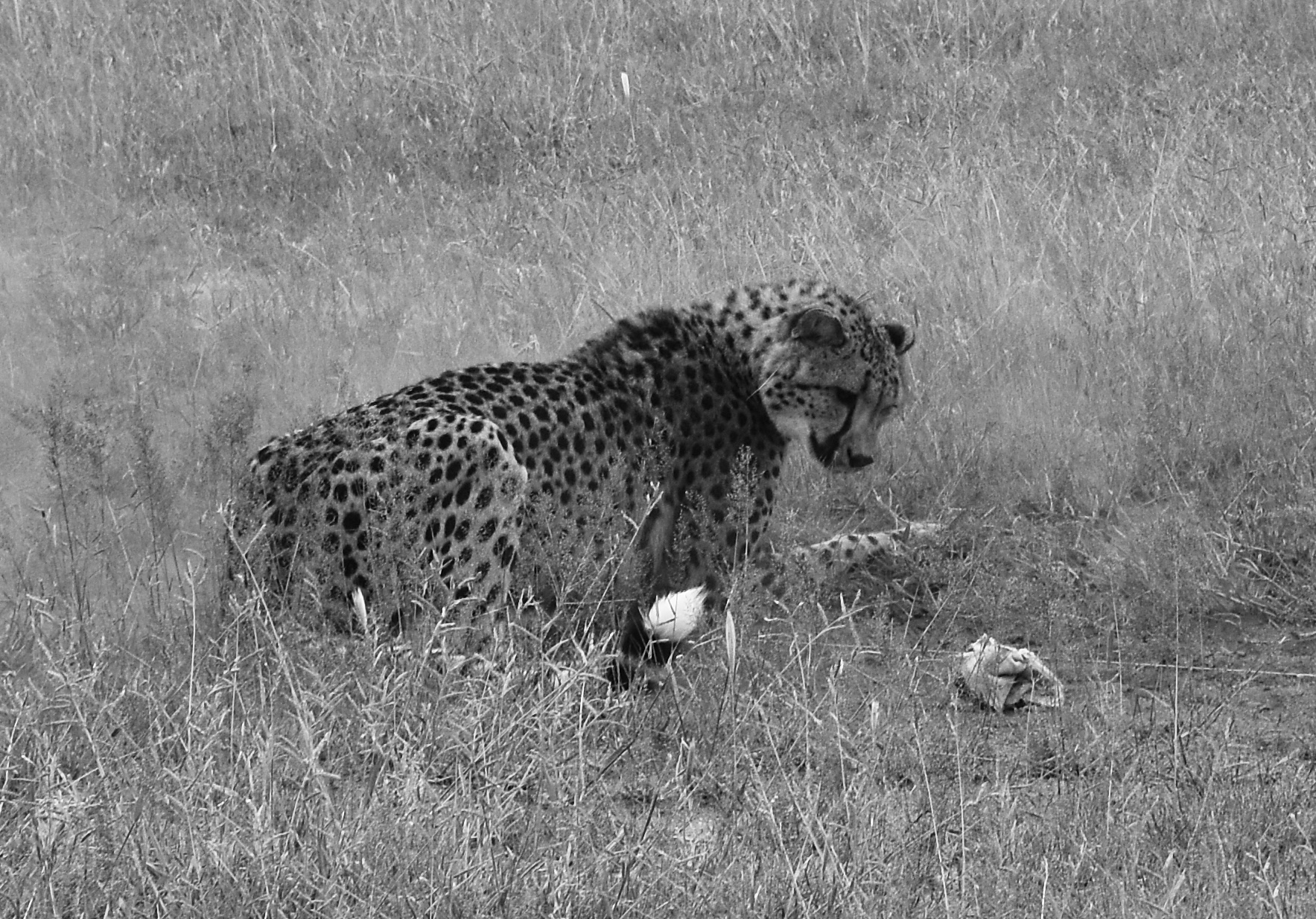
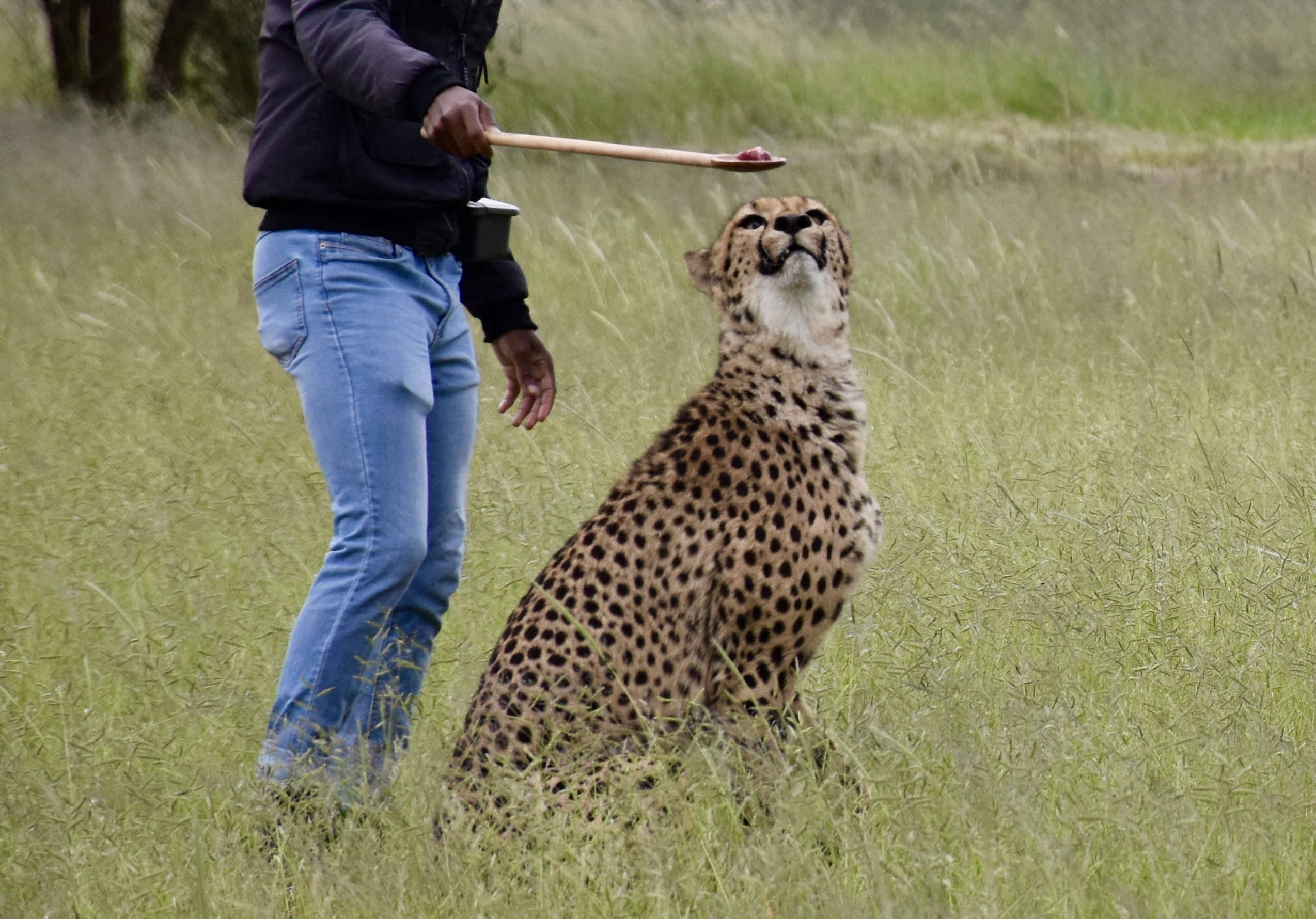
Once the cat catches the lure, it’s rewarded with fresh meat delivered on a long wooden spoon. That keeps the meat off the ground and prevents contamination.
Cheetahs have extremely delicate digestive systems. Unlike lions or hyenas, they cannot eat meat that has been sitting around for long. Their food must be fresh.
Watching the run was extraordinary.
You can IMAGINE the growl…!More growling (she doesn’t want to let go)
Behind the Scenes
Later we went behind the scenes to see the feeding of several cheetahs that are kept away from human contact.
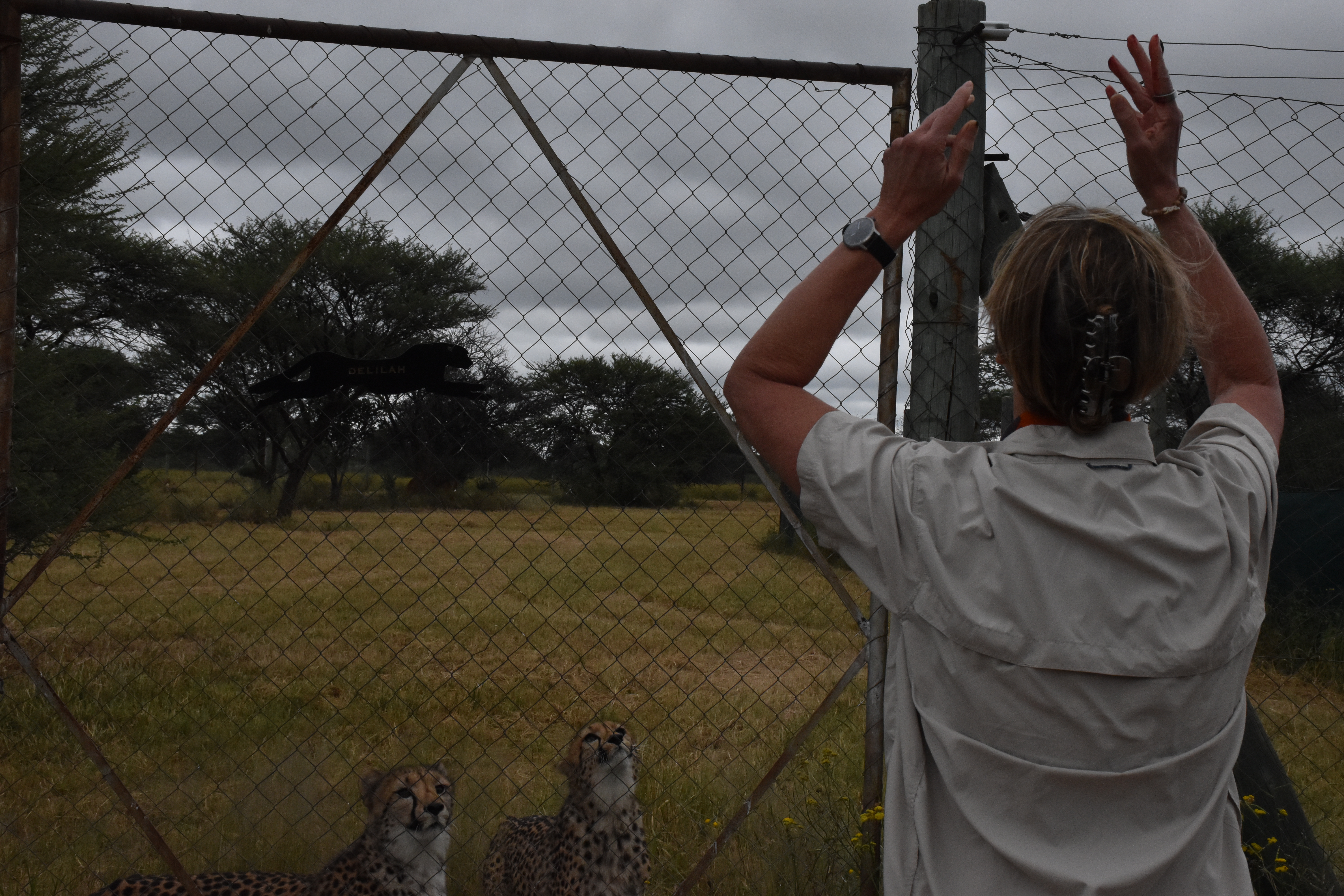
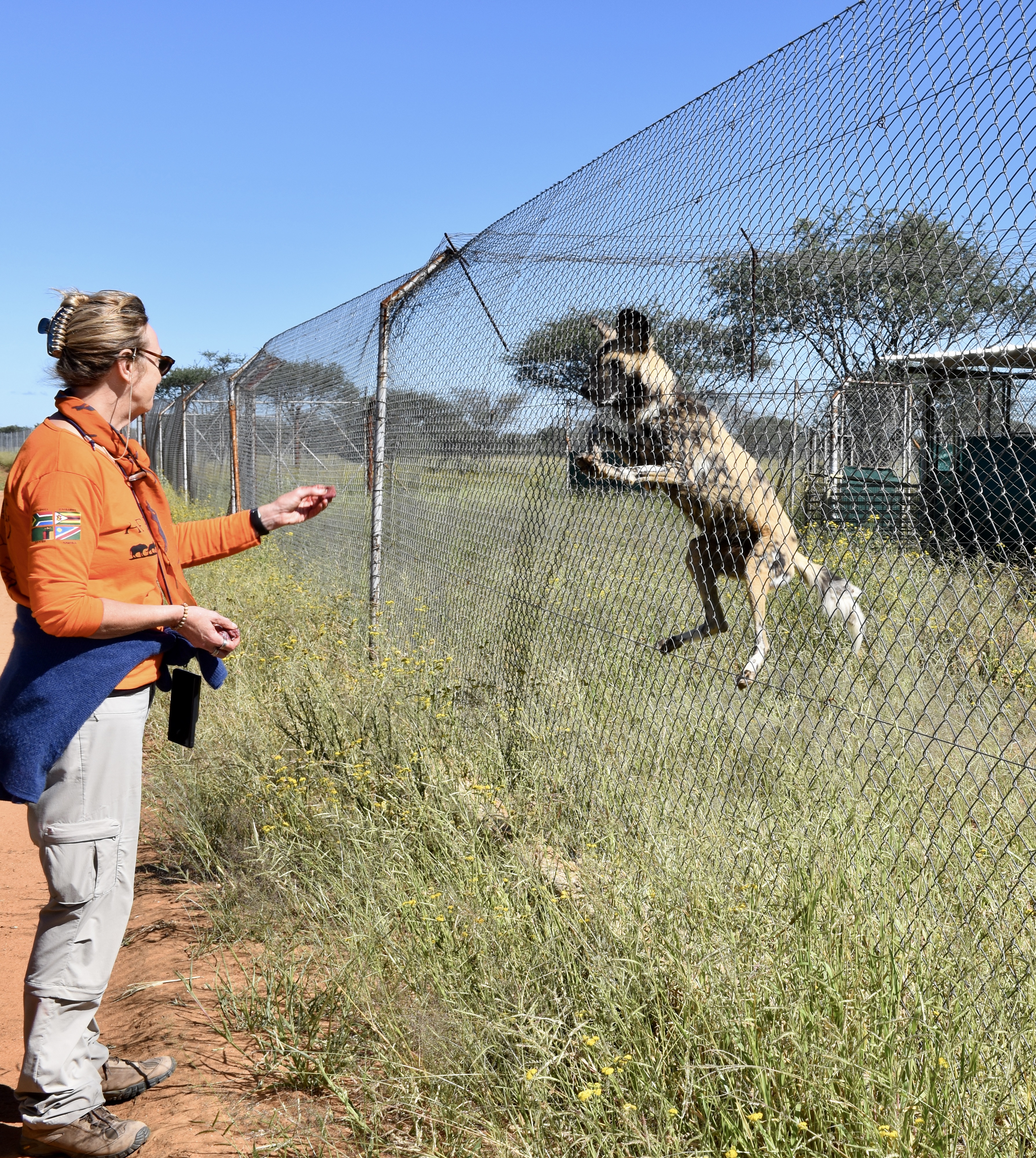
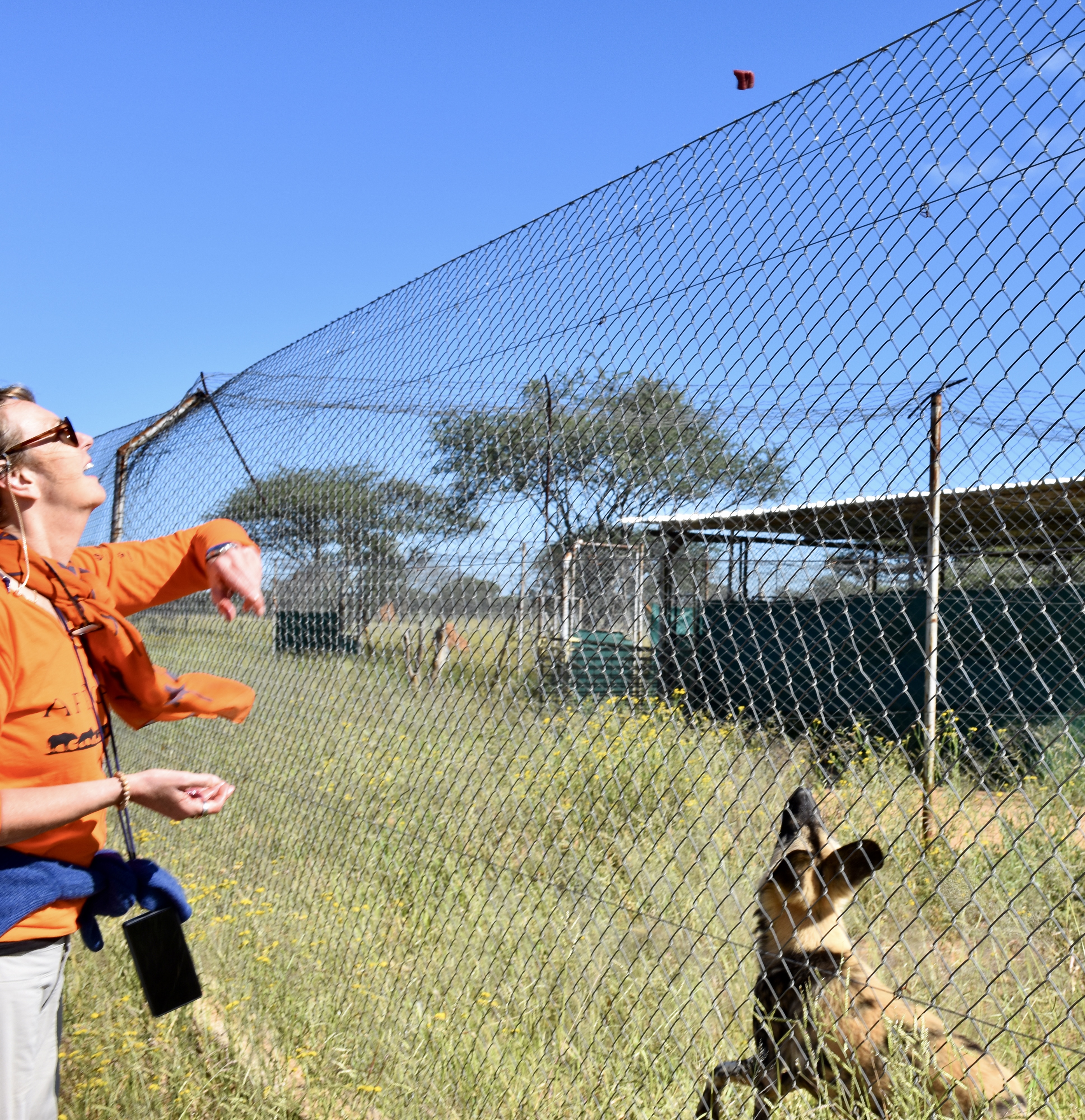
A jeep races down the road outside the enclosure and the cheetahs chase it. Once they arrive, big hunks of meat and bone are tossed over the fence.
Yes.
I was absolutely involved in that process.
Apparently once you’ve thrown meat to cheetahs once, you’re permanently promoted to the “throwing team.”
No one even asked after I’d done it the first time. Someone simply handed me a couple of haunches and pointed toward the fence.
I handed Lynn my camera so she could document the moment.
It’s a strange point in life when throwing meat to cheetahs begins to feel like a routine morning activity.
And I have to say:
A day without blood under your fingernails… how can that be a good day?
Living With Predators
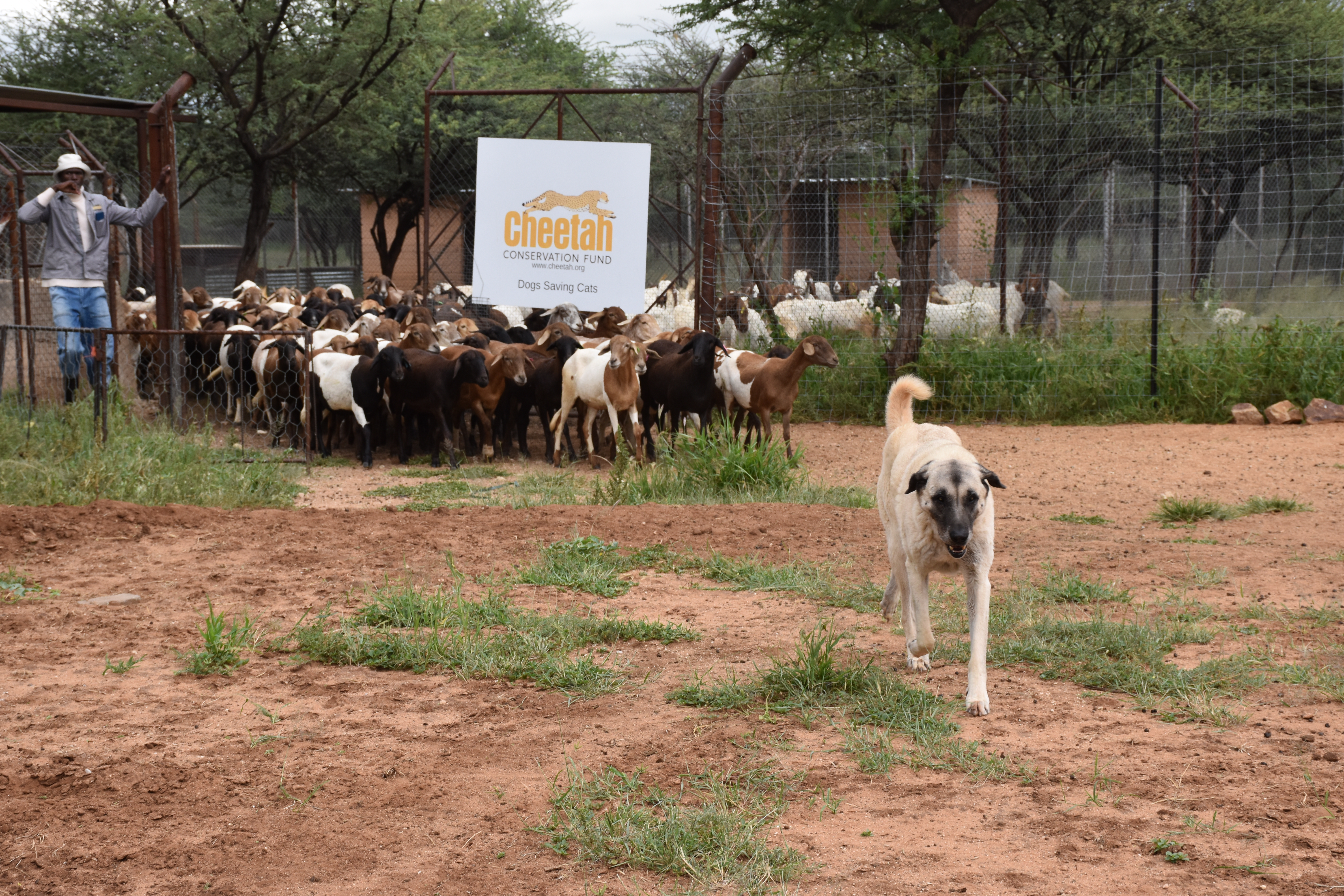
CCF is perhaps most famous for its livestock guardian dog program, which helps farmers protect their animals without killing predators.
These are large Anatolian shepherds who live with the herds of goats or sheep.
Unlike herding dogs such as border collies, which move livestock through pressure and fear, guardian dogs simply become part of the herd.
The animals trust them completely.
When a potential threat appears, the dog moves toward it and “addresses the situation.”
Watching a herd follow their guardian dog out to graze was remarkable. The goats trusted that dog completely.
And when a tractor happened to cross about fifty yards in front of the goats’ path, that dog made very sure the tractor understood it was in the wrong place at the wrong time.
We also met the newest recruits — a litter of milk-drunk Anatolian puppies born just a few days earlier.
They looked like little fuzzy potatoes.
Interestingly, the staff handles them as little as possible. They weigh them for health checks, but otherwise avoid bonding so the puppies will grow up identifying with livestock rather than humans.
Farmers who receive the dogs — after a long waiting list and a small fee — get to name the puppies themselves, which helps build the bond.
Helping Farmers Thrive: Goats, Milk, and New Income
Another part of CCF’s work focuses on helping farmers improve the economics of livestock so that predators become less of a perceived threat.
One of the interesting shifts they’re encouraging is the move from traditional meat goats toward dairy goats.
Many farmers in the region historically raise goats primarily for meat. But CCF has been working with them to demonstrate that dairy goats can provide a more stable and continuous source of income.
A dairy goat can produce milk for years after having a kid, which means the farmer has an ongoing product rather than a single sale. That milk can then be turned into higher-value goods — cheese, yogurt, soap, fudge, even ice cream (and milkshakes! Yum!) — creating additional income streams.
CCF also teaches farmers improved herd management practices.
Instead of goats giving birth sporadically throughout the year, farmers are encouraged to synchronize breeding so that kids are born around the same time. This allows the entire herd to be weaned, vaccinated, and wormed together, which is healthier for the animals and much easier for the farmers to manage.
Interestingly, this better care of the mothers often also results in more kids per birth, increasing the productivity of the herd.
What started as a small program has grown steadily. Many of the dairy goats now found in Namibia trace back to animals originally provided through CCF programs.
Even more encouraging, farmers in the United States have begun collaborating and sharing expertise, helping expand dairy goat knowledge, genetics, and practices.
It’s another example of the philosophy running through everything at CCF: conservation doesn’t succeed unless the people living on the land succeed too.
In other words, the goal isn’t simply to protect cheetahs.
It’s to make sure the farmers who share the landscape with them can make a living without feeling forced to eliminate predators.
If livestock are better protected, herds are healthier, and farmers have reliable income from milk and dairy products, the pressure to shoot a cheetah “just in case” drops dramatically.
Conservation, it turns out, is often less about saving animals directly — and more about helping people succeed on the land they live on.
And when that happens, the cheetahs get a future too.
It’s one of the things you begin to understand here: nothing in this landscape exists alone.
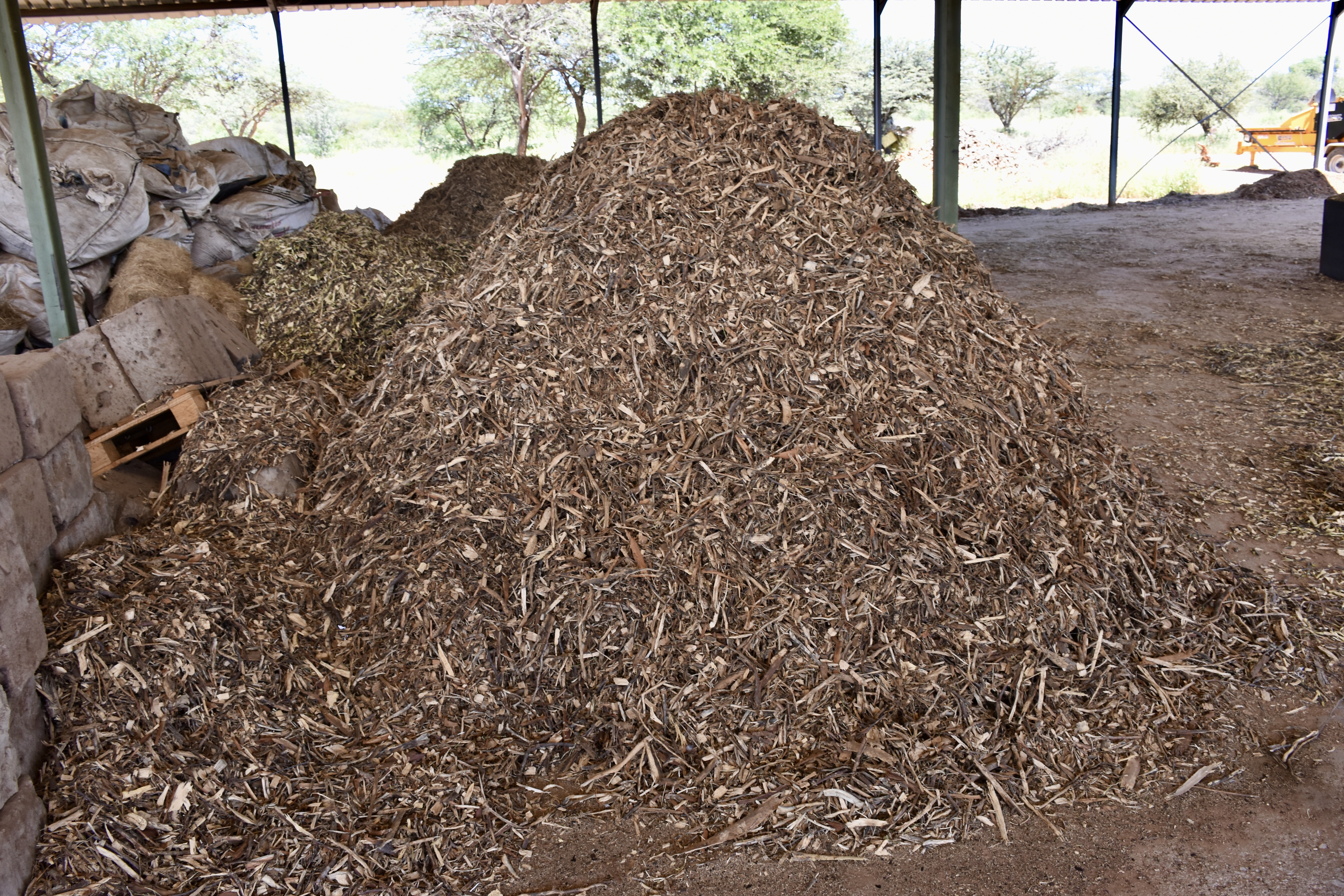
This is the wood going directly to Denmark as is
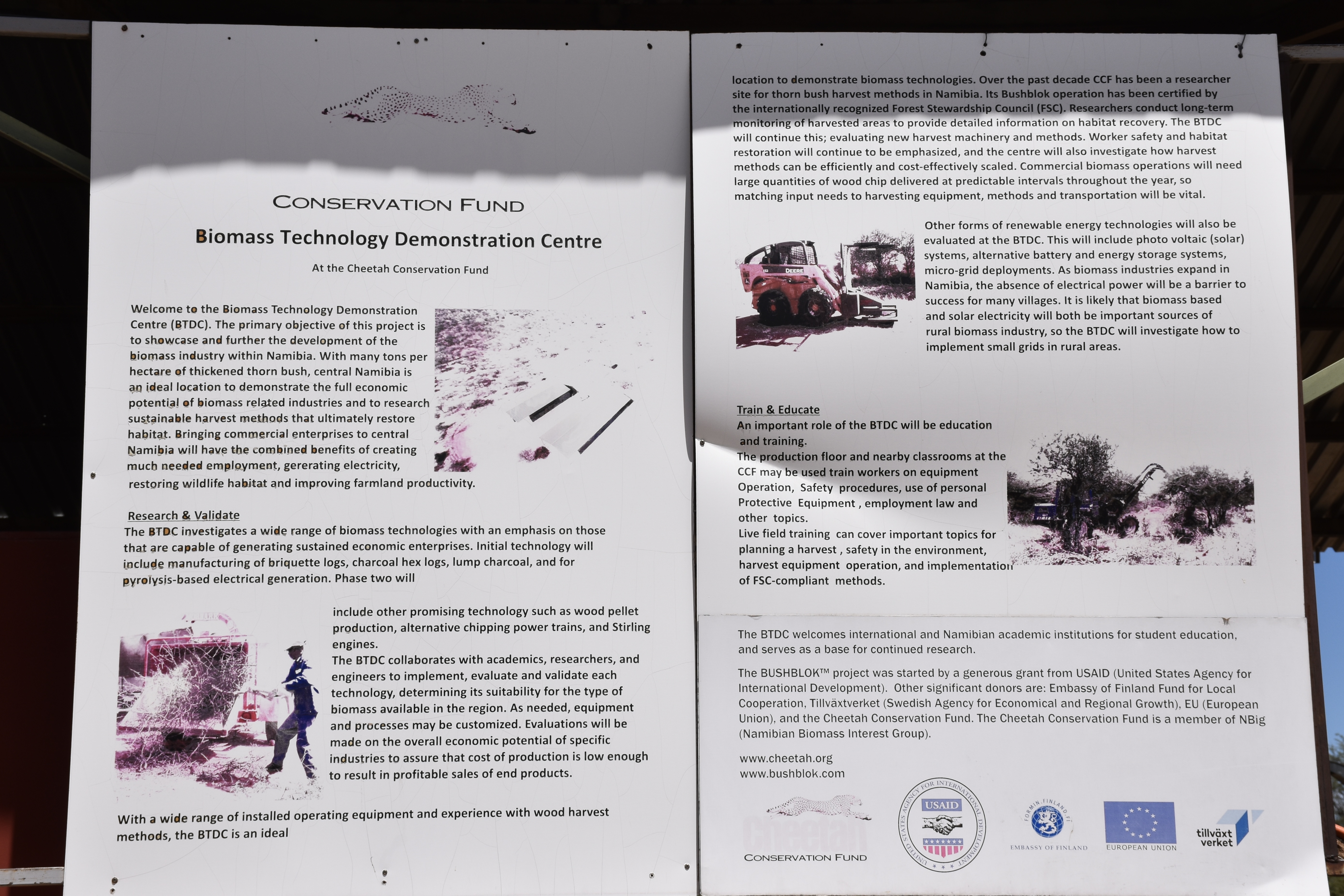
Bush Encroachment and the “BushBlok” Project
One of the biggest environmental challenges in Namibia is bush encroachment.
Large areas of land have become overrun with thorny shrubs and trees — including species like sickle bush (Dichrostachys cinerea) and various acacia relatives.
Some of this is natural, but much of it results from a combination of rainfall variability, climate change, overgrazing by cattle, and the disappearance of large animals like elephants that once knocked down trees and controlled bush growth.
The result is a landscape where thorn bush crowds out palatable perennial grasses that grazing animals depend on.
That affects everything.
Less grass means fewer grazing animals.
Fewer grazing animals means fewer predators.
So CCF developed an ingenious solution.
Bush is cut by hand, allowed to dry in the field, then brought to a processing facility.
Some of the most beautiful hardwood — especially from sickle bush — is actually shipped to Denmark for woodworking.
The rest goes through a multi-stage system:
First it’s chipped (which looks exactly like mulch from home).
Then it’s refined further into something between coarse sawdust and fine wood chips.
That material is fed into a machine that heats and compresses it into dense fuel bricks.
The heat breaks down the plant cell walls just enough for the material to bind together.
“We’re not making charcoal,” Bruce explained.
The process works — but there’s a problem.
Inside the machine is a spiral cutter that processes the wood.
Acacia and sickle bush are incredibly hard.
So hard that the spiral cutter lasts only about six hours before needing sharpening.
The machinery originally came from Denmark, and CCF is now working with engineers in the United States to design a more durable version that can increase production capacity.
Even with those challenges, the project is remarkable.
It restores grassland habitat, improves grazing conditions for wildlife, and produces useful fuel at the same time.
Practical conservation at its best.
New Tracking Technology
After lunch, we visited the Ecology Department. There, the head showed us the tracking collars used on released cheetahs.
The newest collars — being developed with Fahlo, the company that produces the cheetah tracking bracelet I wear — are far lighter and more sophisticated.
In addition to GPS tracking, some include a small camera mounted under the cheetah’s chin.
When the collar’s accelerometer detects hunting behavior, the camera activates so researchers can actually see what the cheetah is pursuing.
Each collar also includes an automatic release system. After about two years, when the battery dies, the collar drops off so the animal isn’t burdened with dead equipment.
If a collar detects that the animal hasn’t moved for a concerning period of time, it sends an alert.
Sadly, that often means a farmer has shot the animal.
Farmers are only allowed to shoot a predator if there is actual evidence it killed livestock. Too often, though, animals are killed simply because someone believes they might cause trouble.
One heartbreaking story involved a female cheetah that had been rehabilitated after a trap injury. She was released from CCF scant days before giving birth, because Namibia does not allow wild animals to give birth in captivity.
A farmer shot her.
Both she and the cubs died.
The ecologist — whose wife is CCF’s lead veterinarian — told us they simply cried and cried.
Sundowner and Dinner
Our second evening we went out on a sundowner drive across the property.
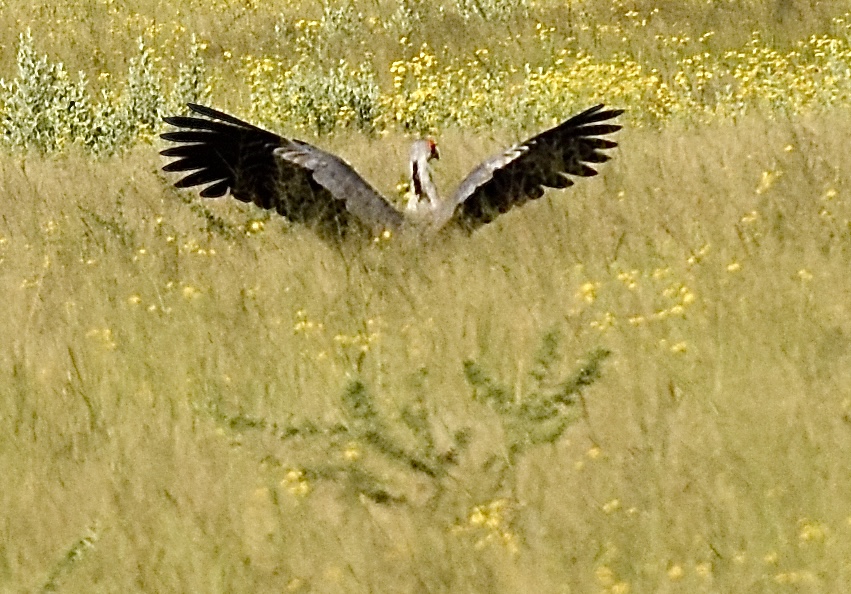
We saw a tower of eighteen giraffes, springbok, another smaller species of antelope, a massive herd of oryx, jackals, Cape hares, and — to my delight — a secretary bird.
I sent the photo to Jean-Marie, the birder from our earlier tour group who had been desperately hoping to see one.
Dinner that night with Dr. Laurie Marker and Bruce was unforgettable.
The conversation ranged from conservation science to Namibia’s wildlife to Somaliland versus Somalia to the founding of Namibia (Dr. Laurie talking about the people we had learned about at the Independence Museum . . . her friends), to the extraordinary amount of work still ahead.
The Last Morning
Our final morning at CCF began, appropriately, with meat.
As I mentioned before, once you’ve thrown meat to cheetahs once, you’re promoted permanently.
No discussion required.
Just hand over the meat and step up to the fence.
Then it was time to head for the airport.
(Yes, yes, I washed my hands . . . )
Even that departure had a little Africa-trip flourish.
When the three of us were checking in on the Windhoek to Frankfurt flight, Dr. Laurie was told that her flight from Frankfurt to San Francisco had been cancelled due to a Lufthansa strike. (Lynn was flying on United from Frankfurt to Chicago; I was on United from Frankfurt to San Francisco.)
Within minutes her journey home turned into a kind of aviation scavenger hunt involving Frankfurt, Copenhagen, and several other stops.
Just before the door closed on our flight, she was whisked on, and came back to show us she had made it.
After a month like this, a perfectly straightforward journey home would almost seem suspicious.
And with that, our time at the Cheetah Conservation Fund came to an end.
We headed for the airport carrying dust on our boots, a few new stories, and more than a little reflection about the journey behind us.
The flight home would bring its own kind of reckoning.
All photos of entire CCF portion can be found HERE
Lynn and I are now at the Cheetah Conservation Foundation (CCF), and as I started to type this, we were sitting on the veranda of Babson House, looking out over two cheetah brothers lounging in the afternoon sun while we sip wine from…appropriately…cheetah glasses.
Travel has its moments.
The name of these mountains translates to “butt mountain.” Our driver agreed that a perhaps better moniker would be “boobs mountain” (Cue Madonna bustiere from the ‘90s)
But first, a note on something we learned on the drive out to CCF. Our driver pointed out something that sparked a lot of conversation. We passed a massive property — roughly 85,000 hectares — that used to be a lodge where travelers could simply drive in, sit on the deck with a drink, and watch hippos, elephants, lions, and rhinos around the watering hole.
It was recently purchased by a private Mexican buyer.
Now the gates are locked, and no one can only enter with special permission. There’s growing concern locally that the property may eventually become a hunting farm.
The Namibian government apparently tried to purchase the land when it came up for sale, hoping to preserve the habitat and wildlife, but the price was simply too high.
Driving past it on the way to the Cheetah Conservation Foundation made the contrast very clear: one piece of land potentially closing to conservation, while another — here at CCF — is devoted entirely to protecting one of Africa’s most endangered predators.
Back to the veranda at Babson House. Babson House, where we’re staying, is absolutely gorgeous — thatched, comfortable, and more like a beautiful large private bush home than a lodge. The refrigerator is fully stocked, there’s wine waiting, and our chef has just headed out to gather the “fixins” for dinner.
This is clearly not roughing it.
Earlier today we watched the feeding of several cheetahs who were orphaned as very young cubs. These animals were bottle-fed as babies after their mothers were killed, and because they never learned to hunt from their mothers, they cannot be released back into the wild. So they live here permanently under CCF’s care. They are fed from bowls that mimic the way that they would be fed in the wild – the mother cheetah digs a hole in the prey on the ground, and the babies then eat from that “container” (TMI?)
But CCF also works with another category of cheetah — those that can eventually return to the wild.
Some animals arrive after being caught in traps or rescued from farms. In those cases the goal is rehabilitation. These cheetahs are kept far away from humans and exercised by running after mechanical lures so they maintain their hunting instincts before being re-released.
Yep, the cheetah brothers, playing with a Kong…
The most recent arrivals are two young brothers, both less than a year old.
They were rescued from a man who had killed their mother, trapped the cubs, and was preparing to sell them as pets — usually to buyers in the Middle East. When they arrived here they were dangerously thin and severely dehydrated. They’re recovering now, but still have a long road ahead.
Lunch at CCF was lovely (and included with the stay), and yes — I will admit to having a salted caramel milkshake.
I am on vacation, after all.
After lunch we were introduced to one of the foundation’s most important team members —one that H and I had actually sent specific donations in for eight years ago — one of the Belgian Malinois sisters who serve as CCF’s “scat dogs.”
Yes. Professional poop finders.
The dogs are scent-trained specifically to detect cheetah and wild dog scat. The scat team goes into the field, collects samples — carefully/not all of it, because the animals use scat for communication — and brings them back to the lab. So, the dogs locate samples, which researchers then analyze for DNA, hormones, and other biological markers that reveal health, diet, and population patterns.
This led us to what was honestly one of the most fascinating parts of the day.
We toured the genetics laboratory.
And wow.
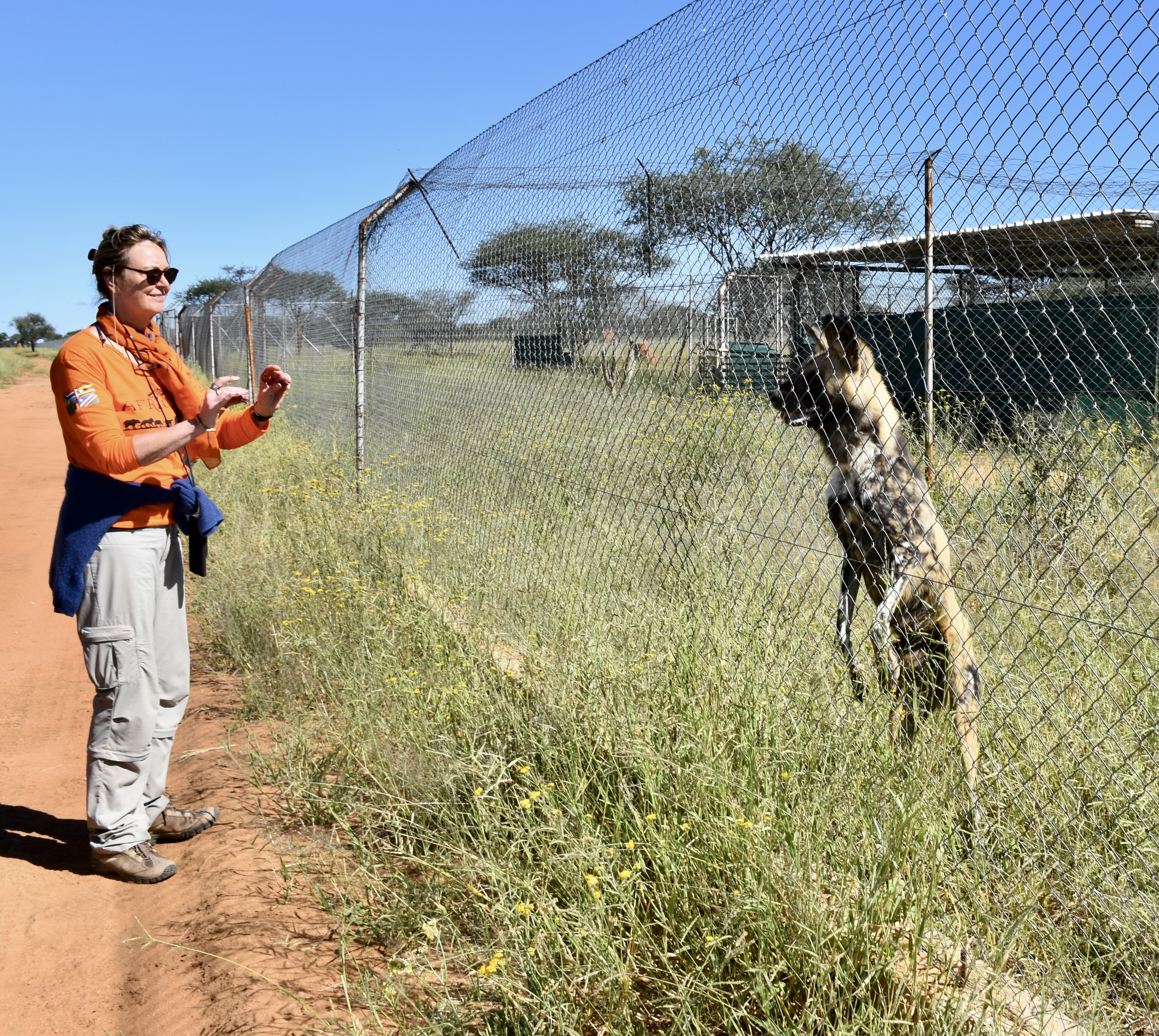
The scientists working there are all pursuing highly specialized PhDs related to carnivore conservation genetics. The woman who showed us around is doing her doctorate on African wild dogs — and interestingly, she has never actually seen one in the wild.
I told her I would bring over my photos from Kruger National Park tomorrow.
CCF also houses one of only three specialized DNA machines in all of Namibia. The other two are used for human purposes — one in a hospital and one by the government for forensic criminal investigations.
We were walked through the entire genetic testing process step by step.
It was a big Wow moment.
I was so impressed that I immediately made another donation — specifically earmarked for the genetics lab.
Tomorrow evening we’ll have dinner with Dr. Laurie Marker, the founder of CCF. As a fun coincidence, she will actually be flying back to the United States the same day we are — headed to Santa Cruz to give a presentation.
Small world.
But perhaps the most unexpected moment of the evening happened because of…a broken stove.
Our chef, Joshua, was preparing dinner in the kitchen at Babson House when the stove suddenly refused to cooperate. The staff (yes, we have “Staff”) sorted that out while we watched the magnificent sunset, which including a “sunset-bow” (rainbow/sunset combo – a first for me!). We drank our wine ignoring the muffled “words” coming from the kitchen, and talked with Tracy, who is looking after us during our stay, and Himee, the CCF assistant manager (Bianca is the manager).
What started as a simple delay turned into one of those quiet, meaningful conversations that travel sometimes gifts you.
Himee and I discovered that both of us had lost someone very important right around the same time — during the early days of COVID. His father. My husband.
We talked for a while about them.
I asked him what his father’s best attribute had been.
He said, without hesitation, that his father had been an amazing joke teller.
That made me smile, and it reminded me of something that has helped me think about loss.
I told him that sometimes I like to imagine that God needs people with very specific talents — and when that happens, they are “called home” because of that need. And during those terrible early days of COVID, Heaven must have been a very sad place.
Maybe Heaven needed someone who could tell great jokes and cheer everyone up.
At that point Himee’s eyes filled with tears.
I told him about H’s marbles — the small glass marbles made from my husband’s ashes that I’ve been sending out into the world so that he can keep traveling.
Himee immediately asked if he could help place one of the marbles here at CCF.
Of course I said yes.
Somehow the stove eventually decided to cooperate, and dinner appeared — and it was absolutely extraordinary.
Michelin-star level extraordinary.
Chef Joshua produced course after course with total calm and humility, and handled Lynn’s lactose intolerance without even blinking. Every plate that arrived felt like something from a high-end restaurant — except we were sitting in the Namibian bush with cheetahs nearby.
Lynn and I kept looking at each other and laughing.
How is this even real?
The people here are remarkable — kind, deeply knowledgeable, and quietly dedicated to the work they’re doing.
And all the while, just outside on the veranda, the two cheetah brothers lounged peacefully in the fading light.
The “sunset-bow.”
Tomorrow morning we wake up early for the cheetah run, when some of the rehabilitating cheetahs will sprint after the lure across the reserve.
But for now, as I write this just before falling asleep, I’m still thinking about the conversations tonight — about fathers, jokes, marbles, and the strange and beautiful ways people meet each other in the world.
And somewhere outside, under the Namibian stars, two cheetahs are still keeping watch under the veranda.
We had an easy day and a late morning. Many people stayed back at the lodge to pack, but a few of us went with Abraham over to a small settlement just inside the park gates.
Once there, Abraham encouraged us to talk with the guard and ask him about his life. When asked if he was married, he said no. Abraham followed up:
“How many children do you have?”
“Two.”
In southern Africa, children don’t necessarily come after marriage — one of those cultural differences that makes you pause for a second and recalibrate your assumptions.
Then the conversation took an unexpected turn.
The guard, who looked to be in his 30s, asked if any of us were “single.”
Without hesitation, Abraham pointed to Mary and me and said that we were both widows.
Which, apparently, was all the encouragement required.
When it came time for a photo, he placed himself very confidently between us — looking quite pleased with how things had worked out.
Abraham was laughing, explaining that here, age is not considered a barrier — even when the woman is older than the man.
(At which point we felt it was only fair to introduce him to the term “Cougar.”)
On the way out, I picked up a “Big Daddy” T-shirt (with enthusiastic encouragement from Mary) along with a few other bits and bobs.
Then it was back to the lodge to pack — and get ready for what would turn out to be a rather magical final night in Sossusvlei.
Just before sunset we headed out in open vehicles for what Abraham carefully described as “drinks and snaaaaaacks.”
He now exaggerates the word because earlier in the trip several people heard him say “snakes.”
Which is…a very different invitation.
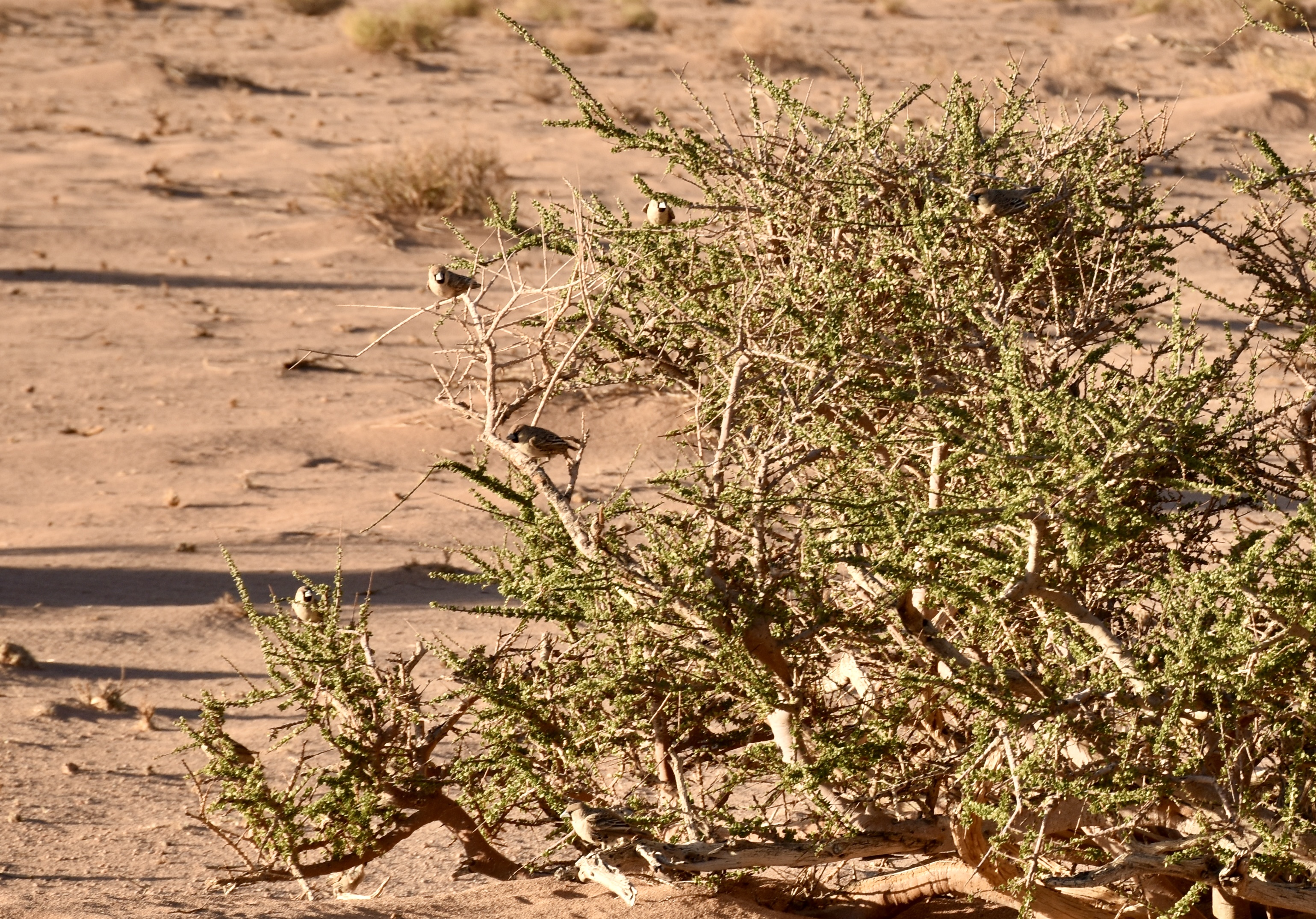
A weaver bird nest that we thought looked like a head!
We drove out into the desert as the sun began to drop behind the dunes. The rocks above us were dotted with dassies — those small, round little creatures that look like guinea pigs but are apparently the closest living relative to elephants. They sat up on the rocks like tiny supervisors, watching us settle in for sunset drinks.
Unfortunately this was the point where my digestive system decided it was still conducting experiments. So while everyone else was enjoying the spread, I stuck with ginger ale and quiet optimism.
Still, the sunset itself was magnificent.
But the real surprise came next.
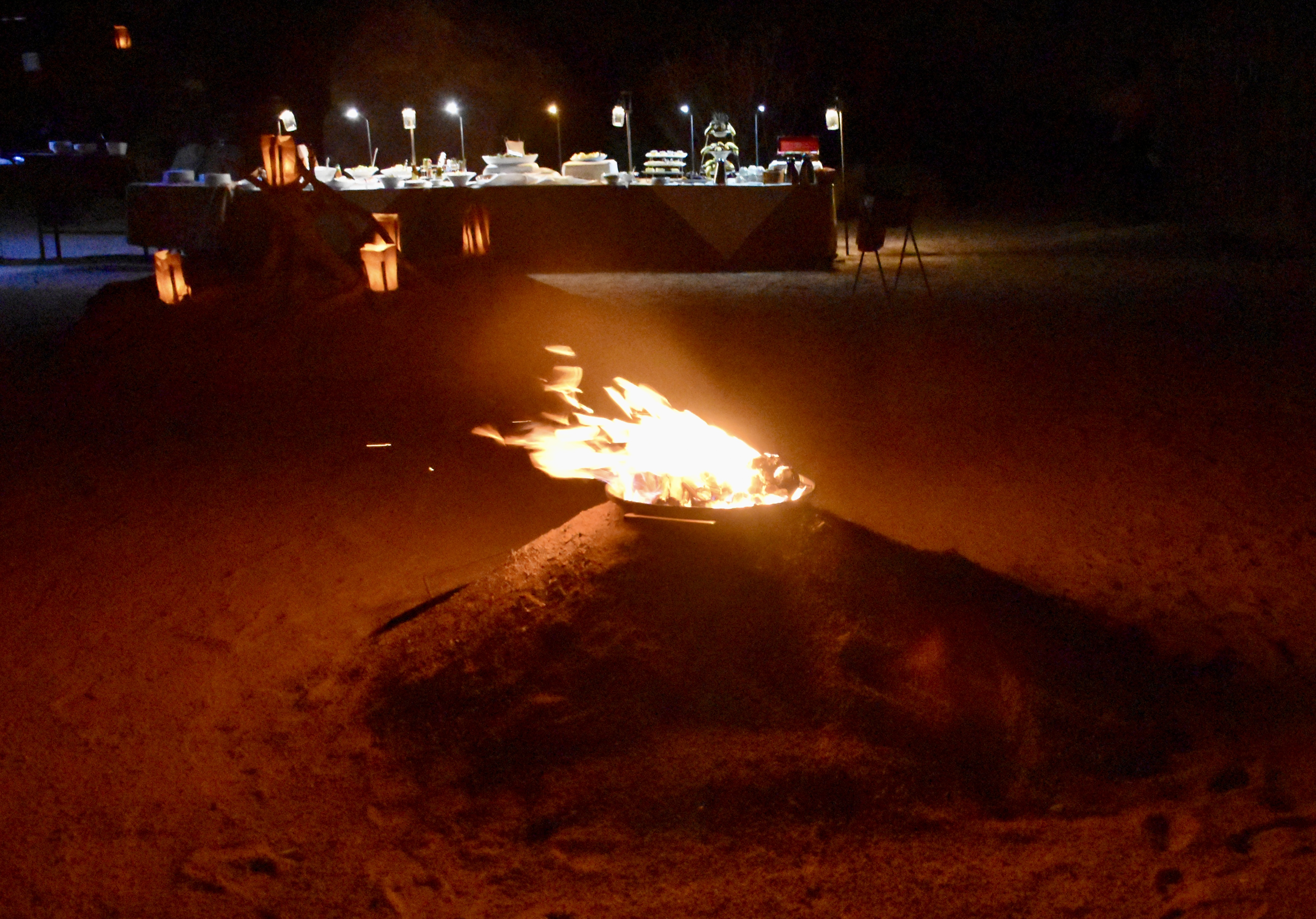
After the sun went down, we walked around a rocky outcrop… and suddenly a fairyland appeared.
Hidden just out of sight was the most elaborate bush dinner setup imaginable — lanterns glowing, tables set under the open desert sky, everything lit softly against the dunes. It felt like we had wandered into some secret desert banquet for a Namibian queen and her retinue.
Since I wasn’t really eating much that evening (Rice. Sigh.), I had plenty of time to simply sit back and take it all in. At one point I leaned back in my chair, tilted my head way back, and cradled it in my palms — elbows outstretched.
And there they were.
More stars than I have ever seen in my life.
Orion hung upside down in the southern sky, the Southern Cross gleamed nearby, and the Milky Way stretched across the darkness like a luminous river. It was one of those moments that travel gives you occasionally — where everything goes quiet and you realize how small and lucky you are at the same time.
The next morning we woke to a fierce desert wind blowing across the dunes. I’m fairly sure the proper word for it is scirocco — and even if it isn’t, it certainly felt like one.
After packing up we began the long drive toward Windhoek, with one legendary stop along the way.
Solitaire.
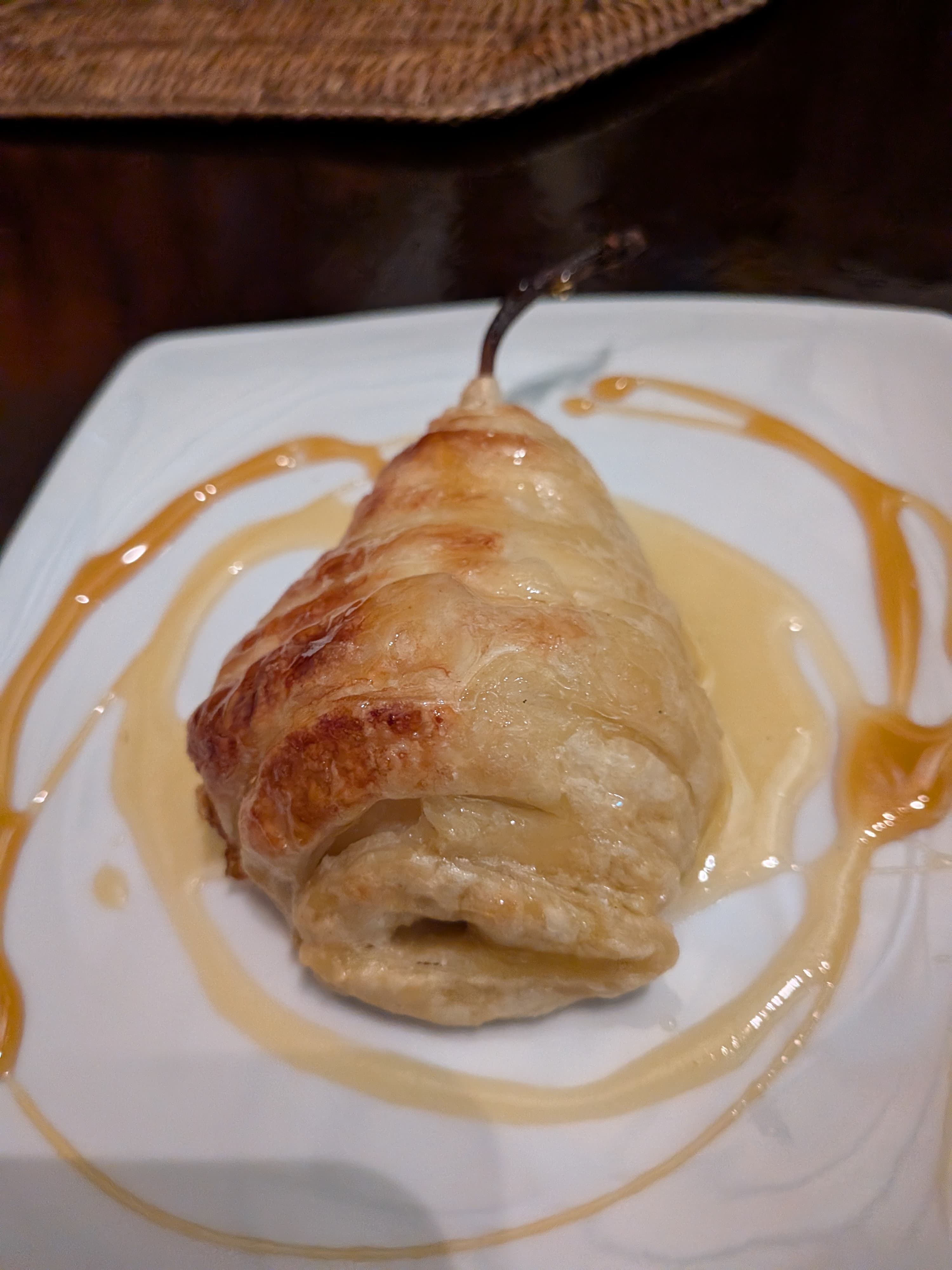
Travelers across Namibia talk about the Solitaire apple pie like it’s a required pilgrimage, so of course we had to stop.
The funny thing is that it isn’t quite what Americans expect when they hear “apple pie.”
Instead of a classic pie crust, the Solitaire version has a thick, crumbly topping — more like a streusel or shortbread crust baked over a deep apple filling. Historically, that made sense: pie dough doesn’t behave well in desert heat, but the crumb topping holds up perfectly for travelers passing through.
So what you actually get is a sort of Namib desert hybrid pastry.
And yes — it’s delicious.
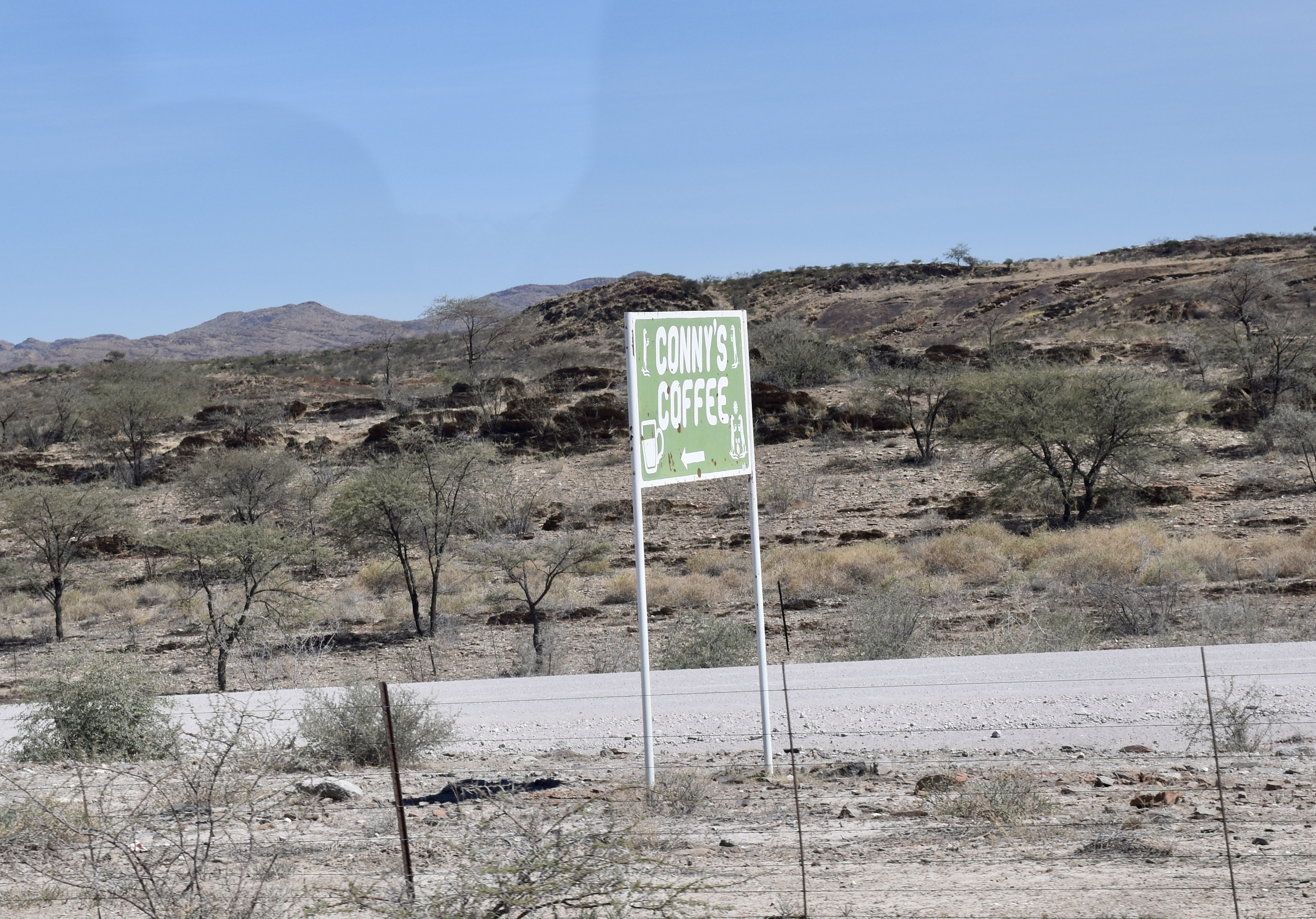
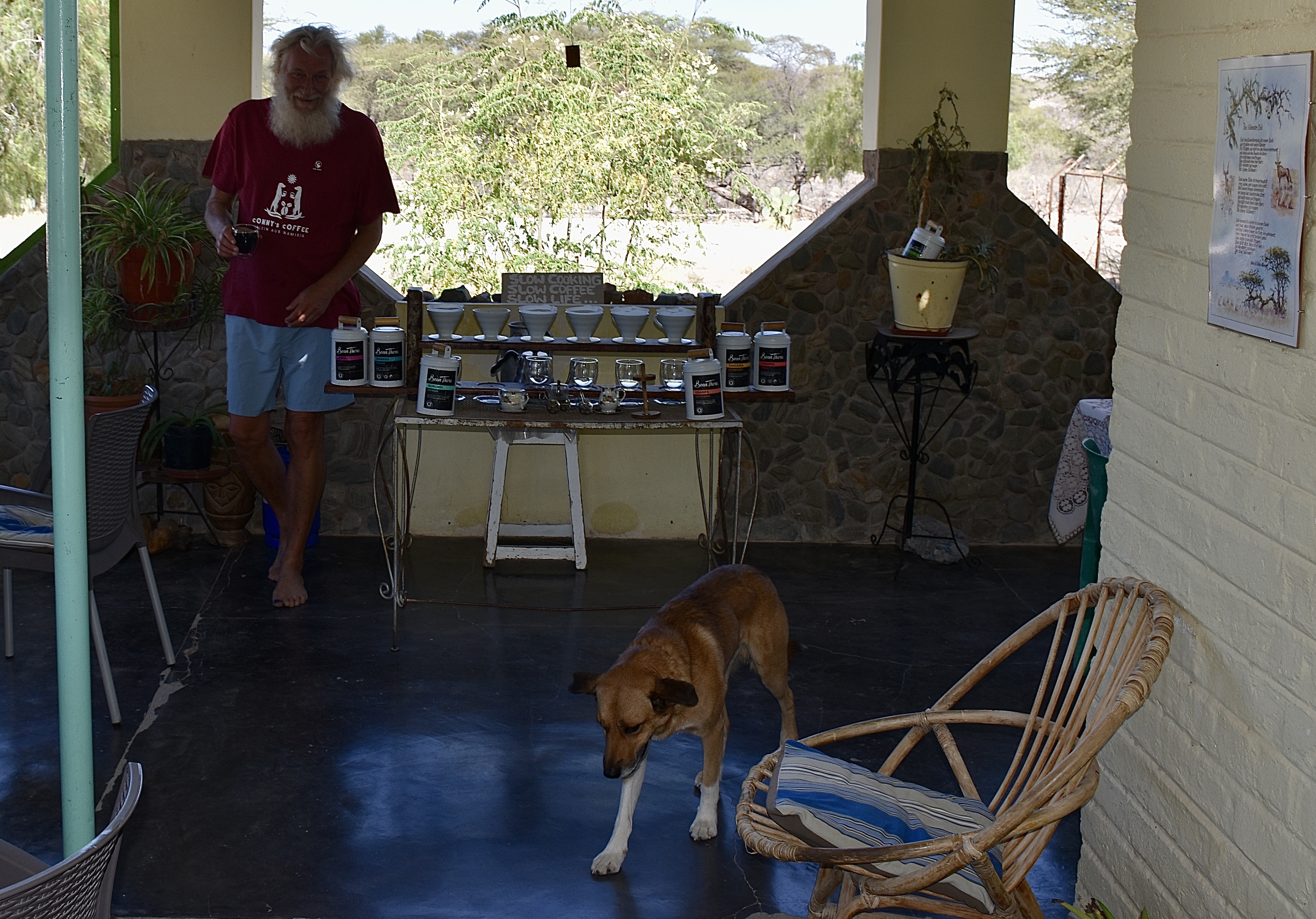
We also made another delightful stop along the way at a tiny roadside outpost where a man named Conny lives in the desert and runs what he calls “Conny’s Coffee.” Using solar power and careful technique, he brews pour-over coffee for travelers passing through.
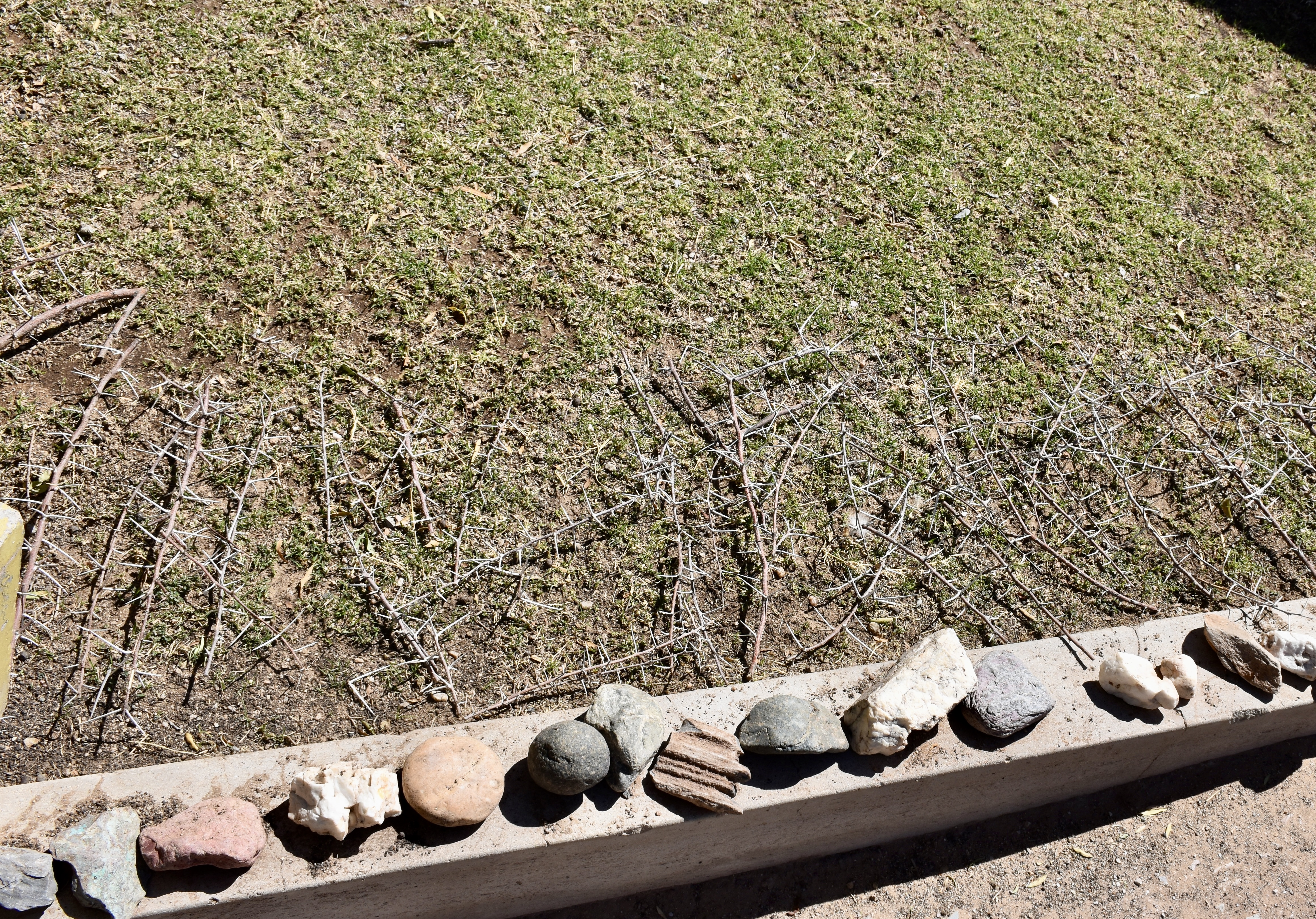
I took several photos of him and his ingenious little setup — including the clever way he keeps his dog, Bobby, off the small patch of grass he’s managed to grow. The solution? Surround the grass with dry acacia thorn branches.
Effective, elegant, and very Namibian.
It was the perfect place to stretch our legs — although I must admit I slept through quite a bit of the drive thanks to what Abraham jokingly calls the “Namibian massage.”
That’s the rhythmic vibration created by Namibia’s long, washboard gravel roads.
Eventually the desert gave way to hills and buildings, and we arrived in Windhoek.
Our hotel here, the AVANI Windhoek Hotel, turned out to have the best breakfast buffet of the entire trip — which felt like quite an achievement after many days on the road.
Another nice change: the hotel is right in the center of the city, within walking distance of many places, whereas previous OAT trips had stayed much farther out.
Before dinner Abraham arranged something special for us.
We stopped at the Independence Museum, and he actually paid to have it opened so he could guide us through the exhibits himself. We ended up touring all three floors with him acting as our docent, explaining Namibia’s long struggle toward independence. (NOTE: When Lynn and I got to CCF and were talking to Dr. Laurie, we mentioned visiting the museum. She noted that she knew *all* the players in Namibia’s independence. Specifically, “They were my good friends.” That’s when it hit me – she had been doing what she does in Namibia for a long, long time.)
The museum itself was powerful. There were moving dioramas depicting genocides, exhibits honoring resistance leaders and independence heroes, and sobering accounts of the violence inflicted during the colonial era. At one point we found ourselves trying to remember what we had been doing back in 1978, when some of the worst atrocities were taking place.
Most of us realized we hadn’t heard much about it at all.
Some vaguely remembered hearing that “Angola” was a “troubled place” in those years — which makes sense, since Angola was a major ally in Namibia’s fight for independence. But the scale of what had happened here — the massacres, the slavery, the brutality — was largely absent from the history many of us had learned or even heard of.
One particularly chilling account described how colonial authorities once instructed local communities to lay down their weapons and gather in a specific place — only to open fire on them once they arrived. Men, women, and children alike.
Standing there listening to Abraham explain it, the room grew very quiet.
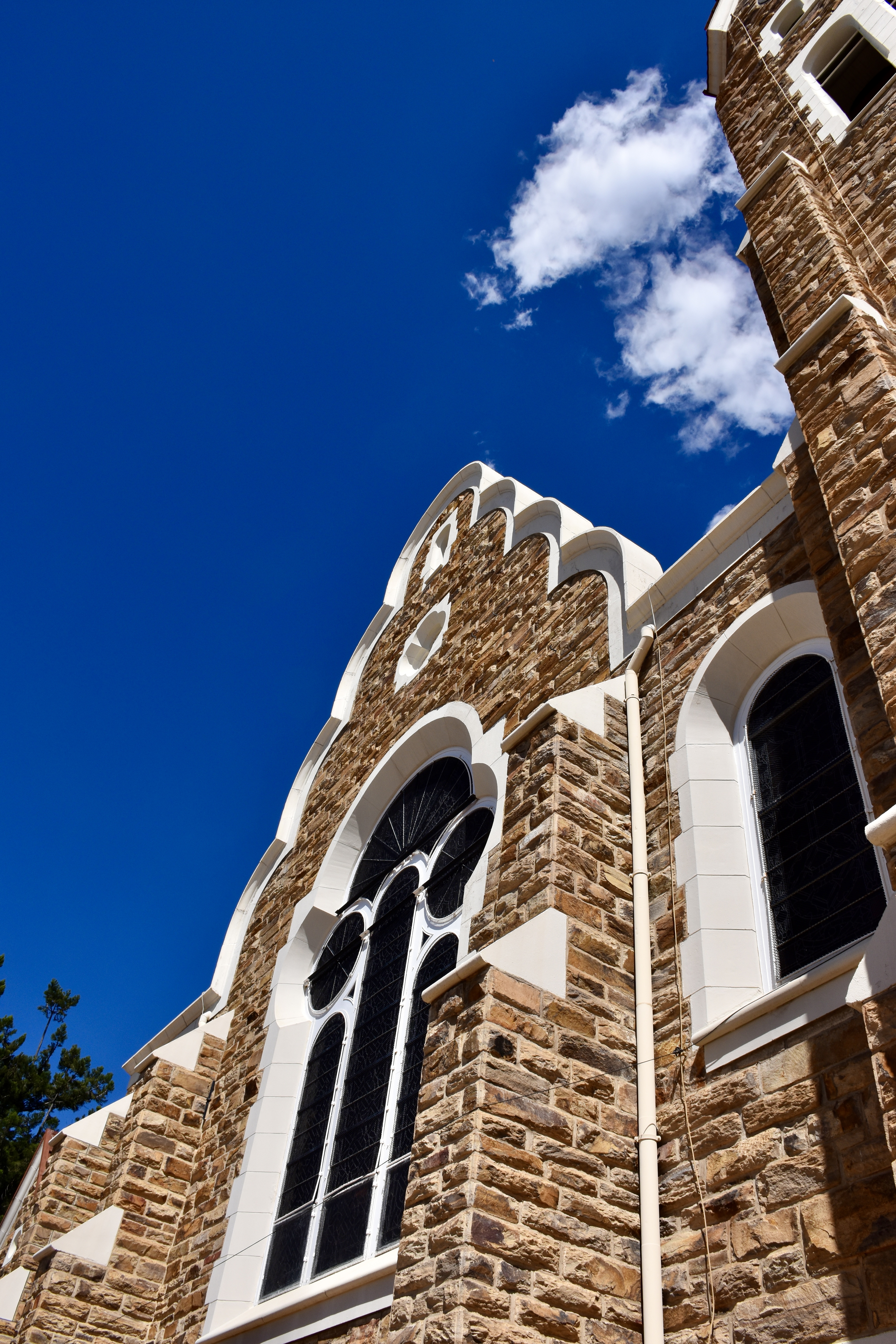
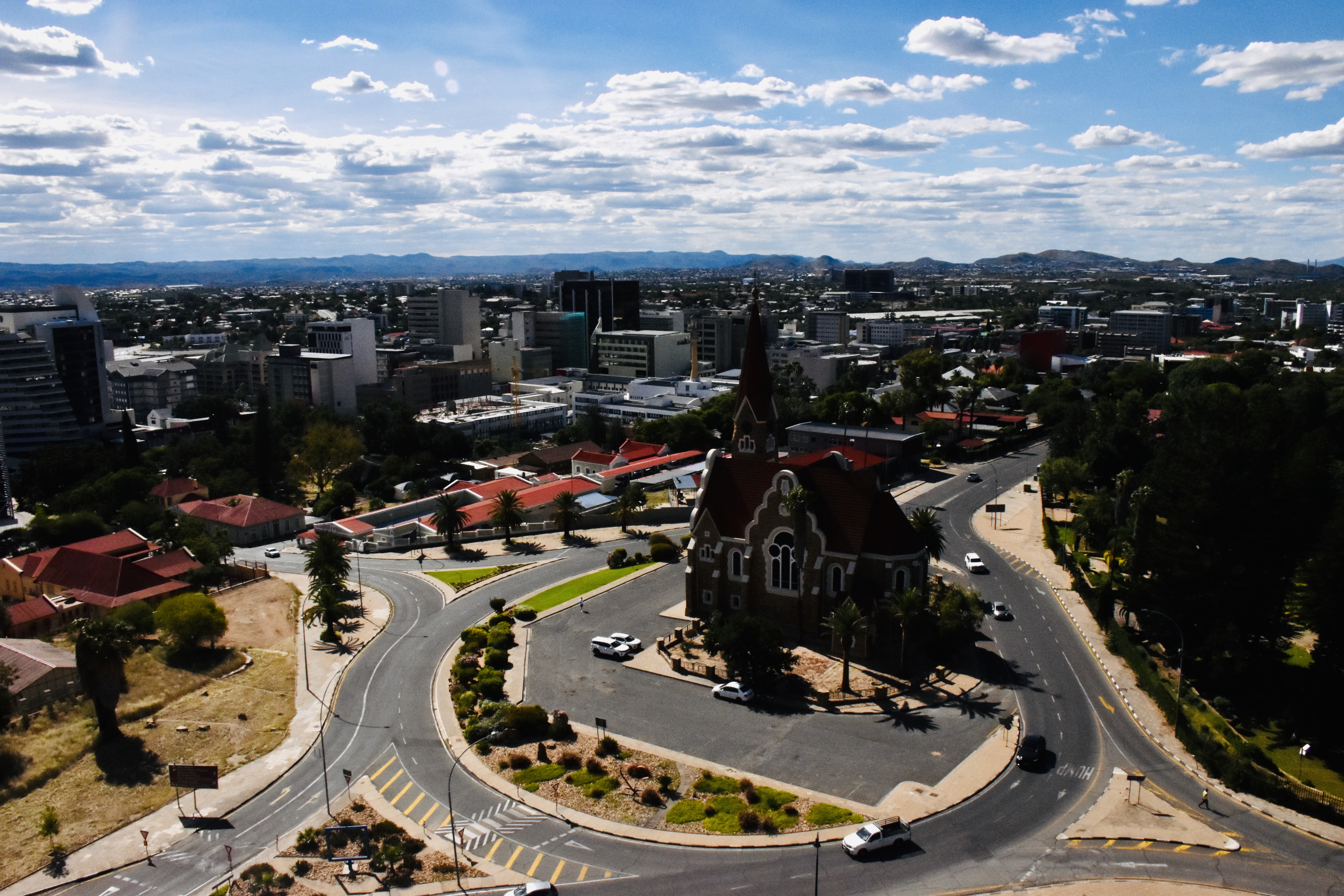
On the fourth floor of the museum there is a lovely restaurant and bar with sweeping views over the city. From there we were able to look down over Windhoek, including the iconic Christuskirche — the historic German Lutheran church that many guides refer to as the “Church of Peace” — glowing softly in the evening light.
Our official farewell dinner for the OAT portion of the trip was held at the lovely Stellenbosch Wine Bar & Bistro.
The meal looked wonderful… but my stomach still had other plans.
Earlier that day I had managed a piece of dry toast; from the prix fixe menu here, I ordered the steak with rice.
Once again, the rice won.
Abraham found a grateful recipient for the steak — the parking attendant guard outside the restaurant.
So although my culinary adventure in Windhoek was somewhat limited, at least someone went home happy.
By the end of the evening we said goodbye to the group as the OAT portion of the trip came to a close.
But the journey isn’t over yet.
Tomorrow Lynn and I head out to the Cheetah Conservation Foundation, where the next chapter of the adventure begins.
I never get a percentage from any links I include – but! – if you are curious about Overseas Adventure Travel and want $100 off, call them at 1-800-955-1925 and request their amazing catalog, tell them you were referred by Sandy Shepard, customer number 3087257, and get $100 off your first trip! The catalog is what all good dreams are made of!
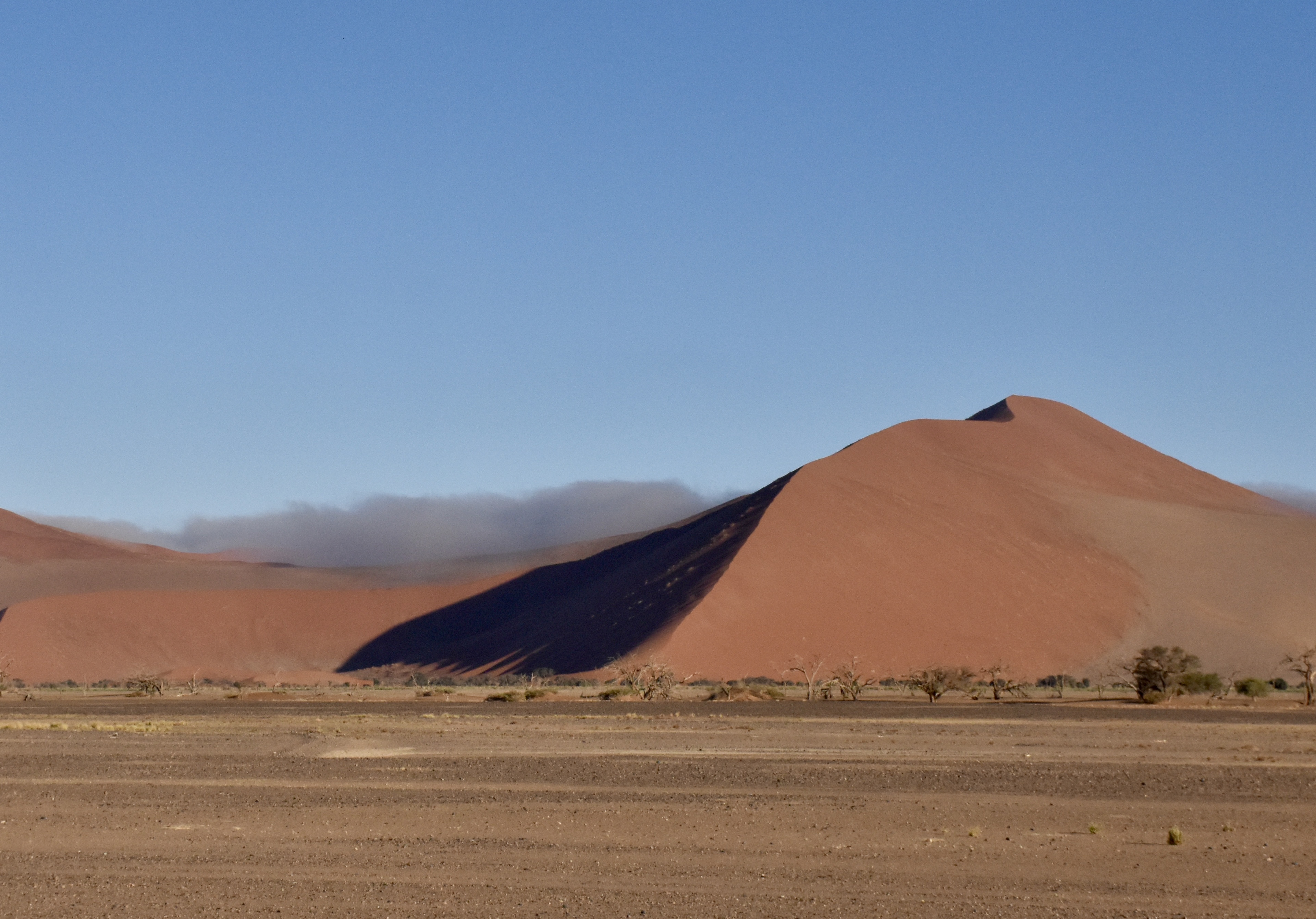
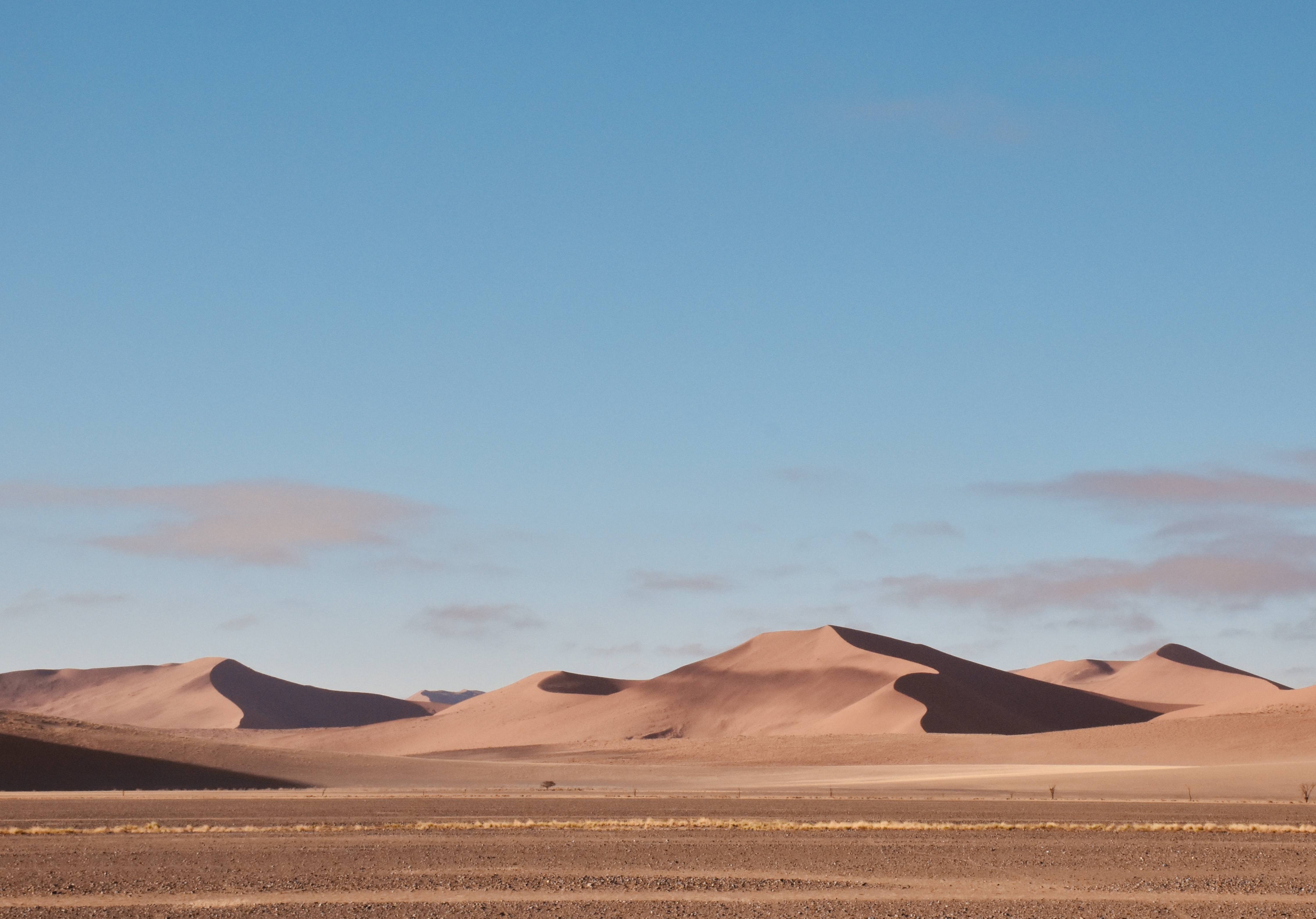
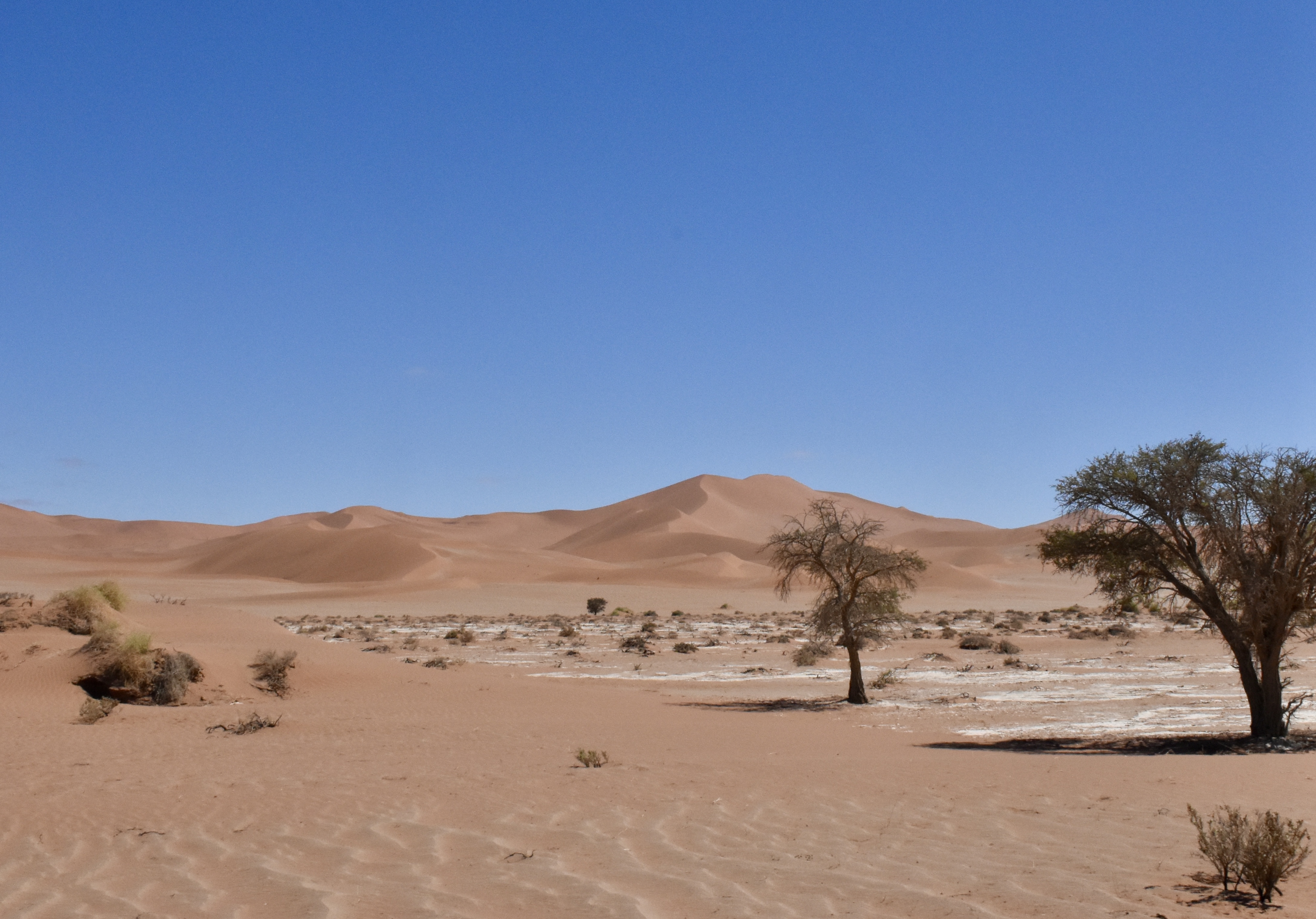
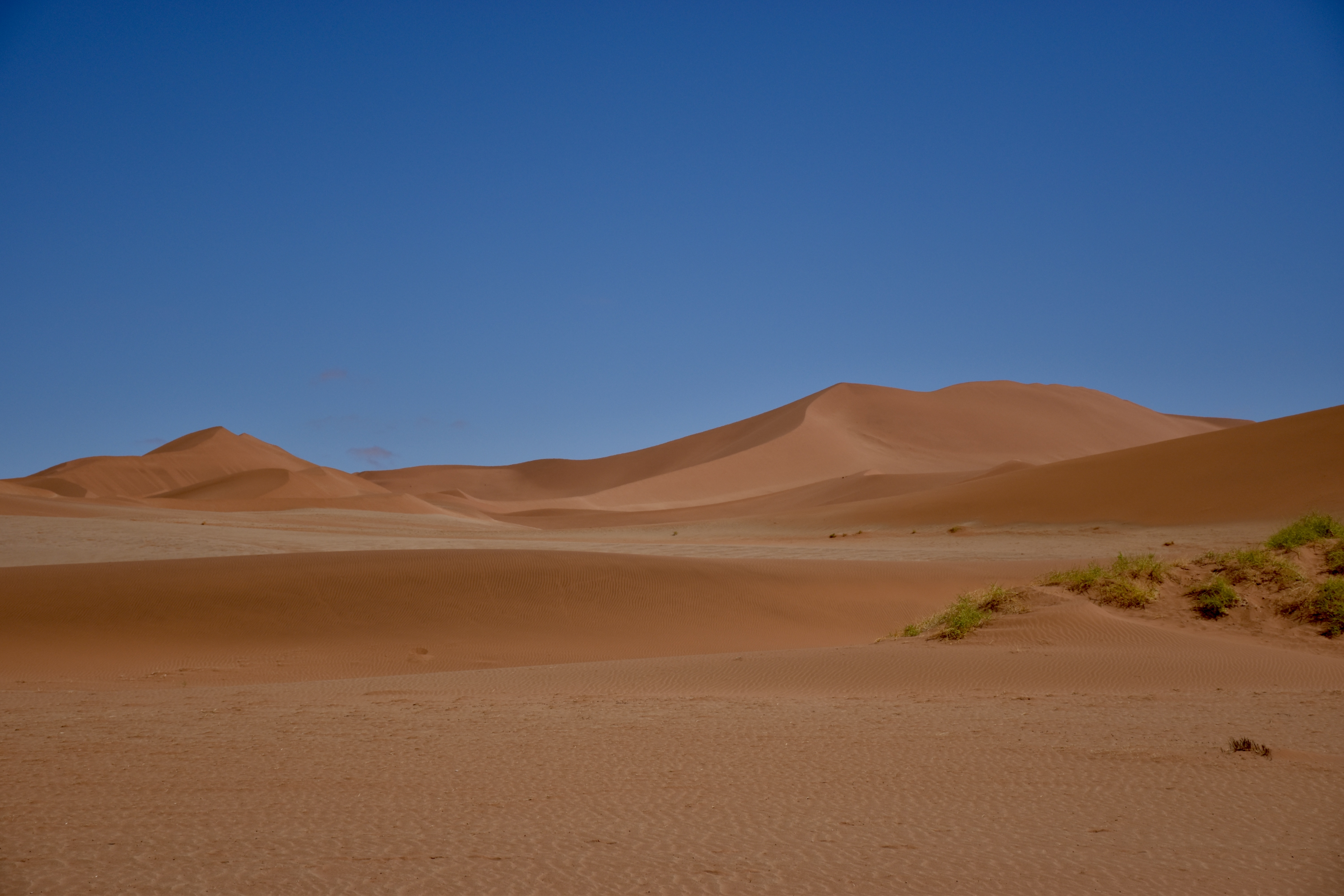
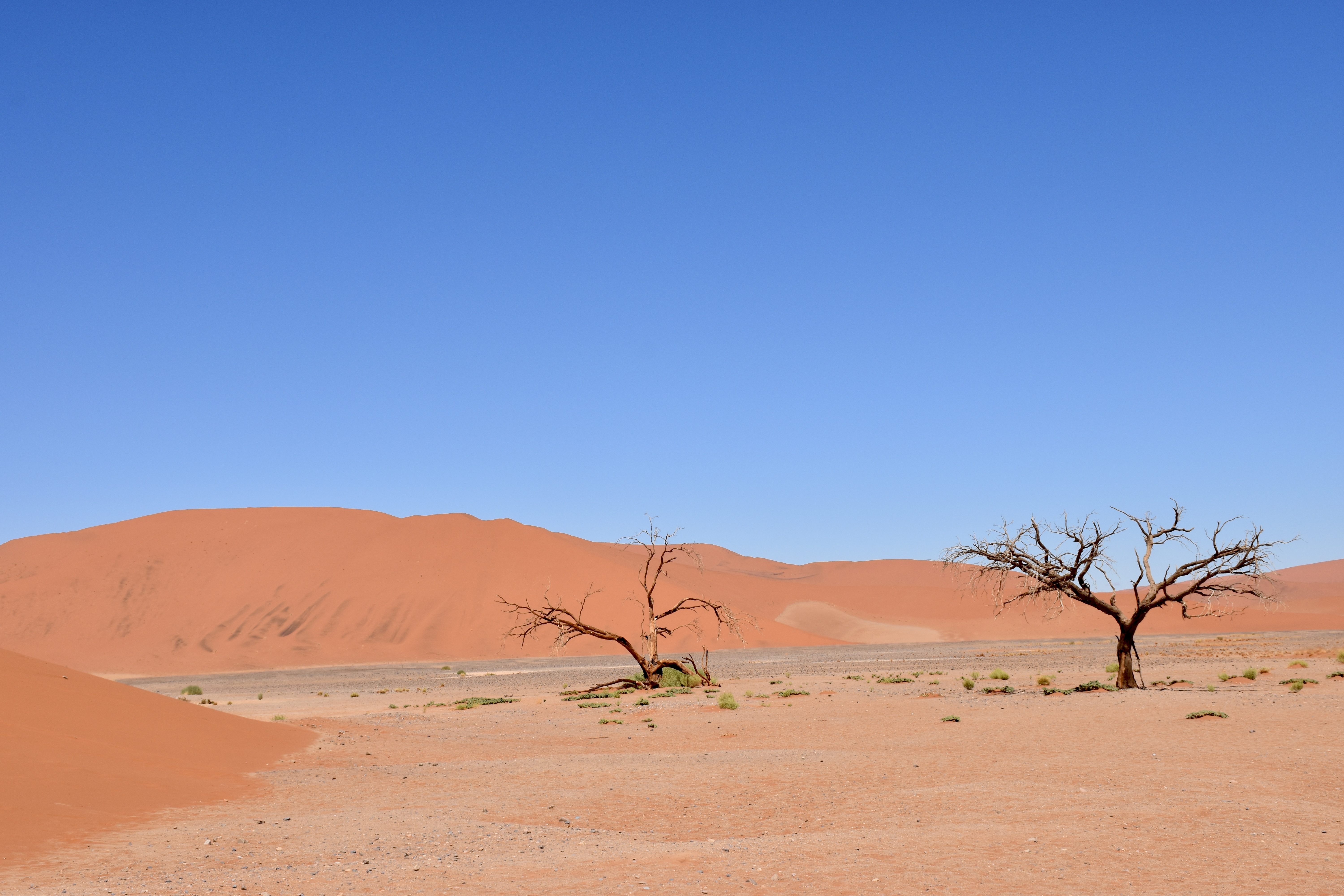
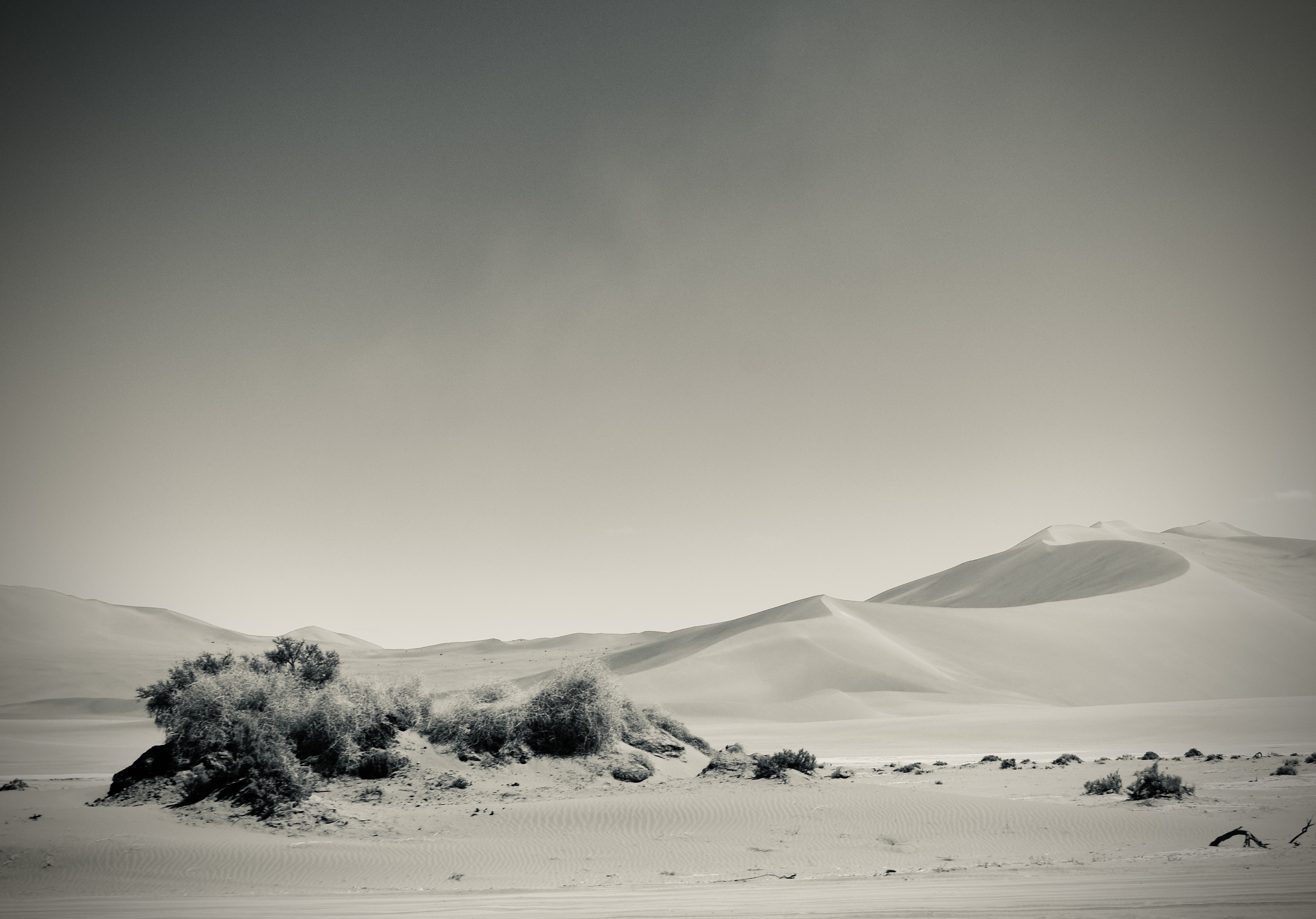
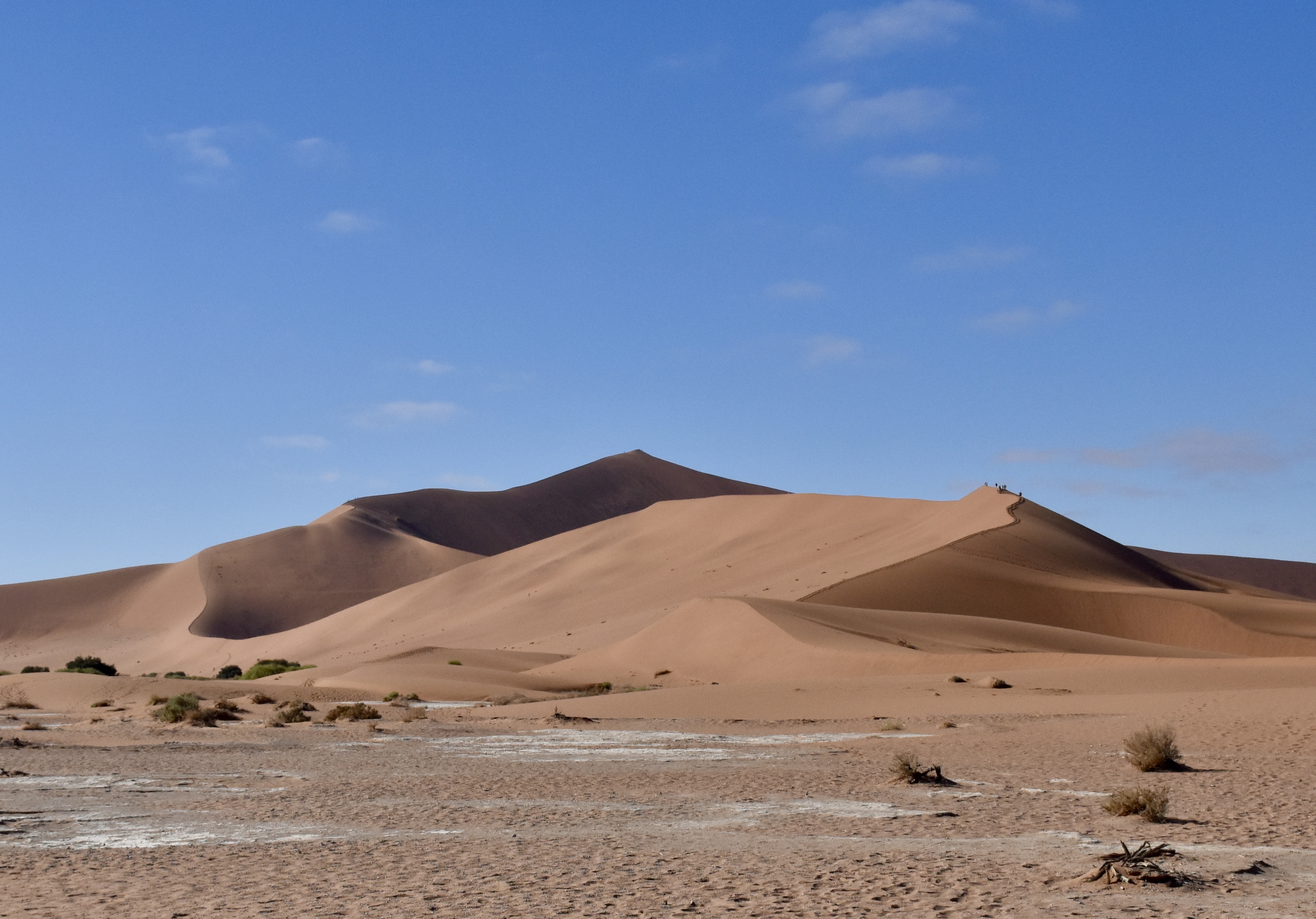
The dunes of Sossusvlei are the kind of place that almost doesn’t look real. Photographs help, but when you actually arrive the scale of it all is hard to comprehend.
These dunes sit inside Namib-Naukluft National Park, which covers roughly 49,000 square kilometers—one of the largest national parks in Africa and among the largest protected areas anywhere in the world.
The Namib Desert itself is also believed to be one of the oldest deserts on Earth, somewhere around 55–80 million years old.
The name “Sossusvlei” is itself a little linguistic mash-up of the region’s history. Sossus comes from the Nama language and means “dead end,” while vlei is an Afrikaans word meaning “marsh” or “pan.” Put together, it roughly means “dead-end marsh”—a place where floodwaters once flowed but now simply stop, trapped by the surrounding dunes.
Even in a desert this ancient, life persists in surprising ways.
The circles are right above the darker line, middle of the photo
On the drive, Abraham pointed out the mysterious “fairy circles.” These perfectly round patches of bare ground puzzled scientists for decades. One leading theory now links them to sand termites that live underground.
Unlike the towering termite mounds you see elsewhere in Africa, it’s simply too dry here for that kind of architecture. Instead, the termites build their entire colony underground—what Abraham jokingly called their “mansions beneath the sand.”
Termite societies are surprisingly sophisticated:
• a queen and king who reproduce (the queen can lay thousands of eggs per day)
• workers who gather food and maintain the colony
• soldiers whose job is to defend it
Unlike bees, termites actually have a king, and the queen isn’t constantly surrounded and “coddled” the way a queen bee is.
Even the desert has its own little civilizations.
Where the Sand Came From
Before we reached the dunes themselves, Abraham crouched down and drew a rough map of Namibia in the sand.
He explained something called the “Red Line.”
North of the line are mostly subsistence farmers. South of the line are the large commercial farms. The line originally served as a veterinary boundary meant to prevent foot-and-mouth disease from spreading between herds, but over time it created a kind of economic divide.
A goat raised above the line and a goat raised below it can have very different market values. Like N$20 versus N$300.
Then Abraham explained something else remarkable.
The sand of the Namib dunes—and even the famous Namibian diamonds—both originated in South Africa.
Over millions of years the Orange River carried sediment and minerals westward. Ocean currents and wind redistributed the sand along Namibia’s coast, and eventually the wind pushed it inland, forming the enormous dunes we see today.
When diamonds were first discovered along Namibia’s coast, the ostriches became accidental casualties.
Like chickens, ostriches swallow small stones to help grind food in their gizzards. The story goes that they sometimes swallowed the diamonds, mistaking them for grit.
A Slow Start (Thanks to the “African Massage”)
Many people visiting Sossusvlei line up early at the park gates when they open at dawn, which can create a bit of a morning scramble.
We, however, avoided that entirely.
The road leading into the park is what Abraham cheerfully calls an “African massage.”
Between the bumps, corrugations, and everyone urging him to slow down, we arrived after the early rush had already passed through.
Sometimes taking it slow has its advantages.
Dune 45 and the Road to Big Daddy
Our first stop was Dune 45 (later, when we returned, Lynn and Mary climbed partway up the slope to get the classic “standing on a Namib dune” photo).
But the real objective lay farther ahead.
To reach the final stretch of dunes you leave the paved road and continue on deep sand tracks that require true four-wheel drive.
Which, apparently, not everyone fully appreciates.
On the way in we spent about twenty minutes helping two young couples who had completely buried their car in the sand.
The sign does in fact say you must have 4WD, but one suspects someone had reasoned:
“Oh hey, Subaru is a four-wheel drive… it will totally do it.”
It did not.
While the guys tried digging and pushing, one of the girls stepped barefoot under an acacia tree after removing her flip-flops—only to immediately begin pulling thorns out of her feet.
This desert does not suffer fools lightly.
We ultimately had to leave them there because we simply couldn’t get the car out.
Later, however, Lynn spotted them at Deadvlei, which means they did eventually escape their sandy predicament. (We tried to help a second car that also got stuck – though they had a strap for us to try to pull them out, the second we put pressure on the strap, it snapped.)
Big Daddy
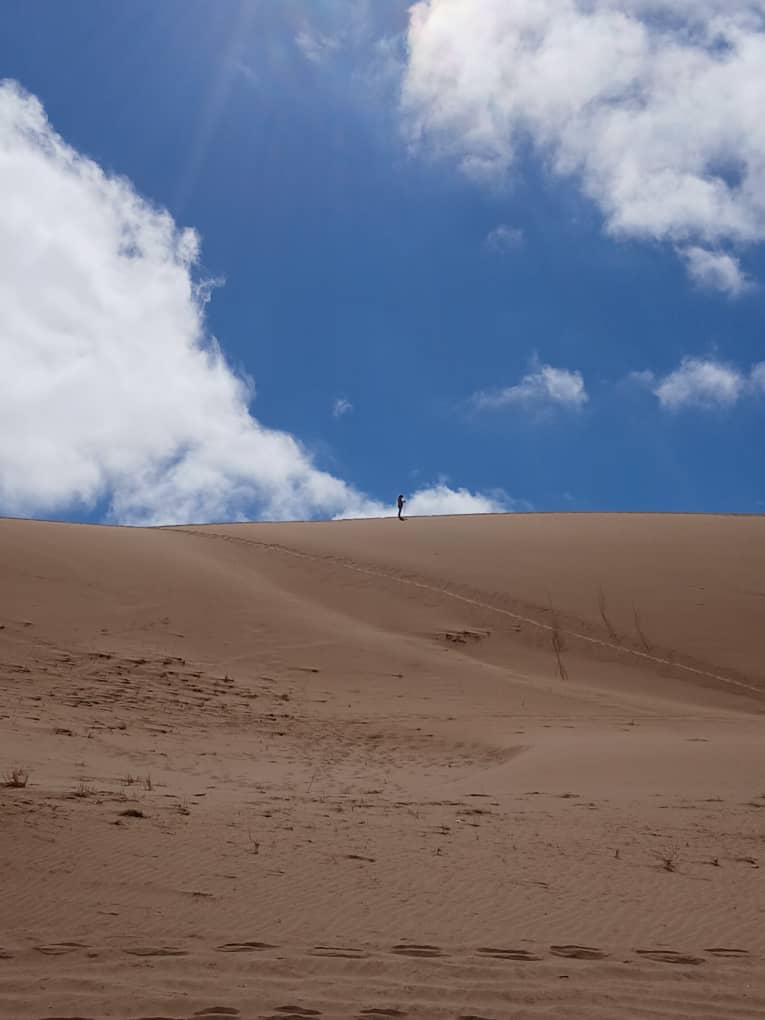
See the person on the left?Person ->the slope in the back is what I “sand skied” down (keep reading…)
The largest dune in the area is Big Daddy Dune, rising about 325 meters (roughly 1,000 feet) above the desert floor. 1,000 feet doesn’t sound that high. It’s high. Believe me.
A narrow knife-edge ridge runs all the way to the top.
Barbara and Lynn were able to walk ½ way to Deadvlei, but had to quit there. Mary and Brigitte did make it all the way to Deadvlei, took photos, and headed back. Janice and Deb bear-crawled up a small section of the side of Big Daddy just to reach the ridge but immediately turned around and walked down.
Jean-Marie thought about following me but couldn’t manage it without poles—one step forward, two sliding steps back.
Those poles turned out to be absolutely critical. The wide baskets kept them from sinking into the sand. Janice had actually found them on Amazon and I immediately bought a pair; it remains unclear why she didn’t bring them and had to bear-crawl her way up instead.
I was about twenty yards behind them.
Step.
Sink.
Step.
Sink.
Yep, that little stick in the middle…that’s me.
Eventually I reached the ridge.
And then I realized the real challenge wasn’t climbing up.
It was deciding whether to go all the way to the top.
I followed a small lizard up the ridge and started counting my steps.
I kept telling myself:
You’re not coming back here in this lifetime.
That thought turned out to be surprisingly motivating (if sobering).
Step.
Sink.
Step.
Sink.
The Ridgeline Encounter
Just as I reached the crest, something funny happened.
The ridge narrows dramatically at the top, and four people were coming down: two men and two women.
The ridge is barely a few feet wide.
The first man tried stepping off the ridge to go around me and immediately sank to mid-calf in the sand.
“No, no!” I called. “You can’t step off!” (Note: ChatGPT had cautioned me about that, when I had looked up the idea of climbing the dunes.)
He corrected course. I turned sideways, he turned sideways, and he walked past. The two women did the same.
The last man, however, was…how shall we say…a very large gentleman, wearing a bright yellow shirt that said “Lithuania.”
There was simply no graceful way for him to pass me.
So we basically rubbed bellies as he edged by.
I laughed and may have made a dramatic “Ohhhhh!” noise.
He turned bright red.
And his friend—already past us—burst out laughing.
Then they continued down the ridge.
And suddenly . . .
I was alone.
Just me and the wind.
From the ridge you can see the dune slope away, but then it curves downward out of sight. Somewhere far below lies Deadvlei, the famous white clay pan filled with ancient dead trees.
From where I stood, those trees looked like matchsticks. No, something smaller. Splinters.
To be clear, from the top, you cannot actually see the full descent if you are contemplating going over the side. The dune curves inward, hiding the middle of the slope.
I stood there for a while.
If someone else had been doing it . . .
If there had been someone to even grimace or give a “thumbs up” to . . .
If someone had been waiting at the bottom . . .
It would have been so much easier.
I walked down a little from the ridge following some faint old footprints in the sand.
“Maybe here,” I thought.
Then I saw another set farther down and tried that spot.
Then I walked back up again.
Back and forth I went, having a very serious conversation with myself.
The climb up the ridge had been a physical triumph.
But that first step over the side – instead of making a 180 and walking down the ridgeline?
That was entirely mental.
Finally I stopped negotiating with myself and simply took one step forward.
Once I did, gravity took over and there I was – sand-skiing down the face of the dune.
And yes—
I was the only one in our group who did it.
And I did it completely alone.
No witnesses.
No encouragement.
No one even to take a photo.*
(I did photograph my footsteps once I reached the bottom, but they don’t really convey the scale of the thing—you can only see the tracks from the lower slope up to the crease in the dune. The ridge itself disappears from view.)
But *I* know what it took to make that first step.
And honestly?
That moment may have been the bigger triumph of the day. One cup plus of sand in each shoe notwithstanding.
*NOTE: I had no idea that Abraham was at the bottom, taking photos of me as I started my ascent. Those are included, above. 🙂
The Lithuanian Reunion
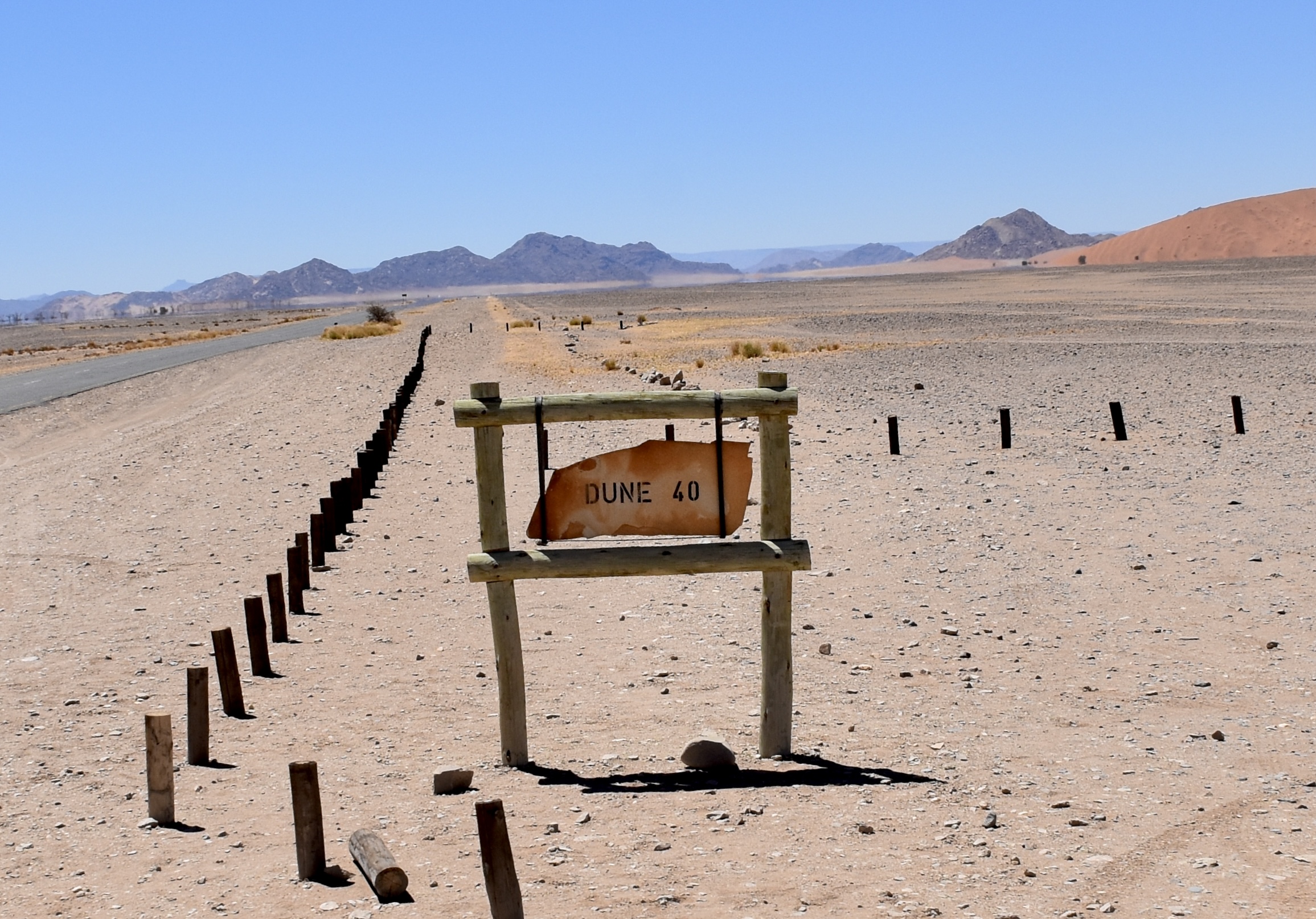
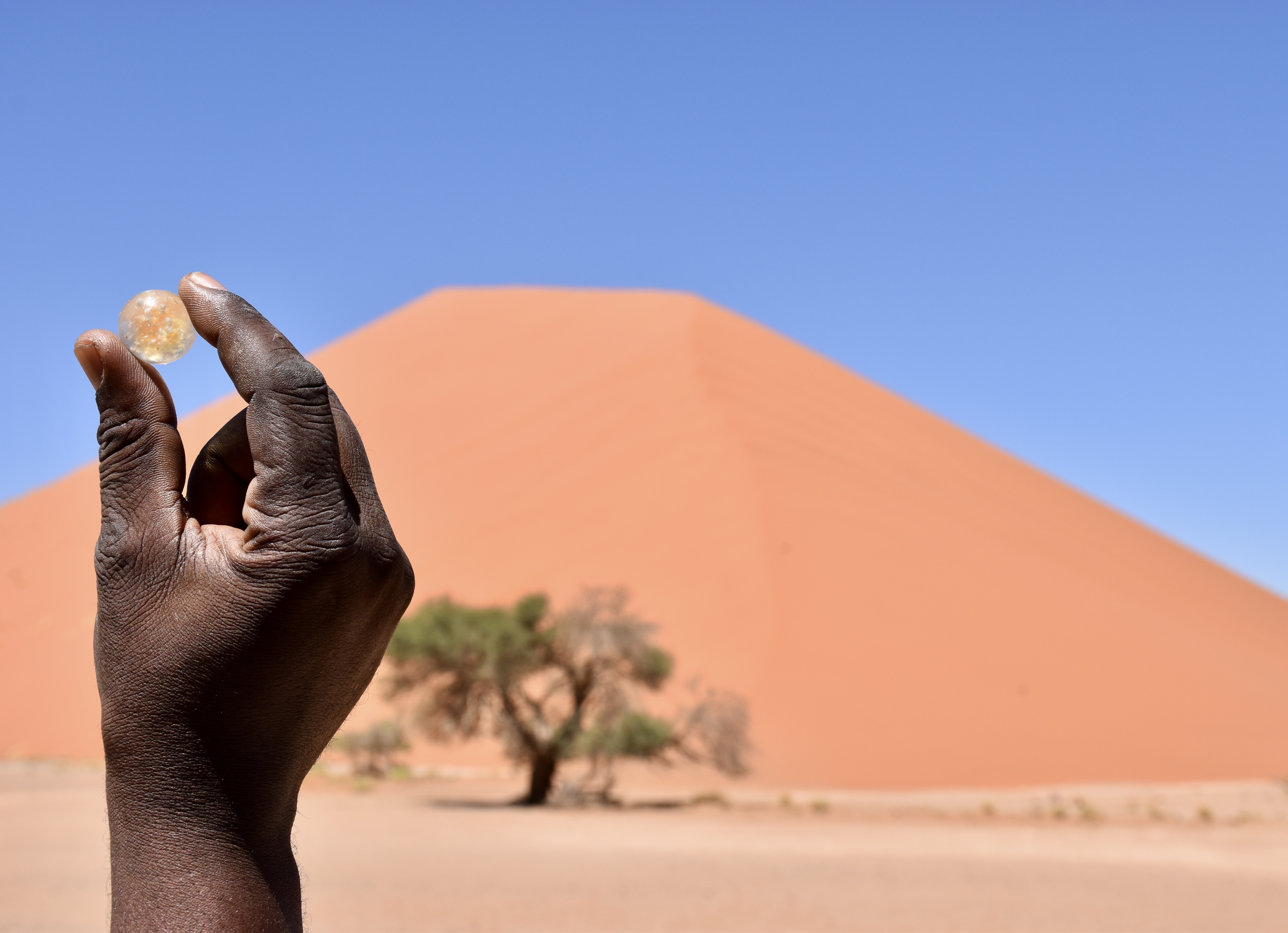
Later we stopped at Dune 40, where I decided to leave one of H’s cremarbles.
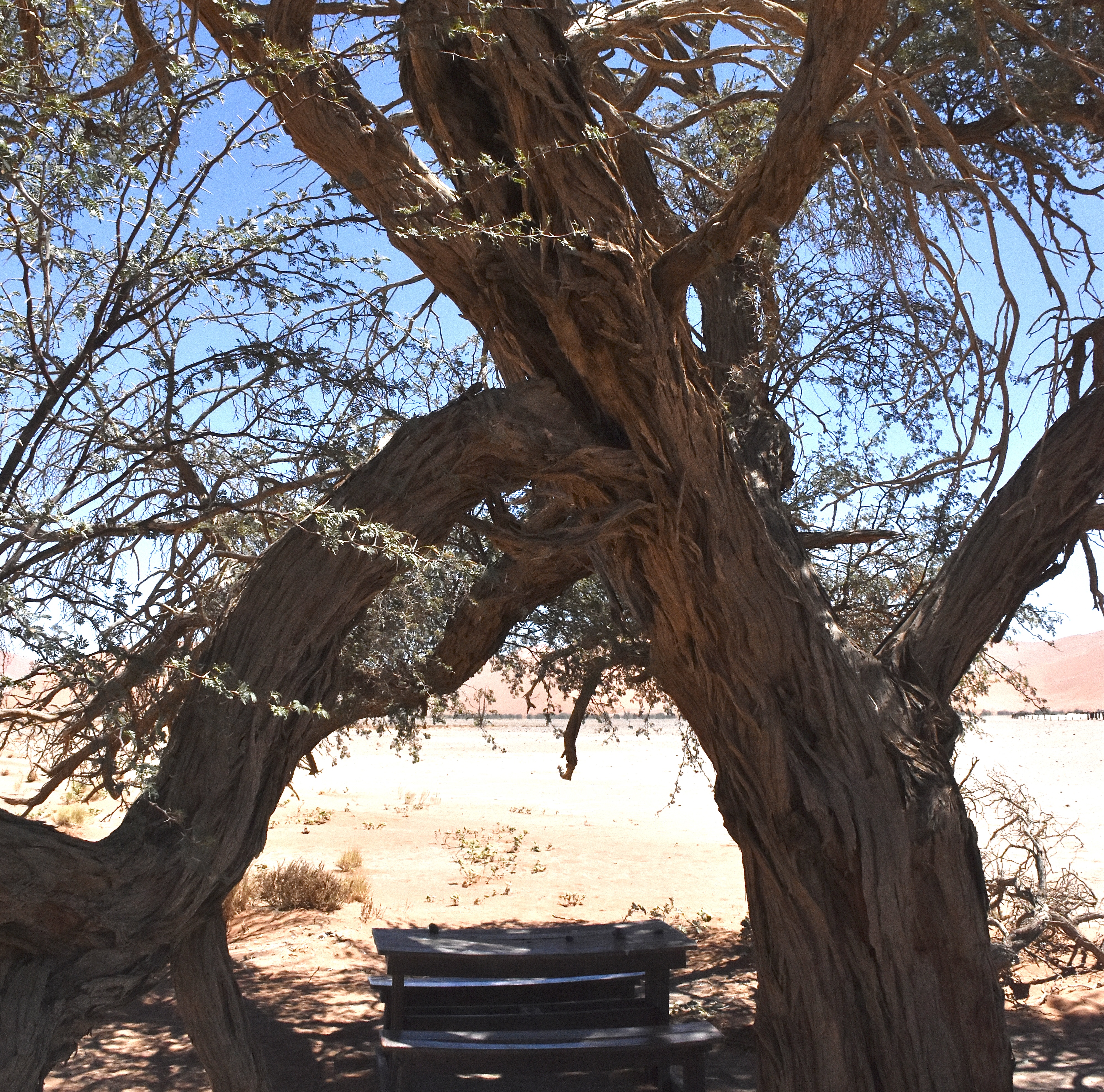
At the base of the dune there’s a large acacia tree with a huge knothole high up on the trunk.
That seemed like the perfect place.
H would have loved this landscape.
Abraham held the cremarble up so I could photograph it against the dune. When I came back he asked where I had placed it.
I told him.
He said he would think of H every time he visited that tree.
And I’m quite sure he will.
As I went back to visit the tree one more time before leaving, a vehicle pulled up.
Out stepped the same four Lithuanians from the ridge.
They recognized me immediately.
“You got down,” they said.
I tried to explain that I had gone over the side, though the language barrier made that tricky.
Then the thinner man—the one who had laughed earlier—walked up to me and gestured.
Clearly he wanted to re-create the ridgeline moment for himself.
So naturally I rubbed bellies with him.
Mary nearly collapsed laughing.
The big Lithuanian turned bright red all over again watching the “reenactment,” and I’m quite certain his friend now has a story about him that will be told for the rest of his life.
Sesriem Canyon
After returning to the lodge and grabbing a much-needed nap, we headed out again to visit Sesriem Canyon.
The name Sesriem comes from the Afrikaans words for “six thongs.” Early settlers supposedly stitched together six strips of oryx hide to lower a bucket down to reach water at the canyon bottom.
Standing down in the canyon is strange because the rock looks almost artificial—like concrete poured around river stones.
That’s because the canyon walls are made of conglomerate, ancient sediment where gravel and stones were cemented together by minerals when water once flowed through here far more regularly.
We took about a 40-minute round-trip hike, and I tried my best to capture the strange beauty of those walls.
Sunset on the Deck
Back at the lodge we had time for another short rest before Abraham gathered us on the deck above the bar to watch the sunset.
He had set up a small sunset bar—bubbly, wine, beer, the works.
Amazingly, the red turned out to be the exact same Tokara Shiraz that Mary had loved during our tasting at Tokara in Stellenbosch earlier in the trip—even the same vintage.
Of all the wines he might have found in the Namib Desert . . . !
The sun slipped behind the mountains, the desert turned gold and then purple, and we sat there drinking first bubbly and then Tokara Shiraz in the middle of the desert.
Not a bad way to end a day that had started on top of Big Daddy.
And, out there in the knothole of a huge old acacia tree, one of H’s cremarbles is now part of the Namib, calmly experiencing the sunset over Dune 40.
A small traveler in a desert that has been here for tens of millions of years.
And just for the record:
I was the only one who climbed the ridge.
And the only one who stepped off. 🌄🏆
I never get a percentage from any links I include – but! – if you are curious about Overseas Adventure Travel and want $100 off, call them at 1-800-955-1925 and request their amazing catalog, tell them you were referred by Sandy Shepard, customer number 3087257, and get $100 off your first trip! The catalog is what all good dreams are made of!
Today we drove from Swakopmund to Sossusvlei, a journey of roughly six hours across the Namib Desert.
Or as Abraham described it:
“Today you will experience an African massage.”
He was referring to the road.
The road — if we are being generous with that term — is mostly corrugated gravel, which means the vehicle vibrates continuously in a way that rattles every bone in your body.
At one point we were sitting behind Jean-Marie and Brigitte when a screw fell out of the bottom of his seat.
Then another.
At that point Lynn and I just started laughing, because what else can you do?
African massage.
The Herero and Nama Genocide
Before leaving Swakopmund this morning, Abraham took us to a quiet cemetery outside town.
It commemorates one of the darkest chapters of Namibia’s history: the genocide of the Herero and Nama peoples by German colonial forces between 1904 and 1908.
At the time, Namibia was known as German South West Africa. When the Herero people rose up against colonial rule in 1904, the German military responded with extraordinary brutality under General Lothar von Trotha.
His orders were explicit.
The Herero people were to be driven into the desert and eliminated.
German forces pushed them into the Omaheke Desert, poisoning water sources and blocking escape routes. Thousands died of thirst and starvation.
Those who survived were placed into concentration camps, where forced labor, disease, and starvation killed many more.
Historians estimate that roughly 80% of the Herero population was killed.
The Nama people, who resisted shortly afterward, also suffered devastating losses — roughly 50% of their population.
Many scholars consider this the first genocide of the 20th century.
Today Germany has formally acknowledged the genocide and in 2021 announced a €1.1 billion development package intended as a form of historical reconciliation.
But the issue remains deeply controversial.
Many Herero and Nama leaders argue that the program is not true reparations, since the money goes to development projects rather than directly to descendants of those affected.
Standing in the cemetery, surrounded by simple unmarked burial mounds, it was hard not to feel the weight of that history.
Even more striking: the cemetery now sits amid modern homes and mansions.
History does not disappear.
It just gets built around.
The Road to Sossusvlei
Once we left Swakopmund behind, the landscape opened into vast desert plains.
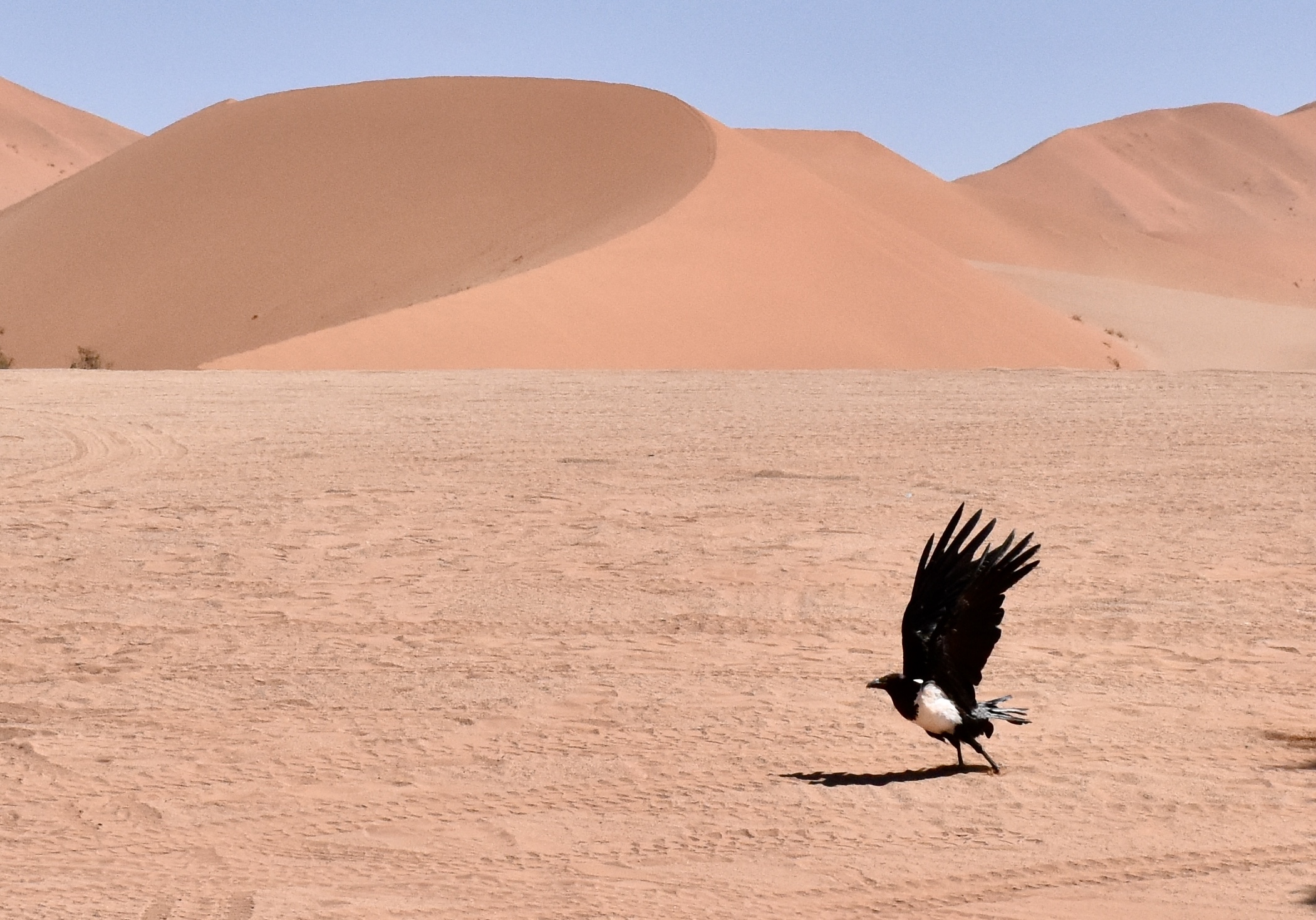
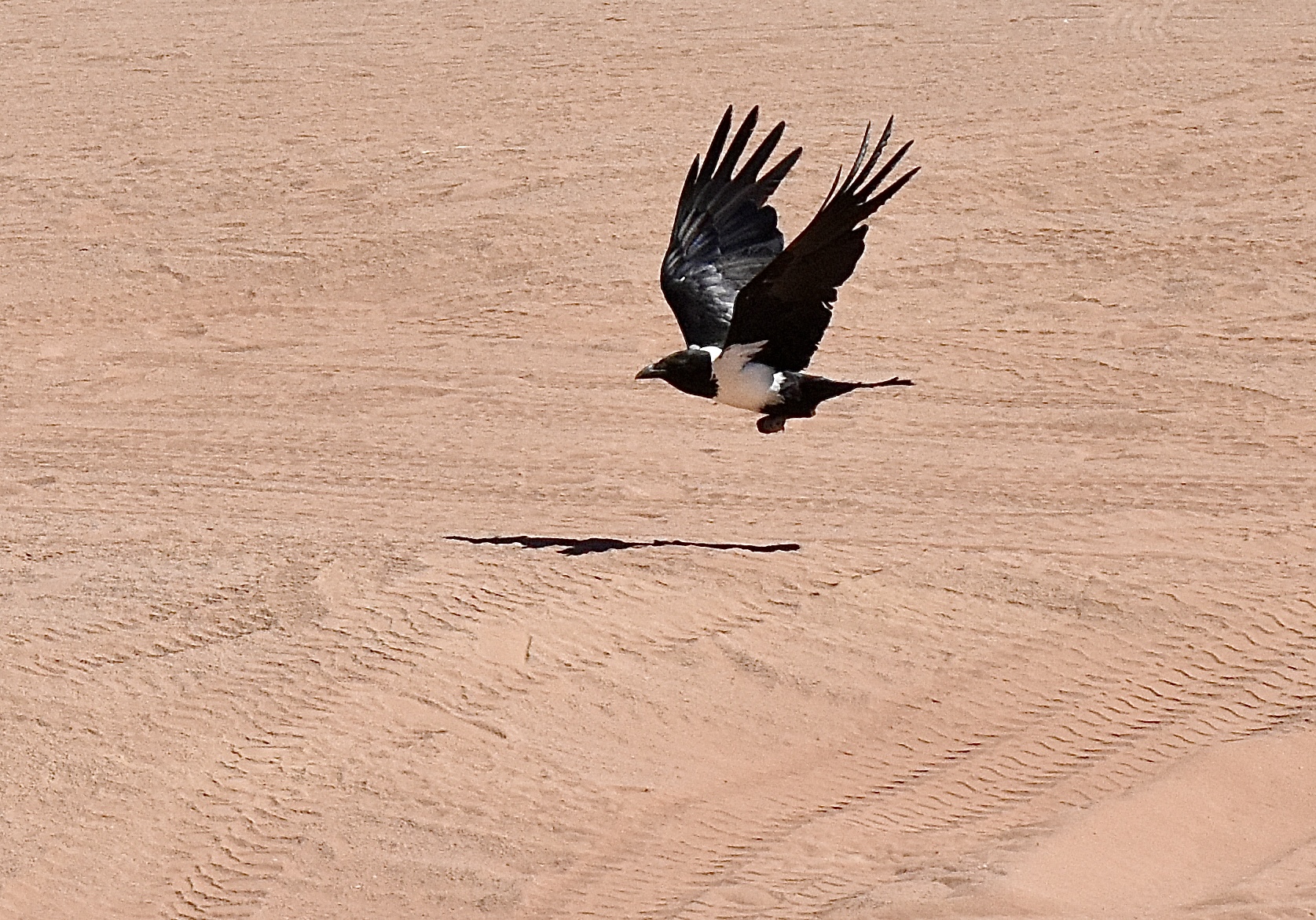
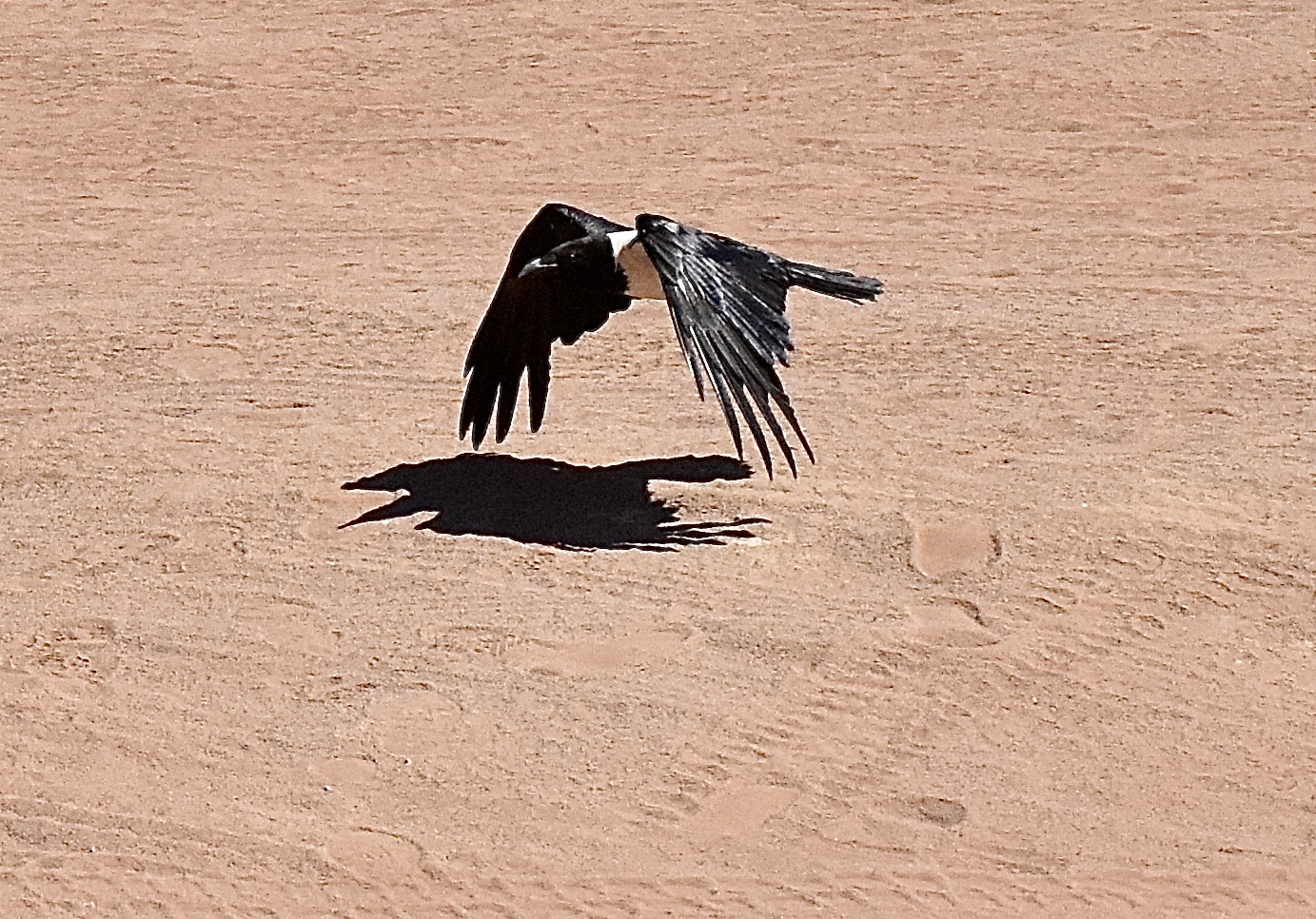
Along the way we saw several wildlife sightings — what our group jokingly calls ALT (Animal-Like Things) and BLT (Bird-Like Things) sightings.
Among them:
a blue wildebeest (too fast for a photo)
oryx, perfectly adapted to desert life
a jackal
three ostriches
Even when animals appear only briefly, they make the immense desert landscape feel alive.
We also stopped for a photo op at the Tropic of Capricorn – an imaginary line encircling the Earth at about 23.5 degrees South of the Equator, where the sun appears directly overhead during the Summer Solstice.
Solitaire
About halfway through the drive we stopped in the tiny settlement of Solitaire.
“Town” might be too strong a word.
Solitaire consists of a gas station, a small shop, and a few scattered buildings — but it has achieved near-legendary status among travelers because of one thing:
Apple pie.
The bakery here is famous throughout Namibia for its homemade apple pies, which have been fueling desert travelers for decades.
Sadly, we didn’t have time to stop for pie today.
But we will be driving past again on the way back to Windhoek.
Hope springs eternal.
Solitaire is also known for its collection of old rusted cars, scattered around the desert like art installations — relics from another era of desert travel.
While we were there, I spotted a small blonde mink-like creature darting across the ground. Abraham didn’t see it, so its identity remains a mystery.
A WWII Desert Escape
Not far from Solitaire, Abraham pointed out a remote rocky area associated with an extraordinary World War II story.
Two German geologists — Hermann Korn and Martin… (the details vary depending on the source) — had been working in the region when the war began.
Unwilling to fight, they escaped into the desert and hid in a cave for two and a half years.
Eventually one of them became ill and had to seek medical help in town. When he did, authorities discovered that his companion was still living out in the desert.
Both men were ultimately arrested.
Their story later inspired the book “The Sheltering Desert.”
Living in the Namib Desert for two and a half years voluntarily is difficult to imagine.
Strange Desert Plants
We also stopped to look at several desert plants used by indigenous San hunters.
One was the milky bush, which looks a bit like a cactus but is actually something quite different. Its sap is highly toxic and was historically used to poison arrow tips for hunting.
Even touching it requires caution.
We also walked out to see a quiver tree, whose hollow branches were once cut by San hunters and used to carry arrows — essentially a natural quiver. (“Milky bush” in the above photos top left; others are the “quiver bush”.)
When you tap the branches, they sound hollow, almost like knocking on wood.
The desert is full of ingenious adaptations.
Into the Dunes
Along the road we passed through dramatic mountain formations and rocky passes where the geology shows clear signs of tectonic uplift — layers of ancient igneous rock pushed upward over immense stretches of time.
It’s the kind of landscape that makes you feel very small.
Sossusvlei Lodge
By late afternoon we finally arrived at Sossusvlei Lodge, right on the edge of the Namib-Naukluft National Park.
Our “room”Dining area
Tomorrow morning we get up very early — out the door at 5:30 a.m. — to try to catch sunrise on the famous red dunes.
African mistletoe: pretty but parasiticAcacia pods: full of proteinWeaver birdAcaciaWeaver bird “condo”Poop guide. With poop (oryx)
A few of us went for a walk around the grounds with Abraham, particularly learning how to distinguish poop. (What is it with Africa and poop?) We also talked a lot about the weaver bird nests…and not to stand underneath one, as, often, since they are built so that snakes cannot get in, snakes fall out. Eep!
Lynn and I skipped the group dinner tonight. After arriving late and eating lunch at nearly 3:00 p.m., neither of us was particularly hungry.
Instead we bought a bottle of wine, sat outside, and watched the desert sunset.
As we sat there, a jackal and an oryx casually wandered past in the fading light.
I tried to take a photo, but by then it was nearly dark.
Some moments are better simply watched.
Tomorrow: the giant dunes of Sossusvlei at sunrise.
Which, if the photos I’ve seen are any indication, may be one of the most spectacular landscapes on the planet.
I never get a percentage from any links I include – but! – if you are curious about Overseas Adventure Travel and want $100 off, call them at 1-800-955-1925 and request their amazing catalog, tell them you were referred by Sandy Shepard, customer number 3087257, and get $100 off your first trip! The catalog is what all good dreams are made of!